King’s straw-to-gold ultimatum
RumplestiltskinThe King’s straw-to-gold ultimatum is the coercive demand that sets the tale’s central chain of bargains in motion. After the miller boasts that his clever daughter can spin gold from straw, the King confines her with an impossible task and a deadline backed by the threat of death. The command is repeated on larger heaps of straw, turning the King’s appetite for gold into a force that determines her fate, the helper’s price, and the later danger to her child.
The Boast Becomes a Threat
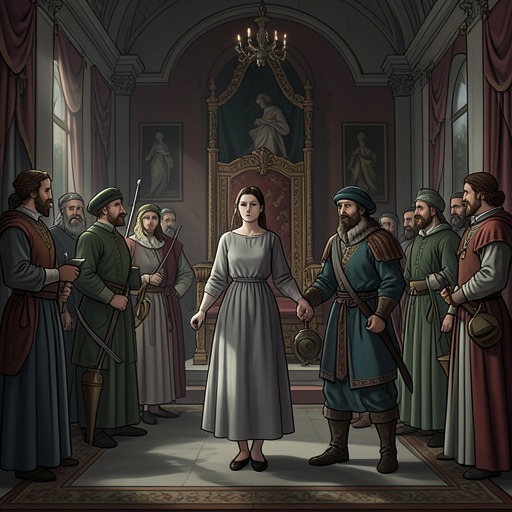
The crisis begins with the miller’s pride in his beautiful, shrewd daughter. He tells the King that she can spin gold out of straw; the King, already fond of money, hears the claim not as a boast to be tested gently but as an opportunity to satisfy his greed. He sends for the girl and takes her to a chamber in his palace, where a great heap of straw and a spinning wheel await her.
The ultimatum makes the power imbalance unmistakable: all the straw must be spun into gold before morning, “as you love your life.” The miller’s daughter explains that her father’s statement was only a silly boast and that she cannot perform the feat. Her protest changes nothing. The door is locked, and she is left alone, with neither the ability to fulfill the command nor freedom to leave. The tale thus makes the supposed marvel originate in a false claim, while the immediate danger falls on the person who did not make it.
Repeated Tasks and Rising Stakes
The first demand is met only after a small man enters the locked chamber and offers to do the work in exchange for the daughter’s necklace. He takes the necklace, sits at the wheel, and sings as he spins; by the time the King returns, the straw has become gold. The King is astonished and pleased, but success does not satisfy him. Instead, the sight of the gold makes his greed grow, and he shuts the daughter away again with another task.
For the second heap, the helper asks what she will give him, and she offers the ring on her finger. He again works at the wheel, and long before morning the straw is spun. The King is delighted by the glittering treasure, yet still wants more. He takes her to a still larger heap and sets a third overnight task. This time the reward he offers is not a jewel but marriage: if she completes the work, she will become his queen. His promises of advancement do not make the work voluntary; each task follows an earlier success and is imposed by the same authority that controls her confinement.
The third demand exposes the cost hidden beneath the gold. Having given away her necklace and ring, the miller’s daughter has nothing left to offer. The helper names his price: the first little child she may have when she is queen. She agrees because she sees no other way to finish the task. The familiar spinning song and transformation recur, but the exchange has changed in kind: a material payment becomes a future claim on a child. The King finds all he wants in the morning and keeps his word by marrying her, so the ultimatum’s sequence of tasks brings her from the miller’s household into queenship while binding her to a perilous promise.
The Bargain Outlasts the Command
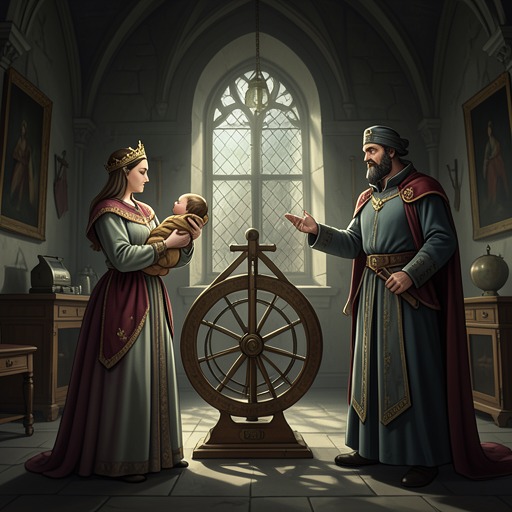
The King’s demands end once he has obtained the gold he wants, but the third bargain survives the tasks that produced it. When the Queen’s first child is born, she is glad and forgets both the helper and her promise. The helper later comes into her room while she sits with the baby and reminds her of the agreement. What began as a response to an overnight royal threat has become a claim made against the Queen in the intimate setting of her child’s presence.
She grieves and offers all the wealth of the kingdom to be released from the promise, but the helper refuses. Her appeal does not undo the bargain; instead, her tears move him to grant three days in which she may guess his name. The condition transforms the problem. The first three trials demanded impossible production under a deadline, whereas the later test gives her a narrow route to keep her child through information and recognition. The King’s ultimatum has therefore set in motion consequences that reach beyond the gold and beyond his own marriage bargain.
From Production to Recognition
The Queen searches through names remembered from her life and sends messengers across the land to discover others. On the first day, a long series of names fails; on the second, comic names fail as well. The search finally yields a report from a messenger who has travelled for two days. In a forest, among the trees, the messenger finds a little hut and sees a dwarf dancing on one leg by a fire while singing that he will make a feast and declaring his name. The clue gives the Queen what the earlier guesses could not: knowledge of the helper’s private identity.
When the helper returns, the Queen arranges for her court to witness the encounter, while the nurse stands beside her holding the baby as if the child were ready to be surrendered. The helper chuckles at the prospect of taking the child home to his hut in the woods and asks the Queen to name him. She tests several names before slyly giving the name learned from the messenger. The helper cries that a witch must have told her, then drives his right foot so deeply into the floor in rage that he must grasp it with both hands to pull it free. He leaves, and the nurse laughs, the baby crows, and the court jeers at him.
The ultimatum’s decisive significance lies in the chain of exchanges it initiates. The King’s demand turns the daughter’s freedom and safety into instruments of his greed; the helper’s labor first costs her personal ornaments and then threatens her future child. Gold repeatedly appears as the King’s desired result, while the child marks the limit of what can be treated as payment. The resolution does not reverse the King’s coercive command or erase the Queen’s earlier promise; it defeats the helper’s claim through the name she learns, ending the danger to the child and closing the sequence the King’s demand began.