The miller’s daughter’s straw-to-gold trials
RumplestiltskinThe miller’s daughter’s straw-to-gold trials begin when her father boasts to the King that she can perform an impossible feat. The King turns the boast into a threat, and a little man’s magical labor first saves her from the immediate danger, then binds her to escalating payments: a necklace, a ring, and finally the first child she will have as queen. The sequence converts straw into gold while steadily changing what is at stake, until the Queen must use information about the helper’s name to defend her child.
The boast becomes a royal demand
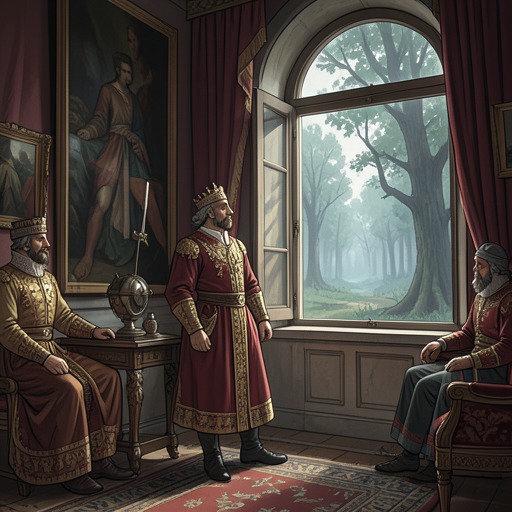
The miller’s daughter is introduced as beautiful, shrewd, and clever, but it is her father’s pride that sets the trials in motion. He tells the King, who comes to hunt in the wood, that she can spin gold out of straw. The boast assigns her a miraculous capacity she does not possess; her intelligence cannot protect her from the consequences once the King decides to test it.
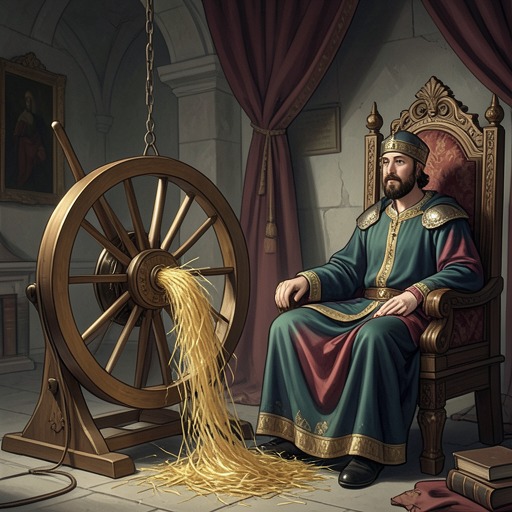
The King is fond of money, and the claim awakens his greed. He summons the girl to his palace, leads her to a chamber containing a great heap of straw, gives her a spinning wheel, and orders that all of it be spun into gold before morning, on pain of death. She explains that her father’s claim was foolish and that she cannot do what he promised. The locked door makes the difference between a boast and a command brutally plain: she is left alone with the straw, the wheel, and a deadline backed by the threat to her life.
The helper’s work and the rising price
As she weeps, a strange little man enters and asks what troubles her. When she tells him the task, he offers to do it in exchange for her necklace. She accepts, and he sits at the wheel, whistling and singing the “Round about, round about” spinning song. The wheel turns merrily; by morning the heap has become gold. The transformation resolves the first immediate crisis, but it does not free the miller’s daughter: it gives the King a result that makes him demand more.
The King is astonished and pleased when he sees the gold, yet his appetite grows rather than being satisfied. He shuts the girl up again with a fresh task. The little man returns, and this time she promises the ring on her finger for his labor. He takes it and spins the next heap into gold, finishing long before morning. The necklace and ring are concrete payments for work that the girl herself cannot perform, but the exchanges occur under duress: the King’s locked rooms and lethal demands leave her with no safe alternative.
For the third trial, the King takes her to a still larger heap. He says that if she spins it all that night, she will become his queen. When the little man asks what she will give him, she has nothing left. He names a different price: the first little child she may have once she is queen. She agrees because she knows no other way to complete the task, while thinking that the promised child may never exist. Again the wheel goes round to the familiar song, and the heap becomes gold. In the morning, the King finds all he wants and is forced to keep his word: he marries her, and she becomes queen.
The bargain outlasts the trials
The third payment marks a decisive change in the terms of the exchanges. The necklace and ring are possessions the miller’s daughter can hand over at once; the child is a future person whose possible arrival turns a payment for present labor into a claim that can survive the completion of the spinning. The gold earns the girl a queen’s status, but the bargain made in the chamber follows her into that new life.
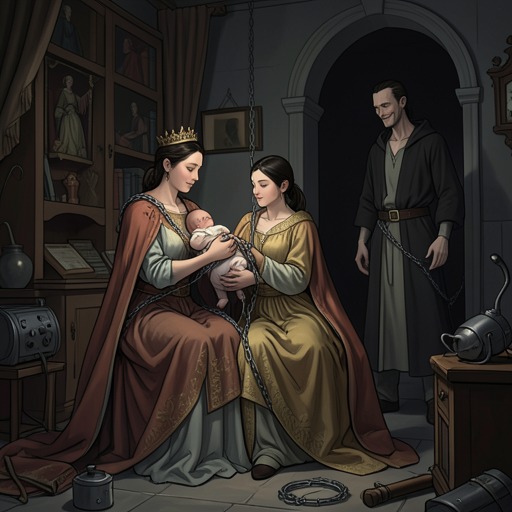
When her first child is born, the Queen is delighted and forgets both the little man and what she promised. One day, while she sits playing with her baby, he comes into her room and reminds her of the agreement. Her earlier hope that a child might never come to exist has failed; the helper now makes the cost of the third trial immediate. She grieves and offers him all the wealth of the kingdom if he will release her from the claim, but wealth cannot buy her out of the bargain.
The little man’s response changes the contest from payment to knowledge. Her tears soften him enough to grant three days’ grace, with a condition: if she can tell him his name within that time, she may keep her child. The Queen lies awake considering the strange names she has heard and sends messengers throughout the land to find more. On the first day she tries familiar names, including Timothy, Ichabod, Benjamin, and Jeremiah; on the second, she tries comic names such as Bandy-Legs, Hunchback, and Crook-Shanks. He rejects every guess. The repeated failure makes clear that the Queen’s new chance depends not on wealth or rank, but on obtaining a piece of information the little man believes she cannot know.
The name turns the contest
On the third day, a messenger returns after travelling for two days without hearing any other names. The previous day, while climbing a high hill among the trees of the forest, he had seen a little hut beside a fire. There a funny dwarf danced on one leg and sang of the feast he would make, the brewing and baking he would do, and the child he expected to take; he ended by declaring, “Rumpelstiltskin is my name!” The report supplies the precise knowledge that the Queen’s searches and guesses had failed to produce.
When the little man arrives, the Queen sits on her throne and gathers her court to watch. The nurse stands beside her with the baby in her arms, appearing ready to surrender the child. The staging sets the helper’s expected reward before him and turns the naming into a public test. He chuckles at the thought of taking the child to his hut in the woods and asks the Queen for his name.
She first guesses John, then Tom, then Jemmy, and he rejects each. Only then does she ask whether his name is Rumpelstiltskin. He cries that some witch must have told her, and in his rage drives his right foot so deeply into the floor that he must seize it with both hands to pull it free. The name breaks the hold of the bargain: he makes his way off, the nurse laughs, the baby crows, and the court jeers at him as he leaves without the child. The trials’ final reversal answers the original chain of coercion not with greater wealth or power, but with the exact name that exposes the helper’s vulnerability.