The queen’s name-guessing challenge
RumplestiltskinThe queen’s name-guessing challenge is the final contest between the queen and the dwarf who once spun straw into gold for her, and the means by which she escapes the claim he made on her first child. After granting her three days to discover his name, he returns to ask whether she has learned it; a messenger’s account of the dwarf singing his name in the forest gives her the answer. The challenge reverses their positions: the queen, who had been bound by a promise and faced the loss of her child, now holds the knowledge that defeats his claim.
Background and Stakes
The contest grows out of a sequence of exchanges that began when the queen was still the miller’s daughter. Her father boasted to the king that she could spin gold from straw, and the king confined her in a palace chamber with a spinning wheel and a demand to finish a heap of straw before morning. When she wept, a little man offered to do the work in exchange for her necklace. The next night, after the king demanded another heap, she paid him with her ring. These earlier bargains involved precious objects; the next demand changed the stakes entirely.
The king was pleased by the gold but wanted more. He set a larger task, promising that if she completed it she would become his queen. With nothing left to give the dwarf, she agreed to hand over the first child she might have as queen. The wheel spun the straw into gold again, and the king kept his word by marrying her. The promise therefore preceded both her queenship and the birth of her child, though it was made when she saw no other way to complete the task.
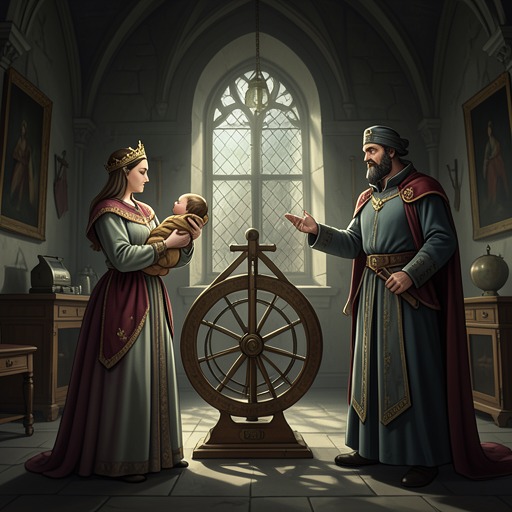
When her first child was born, the queen rejoiced and forgot the bargain. The dwarf later came into her room while she was playing with the baby and reminded her of what she had promised. Her appeal that he release her, even offering all the wealth of the kingdom, first failed. At last, her tears softened him: he granted her three days’ grace, on the condition that she name him within that time. The challenge makes the child’s fate depend not on producing another payment but on uncovering the identity concealed behind the dwarf’s power over their agreement.
The Three Days
The queen spends the first night awake, searching her memory for unusual names, and sends messengers throughout the land to find more. When the dwarf comes the next day, she tests names she knows, including Timothy, Ichabod, Benjamin, and Jeremiah. He rejects them all. Her effort is methodical but, without knowledge of the dwarf’s actual name, the long list cannot settle the contest.
On the second day, she tries comic and descriptive names, among them Bandy-legs, Hunchback, and Crook-shanks. The dwarf again answers each proposal with a refusal. The repeated failure marks the limits of guessing from a name’s sound or a person’s appearance: even a growing inventory of possibilities gives the queen no advantage until she receives information about the dwarf himself.
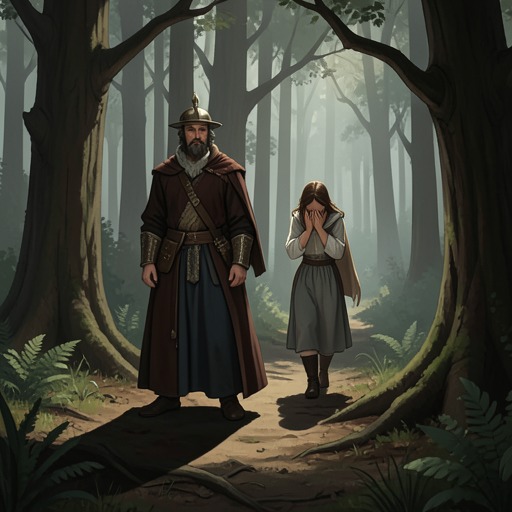
The decisive clue arrives on the third day. A messenger returns after travelling for two days and reports that, the previous day, while climbing a high hill among the forest trees, he saw a little hut with a fire burning outside. There, a funny little dwarf danced on one leg and sang about making a feast, brewing that day and baking the next, before naming Rumpelstiltskin as the one who would bring a stranger. The messenger has not merely supplied another candidate; he has witnessed the dwarf disclose the answer himself, in a boastful song far from the queen’s court.
The Naming Contest
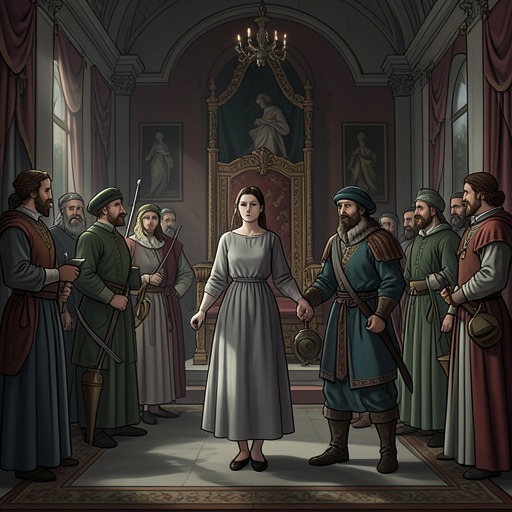
Armed with the messenger’s discovery, the queen prepares for the dwarf’s arrival. When he comes, she sits on her throne and gathers her court to witness the exchange. The nurse stands beside her holding the baby, as if the child is ready to be handed over. This arrangement makes the threatened consequence visible while the queen conducts what appears, at first, to be a game of guesses.
The dwarf chuckles at the thought of taking the child home to his hut in the woods and asks the queen for his name. She first offers John, then Tom, then Jemmy; each is wrong. Those deliberate near-misses allow the final answer to arrive only after the dwarf has confidently expected to win. The queen then asks whether his name is Rumpelstiltskin. He cries that a witch must have told her and, in a rage, drives his right foot so deeply into the floor that he has to seize it with both hands to pull it out.
Resolution and Significance
The dwarf makes his way off, and the claim on the child comes to nothing. The nurse laughs, the baby crows, and the assembled court jeers at the defeated visitor, wishing him a good morning and a merry feast while repeating his name. The ending converts the information the messenger brought back into public recognition: the name that had been hidden is now known and spoken by the queen’s household.
The contest closes the tale’s progression from impossible labor to increasingly costly bargains. The queen first surrendered her necklace and ring to obtain the gold the king demanded; she then risked her future child to complete the final task. The name condition gives her a different means of resistance, but the solution depends on an accidental discovery beyond the palace, not on the queen’s earlier lists. The dwarf’s name, learned from his private song and spoken before the court, breaks the apparent force of his claim and turns a promise made under pressure into a threat she can survive.