Alcohol intoxication
SanctuaryAlcohol intoxication is one of the novel’s most consequential recurring states: it makes the body unreliable, fractures memory, and converts claims of gentlemanly control into scenes of vomiting, shame, delay, and abandonment. Through Gowan Stevens’s repeated drunkenness, the narrative links intoxication to masculine performance, Temple Drake’s vulnerability, and the larger collapse of social and legal protections around the Old Frenchman place.
Definition and Physical Experience
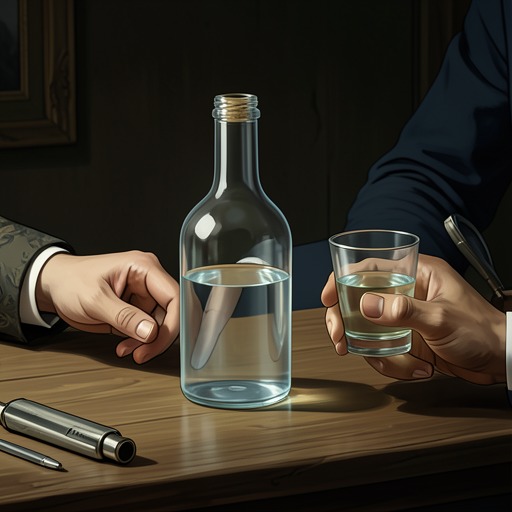
Alcohol intoxication appears first as a condition of bodily disintegration rather than convivial pleasure. Gowan Stevens fills a glass and empties it steadily while claiming that he has learned to drink like a gentleman. The next remembered sensations are radically less dignified: open air, a chill morning, an engine panting beside a dark string of cars, and then vomiting in a cramped place smelling of ammonia and creosote. His weakness is so severe that he must be forcibly kept from lying down; he sways, drools, reads a name on the wall with one eye shut, and falls asleep while trying to explain himself.
The state also destroys continuity of consciousness. Gowan Stevens struggles to wake because he knows that time matters and that failure to wake will bring regret, yet even after opening his eyes he does not immediately know that he is awake. He retches again, bangs his head against the car door, stumbles toward the station, falls on his hands and knees, and looks at the empty siding with unbelief and despair. His stained dinner jacket, burst collar, and broken hair make visible the distance between the social identity he wants to perform and the body intoxication has exposed.
Gowan Stevens and Repetition
Gowan Stevens’s intoxication is distinguished by repetition. Temple Drake reports that he became drunk three separate times in one day: he was already drunk when she left the train at Taylor, drank again after she tried to make him throw away the jar, and became drunk once more after they stopped at a country store to buy him a shirt. At Dumfries, he disappeared from the restaurant while she was too anxious to eat, then returned with the bottle still in his pocket and accused her of having his lighter. The episode is therefore not a single lapse but a cycle in which each attempt to continue the journey is followed by renewed drinking.
The repetition makes intoxication an engine of plot. Gowan Stevens has promised to take Temple Drake to Starkville before the train arrives, but his drinking consumes the time needed to keep that promise. At two o’clock he is driving through pine country in a cheap blue workshirt beneath his dinner jacket, with bloodshot, swollen eyes, blue stubble, and a face Temple Drake recognizes as changed since Dumfries. She understands that he drank hair oil after buying it there. His intoxication has become so extreme that even the substance he consumes is displaced from ordinary drinking into desperate ingestion.
The consequence is a widening gap between intention and result. Gowan Stevens continues to insist that he can get Temple Drake to Starkville and that a brief stop at Lee Goodwin’s will solve the delay. Yet the journey has already moved from a social outing toward isolation, dependence, and danger. The promised destination becomes less attainable with every attempt to recover control, while Temple Drake is left to calculate the arrival of the train, the lost baseball excursion, and the uncertainty of the men waiting at the house.
Effects on Temple Drake and the Household
Temple Drake experiences Gowan Stevens’s intoxication as both practical burden and moral humiliation. She has been warned by her younger brother Hubert that he would beat her if he ever caught her with a drunk man, and she recognizes the absurdity of being accompanied by someone who gets drunk three times in a single day. Her laughter at the situation collapses into breathless silence as she hears the skillet, the kettle, and the harsh masculine voices from the house. The comic surface of drunkenness thus gives way to fear: the household is full of men eating at night, and she does not know what their presence means for her safety.
The intoxicated man’s condition also changes the labor and space of the house. Temple Drake is drawn into cooking for the men, while the woman at the stove already performs that labor every night. The contrast between Gowan Stevens’s failed gentlemanly self-image and the women’s forced practical responsibility is central to the state’s social meaning. His drinking is treated as an individual appetite, but its costs are transferred to Temple Drake and to the woman whose kitchen becomes the place where the consequences must be managed.
When Temple Drake is finally moved barefoot through the darkness toward the barn, intoxication has helped produce the conditions under which she must flee without normal clothing or protection. The route passes from the house to a pitch-dark grain room, where a rat’s movement sends her into panic. The physical vulnerability of the scene is inseparable from the earlier drinking: Gowan Stevens’s inability to function has not merely delayed her journey but left her dependent on unfamiliar people in a hostile environment.
Memory, Shame, and Abandonment
After leaving the house, Gowan Stevens remains unable to reconstruct events clearly. He confuses Van with the wrecked car and does not know that he has been knocked out twice. At the spring, cold water provides the first relief he actively desires; he kneels, bathes his face, and examines his broken reflection while whispering in despair. The spring offers no absolution. It gives him enough physical clarity to recognize what he must face: Temple Drake among the men, the wreck, and the consequences of his own absence.
His recovery intensifies rather than removes the crisis. On the highroad he tells himself that he will clean himself up, obtain another car, and return for Temple Drake. He imagines deciding what to say to her on the way to town and repeats that he passed out twice. But as his body improves through air and motion, the future becomes darker. Town and the world appear as a cul-de-sac in which he will have to endure whispering eyes. When the prospect of facing Temple Drake becomes unbearable, he hires a car, pays the driver, and abandons the return journey; later, another car going the opposite way picks him up.
This movement from intoxication to shame is one of the state’s defining narrative patterns. The drink first suspends responsibility by breaking memory and bodily control. Sobriety then restores enough knowledge for responsibility to become psychologically intolerable. Gowan Stevens’s desertion is therefore not a clean escape from drunkenness but one of its aftereffects: the shame produced by the condition becomes another force that prevents repair.
Social and Narrative Significance
Alcohol intoxication repeatedly unsettles the boundaries that are supposed to protect respectable identity. Gowan Stevens’s declaration that he drinks like a gentleman is answered by a body that vomits, drools, stumbles, and loses time. The resulting irony is structural: the language of gentlemanly conduct survives only as a claim spoken from within physical degradation. Intoxication reveals that social status cannot guarantee self-command, and that the people most endangered by its failure are often not the drinker but those traveling with him.
The state also belongs to a broader network of impaired perception and public disorder. At the Old Frenchman place, the ruined plantation house is already a landscape of historical decay, while the spring’s broken reflections provide an image of identity divided and seen indirectly. Later, Mrs. Goodwin reaches Tull’s house and uses the telephone to report a dead man at the Old Frenchman place, showing how private confusion has become a matter for the sheriff and the law. The shift from drinking to official reporting marks the movement from personal disorder into public consequence.
Even later scenes retain the atmosphere of bodily and social instability associated with intoxication. At dawn, Horace Benbow hears that Lee Goodwin must have had a puncture while waiting for him; then he encounters the glare of a fire near the jail. A man runs carrying a five-gallon coal-oil can that explodes around him, while the central mass of flames contains no audible human cry. The fire is not itself drunkenness, but it extends the novel’s pattern of bodies and institutions losing control. Alcohol intoxication is significant because it initiates and intensifies that pattern: a supposedly temporary state becomes a chain of missed trains, abandoned companions, damaged bodies, exposed secrets, and legal catastrophe.