Prostitution
SanctuaryProstitution functions in the novel not as a single profession with stable conditions but as a social position imposed, entered, suspended, and resumed under pressure. Its clearest human center is Ruby Lamar, whose life moves between streetwalking in Memphis and unpaid domestic labor at the Old Frenchman place, while Temple Drake is drawn into a sexualized environment she did not choose and cannot safely leave. Through these women, the novel shows how prostitution is sustained by mobility, secrecy, male control, underground money, and the threat that respectable society will punish the vulnerable more readily than the men who exploit them.
Rural Labor and the Threat of Return
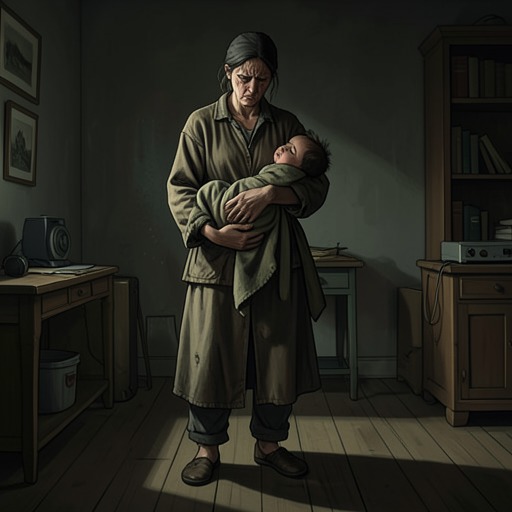
At the Old Frenchman place, Popeye identifies Ruby Lamar as a woman who has withdrawn from prostitution rather than escaped its conditions. He tells her that he can take her back to Memphis on Sunday and that she can return to hustling. His language makes the city and the trade appear as an available destination under his authority, not as Ruby’s independent choice. He also threatens to expose her on Manuel Street, where her present life would be read as a humiliating contradiction: she is in the country, wearing Lee Goodwin’s discarded shoes and chopping her own firewood. Popeye’s threat depends on that contrast. Ruby’s domestic work has not erased her former identity; it has merely concealed it, and concealment itself is one of the few forms of protection available to her.
Ruby’s position is further defined by the grotesque reversal between her past and her present. She is described as having once possessed diamonds and automobiles, acquired through a currency harder than cash, yet she now performs rough rural labor in worn shoes. Her relationship with Lee Goodwin is also publicly legible as scandalous: Horace Benbow understands that Ruby and Goodwin are not married, while Ruby is associated with the household’s illicit business and its sexual economy. The novel therefore places prostitution beside moonshining, informal exchange, and social disrepute rather than isolating it as a private moral failing.
Memphis as a Commercial and Controlled Space
The movement from the Old Frenchman place to Memphis makes prostitution spatially visible as part of an urban network. Popeye drives Temple into a narrow district of smoke-grimed frame houses, galleries, garages, vacant lots, trolleys, and shabby commercial interiors before bringing her to Miss Reba Rivers’s house. The route connects rural secrecy with an urban establishment whose access is controlled by doors, rooms, servants, and watchful occupants. Temple does not simply arrive at a place of sex work; she is delivered into a managed space in which other people determine where she may go, whom she may see, and whether she may use a telephone.
Miss Reba’s house presents prostitution as an organized business with a reputation extending through Memphis’s male institutions. Miss Reba boasts that bankers, lawyers, doctors, police captains, and even the commissioner have spent money there. Her claim that she has never double-crossed anyone describes a code of commercial trust within an illegal or stigmatized economy: protection depends on discretion, reciprocal knowledge, and the ability to preserve clients’ secrets. The house is thus connected to respectable commerce and public authority even while it is treated as socially disreputable. Its wealth is displayed in Miss Reba’s large yellow diamonds, her beer, her staff, and the clientele whose status gives the establishment influence.
Yet the house is also a site of confinement. Temple is brought inside, placed under observation, and surrounded by Miss Reba’s maid, girls, dogs, and household routines. The dogs that crowd into the bedroom become part of the claustrophobic texture of the establishment, while Miss Reba’s maternal manner disguises the fact that she is negotiating the conditions of Temple’s captivity. Her later fear that Temple will be dead or in an asylum within a year shows that the house can shelter women from the street without protecting them from violence.
Coercion, Sexual Violence, and Restricted Movement
Temple’s experience exposes the difference between prostitution as an economic institution and sexual violence as forced appropriation of the body. She asks the woman at the Old Frenchman place to get her out, leaves barefoot through the darkness, and is guided toward the barn. When the two women are about fifty yards from the house, the woman stops, grips Temple by the shoulders, curses her in a whisper filled with fury, and then continues leading her onward. Their escape is therefore not a clean passage into freedom. It is conducted through darkness, fear, secrecy, and the unstable assistance of another woman already trapped within the same violent world.
When they enter a grain-smelling room, something scurries beneath Temple’s foot. The woman says it is only a rat, but Temple panics, throws herself against her, and begs for the door to be opened. The scene joins physical confinement to the degraded material conditions surrounding the women: a concealed room, bare feet, darkness, grain, and vermin. Prostitution here is not merely a transaction involving sexual acts; it is part of an environment in which women can be hidden, transported, threatened, and reduced to bodies whose safety depends on someone else’s decision.
Popeye’s conduct at Miss Reba’s house makes control explicit. According to Miss Reba, he once gave Minnie five dollars a day to keep a girl inside the house and prevent her from using the telephone. The payment converts confinement into a guarded service, while the ban on telephone use blocks the woman’s access to outside assistance. During another period, Popeye failed to appear for a week while the girl was described as wild and exposed to an arrangement in which he watched sexual activity from the bedside. The combination of payment, surveillance, isolation, and sexual display reveals a system in which male power determines both the market and the boundaries of a woman’s movement.
Respectability, Class, and Unequal Judgment
The novel repeatedly contrasts prostitution with the standards imposed on women who are expected to preserve respectable identities. Narcissa Sartoris condemns Goodwin for leaving his wife and mixing with moonshiners and streetwalkers, while Miss Jenny answers that he has left the streetwalker as well. The exchange places the scandal on Goodwin’s male departure and on the woman’s stigmatized status at the same time. Prostitution becomes a label through which respectable families classify contamination, even though men from those same families enter the underground economy as customers, drinkers, clients, or associates.
Miss Reba’s account makes that double standard more direct. She observes that men expect women to resist temptation, while excusing or indulging the temptations that men themselves offer. Her house survives because powerful men patronize it, yet the women inside bear the moral and physical consequences of the arrangement. The statement that Temple was not born for this kind of life distinguishes prostitution from a simple economic choice: Miss Reba believes that some women can inhabit the trade and others will be destroyed by it. Her comparison with being born a butcher or barber is harsh, but it recognizes that the work requires a social and psychological adaptation that Temple lacks.
Horace Benbow’s reflections broaden the indictment beyond the women. He sees Ruby performing a labor associated with poverty despite her former wealth, a blind old man waiting to be fed, and Goodwin led away from the room and apparently from the world. In this constellation, prostitution is one element in a larger system of dependency, racialized labor, disability, illicit commerce, and male violence. The women are judged through sexual respectability, while the men who organize, purchase, or exploit the trade retain greater access to movement and public credibility.
The Underground Economy and Its Consequences
Prostitution shares the novel’s informal economic infrastructure with moonshine and other concealed transactions. Gowan Stevens seeks liquor late at night because he has run out and has an early appointment; he identifies himself as someone who has bought liquor from Lee Goodwin for three years. This exchange establishes the rural property as a supply point in an underground market whose participants travel by car, follow paths, hide goods, and rely on personal recognition. Goodwin’s association with Ruby and the women at the house places sexual commerce within the same network of cash, secrecy, transportation, and risk.
The network also produces information as a commodity. Clarence Snopes approaches Horace with information he claims will be valuable, while a handbill bearing an address connects another male visitor to Miss Reba’s house. Men search for women, boys, liquor, and private knowledge through overlapping channels; access is negotiated rather than openly advertised. The result is an economy in which vulnerability can be priced. Minnie receives five dollars a day to enforce confinement, Miss Reba depends on the spending of influential clients, and Ruby’s possible return to Memphis is presented as a practical option by Popeye because her labor remains available to someone who can command it.
The consequences spread beyond the immediate participants. Temple’s movement to Memphis does not restore her autonomy; it relocates her into a more elaborate system of surveillance. Ruby’s apparent withdrawal from prostitution leaves her exposed to blackmail and social degradation. Goodwin’s connection to the women and to moonshine becomes part of the evidence and suspicion surrounding his arrest, while the respectable town interprets the association through scandal. At the extreme end of the novel’s violence, legal detention, public hostility, and fire form a punitive environment in which those linked to illicit sexual economies can be treated as disposable. Prostitution therefore signifies not only paid sexual labor but the wider order of coercion that makes some bodies available, some reputations expendable, and some men powerful enough to move between respectable and criminal worlds without bearing equal consequences.