Prohibition
SanctuaryProhibition is not merely a background law in the novel; it is the pressure system that reorganizes commerce, mobility, reputation, and violence. By restricting the legal market without eliminating demand, it makes liquor a clandestine commodity and gives criminal intermediaries, local producers, customers, police, courts, and mobs overlapping authority over the same underground economy.
The Underground Market
Tommy explains the economic logic of the liquor trade with unusual directness. Small quantities made locally are only a minor source of income, while the real money lies in making a run, moving liquor quickly, and getting rid of it before discovery. Lee Goodwin distills liquor as an accommodation and to earn an extra dollar or two, but Memphis traffickers pursue the larger profits created by rapid illegal distribution. Prohibition therefore does not simply suppress alcohol; it concentrates value in transportation, speed, secrecy, and the ability to survive exposure.
The market depends on a customer network that crosses social and geographical boundaries. Gowan Stevens presents himself as a stranger who has run out of liquor and needs a quart before an early appointment, asking rural men where he can buy alcohol late at night. Stevens later identifies himself as a regular customer who has bought from Lee for three years, showing that illicit trade is sustained by recurring relationships rather than isolated acts. His request also reveals the ordinary, almost routine character of prohibited commerce: the urgency comes from supply, not from any moral hesitation about the transaction.
Production, Transport, and Risk
The local liquor operation depends on concealment and improvised storage. Stevens enters a ruined structure through a trap and is led across a dangerous floor to an earthenware jug hidden beneath rotting hay. The hiding place is chosen because Popeye is afraid of spoiling the hands of the women who might discover it, linking the practical concealment of liquor to the gendered labor and domestic arrangements surrounding the business. The clandestine market thus occupies abandoned buildings, barns, roads, and houses rather than a stable public storefront.
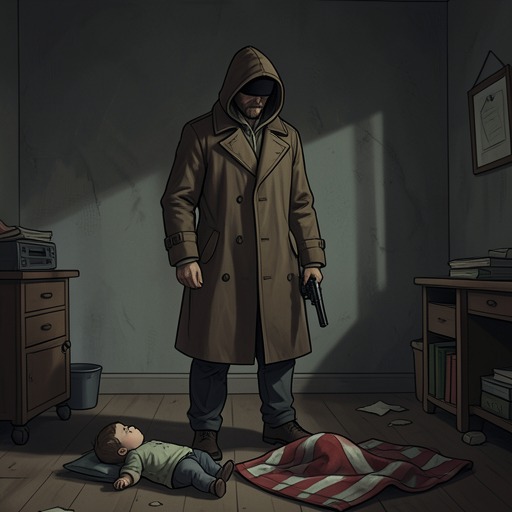
Popeye’s truck represents the more profitable and dangerous side of the trade. Tommy immediately recognizes it as Popeye’s, and distinguishes the Memphis men’s large-scale runs from Lee’s small local production. The truck makes illicit liquor mobile, allowing it to move between markets while also making its owners and associates vulnerable to observation. Popeye’s presence around Lee Goodwin’s house, his pistol, his refusal to drink, and his continual surveillance turn the liquor operation into an atmosphere of intimidation even before the murder investigation reaches its climax.
Law, Exposure, and Selective Enforcement
The authorities know that Goodwin is making liquor, yet they wait until he is down before attacking him. After he surrenders, the sheriff’s men search the property, find and destroy his still, and allow him to recover nearly one hundred and sixty dollars buried in a can in the barn. The sequence exposes the uneven character of Prohibition enforcement: the authorities tolerate or postpone action while the business functions, then seize the opportunity to destroy its productive apparatus once Goodwin is vulnerable. Enforcement is therefore both legal procedure and opportunistic power.
The destruction of the still ends Goodwin’s business even apart from the murder charge. His customers, who bought whiskey from him and drank what he gave them freely, turn against him publicly; the Baptist minister converts the case into a sermon about murder, adultery, and the supposed pollution of the county’s moral atmosphere. Prohibition supplies the material basis for the prosecution, while religious and civic rhetoric expands a liquor offense into a total judgment on Goodwin, the woman associated with him, and their child. The illegal business becomes evidence not only of lawbreaking but of sexual, racial, and moral contamination in the eyes of the community.
From Criminal Law to Collective Violence
Goodwin is bound over for the June term without bail, and he insists that Popeye’s presence at the murder scene must not be disclosed. His silence is partly a legal strategy and partly a recognition that the formal system is surrounded by extra-legal danger. The jail is already a public spectacle: after a Black murderer kills his wife, men gather outside the fence to hear him sing spirituals, and the prison window later becomes Goodwin’s place of confinement. The juxtaposition connects imprisonment, racialized public entertainment, and the threat of death within the same civic landscape.
The threat soon exceeds the courtroom. A crowd gathers outside the jail, ostensibly orderly, while speakers and onlookers turn confinement into a spectacle. Later, gasoline-fed fire erupts in a vacant lot beside the jail. A man carrying a five-gallon coal-oil can becomes a mass of flames, while the central blaze consumes a structure in silence. When the mob identifies Horace Benbow as Goodwin’s lawyer, it calls for him to be burned as well, revealing how Prohibition-era criminal accusation can spread from the accused to anyone who represents him. The law’s language of guilt is translated into collective physical coercion.
Institutional Violence and Its Aftermath
The formal system ultimately presents itself as more orderly than the mob, but it remains embedded in the same punitive world. The District Attorney plans an appeal after Goodwin’s conviction, complaining that the case was too easy and that lawyers like those associated with the accused have made justice appear ridiculous. His confidence in institutional procedure coexists with an acknowledgment that the conviction may not hold, while Goodwin’s earlier fear is that Popeye will not allow him to walk freely from jail to the courthouse. Legal process and criminal intimidation are not separate systems here; each limits what the other can accomplish.
Goodwin’s incarceration also changes the social and economic fate of his household. The money buried in the barn is left to support the woman and baby until the case ends, and the pair had already considered leaving. The illegal economy has provided income, but it has not provided security: its profits remain exposed to seizure, its participants to denunciation, and its dependents to abandonment or flight. Prohibition turns private survival into a matter of concealment and makes family stability contingent on the durability of a criminal enterprise.
The state’s ultimate punishment is represented by Popeye’s execution. He receives cigarettes and a shaving kit in jail, then is led to the scaffold while a minister prays and officials adjust the rope over his oiled hair. His request that the sheriff fix his hair before the trap is sprung places a small act of personal presentation inside an otherwise total apparatus of custody and death. The ending confirms the full punitive range produced by the prohibited economy: production and distribution generate wealth, surveillance produces arrest, accusation produces public disorder, and the state finally answers violence with imprisonment and hanging.
Narrative Significance
Prohibition gives the novel its material infrastructure. It explains why a quart must be sought through strangers at night, why a three-year customer relationship remains hidden, why a still is more consequential than an ordinary household object, and why a truck can signify both business and menace. It also creates the conditions under which legal authority, religious condemnation, commercial interest, racial hierarchy, and mob action converge.
The novel’s treatment of Prohibition is consequently economic as well as legal. Restriction creates scarcity, scarcity raises profits, and profits attract increasingly organized transport and protection. Enforcement then becomes selective and theatrical, destroying equipment, imprisoning producers, condemning their households, and permitting or failing to prevent public violence. The result is a system in which the official ban does not remove alcohol from social life; it relocates alcohol into a hidden market whose risks are borne by those with the least protection, while the surrounding community repeatedly consumes, condemns, and exploits the same trade.