Incarceration
SanctuaryIncarceration is one of the novel’s most persistent structures of power: it confines the accused, the condemned, the supposedly incorrigible child, and even those who are technically outside a cell. Its decisive significance lies in the contrast between legal custody and the wider social conditions that make some lives disposable while granting others protection. The jail houses people awaiting judgment, but the narrative also places confinement in a judge’s locked home, in a woman’s dependence on violent men, in racialized punishment, and in the pressure exerted on witnesses to preserve an official version of events.
Legal Confinement and the Question of Guilt
Incarceration first appears as a condition imposed by the criminal courts on Lee Goodwin after the killing for which he has been arrested. When Horace Benbow visits him, Goodwin sits in a cell whose windows are no more than narrow slits, a physical image of restricted vision and restricted speech. He insists that he did not commit the murder, but he also refuses to state what he believes happened, arguing that speaking would endanger his claim to innocence. His position turns the cell into more than a place of custody: it becomes a setting in which silence is both a defense and a form of enforced helplessness.
Goodwin has been bound over for the June term of court without bail, yet he continues to refuse permission for Horace to reveal Popeye’s presence at the murder scene. The decision leaves him legally exposed while preserving another secret. His repeated confidence that the authorities have nothing against him conflicts with the fact that he is already imprisoned and awaiting trial. The contradiction reveals how incarceration can precede proof: the state does not need to possess a complete truth before it can take control of a body.
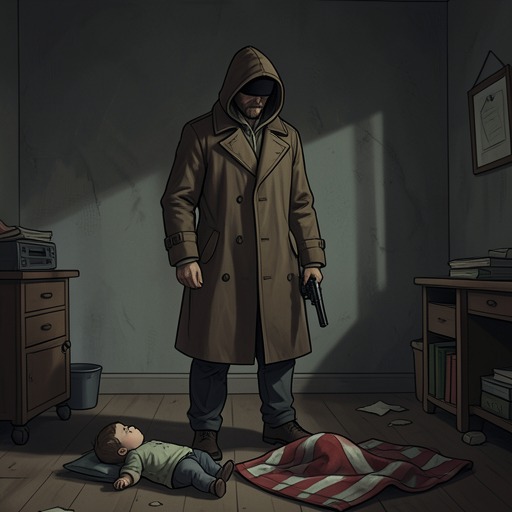
Horace’s visits make the jail a contested space between legal procedure and human obligation. He is admitted, climbs the stairs, and hears a door locked behind him before entering the cell. Goodwin is later found sitting beside the sleeping child in physical exhaustion, positioned before the dangerous slit in the wall. The architecture gives the jailer control over movement, while the narrow window exposes the prisoner to possible violence rather than providing meaningful escape or protection.
Race, Spectacle, and Unequal Punishment
The jail’s racial order is made visible through the Black murderer held there at the same time as Goodwin. The man has killed his wife and is awaiting execution, yet he leans from the barred window and sings spirituals to the Black people gathered along the fence. White listeners slow down or stop in the darkness to hear voices singing about heaven, weariness, death, and the absence of any place for the condemned man. His imprisonment becomes a public spectacle in which racialized suffering is consumed as sound and atmosphere.
The contrast between the singer’s immediate fate and Goodwin’s uncertain future is sharply staged. The Black prisoner is to be hanged on a Saturday without ceremony and buried without circumstance; the following night, the same window is to belong to Goodwin. The succession makes the jail seem to manufacture interchangeable occupants while preserving radically different meanings for their confinement. One prisoner’s death is treated as routine, while Goodwin’s imprisonment becomes the center of legal argument, advocacy, and public concern.
The singing also complicates the meaning of the jail. The barred window is an instrument of exclusion, but it becomes the place from which the prisoner addresses the town. His voice crosses the boundary that his body cannot. The surrounding listeners, however, do not thereby release him or restore his status; they remain spectators to a punishment already determined. The scene exposes a system in which recognition of suffering can coexist with its continuation.
Domestic Captivity and Gendered Vulnerability
The novel extends incarceration beyond official institutions through Temple Drake’s account of her confinement and pursuit. At the house where she seeks help, Temple holds a sleeping child and begs the woman to ask her husband to obtain a car and take her somewhere. Her fear is shaped by the men around her, but it is also constrained by the belief that social status should protect her. She invokes her father’s position as a judge and the governor’s visits to her family home, imagining that political influence and respectable identity might summon protection if violence reaches her.
The woman’s hostile response exposes the class and gender assumptions behind Temple’s appeal. She accuses Temple of claiming purity and superiority until she is in trouble, then coming to women whom she considers beneath her. Temple’s privileged identity does not prevent her from entering a space controlled by men; it instead changes the language through which her vulnerability is judged. Her confinement is therefore socially double-edged: she is endangered by male violence, yet condemned for seeking help outside the boundaries of respectable womanhood.
Temple’s remembered story of Frank shows another form of domestic imprisonment. Her father locks her inside the house after threatening Frank, then waits at the bridge. Temple escapes by climbing down a gutter, but the attempt to leave does not free her from paternal authority. When she and Frank return, her father takes a shotgun, shoots Frank after Temple tries to stand between them, and insults her. The locked house, the threatened journey, and the gun converge as a sequence in which patriarchal control becomes physical confinement and lethal force.
Institutions, Children, and the Production of Criminal Identity
Popeye’s childhood history presents incarceration as an institutional response to a disturbing child whom adults cannot or will not accommodate. He is physically frail, subject to severe medical restrictions, and described as unlikely to become a man in the ordinary sense. After cutting up lovebirds with scissors and later mutilating a kitten in the same way, he is arrested at the instigation of a neighbor and sent to a home for incorrigible children. He remains there for five years and is released because his behavior has been judged impeccable, as though institutional discipline has cured him.
The episode illustrates the uncertainty behind correctional language. The institution can certify improvement, but it cannot erase the violence that preceded confinement or guarantee that the underlying danger has disappeared. After release, Popeye moves through Mobile, New Orleans, and Memphis while presenting himself as a quiet night clerk in hotels. His self-description gives ordinary occupational form to a life that remains shadowed by earlier institutional classification and later criminal violence.
Popeye’s later imprisonment follows a more overtly legal path. He is arrested for killing a man in one town at an hour when he was elsewhere killing someone else, and he is eventually condemned. In the cell he remains controlled by guards, schedules, money, and the approach of execution. Even a turnkey’s attempt to return forty-eight dollars from a hundred-dollar payment receives only Popeye’s detached instruction to keep it and buy a hoop. The exchange reduces the administrative world of imprisonment to a final petty transaction, while Popeye’s indifference suggests a person who has made the institution’s procedures part of his environment.
The Scaffold and the Limits of the State
Popeye’s execution completes the novel’s movement from confinement to state-sanctioned death. At six o’clock the officials bring him to the scaffold, with a minister supporting him by the elbow while the rope is adjusted over his sleek, oiled head. His hands are tied, so he repeatedly jerks his head to keep his hair from falling forward. The gesture is minute and almost absurdly personal within the machinery of execution: even at the edge of death, bodily appearance remains something he attempts to control.
Popeye interrupts the minister’s prayer with a sharp sound and asks the sheriff to fix his hair. The sheriff answers that he will do so and springs the trap. The execution thus combines ritual, bureaucracy, and a final request concerned with appearance rather than confession or repentance. The state asserts absolute power over Popeye’s body, but the scene does not grant it complete interpretive authority. His last gesture remains his own, and the scaffold records not a purified moral conclusion but the final transformation of a prisoner into a corpse.
Witnessing, Silence, and Social Confinement
Incarceration also governs those who stand near the legal process. At the trial, Temple’s body becomes rigid and blank as she is led away from the witness stand by an older man. She stops repeatedly, cringes backward, and appears to cling to the wall until four younger men surround her and hide her from view. The court’s attention shifts between exposure and concealment: she has been made a witness, yet her testimony leaves her socially and psychologically enclosed.
The courtroom’s physical reactions reinforce this pressure. The room repeatedly holds and releases its breath as Temple moves, while the prisoner, the woman with the child, Horace, the District Attorney, and the Memphis lawyer remain seated at the counsel table. The fretful child’s whimper and the woman’s command to hush occur within the same atmosphere of controlled speech. The legal institution appears to seek a definitive truth, but its rituals also discipline bodies, silence distress, and organize whose suffering can be seen.
Across these episodes, incarceration is therefore both overt and diffuse. It is the cell that holds Goodwin, the jail window from which the condemned Black prisoner sings, the reform home that classifies Popeye, and the scaffold that ends his confinement. It is also the locked domestic space, the threatened woman’s dependence, and the courtroom’s demand that trauma become admissible testimony. The recurring pattern is not simply that law imprisons individuals; it is that social power decides whose confinement counts as justice, whose vulnerability counts as guilt, and whose voice may cross the bars without changing what happens behind them.