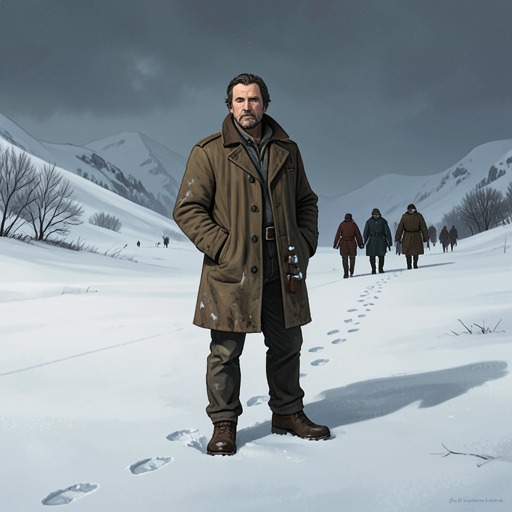
Khaled walks into the snow
ShantaramKhaled Ansari’s walk into the winter is a separation that becomes, in retrospect, a final departure: after laying aside nearly everything he owns, he leaves camp in the grip of a religious vision, while Lin struggles to hold him back. The scene turns their strained friendship into an immediate crisis, then receives its tragic weight from a later report that Khaled’s body was found close to Abdel Khader Khan’s after the attack.
The vision and the relinquished possessions
Khaled returns to the cave muttering in Arabic. Lin sees a striking change in him: his eyes seem lit by a vision, and resolve has settled into his scarred features. The account does not translate his words or explain the vision. Its force is conveyed instead through the contrast between the inward certainty Lin observes and the danger that certainty appears to carry. Khaled’s purpose is clear to him, but remains inaccessible to the people around him.
At the cave, he removes his canteen belt and cartridge belt, then empties his pockets one item at a time. He leaves behind false passports, money, letters, his wallet, weapons, jewellery, and photographs of his long-dead family. The order matters: this is not simply a departure with fewer supplies, but a progressive divestment that ends with the photographs among the things left on the ground. The objects connect Khaled to practical survival, identity, communication, and personal memory. His abandonment of them makes the departure appear deliberate and nearly absolute, although the scene does not state his intention outright.
Lin asks Mahmoud Melbaaf what Khaled is saying. The question comes after four weeks in which Lin has avoided Khaled’s gaze and rejected his friendship. That recent estrangement sharpens the reversal: Lin’s fear of losing him arrives when he can no longer reach him through ordinary companionship. The scene makes the distance between them both emotional and physical, as Lin recognizes the possibility of loss just as Khaled begins to leave.
Lin’s attempt to hold him back
Khaled walks from the cave toward the edge of the compound. Lin pushes him back, then throws his arms around him and drags him several paces inward. Khaled allows both interventions without resisting. He continues to stare ahead and chant verses from the Quran; when Lin releases him, he resumes walking out of the camp. The repeated movement outward, interruption, and renewed departure gives the episode its stark structure. Each effort briefly changes Khaled’s direction, but none changes his resolve.
Lin calls for help, but the others do not join him in restraining Khaled. Mahmoud Melbaaf, Nazeer, and Suleiman Shahbadi instead take hold of Lin and gently pull him away. Lin frees himself and tries again, shouting and striking at Khaled’s face in an effort to make him respond to the danger. Khaled remains unresponsive to these appeals. The others’ intervention therefore has two effects: it allows Khaled to continue, and it prevents Lin from turning his desperation into a physical contest that Khaled does not appear willing to resist.
The scene renders Lin’s fear through his own bodily distress and repeated efforts to keep hold of Khaled. He clings to him, then reaches for his jacket as Nazeer, despite his own weakened condition, peels Lin’s hands away. Mahmoud Melbaaf and Suleiman Shahbadi help hold Lin back. These gestures establish the scene’s conflict without making it a fight between Khaled and Lin: Khaled does not resist either man. The struggle is instead between Lin’s urgent wish to prevent the departure and the group’s recognition that they cannot make Khaled stay.
Departure and later confirmation
Once Lin is separated from him, Khaled walks out of the camp into the winter. The narration describes that winter as having ruined or killed the people in the camp, framing the landscape as a shared threat rather than a neutral setting. Yet Khaled’s exit remains his own action within that danger: he has set down his equipment and possessions, and neither Lin’s appeals nor the others’ intervention turns him back. The account leaves the immediate outcome of the walk unresolved, making the departure itself the scene’s ending.
A later recollection supplies a crucial piece of aftermath. Nazeer saw Khaled’s body beside Abdel Khader Khan’s, very close to him. The speaker believes Khaled would have wanted to be with Abdel Khader even if he had known in advance that they would be attacked and killed, and adds that Khaled was not the only one who would have made that choice. This retrospective information links the walk out of camp to Khaled’s death, while preserving some uncertainty about what he knew when he left. It also recasts the discarded belongings and Lin’s unsuccessful attempts to hold him: the departure was not merely a disappearance from the group but the beginning of a final separation.
Narrative significance
The episode makes friendship visible through a failed act of rescue. Lin’s earlier rejection of Khaled is not erased, but the crisis exposes how much the possibility of losing him now matters. His repeated attempts to stop Khaled cannot undo the preceding weeks or restore their closeness; they can only register his alarm at the moment that closeness is about to become irrevocable loss.
Khaled’s silence is equally consequential. He does not explain the vision, answer Lin, or resist being held. The scene therefore offers no definitive account of his reasoning at the threshold of departure. Instead, it places concrete actions beside that silence: the possessions left in the cave, the verses he chants, the direction in which he walks, and the later discovery of his body beside Abdel Khader Khan. Together, those details suggest a choice shaped by loyalty and a willingness to face death, without claiming more certainty about Khaled’s knowledge or motives than the account provides.