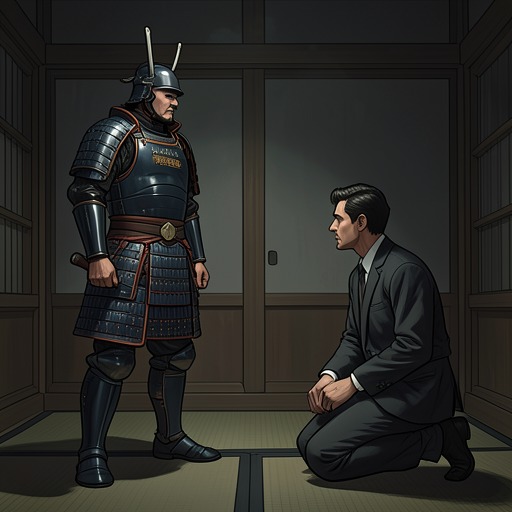
Fujiko’s pair of swords
ShōgunFujiko’s pair of swords are her dead father’s Samurai weapons, offered to John Blackthorne when he must appear before Yabu. More than equipment, they make the obligations and uncertain status of Blackthorne’s new life tangible: a hatamoto must wear two swords, yet whether that title makes him a Samurai is initially left unsettled. Fujiko gives the swords with reverence, and Blackthorne accepts them; their family history and her later request that he keep them make the gesture both a practical preparation and a personal act of recognition.
Provenance and Presentation
When Blackthorne asks what is happening, Fujiko calls into the house, and a maid emerges onto the veranda carrying two Samurai swords. Fujiko takes them reverently and, bowing, offers them to him. The careful transfer gives the weapons a significance beyond their use: they come from within Fujiko’s household and are entrusted to Blackthorne by its head.
Mariko explains the immediate reason for the gift. Blackthorne is to go to Yabu, and, as a hatamoto, he is obliged to wear the two swords of a Samurai. Fujiko considers it improper for him to make the visit unarmed. The swords are presented as a temporary solution, to serve until he can buy his own; Mariko describes them as unworthy, a modesty that contrasts with the weight of the duty they are meant to fulfill.
Their history clarifies the intimacy of Fujiko’s offer. On welcoming Blackthorne home, she explains that the swords belonged to her father, who is dead. She had not given them to her husband because he already had swords of his own. Now she asks Blackthorne to keep them, saying that doing so would please her greatly. What first appears to be a convenient loan is thus also a transfer from her family’s past into the household she now shares with him.
The Swords and Blackthorne’s Status
The exchange makes Blackthorne confront a question the formal title alone has not resolved: whether Toranaga’s appointment has made him a Samurai. Mariko cannot answer with certainty, but observes that no hatamoto has ever been other than a Samurai. Kasigi Omi likewise does not know whether Blackthorne’s appointment settles the matter. He can, however, explain the privileges and obligations attached to it: a hatamoto may keep his swords at all times, even in Toranaga’s presence, and has the right to an immediate audience with a lord.
The swords therefore mark a position that is both privileged and demanding. They signify access and trust, but also an obligation to carry weapons as the expected conduct of a hatamoto. Fujiko’s concern that Blackthorne not visit Yabu without them shows how that status must be enacted in public, through correct conduct as well as appointment. The object makes a political designation visible on his person.
Blackthorne accepts both weapons, placing the short sword and then the long sword in his belt in the same arrangement Kasigi Omi wears. Once armed, he feels better. That physical response is distinct from the unresolved question of rank: the swords immediately change how prepared he feels, even as their deeper meaning remains something Mariko and Kasigi Omi can explain but not definitively settle for him.
Household Gift and Recognition
The swords are also a means for Fujiko to express her place in Blackthorne’s household. On welcoming him home, she says that she is honored to be his consort and the head of his house, and asks him to keep the weapons that belonged to her father. Their use is practical, but their provenance makes acceptance personal: Blackthorne is not merely borrowing anonymous arms for a formal visit but being offered something with a history in Fujiko’s family.
The exchange also establishes Fujiko as an instructor in the customs that govern this new life. After Blackthorne thanks her in an overly elaborate form, Fujiko points out, through Mariko, that a shorter expression is sufficient for a man; the more elaborate politeness is unnecessary and associated with women’s speech. Her correction turns the moment of receiving the swords into a lesson about gendered language and appropriate behavior. The gift does not simply equip Blackthorne to perform a role; Fujiko helps teach him how to inhabit it.
Meaning Within Blackthorne’s New Life
The swords’ significance develops from uncertainty toward recognition. At first, Blackthorne asks whether receiving a hatamoto appointment means that he is a Samurai, and Mariko cannot say for certain. Later, she apologizes for having treated him as a barbarian and says that what he did proves he is a Samurai. The pair of swords belongs to this change in how others regard him: their use accords with the duties of a hatamoto, while their family history connects that public role to the private household Fujiko is building with him.
That recognition does not depend on the swords alone. The evidence places them alongside Blackthorne’s conduct and appointment, rather than presenting the weapons as an independent ceremony that confers rank. Their force lies in how several meanings meet in one object: they arm him for an audience with Yabu, display the responsibilities of his office, and carry a personal history Fujiko chooses to share. In accepting them, Blackthorne receives both the practical means to appear correctly and a sign that Fujiko wishes him to belong within the life of the house.