Erasmus
ShōgunErasmus is John Blackthorne’s ship, a 260-ton, three-masted trader-warship from Rotterdam and the sole surviving vessel of a Dutch expedition that crossed the Strait of Magellan. More than a homeward passage, it represents navigational knowledge, armed sea power, and Blackthorne’s hope of escaping Japan. Its seizure gives Yabu unexpected wealth; its guns and potential crew later become factors in the struggle between Toranaga and the Portuguese; and its destruction finally forces Blackthorne to imagine a future beyond the ship he has spent so long trying to reclaim.
Construction, voyage, and arrival
Erasmus enters the story in a squall, heeling beneath Blackthorne as its timbers squeal. The ship carries twenty cannon and had sailed with an expeditionary force of 496 volunteers, almost all Dutch, sent to attack Spanish and Portuguese possessions, establish trading concessions, and claim Pacific bases for the Netherlands. The voyage has left Erasmus alone: it is the surviving ship of the first Dutch expedition to reach the Pacific by way of the Strait of Magellan, and Blackthorne’s immediate circumstances aboard it are shaped by the losses and hardship that history implies without itemizing here.
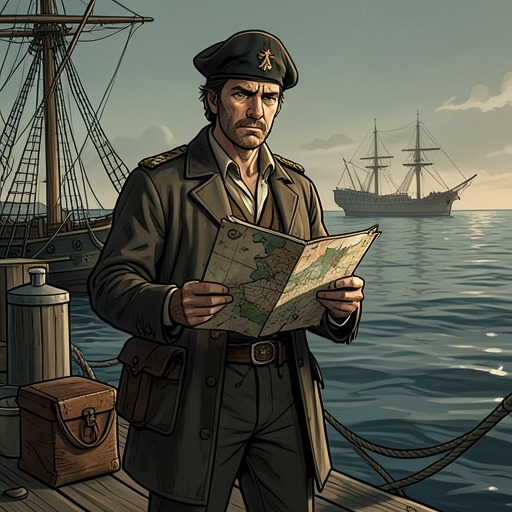
The voyage also belongs to a contest over information. Charts are scarce and too vague to be dependable, and mariners cannot fix longitude. A rutter—a pilot’s record of courses, depths, currents, winds, storms, hazards, anchorages, and places to take on water—can make a dangerous route practicable. Portugal and Spain guard such records as national treasures because they control much of the world’s known ocean passage, while their Dutch and English enemies seek the same knowledge. Erasmus is therefore not just a vessel crossing unfamiliar seas: it carries a pilot whose accumulated expertise has strategic value in its own right.
After reaching Anjiro, Blackthorne finds Erasmus anchored in good water, about fifty yards from shore, with three bow cables and local boats alongside. The ship is present, but his own men are nowhere aboard. It has already passed into other hands: the Dutch crew has been taken away, and Blackthorne cannot simply return to the vessel. For him, seeing Erasmus nearby sharpens the divide between possession and access. Its presence offers the outline of escape, but its sealed-off decks and absent crew make that escape impossible.
Capture, displacement, and the prospect of return
Erasmus’s wealth changes Yabu’s position. The ship reveals riches that give him a degree of power he had never expected, and the cargo becomes something to protect, trade, or bargain over. One consignment is to be kept safe while a dealer at Nagasaki is approached to offer it for sale to the Portuguese, who may come to collect it. The vessel’s arrival thus produces value on shore even while Blackthorne is separated from it: its cargo enters local political and commercial calculations before its captain can regain control.
The ship itself is stripped of its immediate fighting power. When Blackthorne sees it again, he notices that the gun ports are empty and asks what has happened to its cannon, while a slave galley lies where he expected a functioning ship to be. The storm has carried away the foremast’s upper remnant, but that damage seems repairable to him; he imagines slipping the moorings, using the night airflow and tide to reach open water, careening on the far side of an island, and stepping a spare mast. The decisive obstacle is not the wrecked spar. It is the absence of a crew: one man cannot take Erasmus to sea alone.
Blackthorne nevertheless continues to think of bringing the ship home with as many of his men as survive. His longing is practical as well as emotional: Erasmus means clothing, provisions, powder, shot, trade goods, and a route out of Japan. When Toranaga’s promise of a return to the ship leaves him hoping to go aboard, he still has no clothes and has not been allowed back on deck. Later, his cabin is unlocked but ransacked; its books, clothing, instruments, quills, and removable fittings are gone, and his sea chest is empty. The ship is not merely withheld from him as a means of departure. The possessions that made it his working environment have been dispersed as well.
A weapon in the struggle for the sea
Erasmus gradually becomes more than Blackthorne’s hoped-for route home. He considers using it to capture the Portuguese Black Ship, whose bullion could fund his departure and whose seizure would challenge Portuguese commercial power. His plan depends on crew, timing, and the difference between the ships’ capabilities: he imagines taking men at Nagasaki, waiting until the Black Ship leaves port, then overtaking it at sea with Erasmus’s speed and cannon. If successful, he would bring the prize to Yedo, divide the bullion, and either return the ship to the Portuguese, present it to Toranaga, or destroy it. In his proposal, command of Erasmus could convert maritime skill into wealth, leverage, and a larger naval force.
The plan makes the ship’s condition and access to manpower matters of high politics. Blackthorne recognizes that an under-crewed Erasmus would be vulnerable to Portuguese capture; the safer course would be to gather men first and take them back to Yedo. With a full crew and arms, he believes, the enemy would have no ship in those waters capable of challenging him. He later imagines using the two hundred samurai Toranaga has given him as a boarding party, reasoning that his new rank as a samurai and hatamoto will secure their obedience. Erasmus could then turn Japanese military manpower into a seaborne striking force.
That possibility alarms the Portuguese. Rodrigues recognizes that, if Erasmus remains under Toranaga’s control and Blackthorne is released with a capable crew, the ship could outfight the small frigate assigned to interfere with it and threaten the Black Ship between Japan and Macao. The danger, as the Portuguese discuss it, is not simply that Erasmus has powerful guns. Blackthorne might recruit at Nagasaki or Macao and, given time, train samurai or other fighters to serve aboard. The ship’s potential changes how his freedom is assessed: releasing its captain may also release a mobile naval power that Portuguese vessels cannot safely dismiss.
Restoration and renewed command
By the time Blackthorne sees Erasmus at the Yedo wharf, it has been returned to a condition that seems almost impossibly complete. Freshly painted and tarred, with clean decks, a caulked hull, repaired rigging, and a replacement foremast stepped at the proper angle, it again looks ready for sea. The rope ends are coiled, and the cannon gleam behind their gun ports beneath protective oil. The Lion of England flies above it. Blackthorne, who had prepared himself to find a damaged and neglected ship, is overwhelmed by how clean, cared for, and usable it appears.
His inspection tests that appearance against the ship’s working condition. Erasmus lies in three fathoms over a sandy bottom, its bilges sweet. Blackthorne dives beneath the keel and finds little seaweed and only a few barnacles; the rudder is sound. In the dry, spotless magazine, a spark ignites a small test mound of gunpowder at once. Johann Vinck reports that the cannon are back aboard, with powder and shot in ample supply, and that the replacement sails have been made from tough silk, with a spare set copied to match the originals. The foremast has been replaced using a spare carried in the hold. The ship has not yet been tested at sea, so the new sails remain an uncertainty in a gale, but its seams are believed sound and its guns and stores are ready.
The restoration does not erase disputes over ownership and command. Blackthorne brings Vinck with him from Yokohama and sends the others back to Yedo; the crew has argued over the expedition’s bullion, which belongs to the company rather than to Blackthorne personally. Baccus van Nekk, the expedition’s treasurer and chief merchant, shares legal jurisdiction over the money with the Captain-General. After the bullion is counted again and found correct except for a thousand missing coins, van Nekk, supported by Jan Roper, disputes how much Blackthorne may take to hire new men. The argument makes plain that regaining the vessel does not make its cargo his private property or dissolve the expedition’s chain of authority.
Even under close security, Blackthorne claims the quarterdeck as his own and rejoices in Erasmus’s return to the sea. The ship leaves with Yabu beside him on its quarterdeck while Naga sails in a separate galley packed with samurai and the rest of Blackthorne’s vassals. As the current takes the vessel and the jetty falls away, the crew’s excitement at being afloat again overcomes, for a time, its anxieties. Yet Erasmus is not simply restored to an earlier, private life: its sailing now depends on a Japanese force, political permissions, and a crew whose loyalties and resources have been contested.
Destruction and what follows
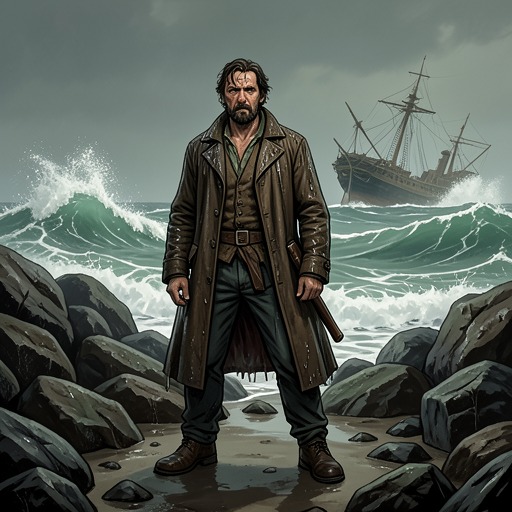
Erasmus’s return does not secure its survival. Blackthorne later stands in the shallows looking out at its burned hull, aground and heeled in the surf about seventy yards offshore. Its masts and decks are gone; only the keel and the ribs of its hull remain, jutting upward. The ship that had once appeared ready to sail on the tide has become a charred skeleton. The loss is physical and strategic at once: without Erasmus, Blackthorne loses the sea-going power that had supported his plans to recruit, fight, and leave Japan.
The circumstances connect the ship’s destruction to Mariko’s choice to protect Blackthorne. In her letter, she explains that she may sacrifice the most prized part of his life to safeguard her Church, but that saving his life matters more to her than even the interests of her lord, Toranaga. She accepts that the ship is doomed whether Blackthorne is aboard or not, and chooses to concede it to his enemies so that he may live. Blackthorne later recognizes the implication: without his ship he is more vulnerable to the Church, and Mariko had asked that he be left alive while the ship was killed. Erasmus’s destruction is therefore not merely a defeat inflicted on his hopes; it is also bound to the protection Mariko sought to secure for him.
In the aftermath, Blackthorne begins to design another vessel in his mind. He judges that he could initially manage a much smaller ship, around ninety to one hundred tons, because he has never overseen or designed a complete ship alone. His training as a shipwright, as well as a pilot, gives him a basis for starting again; he thinks of the Golden Hind as a precedent for what a small ship can endure and immediately returns to the problem of fitting cannon. Erasmus had embodied a particular escape plan, but its ruin does not end his maritime ambition. The ship’s final significance lies in that reversal: losing the vessel closes one route to freedom while revealing that Blackthorne can still build toward another.