Portuguese Secret Rutter
ShōgunThe Portuguese Secret Rutter is a navigational manual whose contents represent both hard-won practical knowledge and a closely guarded national secret. Its importance rests not simply on the information a pilot needs to reach a destination, but on who controls the routes, who may use them, and what possession of the book can cost. For John Blackthorne and the Erasmus crew, it is at once a guide through dangerous waters, evidence of forbidden access, and a potential death warrant.
Nature and Navigational Use
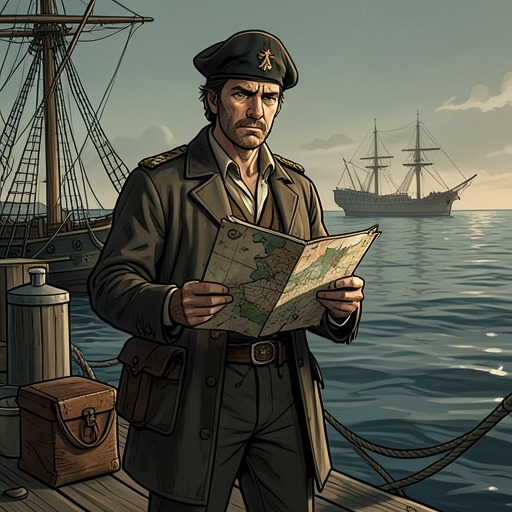
A rutter is a small book built from a pilot’s observations of waters he has already sailed. Rather than offering only a general map, it records compass courses between ports and geographical features, along with soundings, water color, and seabed conditions. It can describe how to reach a place and return from it: the duration of a particular tack, the prevailing winds and currents, when storms or fair weather are likely, where a ship can be careened or take on water, and where it may find friends, enemies, reefs, shoals, tides, or safe harbors. The form makes navigation accumulated, portable experience: information that can help a later pilot act where charts alone leave him uncertain.
That practical value is heightened by the limits of contemporary navigation. Existing charts could be too vague to guide a voyage reliably, and there was no way to fix longitude. A rutter offered an alternative kind of precision, particularly out of sight of land, where a ship could not simply orient itself by coastlines. Yet the manual was not infallible. Its usefulness depended on the pilot who made the observations, the scribe who copied them, any printer involved, and the scholar who translated them. Errors—and even deliberate falsehoods—could enter at any stage. A pilot could not know for certain whether a rutter was sound until he had tested it at sea.
Portuguese Secrecy and Strategic Value
The Portuguese Secret Rutter belongs to a larger struggle over maritime knowledge. English, Dutch, and French pilots had rutters for waters familiar to them, but Portuguese and Spanish navigators had sailed much of the rest of the world. Portugal and Spain treated those manuals as national treasures, while their English and Dutch rivals sought them with comparable determination. The restricted information concerned routes to the New World and passages such as the Strait of Magellan and the Cape of Good Hope, as well as the sea lanes onward to Asia. Control of such knowledge could protect commercial advantage and shape which rival powers were able to make the journey.
For John Blackthorne, the Portuguese book has a particularly immediate value: he believes it unlocks the secret passage through the Strait of Magellan. Father Sebastio insists that the passage is secret and challenges John Blackthorne’s account of how the Erasmus reached Japan. John Blackthorne responds that a Portuguese traitor sold the crew a rutter. The exchange makes the manual more than a technical instrument. Its possession is evidence that the boundaries of Portuguese secrecy have been breached, and its route information could carry consequences beyond the crew’s own voyage.
The book’s strategic significance also clarifies why John Blackthorne’s knowledge of navigation matters in Japan. When Vasco Rodrigues pilots a galley from the Izu Peninsula toward Anjiro, he chooses to leave the coast near Cape Ito and head west-southwest for a landfall at Cape Shinto, rather than follow the safer coastal route. The open-sea passage is chosen to save time, and John Blackthorne can follow and assess the course. That scene shows the difference between a coastal sailing tradition and the ocean-going expertise attached to European pilots. It also recalls the old rule that Japanese ocean ships were to carry Portuguese pilots. The rutter represents the kind of accumulated navigational knowledge that made such pilots valuable, even as its secrecy helped preserve Portuguese influence.
Possession, Exposure, and Mortal Risk
Aboard the Erasmus, the Portuguese Secret Rutter is kept distinct in John Blackthorne’s mind from his own rutter. The latter records dates, places, and amounts of plunder, the dead from the crew’s landings in the Americas and Spanish Africa, and attacks on churches, towns, and shipping. Its contents could identify the crew as pirates before a court outside England and the Netherlands. The Portuguese manual presents a separate danger: John Blackthorne believes that it was stolen, although he thinks it was purchased from a Portuguese traitor, and that Portuguese law calls for the immediate execution of a foreigner found holding one.
The threatened penalty becomes still more severe if the book is found aboard an enemy ship. In John Blackthorne’s understanding, the ship is then to be burned and everyone aboard executed without mercy. This is why, when samurai prevent him from reaching below deck, he concentrates on getting to both rutters before they can be discovered or handed to priests or Japanese authorities. His fear concerns not merely the loss of valuable navigation material, but the possibility that the manual will expose the crew to a punishment that also destroys their ship and lives.
The challenge from Father Sebastio brings that danger into the open. By naming the Strait of Magellan and denying that the route could be known legitimately, he turns John Blackthorne’s claim into an interrogation about the source of the crew’s knowledge. John Blackthorne’s answer—an accusation that a Portuguese seller betrayed his own side—frames the book as the material trace of a breach within the secrecy system itself. The rutter is thus both evidence of the crew’s access and a liability that could make that access fatal.
Knowledge as a Material Source of Power
The Portuguese Secret Rutter belongs to the novel’s wider pattern of knowledge made physical: a book can be carried, hidden, copied, translated, seized, and used. Its compact form contains observations gathered across voyages, yet its reach extends to rival states, commercial routes, and the survival of a single crew. The danger surrounding it also contrasts with the ordinary limits of maps. John Blackthorne can draw a broad representation of the world and explain how a Mercator projection lays the globe flat, but the existence of a world map does not itself supply the detailed, tested sailing directions that make a passage navigable. A rutter’s authority comes from particulars and prior passage, not from a view of the world at a distance.
The manual’s power is therefore inseparable from uncertainty. It can guide a ship through waters where charts fail, but it may contain errors; it can open a route, but the same route knowledge can expose its holder to legal and political punishment. Its secrecy makes it valuable, while its possession makes the Erasmus vulnerable. In this tension, the Portuguese Secret Rutter becomes a concentrated emblem of maritime power: a small book through which experience at sea is converted into access, advantage, and risk.