Event 1
Publication of Silent Spring

[Publication of Silent Spring](entity:event-recall-event-publication-of-silent-s-4ca98c871e14) marked the point at which [Rachel Carson](entity:character-recall-character-rachel-carson-13c8f018d01f) turned years of concern about persistent pesticides into a public challenge to the institutions promoting them. Written over four years amid illness, publisher resistance, and an anticipated chemical-industry campaign, the book made ecological damage legible as a consequence of human decisions; its reception helped propel pesticides into national debate and ecology into popular politics.
## The decision to write
In 1958, when Carson undertook the book that became [Silent Spring](entity:expression-recall-expression-silent-spring-e220320f14d1), she was fifty and had spent most of her professional life as a marine biologist and writer with the [U.S. Fish and Wildlife Service](entity:organization-recall-organization-u-s-fish-and-wil-fcda5a1300d0). Her earlier success had made her a world-famous author, and she had other projects in mind that promised the research and pleasure of her previous books. But her work in government had brought her and her scientific colleagues face to face with the widespread use of [DDT](entity:object-recall-object-ddt-1c2031137c06) and other long-lasting poisons in agricultural control programs. The intended subject of her next book gave way to what she considered a more urgent public responsibility.
Carson tried to interest magazines in an article about the dangers of pesticides, but even her established reputation could not overcome publishers’ fear of losing advertising. A canned baby-food manufacturer, for example, claimed that such an article would cause unwarranted fear among mothers using its product. The difficulty was not simply that Carson needed to persuade editors of a scientific claim: the commercial environment surrounding publication could itself obstruct scrutiny of products and practices with public consequences. When magazine publication failed, the book became the form through which she could assemble the case at length.
The foreword describes the stakes she perceived as far broader than damage to individual wildlife. Carson believed that DDT was causing extensive destruction of wildlife and habitat and clearly endangering human life. She continued despite doubts because silence would have left her no peace. Her choice made the book an act of testimony as well as an extended work of research: the subject was not the pleasure of exploring marine life, but the consequences of poisons being used across the landscape.
## Research, illness, and anticipated opposition
Silent Spring took more than four years to make and demanded a different kind of research from Carson’s previous books. The foreword contrasts the delight she had found in the laboratories at Woods Hole and in marine rock pools at low tide with the sense of near-religious dedication that replaced that pleasure during this work. The shift in tone reflects the book’s central burden: to trace what pesticide use does beyond the immediate target and beyond the moment of application.
The work was also completed while Carson was plagued by what she called “a whole catalogue of illnesses.” She knew that the chemical industry would attack her, not only because she opposed indiscriminate poison use but because her argument exposed what she saw as the irresponsibility of an industrialized, technological society toward the natural world. Illness and expected controversy therefore accompanied the book’s making; neither altered her decision to bring it forward.
The attack, when it came, was described as exceptionally bitter and unscrupulous. The chemical industry spent hundreds of thousands of dollars attempting to discredit the book and malign its author, portraying her as ignorant and hysterical and claiming she wanted to turn the earth over to insects. One company tried to halt publication by alleging that Carson had misstated something about its product. The foreword says she had not, and publication proceeded on schedule. The attempt to shift attention from the evidence to the author’s character—and the unsuccessful effort to stop the book—became part of the controversy surrounding its appearance.
## A book becomes a public issue
The campaign against Carson did not prevent the book’s argument from reaching the federal government. As a direct result of Silent Spring’s message, President Kennedy established a special panel of the [President's Science Advisory Committee](entity:organization-recall-organization-president-s-scie-64b3038613d3) to study pesticides. When the panel’s report appeared some months later, the foreword characterized it as a complete vindication of Carson’s thesis. This sequence gave the book’s claims a consequential institutional hearing: criticism that had been met with commercial and personal attacks was also taken up as a matter for scientific review.
The book’s effects extended beyond that review. It helped make ecology, then an unfamiliar word to many readers, one of the major popular causes of its time, and it led to environmental legislation at every level of government. Its public significance thus lay not only in warning about particular chemicals but in changing what could be discussed as a shared political responsibility. The slow, dispersed consequences of pesticide use were brought into a form that readers, scientists, and public institutions could recognize as connected.
That change in public understanding was consistent with the ecological relationships the book describes elsewhere. In its account of western sage country, the land’s harsh climate and long history of natural development shaped a habitat shared by plants and animals, including the pronghorn and sage grouse. The effort of land-management agencies to satisfy cattlemen’s demand for grassland by removing sagebrush treated that complex landscape as an obstacle to improvement. Spraying could eliminate plants beyond its intended target: in the [Bridger National Forest](entity:location-recall-location-bridger-national-for-8069c0865ae9), willows were killed along with sagebrush, damaging vegetation on which beavers depended and changing a region valued for fishing and hunting. These examples show why the book’s argument exceeded a dispute over whether a particular pesticide worked. The issue was what a narrow control objective could erase from an interconnected living system.
## Reception and lasting significance
The foreword presents the publication as a turning point whose importance did not end with the first controversy. Carson’s account of pesticide danger met resistance from publishers worried about advertising and from an industry able to finance a large campaign against her. Yet the controversy drew attention to the very questions the campaign sought to suppress, and the subsequent presidential panel’s report strengthened rather than dismissed her case. The publication transformed an argument about chemical control into a durable public question about responsibility for the natural world.
The narrative also places Silent Spring within the broader history of postwar control programs, where confidence in chemical intervention could outrun advance investigation. The account of heptachlor notes that research into its peculiar nature came after a control program had begun—or, more precisely, that someone looked up research already published only afterward. In another case, a beetle that had become a minor pest by 1945 declined largely through imported parasitic insects and disease organisms fatal to it. Such contrasts sharpen the significance of Carson’s intervention: control was not synonymous with spraying, and ecological processes could matter as much as a chemical campaign’s immediate objective.
Carson herself described the living world’s beauty as uppermost in her mind, alongside anger at the senseless, brutal things being done to it. She believed she had at least helped a little. The foreword’s account supports that modest self-assessment while documenting effects beyond it: a public cause, a federal scientific inquiry, and environmental legislation across levels of government. The book’s publication made the vulnerability of ecological relationships part of public knowledge, and its central warning acquired force through the consequences that followed its appearance.
Event 2
Kennedy President’s Scientific Advisory Committee Review of Pesticides

The [Kennedy President’s Scientific Advisory Committee Review of Pesticides](entity:event-recall-event-8b9b1f299f38) was a presidential inquiry into the dangers of pesticides, convened after [Rachel Carson](entity:character-recall-character-rachel-carson-13c8f018d01f)’s [Silent Spring](entity:expression-recall-expression-silent-spring-e220320f14d1) challenged the postwar reliance on persistent chemicals. Its report, issued months after the panel was established, was described in the book’s foreword as a complete vindication of Carson’s thesis, turning a contested warning into a finding affirmed by a presidential scientific body.
## Origins and Context
In 1958, Rachel Carson began writing the book that became Silent Spring. A marine biologist and writer who had spent most of her professional life with the [U.S. Fish and Wildlife Service](entity:organization-recall-organization-u-s-fish-and-wil-fcda5a1300d0), she had become alarmed, alongside scientific colleagues, by the widespread use of [DDT](entity:object-recall-object-ddt-1c2031137c06) and other long-lasting poisons in agricultural control programs. She came to believe that these chemicals were destroying wildlife and habitat on a broad scale and endangering human life.
Carson first tried to bring the issue to magazine readers, but publishers feared the loss of advertising. A canned baby-food manufacturer, for example, objected that an article would cause “unwarranted fear” among mothers who used its product. The resistance underscored the conflict surrounding the subject: evidence of risk had to compete not only with scientific and governmental judgments, but also with commercial pressures shaping what could be published.
## Establishment of the Panel
After Silent Spring made its case, President Kennedy set up a special panel of the President’s Science Advisory Committee to study the pesticide problem. The review therefore followed Carson’s public intervention; it was not presented as an inquiry that had initiated her work. The sequence mattered: a book that had struggled to find a platform helped prompt the executive branch to subject pesticide use to formal scientific scrutiny.
The panel’s task, as described in the foreword, was to study the problem of pesticides. The account does not specify its membership, investigative procedures, or individual findings. It does establish the institutional response itself: the issue raised in the book reached the President’s scientific advisers and became the subject of a dedicated review.
## Report and Significance
The panel’s report appeared some months after its creation. The foreword characterizes it as a complete vindication of Carson’s thesis, connecting the review’s conclusion to her central warning about the consequences of widespread pesticide use. In this account, the report is more than a sequel to public controversy: it represents the adoption of her argument by an official scientific body.
Carson, however, was described as modest about her accomplishment. The contrast between the scale of the public response and her personal modesty keeps the emphasis on the living world she sought to protect, rather than on the vindication of her own standing. The review’s enduring significance in the book’s narrative lies in that change of authority: a warning initially constrained by publishers’ commercial concerns received formal consideration at the highest level of presidential scientific advice.
Event 3
落基山兵工厂地下水污染事件

The [Rocky Mountain Arsenal groundwater contamination](entity:action-recall-action-9d6373f3f8b0) episode, as recounted in [Silent Spring](entity:expression-recall-expression-silent-spring-e220320f14d1), turned a local farming district’s unexplained illnesses and crop losses into a warning about pollution that moves unseen and may be difficult to stop. Waste discharged near Denver reached shallow farm wells several miles away over a period of years; investigators found contamination continuing to spread, with no known way to contain it. The discovery of [2,4-D](entity:object-recall-object-2-4-d-c718abd9f205) in both wells and the arsenal’s holding ponds widened the concern: the site’s water could act as a chemical environment in which substances changed, with consequences beyond the farms already affected.
## Industrial operations and the first reports
The [Rocky Mountain Arsenal](entity:location-recall-location-rocky-mountain-arsen-dcb6a72346a3), operated by the Army Chemical Corps near Denver, began manufacturing war materials in 1943. Eight years later, its facilities were leased to a private oil company for insecticide production. Reports of trouble had already begun before that change in use. Farmers several miles from the installation described unexplained sickness among livestock and extensive damage to crops. Plants yellowed, failed to mature, or died, and some people reported illnesses that observers suspected might be related.
These early complaints emerged across a distance from the industrial site, rather than at a single point of visible discharge. That separation made the source less immediately apparent: the affected farms depended on shallow wells for irrigation, while chemical wastes had been sent to holding ponds at the arsenal. The account presents the complaints as the first signs of a connection that later investigation would trace through the groundwater.
## The underground route
A study conducted in 1959 with the participation of several state and federal agencies examined the well water and found a mixture of chemicals. Chlorides, chlorates, phosphoric-acid salts, fluorides, and arsenic had been discharged from the arsenal into its holding ponds during the years of operation. The investigators concluded that the groundwater between the installation and the farms had become contaminated.
The estimated journey was slow but substantial: waste took seven to eight years to travel underground about three miles from the holding ponds to the nearest farm. Seepage had continued to spread beyond that route, and the contaminated area’s full extent was unknown. The investigators knew of no means to contain the pollution or halt its advance. In this account, groundwater is not a separate, sealed resource: it connects the site to farms beyond it, and pollution entering that hidden system can travel far from where it began.
## The discovery of 2,4-D
The episode’s most mysterious and, in the long run, potentially most significant finding was the presence of the weed killer 2,4-D in some wells and in the arsenal’s holding ponds. The concern was not simply that a known chemical had been discharged. Carson describes the ponds as becoming chemical laboratories: in the presence of air, water, and sunlight, substances there could produce a new chemical without the intervention of human chemists. She identifies that resulting chemical as fatally damaging to much of the plant life it touched.
This proposed environmental transformation gives the contamination a reach beyond the measured list of wastes. The damaged Colorado crops could not be understood only as the direct result of chemicals sent into the ponds; the conditions at the site might also create harmful substances. The account treats the discovery as a reason to ask what other such transformations could occur elsewhere, rather than as a problem confined to one installation and a few nearby farms.
## Significance beyond the farms
The incident connects industrial operations, waste storage, groundwater movement, and agricultural exposure in a single chain. A military installation’s holding ponds became the source of contaminants that traveled for years beneath the ground; farms encountered them through the water used for irrigation, amid reports of crop damage, livestock sickness, and human illness. The account distinguishes reported illness from established causation, but emphasizes the scale and persistence of the environmental pathway.
Carson places the episode within a broader argument prompted by the widespread use of long-lasting poisons in agricultural control programs. She recounts that she and scientific colleagues had become alarmed by their effects, and that she decided to speak publicly when she believed wildlife, habitat, and human life were endangered. The arsenal case gives that warning a particular form: contamination can move beyond its point of release, remain hidden during its journey, and continue spreading before its boundaries are known. Its importance lies not only in the damage reported on Colorado farms, but in the unresolved question of what similar underground paths and chemical changes might be occurring elsewhere.
Event 4
图莱湖与下克拉马斯湖鸟类中毒事件

The Tule Lake and Lower Klamath bird-poisoning event was a 1960 episode of wildlife mortality in [California](entity:location-recall-location-california-fd5bbc3f2eb4) refuges whose waters received drainage from intensively sprayed agricultural lands. Hundreds of dead and dying birds were collected; residues of toxaphene, [DDD](entity:object-recall-object-ddd-4b644712b3af), and DDE were identified in fish-eating birds, while insecticides were also detected in fish and plankton. The event made visible the connection between agricultural irrigation and conservation waters: contamination could travel through a shared water system into habitat used by migrating and nesting waterfowl.
## A Connected Water System
The refuges at Tule Lake and Lower Klamath were part of a chain of waters that also included [Upper Klamath Lake](entity:location-recall-location-upper-klamath-lake-65d700203db7), just across the border in Oregon. The surrounding farmlands had been reclaimed from marsh and open water through drainage and stream diversion. Irrigation water from Upper Klamath Lake was applied to those fields, then collected and pumped first into Tule Lake and onward to Lower Klamath. Consequently, the refuge waters carried the return flow of agricultural lands rather than remaining separate from them.
That arrangement gave the incident its broader significance. Water served as a route by which residues from sprayed fields could reach refuge lakes, and the movement did not stop at the visible shoreline. The refuge manager believed residues were building up in the waters through returning irrigation flows from heavily sprayed farmland. The detected chemicals and the pattern of drainage together raised concern about ongoing contamination, not merely the isolated loss of individual birds.
## The 1960 Mortality and Its Evidence
During the summer of 1960, refuge staff collected hundreds of dead and dying birds at Tule Lake and Lower Klamath. Most were fish-eating species, including herons, pelicans, and gulls. Analyses identified toxaphene, DDD, and DDE residues in the birds. Fish from the lakes also contained insecticides, as did samples of plankton, placing contamination at more than one point in the aquatic food network.
The findings linked a visible wildlife loss to a wider environmental pathway. The birds were not the only organisms in which residues were found: plankton and fish, the food resources on which fish-eating birds depend, were also contaminated. The refuge manager’s assessment connected this pattern to irrigation water returning from sprayed fields. The evidence thus presented the refuges not as isolated sanctuaries but as downstream recipients of agricultural drainage.
## Habitat at Risk
The two refuges occupied important positions along the [Pacific Flyway](entity:location-recall-location-pacific-flyway-4335047589aa). In summer they provided nesting areas for waterfowl, particularly the endangered redhead and ruddy duck; in autumn they served birds moving south into the Pacific Coast states. Their role extended beyond the birds found dead in 1960: the lakes and pools sustained habitat used at different stages of the migratory year.
The book warns that serious contamination of these waters could cause irreparable harm to waterfowl populations across the Far West. It also frames the stakes in terms of the broader value of waterfowl, including their importance to hunters and to people who cherish seeing and hearing them cross the evening sky. The incident therefore joined ecological risk to public concern: damage to a refuge water system could affect both wildlife populations and the human communities attached to them.
## Significance of the Event
The poisoning episode exemplifies the consequences of managing land and water as if their uses could be separated. Agricultural spraying took place on reclaimed fields, but irrigation carried residues back through a connected sequence of lakes and refuge waters. The resulting detections in plankton, fish, and birds reveal how contamination could move across habitats and through the food network, reaching species that were not the intended targets of agricultural pest control.
The event also gives the idea of a wildlife refuge a practical test. A boundary set aside for conservation cannot by itself protect a habitat whose water arrives as drainage from elsewhere. At Tule Lake and Lower Klamath, the refuge system’s ecological function depended on waters shared with surrounding farms and linked to Upper Klamath Lake. The hundreds of collected birds, together with residue findings across aquatic organisms, made that dependence—and the risk it carried—concrete.
Event 5
清湖DDD中毒事件
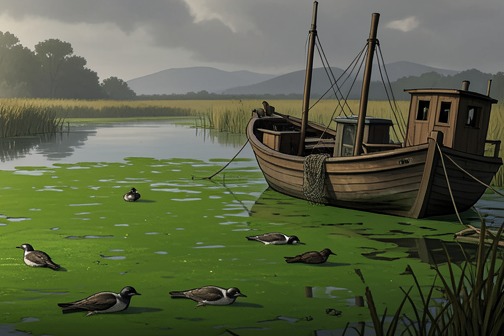
The Clear Lake [DDD](entity:object-recall-object-ddd-4b644712b3af) poisoning episode is [Rachel Carson](entity:character-recall-character-rachel-carson-13c8f018d01f)’s account of a carefully planned insect-control program whose effects spread far beyond its target. Repeated applications of DDD, chosen as a seemingly less dangerous alternative to [DDT](entity:object-recall-object-ddt-1c2031137c06), were followed by the death of western grebes, high concentrations of the chemical in fish and birds, and a drastic decline in the lake’s nesting grebes. The episode makes the food web itself the record of exposure: although DDD soon disappeared from the water, it remained in the living organisms the water supported.
## A lake treated for gnats
Clear Lake lies in mountainous country about 90 miles north of San Francisco and had long been popular with anglers. Its abundant gnat, [Chaoborus astictopus](entity:creature-recall-creature-chaoborus-astictopus-a9a64829c715), was related to mosquitoes but did not suck blood and probably did not feed as an adult. Its sheer numbers nevertheless annoyed people sharing its habitat. Earlier efforts to control it had largely failed, and chlorinated hydrocarbon insecticides offered a new means of attack.
In 1949, DDD—a close relative of DDT, but one apparently thought to pose fewer threats to fish—was selected for a new campaign. The operation was carefully planned: the lake was surveyed, its volume determined, and the chemical diluted to one part in 70 million parts of water. The initial gnat control was good. By 1954, however, treatment had to be repeated, at a concentration of one part in 50 million parts of water; the destruction of the gnats was then thought virtually complete.
The result did not hold. After a third assault on the resilient gnat population in 1957, the control effort had again failed to eliminate it. The repeated applications are central to the episode: the intended target persisted, while the chemical introduced to control it entered a much wider ecological system.
## The warning in the birds
The first clear sign that other life had been affected came during the winter months after the 1954 treatment, when western grebes on the lake began dying. More than a hundred were soon reported dead. The grebe was not merely a passing visitor: it bred at Clear Lake and also wintered there. Its presence connected the episode to the lake’s reproductive life as well as to the immediate deaths.
After the 1957 application, more grebes died. Examinations, as in 1954, found no evidence of infectious disease. The change in understanding came when someone analyzed the birds’ fatty tissues: they contained DDD at an extraordinary concentration of 1,600 parts per million. The birds were fish eaters, and tests of the fish began to reveal how the chemical had reached them. It had been taken up by the smallest organisms, concentrated, and passed onward to larger predators.
The measurements traced the transfer through the food web. Plankton contained about five parts per million of the insecticide; the poison then moved through organisms that ate plankton and through smaller carnivores that ate those organisms. Fish-eating grebes thus carried a burden far beyond the concentration applied to the lake water. The episode turns an apparently dilute treatment into a chain of exposure whose successive links magnified the chemical.
## A poison remaining in the living lake
Later findings sharpened the distinction between disappearance from water and disappearance from the environment. No trace of DDD could be found in the water shortly after the last application. Yet the poison had not truly left the lake: it had entered the life the lake supported. Fish, including fish hatched nine months after the last application, were among the living carriers. Grebes and [California](entity:location-recall-location-california-fd5bbc3f2eb4) gulls also accumulated concentrations exceeding 2,000 parts per million.
The grebes’ nesting record registered the longer consequence. Before the first insecticide treatment, the nesting colonies numbered more than 1,000 pairs. By 1960, about 30 pairs remained. Even those remaining pairs appeared to have nested without success: no young grebes had been observed on the lake since the last DDD application. The account does not reduce this decline to a single measured cause, but places the collapse alongside the detected contamination, repeated bird deaths, and continuing presence of DDD in the food web.
## A belated halt and the episode’s significance
The findings also raised a question about people who ate fish from the lake. The California Department of Public Health professed to see no hazard, yet in 1959 it required DDD use in Clear Lake to stop. Carson presents the order as a minimum safety measure in light of the chemical’s demonstrated biological potency, not as proof that all the risks had been resolved.
The episode’s force comes from the contrast between the plan and its consequences. Surveying the lake and carefully calculating dilution had made the 1949 operation appear controlled; the renewed treatments and the gnat’s resilience undermined that confidence. Meanwhile, the evidence of harm emerged only as the chemical was followed through organisms—from plankton to fish to birds—and as a breeding colony contracted over time. Clear Lake therefore illustrates a central concern of the book: a poison need not remain visible in water to persist in an ecosystem, and a treatment aimed at one troublesome species can have consequences throughout the food web.
Event 6
布里杰国家森林鼠尾草灌丛喷药事件

The [Bridger National Forest](entity:location-recall-location-bridger-national-for-8069c0865ae9) sagebrush spraying was a large-scale vegetation-control operation that exposed the ecological cost of treating a landscape as an obstacle to cattle grazing. In 1959, the U.S. Forest Service sprayed about 10,000 acres of Wyoming sage country; the chemical killed the intended sagebrush, but it also destroyed streamside willows. As [William O. Douglas](entity:character-recall-character-o-00cb0c7da98e)’s account, recounted by [Rachel Carson](entity:character-recall-character-rachel-carson-13c8f018d01f), makes clear, that collateral damage did not remain collateral: without the willows, the moose and beavers disappeared, a principal dam failed, the lake drained, and large trout vanished from the creek. The episode turns an abstract warning against indiscriminate spraying into a chain of visible losses across a connected habitat.
## Land-Management Background
Carson places the incident within a broader effort to convert western rangelands into grassland for cattle. The land of the sage, she explains, was formed by the uplift of the Rocky Mountain system and shaped by harsh extremes of climate. Its vegetation and wildlife had developed through long adaptation to those conditions. The sagebrush country was not simply unused ground awaiting improvement: it was a functioning landscape, with plants and animals suited to its particular demands.
That ecological history sets up the conflict behind the spraying. Land-management agencies sought to meet cattlemen’s demand for more grazing land, defining the desired result as grass without sage. But sagebrush and other native vegetation also sheltered and sustained wildlife. Carson notes that removing this cover could leave sheep exposed to winter storms without sage, bitterbrush, and other wild plants. The project’s stated aim of enlarging grassland therefore narrowed the meaning of improvement to a single agricultural use, while the landscape’s other dependencies remained at risk.
## The Spraying and Its Collateral Damage
The U.S. Forest Service sprayed roughly 10,000 acres of sage country in Bridger National Forest, Wyoming, yielding to pressure for more grassland. The treatment killed the sagebrush as intended. Its effects, however, did not stop at the target plant: the same spray also killed the green ribbon of willows following the area’s meandering streams.
Those willows were part of a habitat supporting moose and beavers. Before the damage, the region was also valued as a recreational area, with excellent fishing and hunting. The spray thus altered more than the appearance or botanical composition of the range. It struck at the streamside vegetation on which animals depended and at the ecological conditions that made the area useful to people for purposes beyond grazing.
## Douglas’s Return and the Cascade of Loss
William O. Douglas described the destruction in his book *My Wilderness: East to Katahdin*. He visited the area in 1959, the year of the spraying, and was shocked by the sight of shriveled, dying willows. Carson reports his judgment of the damage as vast and incredible. The image of the damaged streamside growth matters because it records an immediate consequence of the intervention before the wider changes had run their course.
Douglas returned a year later to find the consequences written into the landscape. The moose were gone, and so were the beavers. Their principal dam had failed for want of attention from its skilled architects; the lake had drained away. The large trout were gone as well: none could live in the tiny creek that remained, winding through bare, hot ground without shade. The sequence links a plant community’s destruction to the loss of animals, water retention, and fish habitat. A treatment aimed at clearing sagebrush had remade the stream environment from shaded, dammed waters into a small exposed creek.
## Significance in Carson’s Argument
Carson uses Bridger as an example of the “shotgun approach to nature”: a spray applied to eliminate one target also eliminates many plants outside the target’s definition. The episode is particularly forceful because the consequences are not presented as a solitary poisoning or a momentary die-off. They unfold through relationships—willows, beavers, a dam, a lake, shade, and trout—so that each loss makes the next one intelligible.
The account also challenges the language of improvement. More grass for cattle may have been the immediate management objective, but the resulting bare landscape no longer supported the same wildlife, water conditions, or fishing and hunting. Carson’s record of Douglas’s two visits gives the change a temporal structure: first the dying willows, then the disappearance of animals and the draining of the lake. The event stands as a warning that a chemical operation can produce effects far beyond its intended target, especially when the target is removed from a living system rather than considered within it.
Event 7
克拉马斯草生物防治计划
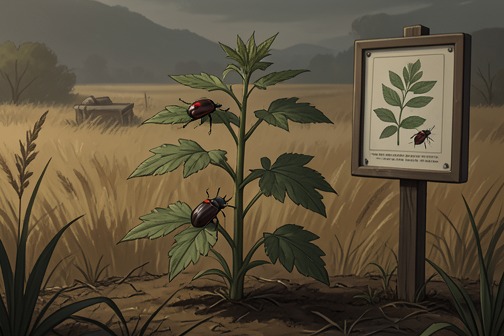
The Klamath weed biological-control program became a striking example of controlling an introduced plant by restoring an ecological relationship rather than trying to eliminate the plant indiscriminately. Two beetle species that feed and reproduce only on the weed were brought from southern France; once established, they spread through infested range, reduced the weed to a harmless remnant, and allowed crowded-out desirable plants to return. The result, measured in a ten-year survey completed in 1959, was not eradication but a durable form of restraint: the remaining weed helped preserve the beetle population that could check a future resurgence.
## An Introduced Plant and a Changed Landscape
Klamath weed, also known as goatweed or St. Johnswort, was native to Europe. It accompanied human westward migration to the [United States](entity:location-recall-location-united-states-2f533bc8d0b9), first appearing near Lancaster, Pennsylvania, in 1793. It reached [California](entity:location-recall-location-california-fd5bbc3f2eb4) near the Klamath River by 1900, acquiring the local name by which the infestation became known. By 1929 it occupied about 100,000 acres of rangeland; by 1952 it had invaded roughly two and a half million acres.
The plant's spread carried direct costs for livestock and landholders. Animals that fed on it became scabby, sore-mouthed, and unthrifty. The resulting decline in land values reflected how thoroughly the weed had come to dominate ranching concerns: it was regarded as holding the first mortgage on the land. Yet the problem was not simply that the plant was unfamiliar or unwanted. Unlike native sagebrush, Klamath weed had no established place in the local ecological system, and its unchecked abundance crowded out plants valuable to the range.
## A Natural Check Reintroduced
In Europe, Klamath weed had not become a comparable problem. Insects that had evolved alongside it fed on the plant and kept its abundance severely limited. Two beetle species from southern France were especially suited to the weed: each was pea-sized, metallic in color, and dependent on Klamath weed both for food and reproduction. Their specialized relationship offered a possible control method that did not require a broad attack on other vegetation.
The first shipments of the beetles reached the United States in 1944. This was the first attempt in North America to control a plant by introducing a plant-eating insect. The beetles established themselves so well that by 1948 no further importations were needed. Rather than repeatedly importing more insects, workers collected beetles from the original colonies and redistributed them, at a rate of millions a year, to new infested areas.
## Dispersal, Recovery, and Measured Results
The beetles also spread on their own within smaller areas. As the Klamath weed died out in one patch, they moved on and located new stands with great precision. Their movement tracked the presence of their food source: control emerged through the interaction of insect and plant, not through a single application imposed across the landscape.
As the beetles thinned the weed, desirable range plants that had been crowded out could return. A ten-year survey completed in 1959 judged the control more effective than even its enthusiasts had expected. Klamath weed had fallen to just one per cent of its former abundance. That remaining fraction was not treated as a failure. It was harmless and served an ecological purpose by maintaining enough beetles to protect against a future increase in the weed.
## Significance as an Alternative to Broad Control
The program's success rests in its distinction between suppressing an invasive plant and attempting to erase it altogether. A residual population of the weed sustained its specialized predators; those predators, in turn, kept the plant from again reaching its former abundance. The arrangement made the outcome depend on an enduring relationship rather than on repeated chemical treatment or total removal.
In the book's wider argument about human efforts to manage nature, this case demonstrates the value of observing an existing ecological check and using it carefully. The imported beetles did not simply destroy vegetation at random: their narrow dependence on Klamath weed allowed other range plants to recover as the infestation receded. The ten-year result therefore measured more than a reduction in acreage. It showed how a control program could address damage while preserving the small remnant needed to maintain control into the future.
Event 8
澳大利亚仙人掌生物防治行动
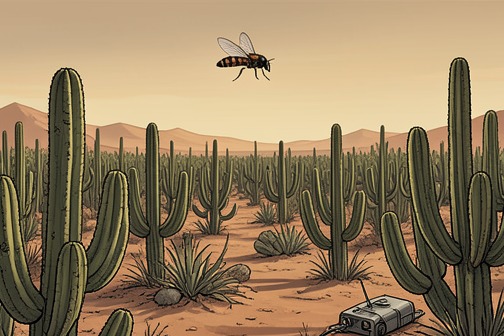
[Australia](entity:location-recall-location-australia-443153725cd3)’s prickly-pear campaign is [Rachel Carson](entity:character-recall-character-rachel-carson-13c8f018d01f)’s striking example of biological control replacing expensive, unsatisfactory chemical attempts with a method that restored vast areas of land to settlement and grazing. The episode turns on an ecological reversal: plants carried to a new country for human purposes escaped cultivation, flourished without their natural controls, and were eventually checked by an insect enemy sought in their native habitat.
## Introduction and Background
Around 1787, Captain Arthur Phillip brought several kinds of cactus to Australia, intending to use them to cultivate cochineal insects for dye. Some prickly pears escaped from his gardens. By 1925, about twenty species were growing wild, with no natural controls in their new territory to restrain them. Their spread was immense: the plants eventually occupied about 60 million acres, at least half of which was so densely covered that it was useless.
The infestation was not simply a problem of an unwanted plant appearing in a landscape. It was an introduced species multiplying beyond the bounds of cultivation and occupying land on a scale that curtailed its use. Carson places the cactus’s escape within a wider ecological principle: organisms moved into a new territory may be freed from the relationships that had kept them in check in their native habitat. The campaign’s response began by looking back to those relationships rather than treating chemical eradication as the only available course.
## Search for a Biological Control
In 1920, Australian entomologists were sent to North and South America to study the insect enemies of prickly pears in their native habitat. The mission made the search for a control organism an exercise in ecological investigation: before releasing an insect in Australia, researchers sought out the relationships between cactus and insect where the plants had evolved.
After trials of several insect species, the entomologists selected an Argentine moth. In 1930, they released three billion of its eggs in Australia. The scale of the release was enormous, but the intervention relied on the moth’s capacity to attack the introduced plant, rather than on a chemical treatment applied indiscriminately across the land. Carson presents the choice of an insect enemy as a practical outcome of studying the weed in relation to its natural controls.
## Results and Costs
Seven years after the release, the last dense growth of prickly pear had been destroyed. Areas that had been made uninhabitable by thick cactus growth were reopened to settlement and grazing. The account describes a rapid and substantial landscape change: within less than a decade, the widespread infestation that had rendered at least half of its 60 million acres useless no longer remained in dense growth.
The campaign’s cost sharpened the contrast with earlier chemical efforts. The biological operation cost less than a penny per acre, while unsatisfactory attempts at chemical control in earlier years had cost about £10 per acre. Carson uses these figures to make the case not just for the success of the moth, but for the practical and economic value of seeking a control suited to the target organism. In this example, the alternative to chemical treatment was neither inaction nor an abstract ideal: it was a deliberately researched biological intervention with a measurable result.
## Significance in Carson’s Argument
Carson draws from the Australian case a broader lesson about managing unwanted vegetation. Effective control, she argues, may be achieved by paying more attention to the role of plant-eating insects. The episode therefore serves as evidence for biological control as an alternative to chemical methods, particularly when the target plant’s natural enemies can be identified and used.
The story also carries an irony: the cactus had been brought to Australia through human intervention, spread after escaping cultivation, and was checked only after investigators looked beyond the invaded landscape to its original ecological relationships. The campaign’s success does not make every biological release universally suitable; rather, in Carson’s account, its force lies in the contrast between a researched use of an organism’s natural role and earlier chemical efforts that were both unsatisfactory and far more costly. Its central measure of success is concrete: dense prickly pear disappeared, and land once rendered useless reopened to human use.
Event 9
日本甲虫传入美国

The introduction of the [Japanese beetle](entity:creature-recall-creature-japanese-beetle-a8267e847eee) into the [United States](entity:location-recall-location-united-states-2f533bc8d0b9) began with a small, initially unrecognized discovery near Riverton, [New Jersey](entity:location-recall-location-new-jersey-25586b9a9d1c), in 1916. The beetle had apparently arrived on nursery stock imported before restrictions were established in 1912. Its subsequent spread and the contrasting control methods used in different regions made its history more than a record of an invasive insect: it became evidence that chemical eradication could disregard both ecological alternatives and the uneven costs of control.
## Arrival and Spread
A few shiny, metallic-green beetles were first seen in a nursery near Riverton. They were not recognized at once; identification eventually established that they were common inhabitants of [Japan](entity:location-recall-location-japan-2b426de89e42)’s main islands. Their likely route into the country was imported nursery stock brought in before the 1912 restrictions, turning a routine movement of plants into an inadvertent crossing of ecological boundaries.
From that point of entry, the beetle spread widely through states east of the Mississippi River where temperature and rainfall suited it. Its range did not remain fixed: each year usually brought some outward movement beyond the existing distribution. The account describes an ongoing expansion rather than a single isolated incursion, a process that later placed Midwestern states on the fringe of the beetle’s established range in the position of deciding how to respond.
## A Pest That Could Be Held in Check
The beetle’s history did not consist of uninterrupted growth. In eastern areas where it had been established longest, attempts were made to establish natural controls. The recorded results, Carson notes, showed that these controls kept populations at relatively low levels. This regional experience provided a practical counterpoint to the assumption that the insect required a sweeping chemical assault.
The longer view also complicates the idea that the beetle was an ever-escalating threat. During its first dozen years in the United States, it increased rapidly while free of restraints that held it in check in its native land. Yet by 1945 it had become a pest of only minor importance across much of the territory it had reached. Carson attributes much of this decline to the importation of parasitic insects from the Far East and the establishment of disease organisms fatal to the beetle. The reported history therefore includes both rapid spread and a substantial decline associated with biological control.
## Chemical Campaigns and Their Context
Against that record, Midwestern states at the edge of the beetle’s range launched an attack Carson characterizes as disproportionate to the pest. In the broader decade she describes, private and community spraying had also risen steadily, as a record of wildlife destruction and death accumulated. Her discussion places beetle control within that widening shift toward chemical campaigns, including the aerial distribution of lethal chemicals over towns and cities as well as forests and cultivated fields.
One specific example of the period’s aerial spraying was the heavy dusting, in fall 1959, of about 27,000 acres in southeastern Michigan, including numerous suburbs of [Detroit](entity:location-recall-location-detroit-c63f400ec324), with pellets of aldrin. This detail helps establish the scale and setting of the chemical-control era, but the supplied account does not identify this particular operation as a Japanese beetle treatment. It should therefore be distinguished from the beetle’s introduction and spread rather than treated as a direct consequence of the 1916 discovery.
## Significance in Carson’s Account
The episode’s significance lies in the contrast between ecological history and administrative response. The beetle entered through imported nursery stock, spread where conditions permitted, and later declined across much of its range as parasites and disease organisms took hold. In eastern areas, natural controls had already kept populations relatively low. Those outcomes sit uneasily beside the Midwestern campaign Carson presents as an attack worthy of a deadly enemy: they suggest that the insect’s presence alone did not determine the choice of control method.
Carson’s wider argument makes the history relevant to public debate as well as pest management. When she tried to interest magazines in an article about pesticide dangers, publishers turned her down for fear of losing advertising; a canned baby-food manufacturer, for example, argued that such an article would create “unwarranted fear” among mothers who used its product. In this context, the beetle’s story belongs to a larger examination of how threats are framed, which alternatives are recognized, and what consequences receive attention when chemical control is treated as the ready answer. The introduction was accidental, but the choices made in response were not presented as inevitable.
Event 10
1959 Aerial Aldrin Application in the Detroit Area, Michigan

The [1959 Aerial Aldrin Application in the Detroit Area, Michigan](entity:event-recall-event-1959-656617740582) was a large-scale insect-control campaign whose chemical fallout reached far beyond its stated target. In the fall of 1959, low-flying aircraft dusted 27,000 acres of southeastern Michigan, including suburbs of [Detroit](entity:location-recall-location-detroit-c63f400ec324), with pellets of aldrin. The episode joined a contested public purpose to a permissive spraying law and a stark aftermath: poison intended for the [Japanese beetle](entity:creature-recall-creature-japanese-beetle-a8267e847eee) descended on residents, birds, and other forms of life alike.
## Purpose and Decisions
The campaign was conducted by the [Michigan Department of Agriculture](entity:organization-recall-organization-michigan-departm-c38df60239eb) with the cooperation of the [United States Department of Agriculture](entity:organization-recall-organization-united-states-de-54f6aeafe860). Its announced purpose was control of the Japanese beetle, but [Rachel Carson](entity:character-recall-character-rachel-carson-13c8f018d01f) emphasized that little need had been shown for so drastic a response. The choice of aldrin, one of the most dangerous chlorinated hydrocarbons, was not made because the chemical was peculiarly suited to controlling the beetle. It was selected because it was the cheapest of the available compounds. The difference between a chemical’s suitability and its price therefore mattered directly to the risk imposed on people and wildlife.
The decision also sat within a broader wave of chemical beetle-control programs. Michigan, Kentucky, Iowa, Indiana, [Illinois](entity:location-recall-location-illinois-25abcbf64a4d), and Missouri were all experiencing chemical fallout in the name of beetle control; the Michigan campaign was among the first large-scale aerial attacks on the Japanese beetle. The book places such programs against the wider postwar spread of persistent poisons in agricultural control. Rachel Carson and scientific colleagues had become alarmed by the widespread use of [DDT](entity:object-recall-object-ddt-1c2031137c06) and other long-lasting chemicals, and Carson undertook the work that became [Silent Spring](entity:expression-recall-expression-silent-spring-e220320f14d1) after concluding that the destruction of wildlife and habitat also threatened human life. The Detroit operation is presented not as an isolated technical mishap, but as a local expression of a much larger reliance on chemical intervention.
## Aerial Application and Public Exposure
Michigan’s pest-control law allowed the state to spray indiscriminately without notifying individual landowners or obtaining their permission. Acting under that authority, low-flying planes began crossing the Detroit area. The campaign’s reach was therefore determined not by the boundaries of consenting properties, but by the area selected for treatment. Residents had no individual opportunity to accept or refuse the exposure imposed over their land and communities.
Officials’ reassurances did little to make the operation seem benign. One explanation noted that the aircraft were authorized to fly low and added that emergency valves could release an entire load instantaneously. The valves were not used in that way, but the planes continued their work, scattering insecticide pellets over beetles and people alike. The pellets fell on people shopping or traveling to work and on children outside during the lunch hour. A treatment represented as pest control thus became a mass exposure in ordinary public places, where those affected were not the intended targets and had not chosen to be part of the experiment.
The physical form of the treatment helped extend its reach beyond the moment of flight. Accounts described pinhead-sized pellets of aldrin mixed with clay, lodged by the millions; when snow and rain came, every puddle could become a possible death potion. This detail makes the campaign’s hazard more than a passing shower from above: the material remained in the surroundings and could be carried into water after the aircraft had gone. The immediate aerial application and the later possibility of contaminated puddles formed successive stages of exposure.
## Reports of Harm
Within days of the dusting, the Detroit Audubon Society began receiving calls about birds. People reported many dead birds and no live ones, including at feeders that had previously drawn birds. Birds found alive but dying displayed symptoms identified as typical of insecticide poisoning: tremors, loss of the ability to fly, paralysis, and convulsions. The reports turned the campaign’s less visible environmental reach into an observable pattern in neighborhoods, where the disappearance of birds and their bodies gave residents reason to question the assurances surrounding the spray.
Birds were not the only animals reported to have been affected. The book records additional impacts on animal life alongside the calls received by the Audubon Society, reinforcing that the chemical’s effects were not confined to the beetle it was intended to kill. This distinction is central to the episode: the intervention was organized around a single pest, while its actual field of exposure included other species sharing the treated environment. The campaign’s broad application and the range of reported casualties illustrate the ecological cost of treating a landscape as though its organisms could be separated into targets and collateral life.
People exposed while watching the planes at work also reported illness. A Detroit internist treated four patients within an hour after their exposure; all showed similar symptoms, including nausea, vomiting, chills, fever, extreme fatigue, and coughing. The local Health Department, despite suggestions that irritation and animal deaths must have come from some other kind of spraying or cause, received a constant stream of complaints. These accounts do not turn every reported symptom into a laboratory finding, but they document a cluster of complaints linked in time to the operation and a serious clinical response to the exposure.
## Aftermath and Significance
The Detroit campaign became one of the examples through which Rachel Carson examined the hazards of spraying lethal chemicals over towns and cities as well as forests and fields. Reports of dead birds, symptomatic animals, and illness among exposed residents sharply contrasted with the presentation of the operation as routine beetle control. The disparity exposed a governing problem: the campaign’s intended benefit was narrowly defined, while its risks spread across a community and its surrounding ecology.
The event also made procedure inseparable from toxicity. The state law allowed spraying without notice or permission; aldrin was chosen on grounds of low cost rather than special suitability; and the aircraft released pellets over people going about daily activities. Each choice widened the distance between those who authorized the campaign and those who bore its consequences. The episode’s significance lies not only in the poison’s effects, but in the way an administrative power to treat an area converted residents and wildlife into involuntary recipients of a hazardous intervention.
The account places the operation within a wider history in which chemical controls could be adopted before adequate inquiry into their consequences. In other pesticide programs discussed in the book, research into a chemical’s particular properties followed rather than preceded the launch of control measures. Against that background, the Detroit spraying illustrates the pattern Carson challenged: a campaign justified by the name of a pest, selected in part for economy, and carried out across inhabited land before those exposed could meaningfully consent. The dead birds and the four patients treated within an hour are the concrete counter-record to the official purpose of beetle control.
Event 11
谢尔顿地区日本甲虫化学根除行动
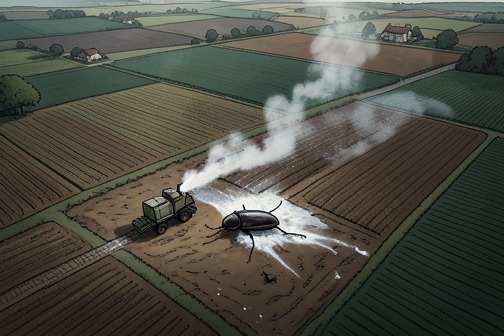
The Sheldon-area [Japanese beetle](entity:creature-recall-creature-japanese-beetle-a8267e847eee) eradication campaign was an expanding chemical-control program whose stated aim—to destroy an invading beetle population—was not achieved, while its ecological costs spread across wildlife, farm animals, and the surrounding community. Beginning with aerial dieldrin treatments in 1954, the operation grew to cover about 131,000 acres by the end of 1961; its insecticide changed to the more toxic aldrin, yet the beetle was only temporarily suppressed and continued moving west.
## Origins and Expansion
In 1954, the [United States Department of Agriculture](entity:organization-recall-organization-united-states-de-54f6aeafe860) and the [Illinois Department of Agriculture](entity:organization-recall-organization-illinois-departm-d312a6ed54eb) began treating Sheldon, in eastern [Illinois](entity:location-recall-location-illinois-25abcbf64a4d), and nearby parts of [Iroquois County](entity:location-recall-location-iroquois-county-e276c780b961) as a line of defense against the Japanese beetle’s advance into Illinois. Officials held out the hope—and, the account says, the assurance—that intensive spraying would destroy the invading populations. That promise framed the campaign as eradication rather than limited suppression, setting a demanding objective against which its repeated applications would ultimately be judged.
The first treatment that year covered 1,400 acres, where dieldrin was applied by air. A further 2,600 acres received aerial treatment in 1955, and the task was presumably considered complete. Instead, more chemical treatments were called for. By the end of 1961, the treated area had reached about 131,000 acres. The widening footprint marked a reversal in the program’s apparent trajectory: what began as a bounded effort, apparently finished after two seasons, became a succession of treatments over a much larger landscape.
## Exposure and Wildlife Loss
The ecological danger arose not only from the chemicals selected but also from what their application set in motion. During the early Sheldon treatments, dieldrin was applied at three pounds per acre. Insects killed or dying after the spray remained available to insect-eating birds; dead and dying insects of several kinds were conspicuous for about two weeks. Dead earthworms were also seen in numbers after gentle rain, and the account suggests that robins probably fed on poisoned worms. Puddles left by rain became another exposure route: birds seen drinking or bathing in them days after spraying were described as doomed.
The reported bird losses were severe. Brown thrashers, starlings, meadowlarks, grackles, and pheasants were virtually wiped out; biologists described robins as almost annihilated. Some birds survived, but the evidence raised concern that they had been rendered sterile: nests were found in the treated area, including nests with eggs, yet none contained young birds. Thus the account distinguishes immediate losses from a possible reproductive consequence among survivors, while presenting both as results of the campaign’s exposure conditions.
Mammals and domestic animals were also affected. Ground squirrels were virtually annihilated, and dead muskrats and rabbits were found in treated areas. Fox squirrels, formerly relatively common in town, disappeared after spraying began. Farm cats suffered especially heavy losses: an estimated 90 percent fell victim to dieldrin during the first season. The campaign’s effects therefore reached beyond the targeted beetle and beyond wild birds, encompassing animals that lived in fields, waterways, and homes.
## Monitoring and the Cost of the Program
Heavy losses among wildlife and domestic animals were apparent even in the program’s early years, but chemical treatments continued without consultation with either the [United States Fish and Wildlife Service](entity:organization-recall-organization-united-states-fi-4dad7e97ccd2) or the Illinois Game Management Division. The mismatch between intervention and investigation persisted in the research budget. Biological field studies received only about $6,000 during the program’s eight years, while the federal government spent about $375,000 on control work, in addition to thousands more from other sources. The account cautions that the losses measured by Illinois biologists were minimum figures: inadequate funding limited the coverage of the studies, so the documented destruction did not represent a complete accounting.
When biologists resumed studies that had been interrupted in 1955, the picture of wildlife loss had changed little. By then the chemical had been changed from dieldrin to aldrin, which was reported as 100 to 300 times as toxic as [DDT](entity:object-recall-object-ddt-1c2031137c06) in tests on quail. By 1960, every species of wild mammal known to inhabit the area had suffered losses. Bird numbers had also fallen, and the number of young in a brood declined; pheasant hunting, once good in the area, was virtually abandoned because it had become unrewarding. The resumed observations connected the early reports of acute mortality to a continuing and broader disruption of local wildlife.
## Outcomes and Historical Significance
After more than 100,000 acres in Iroquois County had been treated over eight years, the campaign appears to have achieved only temporary suppression. The Japanese beetle continued its westward movement, leaving the original promise of eradication unfulfilled. The contrast is central to the episode: the treated area expanded dramatically and wildlife losses accumulated, but the target insect was not permanently removed.
The account places the campaign within the beetle’s longer history in the [United States](entity:location-recall-location-united-states-2f533bc8d0b9). During the first dozen years after its arrival, the insect increased rapidly, free from the restraints that kept it in check in its native land. By 1945, however, it had become a pest of only minor importance across much of the territory it had reached. Its decline was attributed largely to the importation of parasitic insects from the Far East and the establishment of disease organisms fatal to it. Against that history, Sheldon’s chemical eradication effort stands not simply as a failed local operation but as an example of an intensive intervention that inflicted broad ecological damage while offering only temporary control, despite the availability of biological forces that had already helped limit the beetle elsewhere.
Event 12
美国东部日本甲虫乳孢病防治计划
The eastern [United States](entity:location-recall-location-united-states-2f533bc8d0b9) [Japanese beetle](entity:creature-recall-creature-japanese-beetle-a8267e847eee) milky-disease control program sought to restrain a widespread agricultural pest by accelerating the spread of a disease specific to beetles in the scarab family. From its discovery in [New Jersey](entity:location-recall-location-new-jersey-25586b9a9d1c) through a cooperative treatment campaign across 14 eastern states, the program relied on an organism that could persist in soil and continue acting after organized distribution ended. Its lasting protection offered a pointed contrast to the book’s accounts of indiscriminate chemical campaigns: control could be built around a natural enemy with narrow effects rather than imposed through poisons with broad reach.
## Background and discovery
The Japanese beetle had spread widely after entering the United States, initially free of the restraints found in its native range. By 1945, however, it had become a pest of only minor importance over much of the territory it had colonized. The book attributes that decline largely to imported parasitic insects and established disease organisms fatal to the beetle, placing the milky-disease campaign within a broader effort to find and strengthen natural controls.
Between 1920 and 1933, researchers searched the beetle’s native range and imported 34 species of predatory or parasitic insects in an effort to establish such control. Five became well established in the eastern states. A wasp was credited with an important role in reducing beetle numbers, but the book identifies a bacterial disease as having an even more important effect. Unlike a broad poison, this organism attacked no other type of insect and was described as harmless to earthworms, warm-blooded animals, and plants.
Milky disease was discovered in New Jersey in 1933. By 1938 it was already rather widely prevalent in older areas of Japanese beetle infestation. The program that followed did not introduce an entirely unfamiliar disease into those regions so much as deliberately hasten the spread of an organism already present and spreading among beetles.
## Preparation and distribution
No method had been developed for growing the disease organism in an artificial medium. Instead, a workable preparation was made from infected grubs: they were ground up, dried, and mixed with chalk. In the standard mixture, each gram of dust contained 100 million spores. This practical substitute made large-scale distribution possible without laboratory cultivation of the organism.
A control program designed to accelerate the disease’s spread began in 1939. Between 1939 and 1953, the cooperative federal-state effort treated about 94,000 acres in 14 eastern states. Federal lands were treated as well, and private organizations and individuals covered an additional, extensive but unquantified area. The campaign thus extended beyond a single government operation, involving public agencies and local private participation in the same biological-control effort.
By 1945, milky-spore disease was widespread among beetle populations in Connecticut, New York, New Jersey, Delaware, and Maryland. In some test areas, infection among grubs reached 94 percent. That figure records an especially high local result, while the broader account emphasizes the disease’s spread across established infestation zones rather than claiming uniform infection or eradication throughout the region.
## Persistence and outcome
The government distribution program ended in 1953, when production was taken over by a private laboratory. The laboratory continued to supply the preparation to individuals, garden clubs, citizens’ associations, and others interested in beetle control. The change in administration did not mean that the biological effort itself had simply vanished: private supply remained available even after the public program ceased as a government enterprise.
In the eastern areas where the program had been carried out, the beetle’s natural enemies now provided a high degree of protection. The disease organism remained viable in the soil for years, becoming, in the book’s account, effectively established for the long term. It could increase in effectiveness and spread continuously through natural agencies, so that the work of control did not depend solely on repeated, centrally organized applications.
The account presents this persistence as the program’s defining advantage. The treatment did not merely deliver a short-lived toxic effect; it helped establish a specific disease in the beetle’s environment, where it could continue to exert pressure. The contrast is especially significant in a book concerned with the extensive reach and collateral damage of chemical spraying: the milky-disease example shows how targeting a pest’s biological vulnerability could produce durable protection while sparing unrelated organisms named in the account.
Event 13
East Lansing robin die-off
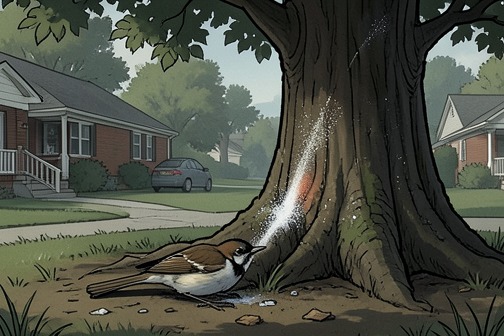
The [East Lansing robin die-off](entity:event-recall-event-east-lansing-robin-die-35e9d8aa1458) was a mass poisoning and reproductive failure associated with insecticide spraying for [Dutch elm disease](entity:state-recall-state-dutch-elm-disease-8807d55037da). Beginning with campus spraying in 1954 and expanding as the city of [East Lansing](entity:location-recall-location-east-lansing-778bd4952bc9) joined the effort, the program turned a familiar spring habitat into a place where returning robins died, failed to nest successfully, or produced eggs that did not hatch. The episode showed how a chemical applied to trees could reach birds indirectly through earthworms, and how the damage extended beyond immediate deaths to the future of the local population.
## Spraying and the return of the robins
Dutch elm disease spraying began on the [Michigan State University campus](entity:location-recall-location-michigan-state-unive-11124fbeed88) on a small scale in 1954. The following year, East Lansing joined the campaign, campus spraying expanded, and local programs against other pests added to the insecticide use in the area. The expanding treatment was intended to address tree disease and insect problems, not to harm birds; at first, no one suspected that the robins would be endangered.
When the robins returned to the campus in spring, they entered familiar territories. The change from an ordinary seasonal return to a pattern of loss was gradual but unmistakable: dead and dying birds appeared, few were observed feeding or gathering at their usual roosts, and few nests or young were seen. As one wave of migrants arrived after another, the losses recurred. The campus became, in the account of Dr. Wallace, a graveyard for many robins attempting to settle there.
## Poison moving through the food chain
The evidence pointed away from direct contact with the sprays as the main route of poisoning and toward the robins’ food. In a research project, campus earthworms had been fed to crayfish, all of which died; a caged snake developed severe tremors after eating worms from the same setting. Earthworms were also the robins’ principal spring food, making them a plausible link between treated surroundings and the birds’ deaths.
Research by [Roy Barker](entity:character-recall-character-roy-barker-e8166d42010b) of the [Illinois Natural History Survey](entity:organization-recall-organization-illinois-natural-79714ee7e29e), published in 1958, helped explain that link. Earthworms could take up persistent poison from contaminated material and retain it in their bodies; surviving worms thereby concentrated the chemical and carried it onward. When robins returned to feed, the food chain completed the transfer: as few as eleven large earthworms could deliver a lethal dose of [DDT](entity:object-recall-object-ddt-1c2031137c06) to a robin. The number was small relative to a bird’s feeding rate, since a robin could eat ten to twelve earthworms in as many minutes. The event thus exposed a danger that assurances about spray safety to birds had obscured: chemicals did not have to strike a bird directly to reach it.
## Deaths and reproductive failure
The losses were not limited to robins that received a lethal dose. The population’s ability to replace itself also faltered. In 1957, when at least 370 young birds would normally have been foraging over the campus as replacements for the adult population, [John Mehner](entity:character-recall-character-john-mehner-1b4db3469672) found only one young robin. Dr. Wallace reported that he saw no fledgling anywhere on the main campus during the spring or summer of 1958, and knew of no one else who had seen one there.
Observations of nesting pointed to a further consequence. Some birds laid eggs and incubated them without hatching; one robin reportedly sat on its eggs for 21 days, although the normal incubation period was 13. Chemical analyses presented to a congressional committee in 1960 found high DDT concentrations in the reproductive organs of breeding birds. Ten males had between 30 and 109 parts per million in their testes, while two females had 151 and 211 parts per million in their ovarian egg follicles. Together, the missing young, failed hatching, and measured residues showed that the effect reached reproduction as well as survival.
## A local event with wider implications
The episode unfolded in the setting of the rapid postwar expansion of persistent pesticides. [Rachel Carson](entity:character-recall-character-rachel-carson-13c8f018d01f) undertook the book that became [Silent Spring](entity:expression-recall-expression-silent-spring-e220320f14d1) in 1958 after she and scientific colleagues had grown alarmed by the widespread use of DDT and other long-lasting poisons in agricultural control programs. The East Lansing evidence gave that concern a concrete local form: spraying undertaken for one purpose produced consequences for birds through a pathway involving contaminated earthworms, and the resulting harm could be measured in both deaths and the absence of a new generation.
The die-off also illustrates why a pesticide’s effects cannot be judged only at the point where it is applied. The robins’ exposure was bound up with the campus environment, their spring feeding, and the persistence of poison in organisms they ate. What began as a disease-control operation therefore became an account of ecological interdependence: a treatment aimed at trees could alter the conditions of life for birds, with consequences continuing after the spray itself had been applied.
Event 14
1957年长岛舞毒蛾喷药事件

The [1957 Long Island gypsy moth spraying](entity:action-recall-action-1957-e66d02fc3925) was a government campaign that showered [DDT](entity:object-recall-object-ddt-1c2031137c06) in fuel oil over densely settled communities and coastal habitat, turning a pest-control operation into a public confrontation over who bore the risks of chemical control. Its aftermath included dead animals, damaged gardens and cars, and a legal challenge that reached the Supreme Court but could not prevent an application already completed. The case made the expanding power of mass spraying—and the difficulty of contesting it in time—visible to a wider public.
## Background and scale
By the late [1950s](entity:time-recall-time-1950s-9d888ed1c4fe), aerial distribution of lethal chemicals over millions of acres had become a source of growing public misgiving. Two mass-spraying campaigns in that decade intensified the doubts; the [Long Island](entity:location-recall-location-long-island-f692f10da472) operation was one of them. In 1957, plans to spray three million acres prompted stronger opposition, but state and federal agriculture officials dismissed individual complaints as unimportant.
The Long Island area included in the campaign consisted chiefly of populated towns and suburbs, as well as coastal areas bordered by salt marsh. Nassau County was among the most densely settled counties in the country. Yet the planes hired by the [United States Department of Agriculture](entity:organization-recall-organization-united-states-de-54f6aeafe860) and the New York Department of Agriculture and Markets applied the prescribed DDT-in-fuel-oil without regard to those differences in settlement and land use. The spraying reached truck gardens, dairy farms, fish ponds, salt marshes, and small suburban lots alike.
## The spraying and its immediate effects
The operation brought the spray into the ordinary spaces of daily life. One housewife tried desperately to cover her garden before a roaring plane reached it; children at play and commuters waiting at railway stations were showered with insecticide. The aerial treatment did not distinguish between places targeted for pest control and the people, animals, and habitats surrounding them.
At Setauket, a fine quarter horse drank from a trough in a sprayed field and died ten hours later. The oily mixture spotted automobiles and ruined flowers and shrubs. Birds, fish, crabs, and useful insects were also killed. These effects gave the campaign a reach beyond its stated target: the same spray fell on farms, gardens, waterside habitat, and built-up neighborhoods, while the documented losses included domestic animals and wildlife as well as damage to property.
## The legal challenge
A group of Long Island citizens led by the ornithologist [Robert Cushman Murphy](entity:character-recall-character-robert-cushman-murp-03ecf71ad765) sought a court injunction to stop the 1957 spraying. They were denied a preliminary injunction and consequently had to endure the application. Rather than abandon the effort, the protesters continued seeking a permanent injunction after the spraying had taken place.
The courts held that the petition was moot because the act it sought to prevent had already been performed. The case went all the way to the Supreme Court, which declined to hear it. Justice [William O. Douglas](entity:character-recall-character-o-00cb0c7da98e) strongly dissented from that decision, pointing to the alarms raised by experts and responsible officials about DDT’s dangers and arguing for the public importance of the case. The procedural outcome exposed a central difficulty of challenging a spraying campaign: once the chemical application was complete, the courts could treat the request to prevent it as too late.
## Public consequences and significance
Although the suit did not stop the 1957 application, it helped focus public attention on the growing trend toward mass insecticide use and on control agencies’ power and willingness to disregard private property rights. The campaign’s consequences were therefore both material and political: the spray killed animals and useful organisms and damaged property, while the unsuccessful attempt to halt it sharpened questions about public participation and legal recourse.
The episode also exemplified the mismatch between an indiscriminate method and a populated, ecologically varied landscape. Spraying did not remain confined to the pest-control task: it crossed into gardens, dairy farms, fish ponds, salt marshes, and residential lots, with human activity and wildlife alike exposed to the same treatment. In [Rachel Carson](entity:character-recall-character-rachel-carson-13c8f018d01f)’s account, Long Island became evidence of how a campaign framed as insect control could distribute its costs across a community—and how difficult it was for citizens to secure protection before those costs had been imposed.
Event 15
美国舞毒蛾根除喷药行动(1956—1961年)

The U.S. gypsy moth eradication campaign (1956–1961) turned a pest that had been largely contained into the target of a sweeping chemical offensive. The federal effort promised complete eradication, but it replaced a combination of natural controls, quarantine, and local spraying with blanket treatment of millions of acres a year. The moth survived; wildlife and public confidence suffered; and the campaign’s retreat left its original promise unfulfilled.
## A Contained Pest Becomes an Eradication Target
The gypsy moth had arrived on the continent nearly a century earlier and spread through parts of the Northeast. Its westward advance had been checked in part by the [Adirondack Mountains](entity:location-recall-location-adirondack-mountains-e614e2cb7f9a), whose forests contained tree species unattractive to it. The long-standing fear that it would invade the great hardwood forests farther south had not come to pass. By the account presented in the book, the task of confining the moth to the northeastern corner of the country had been accomplished through several methods, rather than a single all-out campaign.
[Biological control](entity:concept-recall-concept-1c5623e84692) was among them. Insects imported from abroad, together with disease organisms fatal to the moth, helped reduce the frequency and destructiveness of outbreaks. The [United States Department of Agriculture](entity:organization-recall-organization-united-states-de-54f6aeafe860) credited these introductions with appreciably reducing damage. Alongside quarantine measures and local spraying, natural control had produced what the Department described in 1955 as “outstanding restriction of distribution and damage”. The phrase recorded a substantial degree of success, not the moth’s extinction.
Only a year later, however, the Department’s Plant Pest Control Division proposed blanket spraying across several million acres each year, with the announced goal of eventually eradicating the species. Eradication meant complete and final extinction throughout its range. The ambition thus went beyond containing outbreaks or limiting damage, even though those more limited aims had already been substantially achieved.
## Expansion and Public Opposition
The chemical campaign began on a large scale in 1956, when nearly a million acres in Pennsylvania, [New Jersey](entity:location-recall-location-new-jersey-25586b9a9d1c), Michigan, and New York were sprayed. People in treated areas made many complaints about damage, while conservationists grew increasingly alarmed as plans for spraying huge areas took shape. When officials announced a target of three million acres for 1957, opposition strengthened. State and federal agriculture officials, the book reports, characteristically dismissed individual complaints as unimportant.
The campaign belonged to a broader moment of expanding aerial pesticide use. By the late [1950s](entity:time-recall-time-1950s-9d888ed1c4fe), doubts were growing about the distribution of lethal chemicals over millions of acres, and the moth operation became one of two mass-spraying campaigns that intensified public misgivings. Its scale made the promised benefit and the risks difficult to separate: treatment was imposed across broad landscapes, while complaints from those who experienced damage were treated as marginal rather than as a reason to reconsider the program.
## The 1957 Turning Point and Retreat
After the disastrous 1957 spraying, the program was abruptly and drastically curtailed. Officials offered vague explanations about evaluating earlier work and testing alternative insecticides. The area treated fell from three and a half million acres in 1957 to half a million in 1958, then to about 100,000 acres in each of 1959, 1960, and 1961. This was not a gradual adjustment within an expanding eradication drive: it was a sharp contraction following the damage and controversy of the largest spraying year.
The retreat also exposed a gap between the public promise and the results. The expensive operation had cost the Department public confidence and goodwill, yet it had not eliminated the insect. During the reduced-spraying years, the gypsy moth reappeared in numbers on [Long Island](entity:location-recall-location-long-island-f692f10da472). The campaign that had been intended to wipe it out for ever had, in the book’s blunt assessment, accomplished nothing at all toward that aim.
## Consequences and Significance
The campaign’s aftermath was not simply that officials sprayed less. Damage to wildlife and public complaints had helped make the risks of blanket chemical treatment visible, while the moth’s return undercut the justification for calling the effort an eradication. The course of events set a prior record of successful restriction through several means against the promise of total chemical elimination: natural enemies and quarantine had helped contain the pest, but the much larger spraying drive neither secured extinction nor preserved public trust.
The episode therefore stands as a case in which the scope of an intervention outran the evidence of need and the demonstrable outcome. The Department had acknowledged meaningful limits on the moth’s distribution and damage, then shifted to a plan demanding millions of acres of treatment. Its subsequent retreat, followed by the moth’s return on Long Island, made the contradiction plain: immense effort and broad exposure did not amount to control, still less eradication. In the book’s larger account of pesticide campaigns, the failed promise of a final solution is inseparable from the costs borne by wildlife and the public confidence spent in trying to achieve it.
Event 16
美国火蚁根除计划

The [U.S. fire ant eradication program](entity:action-recall-action-298bb5191d67) became a sweeping test of whether a pest could be eliminated by treating vast areas with powerful pesticides. Announced in 1957 and launched the following year, it promised a federal-state campaign across 20 million acres in nine southern states. The results described in *[Silent Spring](entity:expression-recall-expression-silent-spring-e220320f14d1)* were the reverse of that promise: extensive damage to wildlife and other animals, chemical residues persisting beyond the treatment period, and more infested acreage in [Louisiana](entity:location-recall-location-louisiana-2de999a335e6) than when the campaign began.
## From pest to national emergency
Before the campaign, the evidence presented by [Rachel Carson](entity:character-recall-character-rachel-carson-13c8f018d01f) indicates, there had been little official or private concern that fire ants threatened crops or livestock. That changed with the arrival of chemicals capable of killing broadly. In 1957, the [United States Department of Agriculture](entity:organization-recall-organization-united-states-de-54f6aeafe860) mounted a major publicity campaign: government releases, motion pictures, and government-inspired stories portrayed the ants as a danger to southern agriculture, birds, livestock, and people. The proposed response was enormous in scale, with the federal government and affected states planning treatment of 20 million acres in nine southern states.
The campaign’s public framing mattered because it helped turn a pest into an emergency warranting a vast intervention. Congressional support was initially secured through claims about the ants’ threats to crops and wildlife, including attacks on young ground-nesting birds; Carson reports that these representations were later discredited. A trade journal welcomed the program in 1958 as a sales opportunity for pesticide makers. Against that commercial enthusiasm, Carson presents the plan as an expensive and damaging experiment that also eroded confidence in the Agriculture Department.
## Launch without adequate preparation
Conservation departments, national conservation organizations, ecologists, and some entomologists protested the proposed treatments. They urged Agriculture Secretary Ezra Benson to delay the campaign until research could establish the effects of heptachlor and dieldrin on wild and domestic animals and determine the least amount needed to control the ants. The protests were ignored. The program began in 1958, and one million acres were treated in its first year; as Carson stresses, research undertaken afterward could only document consequences after exposure had already occurred.
The scale of the chemical hazard was not incidental to those objections. In terms of effects on birds, Carson compares the prescribed heptachlor use to 20 pounds of [DDT](entity:object-recall-object-ddt-1c2031137c06) per acre and the prescribed dieldrin use to 120 pounds per acre. Yet the campaign proceeded before the requested assessment of effects and minimum effective quantities. The sequence—large-scale treatment first, accumulating biological evidence afterward—is central to the episode’s significance in her account.
## Wildlife losses and persistent exposure
Studies by biologists from state and federal wildlife agencies and several universities recorded losses ranging up to the complete destruction of wildlife on some treated areas. Poultry, livestock, and pets were also killed. The Agriculture Department, Carson writes, brushed aside evidence of damage even when chemical analysis of animal tissues demonstrated exposure. The house sparrow was the only bird reported to survive in numbers, and Carson notes that it had shown signs of relative immunity in other places as well.
A 1959 treatment tract in [Alabama](entity:location-recall-location-alabama-2bbbae281095) gives the losses a specific local measure: half its birds were killed. Ground-dwelling species and those frequenting low vegetation suffered 100 percent mortality there. The impact did not end with the initial application; a spring songbird die-off followed a year after treatment, while much good nesting territory remained empty. Residues were also detected in birds collected in the area: 90 percent contained dieldrin or a form of heptachlor, at levels reaching 38 parts per million.
The contamination extended beyond the treated fields and across seasons. Woodcocks wintering in Louisiana and breeding farther north carried residues of the fire-ant pesticides. Carson identifies their feeding on earthworms as a route of exposure: the birds probed for worms with their long bills, linking chemical treatment of the landscape to contamination carried by a migratory species beyond the immediate application site. In this account, the campaign’s reach is measured not only in acres sprayed but in the movement of residues through wildlife and habitat.
## Failure and retreat from eradication
Research did not precede the campaign as the protesters had requested. Carson reports that, after the program began, officials looked back to already published research on heptachlor, while further studies and field observations accumulated amid the damage. Meanwhile, the chemical assault was also followed by an upsurge of insects destructive to sugarcane. The program was thus failing on more than one front: it damaged wildlife, contributed to a new agricultural problem, and did not achieve its stated eradication objective.
In spring 1962, Louisiana State University Agricultural Experiment Station entomology research director L. D. Newsom summarized the record by calling the imported fire ant eradication program a failure: Louisiana had more infested acres than at its start. [Florida](entity:location-recall-location-florida-1618e1042117) likewise reported more fire ants than before the campaign and abandoned the idea of broad eradication, choosing instead to concentrate on more limited control. The shift toward more conservative methods closed the episode without the promised victory. The program’s lasting force in Carson’s narrative lies in that contrast: an immense, publicly promoted intervention produced lasting collateral harm while leaving its target more widespread in at least one of the states at the center of the effort.
Event 17
DDT Spraying and Salmon Loss in the Northwest Miramichi River Basin (1954)
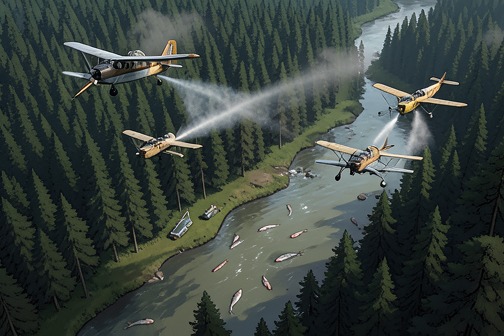
[DDT Spraying and Salmon Loss in the Northwest Miramichi River Basin (1954)](entity:event-recall-event-ddt-1954-df5445edb910) was a Canadian forest-protection campaign whose June aerial spraying killed the aquatic insects sustaining salmon and trout, followed by severe losses among young salmon. Because the [Fisheries Research Board of Canada](entity:organization-recall-organization-fisheries-resear-caa04b1037a2) had counted fish in the [Northwest Miramichi](entity:location-recall-location-northwest-miramichi-59170c9b3294) stream since 1950, the destruction could be measured against a detailed record of life before the planes arrived. The episode shows how an intervention aimed at protecting forests could carry its poison into waterways, unravel food supplies, and leave a lasting mark on a stream ecosystem.
## Causes and the Forest Campaign
The immediate setting was a surge in spruce budworm, a native insect that attacks several kinds of evergreens and becomes extraordinarily abundant in eastern [Canada](entity:location-recall-location-canada-a93ef5aae6af) at intervals of about thirty-five years. After populations rose in the early [1950s](entity:time-recall-time-1950s-9d888ed1c4fe), the Canadian Government began spraying [DDT](entity:object-recall-object-ddt-1c2031137c06) to protect balsams, a mainstay of the pulp and paper industry. Spraying began on a small scale, then accelerated sharply in 1953: millions of acres were treated instead of thousands. The Northwest Miramichi watershed was brought into this widening program the following year.
The planes’ objective was to suppress a forest pest, but their route crossed a watershed threaded with streams. In June 1954 they flew over the Northwest Miramichi forests, laying down a crisscross pattern of white mist. The spray contained one half pound of DDT per acre in an oil solution and filtered through the balsam forest. The account notes that the aircraft did not try to avoid streams or shut off their nozzles while passing over them. Even if they had, however, the spray could drift far in the lightest movement of air; the risk to water was not confined to the exact path of the planes.
## The Stream Before and After Spraying
Before the intervention, young salmon fed on a rich assortment of aquatic life. [Caddisfly](entity:creature-recall-creature-caddisfly-8424280b74b2) larvae and mayfly nymphs clung to rocks in the currents; blackfly larvae occupied stones beneath riffles and where water spilled over slanting rock. These insects were not incidental details of the landscape: they formed the food base on which salmon and trout depended. Once DDT killed them, the stream’s capacity to feed its fish was damaged along with the fish themselves.
Signs of disaster appeared soon after spraying ended. Dead and dying fish, including many young salmon, were found along the banks within two days. [Brook trout](entity:creature-recall-creature-brook-trout-48ee8cf825f1) were also among the dead, and birds were dying along roads and in the woods. The stream’s life was stilled: its insect food supply had been killed, leaving young fish without the prey they had relied on. The damage thus extended beyond visible fish mortality. It struck the connected community that made the stream a viable habitat.
By August, none of the young salmon that had emerged from gravel beds that spring remained. A whole season’s spawning had come to nothing. Older juveniles also suffered: of every six fish from the 1953 hatch that had foraged in the stream as the planes approached, only one survived. Among the 1952 hatch, whose members were nearing their migration to sea, a third were lost. The losses fell across successive year classes, removing both the newest fish and a substantial portion of those close to leaving the stream.
## Evidence and Long-Term Change
The scale of the loss was unusually well documented. The Fisheries Research Board of Canada had studied salmon in the Northwest Miramichi since 1950, making an annual census of the fish living in the stream. Its records established conditions before the spraying and made it possible to compare the aftermath with a measured baseline. The account emphasizes that this allowed damage to be assessed with an accuracy seldom matched elsewhere. The disaster was not inferred from a single dramatic sighting: earlier counts made it possible to trace how many fish remained in each cohort.
The survey also showed that the consequences were not limited to the immediate die-off. Repeated sprayings had completely altered the stream environment, killing the aquatic insects that salmon and trout ate. The intervention therefore left more than a short-lived pulse of poison or a temporary reduction in fish numbers: it changed the conditions on which stream life depended. In the book’s account, the sudden spectacle of dead fish sits within a longer process of ecological alteration, one whose full effects could be recognized because observations had begun years before the spraying.
## Significance in the Book
The Northwest Miramichi episode makes the distance between a program’s declared target and its actual reach concrete. DDT was applied against spruce budworm in forests, yet it also entered streams and killed the insects that fed fish. The sequence links administrative purpose to ecological consequence without treating the watershed as a boundary that chemicals would respect: airborne drift, contaminated water, lost prey, and declining salmon were parts of the same event. The contrast is especially stark because the campaign sought to preserve economically important balsams while disrupting the aquatic life of the same landscape.
The case also demonstrates the importance of sustained observation. Without the Fisheries Research Board’s annual censuses beginning in 1950, the disappearance of the spring’s salmon or the sharply reduced survival of earlier hatchings would have been harder to quantify against ordinary variation. Here, records turn loss into evidence: they show not only that fish died, but which cohorts were affected and how extensively. The episode stands as one of the book’s accounts of the broad ecological costs of long-lasting pesticides, and of the way harm can travel from the intended target through the relationships that sustain other life.
Event 18
Yellowstone River Fish Kill (1955)
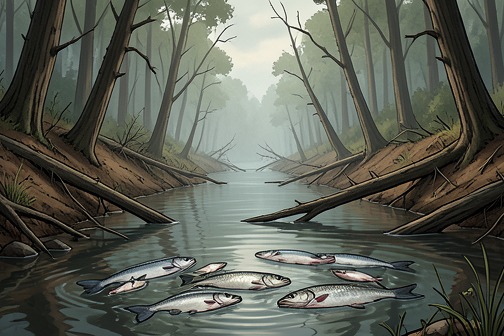
The [Yellowstone River Fish Kill (1955)](entity:event-recall-event-1955-58f7181a32a7) exposed the consequences of treating forest insect control as a limited, local operation: spraying in and near [Yellowstone National Park](entity:location-recall-location-yellowstone-national-ef3bfe358630) was followed by dead fish along about 90 miles of river, the disappearance of trout’s aquatic food, and lasting damage to stream life. The episode turned an assumption of safety—one pound of [DDT](entity:object-recall-object-ddt-1c2031137c06) per acre—against visible evidence of ecological disruption, and prompted a cooperative investigation that traced contamination through fish and their food supply.
## The forest and the river
The episode belongs to a broader account of how modern insect-control methods threatened fish in streams sheltered by forests. In autumn 1955, dead fish found along the [Yellowstone River](entity:location-recall-location-yellowstone-river-08544e4c3967) alarmed sportsmen and [Montana](entity:location-recall-location-montana-a4c636ab2f04) fish-and-game administrators. The scale was not confined to a single bank or reach: about 90 miles of river were affected. On one 300-yard stretch of shoreline, observers counted 600 dead fish, including brown trout, whitefish, and suckers.
The account places the fish kill within an ecological chain rather than presenting it as an isolated casualty. Stream insects were the natural food of trout, and those insects had disappeared. The river’s damage therefore included both the fish already dead and the loss of the organisms on which their continued survival depended. What appeared to be a forest treatment had consequences downstream in the aquatic system.
## The safety claim and the investigation
Forest Service officials said they had acted on advice that an application of one pound of DDT per acre was safe. The fish kill made that assurance difficult to reconcile with what had happened in the river. In 1956, the [Montana Fish and Game Department](entity:organization-recall-organization-montana-fish-and-0fb3c6e35d01) joined two federal agencies, the Fish and Wildlife Service and the Forest Service, in a cooperative study of the effects of spraying.
The investigation had ample treated ground to examine. Montana spraying covered 900,000 acres in 1956 and another 800,000 acres in 1957. Across study areas, the researchers encountered a recurring pattern: the smell of DDT over the forest, an oil film on the water, and dead trout along the shoreline. The sequence connected the application in the forest to contamination in the stream and mortality at its edge.
## Contamination and delayed losses
Chemical analysis showed DDT stored in the tissues of every fish examined, whether it had been collected alive or dead. The finding extended the concern beyond the visible fish kill: survival at the moment of collection did not mean a fish had escaped exposure. The river’s inhabitants carried evidence of the chemical in their bodies, while the condition of the water and shoreline registered the broader disturbance.
A second major effect was the severe reduction of stream-bottom fauna, including aquatic insects. In many study areas, these organisms fell to one-tenth of their normal populations. Their destruction mattered not only as an immediate loss of biodiversity but as a prolonged shortage of food for trout. The insect populations recovered slowly; even at the end of the second summer after spraying, only meager quantities had returned. One stream, formerly rich in bottom fauna, still yielded scarcely any.
In that stream, game fish had declined by 80 percent. The figure gives a measure of the lasting consequence where the food base had been particularly damaged. Fish did not necessarily die at once, and delayed mortality could exceed the immediate kill. The study thus complicates any assessment based only on bodies found soon after spraying: a dramatic count along the bank captured only part of the harm, while weakened food populations and later fish deaths extended it through time.
## Significance
The Yellowstone case shows why a pesticide’s effect cannot be judged solely by the acreage treated or by the dose described as safe. DDT applied over forest land entered a river system where fish, aquatic insects, and stream-bottom communities were interdependent. The loss of insects reached trout through their food supply; the chemical was present in the tissues of living as well as dead fish; and in one stream the fish population remained sharply diminished after the spray.
The narrative’s movement from an official safety assurance to repeated field observations and measured biological losses makes the river itself a test of the claim. The fish kill was both an acute visible event and the beginning of a slower aftermath: depleted food organisms took years—or, in the reported observations, at least more than two summers—to recover, while delayed mortality could escape immediate notice. The case makes the wider argument concrete: insect-control programs could injure the connected ecosystems they were meant to manage, and their effects could continue after the spraying and the first deaths were over.
Event 19
Mass Salmon Deaths Following Budworm Control in British Columbia (1957)
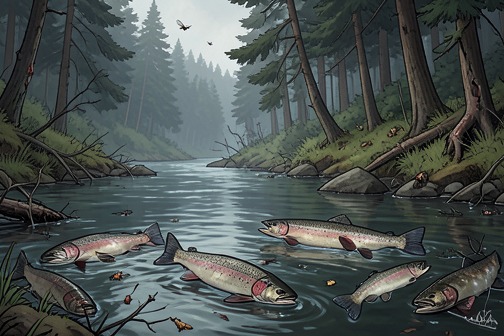
The 1957 [British Columbia](entity:location-recall-location-british-columbia-77757a75fac9) budworm-control campaign became a stark example of the limits of trying to make pesticide spraying safe by modifying its operation: despite consultation with wildlife officials and precautions intended to protect salmon, almost all the salmon in at least four major streams were killed. In one river, the loss nearly annihilated the young of a run of 40,000 adult [Coho salmon](entity:creature-recall-creature-coho-salmon-f2576411673d), threatening a commercially important population that could not simply be replenished from neighboring streams. The episode turns a proposed compromise between forestry and fisheries into a warning about ecological consequences that persist long after the spraying ends.
## Causes and Competing Priorities
A black-headed budworm outbreak had been raging for several years. Forestry officials feared that another season of defoliation could cause severe tree losses, and in 1957 they decided to undertake control operations. The campaign was therefore framed as a response to a sustained forest threat, with the anticipated damage to trees driving the decision to act.
The salmon runs were not overlooked. Forestry officials consulted the Game Department, whose officers were concerned about the fish, and the Forest Biology Division agreed to alter the spraying program in every possible way short of undermining its effectiveness. The planned precautions represented a deliberate effort to accommodate fish protection within a campaign whose principal purpose remained budworm control. The outcome makes that qualification consequential: mitigation was pursued, but the operation continued, and the fish were still exposed to devastating harm.
## The [Salmon](entity:creature-recall-creature-salmon-7201c38bcc81) Losses
Despite the precautions—and despite what the account describes as an apparently sincere effort to reduce the risks—almost 100 percent of the salmon were killed in at least four major streams. The deaths were not limited to a small or incidental part of the runs; the scale of loss across multiple waterways showed that consultation and program modification had failed to prevent catastrophic damage.
In one river, the young of a run numbering 40,000 adult Coho salmon were almost completely annihilated. The same event destroyed the young stages of several thousand steelhead trout and other trout. The losses thus reached beyond one salmon population, affecting multiple kinds of fish at vulnerable early stages and turning the streams into the site of a broad aquatic disaster.
## Why Recovery Would Take Years
The damage was magnified by the Coho salmon's life history. Its three-year life cycle meant that the run was composed almost entirely of fish belonging to a single age group. The destroyed young therefore represented not a readily replaceable fraction of a mixed-age population, but nearly the whole future generation of that run.
Coho salmon also have a strong homing instinct: they return to their natal stream. The account stresses that other streams would not naturally repopulate the affected river. As a result, the loss could not be repaired simply by salmon arriving from elsewhere. Every third year, the river's run would be almost nonexistent until careful management—through artificial propagation or other means—could rebuild the commercially important population. A single season's control operation thus threatened a recurring absence, measured in the salmon's own generational cycle.
## The Book's Argument About Control
The episode appears in a broader account of the mounting destruction associated with chemical control programs. The book contrasts the intention to reduce forest damage with what actually happened in the streams: precautions were taken, yet the salmon losses approached totality in several major waterways. In that contrast, the effort to minimize adverse effects cannot be treated as proof that the program was safe. The campaign's limited accommodation of fisheries, explicitly bounded by the requirement that spraying remain effective, left the basic conflict unresolved.
The account does not present the choice as forest protection or fish protection. It argues that there are ways to preserve forests and save fish, rejecting the notion that waterways must be accepted as rivers of death. That ending matters: the episode is not only a record of destruction but an argument against treating destruction as inevitable. Its central warning is that a control measure judged by its target alone can obscure the connected systems and future generations it puts at risk; its alternative is to seek methods that do not force one ecological interest to be sacrificed for another.
Event 20
Flint Creek Fish Kill (1950)
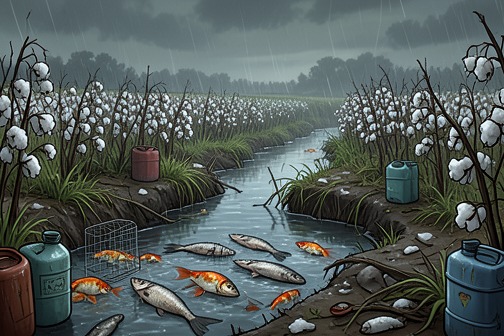
[Flint Creek Fish Kill (1950)](entity:event-recall-event-1950-bf535d024d6e) was a series of fish deaths in northern [Alabama](entity:location-recall-location-alabama-2bbbae281095) after heavy rain carried toxaphene from cotton fields into [Flint Creek](entity:location-recall-location-flint-creek-e0f6cf1a58d4). The disaster followed a rapid turn to insecticides against boll weevils and repeated applications through a rainy summer; each storm flushed more poison into the water. Carson presents the creek’s rising floodwater, circling fish, and dead goldfish in test cages as evidence that a pest-control program had become a watershed-wide hazard.
## Background and agricultural campaign
Before 1950, organic insecticides had been used only to a limited extent against the boll weevil in the region. A series of mild winters produced many weevils that year, and, urged by county agents, an estimated 80 to 95 percent of farmers turned to insecticides. [Toxaphene](entity:object-recall-object-b042416dc8b5), particularly destructive to fish, became the most popular choice. The scale of application was striking: the average cotton acre received 63 pounds, some received as much as 200 pounds, and one farmer applied more than a quarter of a ton per acre.
The campaign unfolded in a summer of frequent, heavy rain. Rather than interrupting treatment, rainfall washed chemicals into streams and was followed by further applications. That cycle linked decisions in cotton fields to conditions downstream: the chemical did not remain where it had been spread, and repeated storms renewed the contamination. Carson situates the creek’s poisoning within the wider postwar expansion of long-lasting pesticides, whose hazards had alarmed her and her scientific colleagues as she began work on [Silent Spring](entity:expression-recall-expression-silent-spring-e220320f14d1).
## The creek after the storm
Flint Creek ran for 50 miles through Alabama cotton country before emptying into [Wheeler Reservoir](entity:location-recall-location-wheeler-reservoir-a4ac5aeb6f6c). On August 1, torrents of rain descended on its watershed. Water poured off the land in trickles and rivulets, then in floods; the creek rose six inches. By the next morning, fish near the surface were swimming in aimless circles. Some flung themselves onto the bank, where they could be picked up easily.
One farmer carried several affected fish to a spring-fed pool. In the cleaner water, those fish recovered—a limited, telling contrast with the creek itself. There, dead fish floated downstream throughout the day. The first storm was only a prelude: each succeeding rain carried more insecticide into the water and killed more fish. The account makes the watershed, rather than the field boundary, the scale at which the consequences became visible.
## Repeated kills and evidence of poisoning
The rain of August 10 caused a fish kill so heavy that few fish remained to be caught in the next surge of poison, which followed on August 15. This sequence gives the episode its grim progression: the later contamination did not arrive in an untouched stream, but in one already depleted by the earlier runoff. The deaths were recurring consequences of continued chemical movement, not a single isolated mishap.
The presence of a deadly substance in the water was also tested directly. Goldfish placed in cages in the river were dead within a day. Their fate supplied a stark measure of the stream’s toxicity, while the recovery of a few fish moved to a spring-fed pool underscored the difference between the poisoned creek and cleaner water. The chapter’s concrete observations—storm dates, a six-inch rise, visible distress, repeated kills, and the caged fish—turn runoff from an abstract possibility into a sequence of observable effects.
## Significance
The fish kill reveals the weakness in treating insecticide application as a local act with local consequences. Toxaphene was applied to cotton in response to a severe boll-weevil season, but rain carried it from farmland into a stream that drained a broad agricultural landscape and flowed toward Wheeler Reservoir. Continued spraying as the chemicals washed away compounded the problem: the response to pests helped replenish the hazard to fish.
Carson’s account also records how the crisis was made legible. Fish swimming in circles, dead bodies drifting down the creek, survivors recovering in a spring-fed pool, and goldfish dying in river cages are distinct observations that connect field treatment to aquatic harm. Flint Creek is therefore not merely the setting for a mass death; it is the route by which a pesticide campaign’s costs moved beyond its target and entered the waters on which other forms of life depended.
Event 21
Austin Colorado River Fish Kill (1961)
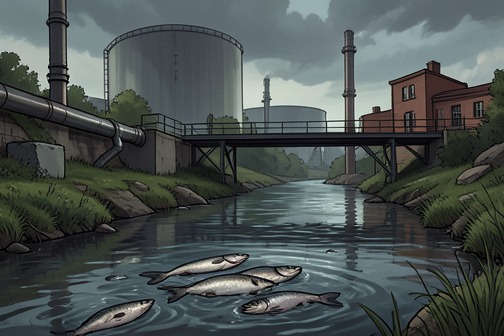
The [Austin Colorado River Fish Kill (1961)](entity:event-recall-event-1961-22584fcde71b) began in mid-January when a pulse of insecticide-contaminated water entered [Town Lake](entity:location-recall-location-town-lake-94476a3a6e10) and moved down the Colorado River. Investigators traced the contamination to insecticide residues that had accumulated in storm sewers and were released during a high-pressure flushing operation. The episode killed fish across a long stretch of river, exposed routine industrial disposal practices, and left state officials warning that the river’s fish population could be changed for years.
## The River and the First Signs
One of the most extensive fish kills described in the book occurred below [Austin](entity:location-recall-location-austin-208e01a2a58e) in 1961. Shortly after daylight on Sunday, January 15, dead fish appeared in the new Town Lake and in the river for roughly five miles below it; none had been observed the previous day. Reports of dead fish came from 50 miles downstream by Monday. The spreading reports showed that this was not a localized loss at the lake but a moving contamination event carried by the river.
By January 21, fish were dying 100 miles downstream. During the final week of January, authorities closed the locks on the Intracoastal Waterway to keep the toxic water out of [Matagorda Bay](entity:location-recall-location-matagorda-bay-69bbdd265194), diverting it toward the Gulf of Mexico instead. The response marked the scale of the threat: the contamination had traveled far enough that officials were acting to prevent it from entering another major water body.
## Tracing the Contamination
Investigators in Austin noticed an odor associated with chlordane and toxaphene, especially near the discharge from a storm sewer. Because that sewer had previously been linked to industrial waste problems, officers traced it upstream through the sewer system. Their investigation found benzene hexachloride at openings as far back as a feeder line from a chemical plant.
The plant produced [DDT](entity:object-recall-object-ddt-1c2031137c06), benzene hexachloride, chlordane, toxaphene, and smaller quantities of other insecticides. Its manager acknowledged that powdered insecticide had recently been washed into the storm sewer. More consequentially, he admitted that disposing of insecticide spillage and residues in this way had been common practice for ten years. Fishery officers found other plants where rainwater or ordinary cleanup water could also carry insecticides into sewers, indicating that the problem extended beyond one discharge point.
The final link was the timing of a system-wide sewer flush. A few days before the lake and river became lethal to fish, several million gallons of water had been forced through the storm-sewer network under high pressure to clear debris. Insecticides lodged among accumulated gravel, sand, and rubble were dislodged and carried into Town Lake, then downstream. Chemical tests later confirmed insecticides in the river. The disaster thus followed not a single accidental spill alone, but the release of residues that had built up through recurring disposal practices and were mobilized by a large-scale cleaning operation.
## Scale of the Fish Kill
The toxic mass continued to carry its effects downstream. For 140 miles below the lake, the fish kill was so extensive that later seining efforts brought up no fish. Observers recorded dead fish from 27 species, amounting to about 1,000 pounds for each mile of riverbank. The victims included channel catfish, the river’s chief game fish, as well as blue and flathead catfish, bullheads, four species of sunfish, shiners, dace, stone rollers, shad, and buffalo.
Some of the dead fish were exceptionally large and evidently old. Many flathead catfish weighed more than 25 pounds; local residents reportedly recovered some weighing 60 pounds. An 84-pound blue catfish was officially recorded. These fish made the loss more than a tally of individuals: their size testified to animals that had lived in the river for years, while their disappearance raised questions about the future of the river’s established fish community.
## Consequences and Significance
The state Game and Fish Commission predicted that even without further pollution, the river’s fish population would be altered for years. Some species living at the limits of their natural range might never re-establish themselves; others, officials said, could recover only through extensive state stocking. The book also notes that the toxic water retained its lethal power more than 200 miles downstream, and that it was considered too dangerous to admit to the receiving waters there.
The event connects an apparently routine act of waste disposal and sewer maintenance to damage across an entire river corridor. Industrial residues had accumulated out of sight; flushing the sewers transferred them into open water, and the river carried the consequences far beyond the original source. By tracing the fish deaths back through the drainage system, the account makes the scale of the disaster legible as a chain of practices, releases, and downstream effects rather than as an isolated episode of unexplained mortality.
Event 22
Mass Fish and Crustacean Deaths in St. Lucie County Salt Marshes (1955)
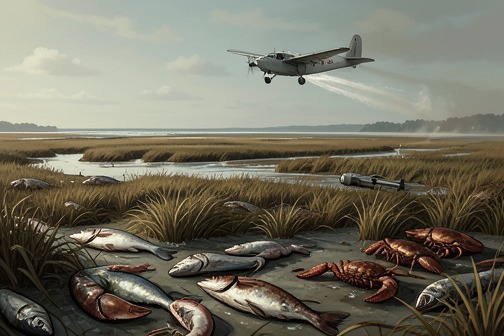
The 1955 [St. Lucie County](entity:location-recall-location-st-lucie-county-14b0a8adc3a4) salt-marsh poisoning was a pesticide kill on [Florida](entity:location-recall-location-florida-1618e1042117)’s eastern coast, where an effort to eliminate sandfly larvae with dieldrin devastated fish and crustacean life. Its measured scale—at least 20 to 30 tons of fish, representing about 1,175,000 individuals across at least 30 species—makes the episode one of [Rachel Carson](entity:character-recall-character-rachel-carson-13c8f018d01f)’s clearest accounts of the ecological cost of treating a connected wetland as though it were only an insect-control target.
## Setting and purpose
Coastal waters receive contaminated river discharges and are also sprayed directly in attempts to control mosquitoes and other insects. Against that wider background, the [Indian River](entity:location-recall-location-indian-river-4a5a26782ac5) country on Florida’s eastern coast offered a particularly graphic example of what pesticides could do to salt marshes, estuaries, and sheltered inlets.
In the spring of 1955, about 2,000 acres of salt marsh in St. Lucie County were treated with dieldrin to eliminate sandfly larvae. The application rate was one pound of active ingredient per acre. The stated target was insect larvae, but the marsh was not an isolated treatment surface: the operation exposed a broad aquatic habitat and the many forms of life within it.
## The immediate kill
Scientists from the Entomology Research Center of the State Board of Health surveyed the aftermath. They judged the fish kill “substantially complete.” Fish were found dead across the affected shores, and sharks appeared in the area, drawn by dying fish in the water. The losses were not confined to a single kind of fish: mullets, snook, mojarras, and gambusia were among those reported dead, and the account states that no species was spared.
The survey’s minimum estimate for the immediate fish kill across the marshes, excluding the Indian River shoreline, was 20 to 30 tons—or about 1,175,000 fish belonging to at least 30 species. The estimate is explicitly bounded: it counts the marshes but excludes the river shoreline. Even on that limited accounting, it conveys a regional disaster rather than a localized loss around a few treated patches.
## Different fates within the marsh
The effects varied among groups of aquatic life. Mollusks seemed unharmed by dieldrin, while crustaceans were virtually exterminated across the area. The aquatic crab population appeared to have been destroyed; fiddler crabs were almost entirely eliminated, surviving temporarily only in patches of marsh that the pellets apparently missed.
The sequence of deaths also exposed the connections among species. Larger game and food fish succumbed most rapidly. Crabs fed on and destroyed moribund fish, but were dead themselves the following day. Snails continued to feed on fish carcasses. The account thus records not only the first losses caused by spraying but a succession in which the surviving organisms encountered the poisoned aftermath in turn.
## Ecological significance
Carson places the St. Lucie County episode within a broader criticism of direct pesticide treatment in coastal waters. The contrast between the narrow purpose—killing sandfly larvae—and the breadth of the reported damage makes the case an illustration of nonselective effects: a chemical applied against one target could alter the life of an entire marsh community, with sharply different consequences for fish, crabs, and mollusks.
The episode also gives concrete form to the book’s concern about ecological interdependence. The marsh’s inhabitants did not experience the application as separate species facing separate risks: the rapid loss of fish, the near-disappearance of crabs, and the deaths of crabs after feeding on dying fish unfolded as related consequences of one treatment. In Carson’s account, the survey figures and the brief food-chain sequence together show why insect-control programs must be judged by what happens throughout the habitat, not solely by whether they reach their intended target.
Event 23
Mass Blackbird Poisoning in Indiana (1959)
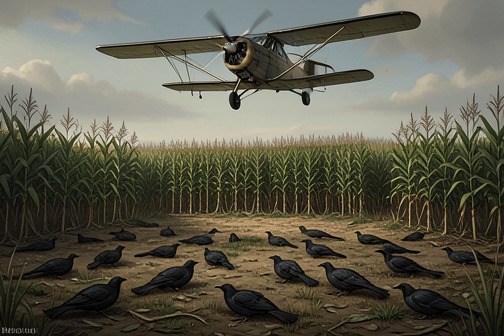
In the summer of 1959, a group of farmers in southern Indiana hired a spray plane to treat river bottomland with parathion, targeting a roost used by thousands of blackbirds feeding in nearby cornfields. The operation killed about 65,000 red-winged blackbirds and starlings; its wider, unrecorded toll and the danger left on the treated land make the episode, in [Rachel Carson](entity:character-recall-character-rachel-carson-13c8f018d01f)’s account, a pointed example of how a local agricultural problem could be turned into an indiscriminate public and ecological hazard.
## Background and Decision
The birds roosted in the bottomland and fed in adjacent cornfields. Carson notes that the conflict could have been addressed by changing agricultural practice: farmers could have planted a variety of corn with ears set too deep for the birds to reach. Instead, persuaded of the merits of killing by poison, the farmers chose chemical treatment and engaged an airplane to spray the area.
The episode belongs to a wider period of rapidly expanding pesticide use. Carson had undertaken the work that became *[Silent Spring](entity:expression-recall-expression-silent-spring-e220320f14d1)* in 1958 after she and scientific colleagues became alarmed by the widespread use of [DDT](entity:object-recall-object-ddt-1c2031137c06) and other persistent poisons in agricultural control programs. She describes the Indiana action within a growing record of spraying and wildlife destruction, not as an isolated accident but as one instance of decisions made in the name of control without accounting for their wider consequences.
## The Spraying and Its Toll
The material used was parathion, which Carson describes as a universal killer rather than a chemical specific to blackbirds. The recorded casualties included some 65,000 red-winged blackbirds and starlings. The number of other animals that died may never have been established: rabbits, raccoons, and opossums that lived in the bottomlands were exposed to the same poison even if they never entered the farmers’ cornfields.
That uncertainty is part of the event’s significance. The casualty figure records only the deaths that were counted; it does not measure the full impact of treating the habitat. The campaign’s reach followed the poison across the boundary between the perceived agricultural nuisance and the surrounding community of wildlife, affecting animals that were neither the target nor a party to the decision.
## Human Exposure and Public Risk
Carson connects the Indiana spraying to evidence of danger to people from the same pesticide. In [California](entity:location-recall-location-california-fd5bbc3f2eb4) orchards treated with parathion, workers handling foliage that had been sprayed a month earlier collapsed and went into shock; they survived only after receiving skilled medical attention. This account does not establish that Indiana residents were poisoned, but it underscores why residues on treated vegetation could not be treated as a risk confined to birds.
The river-bottomland operation also raised the prospect of people entering a poisoned area without knowing it. Carson asks who would guard the site or warn a child exploring the fields and river margins that the vegetation had been treated. Her questions draw attention to a practical failure of protection: the farmers could hire an aircraft and apply a dangerous chemical, but the account identifies no corresponding provision to keep uninformed visitors away from the treated land.
## Significance in Carson’s Account
The episode’s central contrast is between a readily available agricultural alternative and a choice to use poison. Planting corn with deep-set ears could have made the crop less accessible to the birds; instead, the treatment imposed lethal exposure across a shared landscape. Carson stresses that the wildlife casualties extended beyond the intended target and that the consequences for other animals were not fully known.
By placing the blackbird deaths beside the possible exposure of people and nontarget animals, Carson makes the campaign a question of who decides which lives and risks count. The farmers’ response treated the roost as a problem to eliminate, while leaving the larger burden to wildlife and anyone who might enter the treated ground. The account ends not with a documented local aftermath, but with the larger question of who is authorized to set such chains of poisoning in motion.
Event 24
英国拌种农药引发的鸟类死亡危机(1960—1961年)
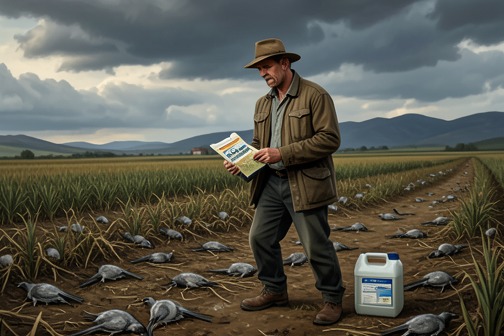
The 1960–1961 British bird-poisoning crisis was a nationwide wildlife emergency linked to insecticide-treated seed. A change in agricultural practice, followed by successive waves of reported deaths, brought the issue before Parliament and made visible the wider ecological reach of pesticides intended to control soil insects.
## From seed treatment to wildlife emergency
Treating seed before sowing was not new, but the chemicals used had changed. Earlier treatments had principally relied on fungicides, and the book notes that effects on birds had not been observed. Around 1956, the practice shifted to dual-purpose dressings: fungicide was combined with dieldrin, aldrin, or heptachlor to combat soil insects. The reports that followed marked a sharp change in the perceived consequences of seed treatment.
In spring 1960, British wildlife authorities received a flood of reports of dead birds. They included the [British Trust for Ornithology](entity:organization-recall-organization-british-trust-fo-4a8000e8905e) and the [Royal Society for the Protection of Birds](entity:organization-recall-organization-royal-society-fo-14ee6e1c8848), which later joined in documenting the incident. The crisis emerged not from a single aerial operation but from the distribution of treated seed across agricultural land, where chemicals intended to act against soil pests were associated with extensive harm to birds.
## Reports and recorded losses
A joint report by the British Trust for Ornithology and the Royal Society for the Protection of Birds recorded 67 bird kills in spring 1960, while warning that this was far from a complete accounting. Seed dressings were implicated in 59 of the recorded kills; toxic sprays accounted for the other eight. The figures identified treated seed as the principal reported source without suggesting that the documented cases captured the full extent of the destruction.
Reports intensified the following year. One account described 600 birds dying on a single estate in Norfolk, and another reported 100 pheasants dead on a farm in North Essex. The crisis was not confined to those localities: reports eventually indicated 10,000 dead birds, and destruction was reported throughout agricultural [England](entity:location-recall-location-england-b153c1f368ea), from Angus in the north to Cornwall in the south and from Anglesey in the west to Norfolk in the east. The widening geographical pattern turned scattered incidents into evidence of a problem reaching across the country.
The losses were not limited to birds. Between November 1959 and April 1960, at least 1,300 foxes died. The book suggests that foxes may have been affected indirectly by eating poisoned mice or birds. That possibility connected the deaths to a broader food-web consequence: poison associated with agricultural pest control could reach predators through the animals they ate. The loss was especially consequential in a country plagued by rabbits, where foxes were needed as predators.
## Investigation and official response
By spring 1961, concern had grown enough for a special committee of the House of Commons to investigate. The committee heard testimony from farmers, landowners, and representatives of the Ministry of Agriculture and other governmental and non-governmental bodies. The inquiry brought local reports and the views of people involved in agriculture and wildlife into a parliamentary examination of the danger.
The hearings convinced the committee that the threat to wildlife was most alarming. It consequently recommended that the House of Commons call on the Minister of Agriculture and the Secretary of State for Scotland to secure the immediate prohibition of the use of the implicated insecticides as seed dressings. The recommendation was a direct response to the evidence assembled, and it framed the issue as one requiring prompt limits on a specific agricultural use rather than merely further observation of bird deaths.
## Significance in the pesticide debate
The crisis shows how a change in the composition of a familiar agricultural treatment could alter its consequences. Seed dressing had previously been associated chiefly with fungicides; the addition of persistent insecticides to target soil pests coincided with widespread reports of bird deaths. The difference between the 67 documented kills in 1960 and the warning that this count was incomplete also underscores the difficulty of measuring harm when incidents are dispersed across farms and counties.
The fox deaths extended the account beyond the directly affected birds. Their suspected exposure through poisoned mice or birds made the episode an example of how pesticide effects could pass from treated land through prey to predators. Together, the nationwide reports, the parliamentary inquiry, and the call for immediate prohibition turned the crisis into a public test of whether agricultural pest control could be judged solely by its intended target, or also by the wildlife and ecological relations it put at risk.
Event 25
Paralysis from Jamaica Ginger Poisoning During Prohibition

[Paralysis from Jamaica Ginger Poisoning During Prohibition](entity:event-recall-event-cf864979ac2d) was a mass poisoning caused by counterfeit Jamaica ginger adulterated with triorthocresyl phosphate. About 15,000 people who drank the bootleg product developed permanent paralysis of the leg muscles. In [Rachel Carson](entity:character-recall-character-rachel-carson-13c8f018d01f)’s account, the episode reaches beyond the history of illicit liquor: because the adulterant acted on the same protective enzyme affected by parathion and related organic phosphates, it foreshadowed later cases of poisoning associated with insecticides.
## Prohibition and the counterfeit remedy
During the [Prohibition era](entity:time-recall-time-prohibition-era-1531067b357a), some medicinal products were being used as substitutes for liquor and were exempt from the prohibition law. Jamaica ginger was one such product. The legitimate preparation described in the book was expensive, creating an incentive for bootleggers to make a cheaper substitute and sell it in its place.
The counterfeit succeeded in deceiving government chemists: it responded to the appropriate chemical tests for Jamaica ginger. This detail makes the episode more than a story of an obviously fraudulent product. The substitute could pass a test intended to identify it, even though its composition had been altered in a consequential way.
## The adulterant and its effects
To provide the false ginger with the expected sharp taste, the bootleggers added triorthocresyl phosphate. Carson identifies this chemical as belonging to the same group as organic phosphate insecticides and explains the shared mechanism: like parathion and its relatives, it destroys cholinesterase, a protective enzyme.
The poisoning affected roughly 15,000 people, who developed a permanently crippling paralysis of the leg muscles. The account also describes damage to nerve sheaths and degeneration of cells in the anterior horns of the spinal cord. The lasting effects distinguish this episode from a brief illness following exposure: the harm remained after the drink had been consumed and was associated with serious neurological damage.
## A warning about delayed poisoning
Carson places the episode within a discussion of delayed paralysis and the capacity of organic phosphate compounds to cause lasting physical damage to nerve tissue. The Jamaica ginger poisoning was not itself an insecticide incident; its importance lies in the chemical relation she draws between the adulterant and later-used insecticides. The example shows how a compound introduced for one purpose could produce severe effects through a mechanism shared with chemicals subsequently used for pest control.
The account then turns to the later use of other organic phosphates as insecticides. About two decades after the Jamaica ginger episode, cases reminiscent of the earlier paralysis began to appear. The historical sequence gives the poisoning a warning function: it demonstrates that the relevant kind of neurological harm was known before the later insecticide cases, even though the substances were being used in different settings.
## Significance in the book
The episode extends Carson’s argument from acute poisoning to the broader question of chemical exposure and lasting consequences. Elsewhere in the book, she distinguishes sudden illness or death after a sufficiently large exposure from the more pervasive problem of chemicals encountered in ordinary life, and notes that people are not exposed to only one chemical at a time. The Jamaica ginger case supplies a sharply defined historical example of a chemical acting through a specific mechanism and leaving persistent effects.
Its narrative force comes from the contrast between an apparently ordinary medicinal substitute and the injury concealed within it. The counterfeit passed government chemical tests, yet the added ingredient transformed it into a source of widespread and lasting harm. Carson uses that reversal to connect an episode from the Prohibition era with her later warning about the consequences of chemical agents, without treating the two settings as identical.
Event 26
Curaçao Screwworm Eradication Campaign

The [Curaçao Screwworm Eradication Campaign](entity:event-recall-event-cura-ao-c3c586105a6c) was a striking field demonstration that an insect pest could be eliminated without blanketing a landscape in poison: sterile screwworms were bred in a laboratory, flown to an isolated Caribbean island, and released from the air until reproduction collapsed. Within seven weeks, eggs laid on experimental goats were infertile; soon no egg masses could be found, and the screwworm had been eradicated on [Curaçao](entity:location-recall-location-cura-ao-2141162f2932). The success offered a consequential alternative to chemical control, while also setting up the far more difficult question of whether the method could work at a scale hundreds of times greater.
## Background and Rationale
The campaign grew from years of research into the screwworm’s biology by [United States Department of Agriculture](entity:organization-recall-organization-united-states-de-54f6aeafe860) scientists in [Texas](entity:location-recall-location-texas-f19b16f8e87c). The stakes were substantial: the pest had spread into southern [Alabama](entity:location-recall-location-alabama-2bbbae281095) and Georgia, and the livestock industry of the southeastern states faced annual losses estimated at $20 million. The accumulated biological knowledge made it possible to move beyond broad chemical treatment and test a method directed at the insect’s capacity to reproduce.
By 1954, after preliminary field trials on islands in [Florida](entity:location-recall-location-florida-1618e1042117), Dr. Knipling was ready to test his theory on a larger scale. The choice of Curaçao, made by arrangement with the Dutch Government, was integral to the experiment rather than incidental: the island was separated from the mainland by at least 50 miles of sea. That isolation made it possible to test whether sustained releases of sterile insects could suppress a population without continual immigration undoing the result.
## The Field Experiment
Beginning in August 1954, screwworms reared and sterilized in a Department of Agriculture laboratory in Florida were transported by air to Curaçao. Aircraft released them at a rate of about 400 per square mile each week. The approach did not attempt to poison the island or destroy every organism sharing the screwworm’s habitat. It introduced sterile members of the target species into the reproductive process, making control depend on the failure of eggs to produce offspring.
The experiment’s early indicators appeared on goats used for observation. Almost at once, the number of egg masses deposited on them began to fall, as did the fertility of the eggs. Seven weeks after releases began, all the eggs were infertile. Soon investigators could not find a single egg mass, whether sterile or otherwise. The sequence—from fewer egg masses, to complete infertility, to no detectable egg masses—gave the campaign a measurable endpoint rather than relying only on a general impression that the pest had diminished.
## Eradication and Its Significance
The book describes the result without qualification: the screwworm had been eradicated on Curaçao. The rapid collapse of reproduction made the island trial a resounding success and showed that biological knowledge could be put to work in a practical control program. In the book’s broader argument about pesticide use, this mattered because it supplied an example of a different kind of intervention: instead of spreading a lethal chemical with effects extending beyond the intended pest, the campaign used sterile screwworms to interrupt that pest’s breeding.
The success immediately raised expectations beyond the island. Florida livestock raisers, seeking relief from the screwworm, were eager for a similar achievement. But the comparison also exposed a crucial limit to what the trial alone could prove: the Florida undertaking would cover an area 300 times larger than Curaçao, making the logistical and ecological challenge enormously greater. The island experiment established the method’s promise; it did not, by itself, establish that the same result could be reproduced across a vastly larger territory.
Event 27
美国东南部螺旋蝇根除行动
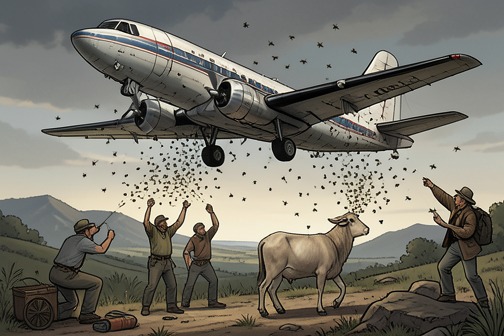
The U.S. Southeast screwworm eradication campaign was a large-scale test of whether a pest could be eliminated by releasing artificially reared, sterilized males rather than by spreading poison. Over 17 months, the program released 3.5 billion flies across [Florida](entity:location-recall-location-florida-1618e1042117) and parts of Georgia and [Alabama](entity:location-recall-location-alabama-2bbbae281095); after the last known wound infestation in February 1959 and a few subsequent captures in traps, no further trace was found. Its success stood as a vivid contrast to the chemical eradication programs elsewhere in the book: here, basic biological research, persistence, and an enormous coordinated release achieved eradication, though the victory required a quarantine barrier against return from the Southwest.
## From the [Curaçao](entity:location-recall-location-cura-ao-2141162f2932) trial to a regional campaign
The immediate precedent was the successful experiment on Curaçao, where the screwworm had been eradicated after the release of sterile flies. That result encouraged Florida livestock raisers to seek a similar solution to the costly pest. The Southeast undertaking, however, was about 300 times larger than the Caribbean island trial, making the transition from experiment to regional campaign a substantial leap in scale.
In 1957, the [United States Department of Agriculture](entity:organization-recall-organization-united-states-de-54f6aeafe860) and the State of Florida joined in funding the eradication effort. Its method depended on producing large numbers of flies, sterilizing them, and distributing them over the infested area. The aim was not to poison the landscape, but to make reproduction fail through repeated releases of sterile insects.
## Production and release
The campaign’s logistics were built around a specially constructed fly factory, which produced about 50 million screwworms each week. Twenty light airplanes carried out prearranged flight patterns for five to six hours a day. Each plane carried a thousand paper cartons, and each carton held between 200 and 400 irradiated flies. The method’s biological premise thus required an industrial rhythm of breeding and irradiation, joined to systematic aerial distribution.
The cold winter of 1957–58 unexpectedly improved the timing. Freezing temperatures reduced screwworm populations in northern Florida and confined them to a smaller area, offering an opportunity to begin the program when the pest was less widespread. By the time the campaign was considered complete, after 17 months, 3.5 billion artificially reared, sterilized flies had been released over Florida and sections of Georgia and Alabama.
## Eradication and its evidence
The account marks the final phase through a sequence of diminishing signs. The last known animal-wound infestation attributable to screwworms occurred in February 1959. Several adults were captured in traps during the following weeks; after that, no trace could be discovered. The progression—from the final infestation, to isolated trapped adults, to no further detection—provides the reported basis for declaring the Southeast infestation eradicated.
The book characterizes the outcome as a triumphant demonstration of scientific creativity, supported by thorough basic research, persistence, and determination. That praise is specific to the method and campaign described: the achievement came through mass releases of sterile flies, not through a claim that every screwworm population had been eliminated everywhere.
## The barrier and the unfinished problem
A quarantine barrier in Mississippi was intended to prevent screwworms from re-entering the Southeast from the Southwest, where the pest remained firmly established. The barrier makes the limits of the victory clear. The regional campaign had removed the infestation from its target area, but it could not by itself prevent movement back from outside that area.
Eradication in the Southwest was described as a formidable undertaking because of the vast territory involved and the likelihood of reinvasion from Mexico. The Department nevertheless appeared to be considering some kind of program for [Texas](entity:location-recall-location-texas-f19b16f8e87c) and other infested southwestern areas, perhaps aimed at keeping screwworm populations very low rather than eliminating them outright. The Southeast campaign therefore closed with a double prospect: a demonstrated biological success, and a continuing struggle to contain a pest whose wider range made complete eradication much more difficult.
Event 28
Broad Street 霍乱暴发与水泵移除

The Broad Street cholera outbreak and the removal of the pump handle serve as a concise historical demonstration of environmental prevention: physician [John Snow](entity:character-recall-character-john-snow-d77ee694eb4f) mapped cases to a shared water source, and taking the handle off the Broad Street pump helped bring the epidemic under control. In [Rachel Carson](entity:character-recall-character-rachel-carson-13c8f018d01f)’s account, the episode contrasts control of disease at its environmental source with reliance on a remedy that acts only after illness has begun.
## Tracing the outbreak
More than a century before the passage was written, a major cholera outbreak occurred in London. John Snow, a London physician, mapped where cases occurred and found that they originated in one area. Its inhabitants drew their water from a single pump on Broad Street. The map and the shared source connected the scattered cases to a common environmental condition.
The account emphasizes the sequence of reasoning: Snow located the concentration of cases, identified the source of the water used by the affected inhabitants, and acted on that finding. The pump was not merely a setting for the epidemic. It was the specific point where the outbreak’s connection to the environment could be addressed.
## Removing the pump handle
Snow removed the handle from the Broad Street pump. Carson describes this as a swift and decisive act of preventive medicine. Rather than waiting for a treatment to act on people already ill, the intervention disrupted access to the implicated source; the epidemic was brought under control.
The account distinguishes this measure from treatment with a drug that kills the disease organism inside the body. The cholera organism was then unknown, yet the environmental intervention could still be effective. The episode therefore shows how practical prevention can proceed by identifying and changing the conditions of exposure even when the agent causing disease has not been identified.
## Prevention and the environment
Carson uses Snow’s action to challenge the prominence given to drugs in popular understanding of the struggle against infectious disease. She argues that many of its decisive battles consisted of eliminating disease organisms from the environment. The Broad Street case makes that argument concrete: mapping, identifying a shared water source, and removing the pump handle mattered more to controlling the outbreak than a hypothetical medicine directed at the unknown organism.
The example also clarifies that treatment and prevention are not necessarily opposites. Carson notes that therapeutic measures can both cure an individual patient and reduce sources of infection. But the pump-handle intervention stands apart as a direct environmental measure: it acted on the conditions through which disease reached people, rather than depending solely on treating its consequences.
## Significance in Carson’s argument
The outbreak appears in an argument for addressing causes within the environment rather than assuming that technological intervention must take the form of a powerful chemical or a remedy applied to each affected individual. Snow’s response depended on observation and a targeted change to one shared source. Its scale and method provide a contrast to broad, indiscriminate chemical programs discussed elsewhere in Carson’s book: here, prevention followed evidence about a specific exposure and acted on that exposure.
The episode’s force lies in the order of its decisions. Cases were mapped before the source was identified; the source was identified before the intervention; and the intervention preceded control of the epidemic. The pump handle thus becomes an emblem of environmental preventive medicine—not because the account treats it as a cure for every infectious disease, but because it demonstrates that changing a condition that sustains an outbreak can be decisive even without a drug that directly attacks the organism.
Event 29
加利福尼亚柑橘棉蚧壳虫生物防治行动

The [California](entity:location-recall-location-california-fd5bbc3f2eb4) citrus cottony cushion scale biological-control campaign became one of the most celebrated demonstrations that a pest could be controlled by restoring ecological checks rather than saturating a landscape with poison. When a sap-feeding scale insect threatened California’s young citrus industry with ruin, an imported lady beetle from [Australia](entity:location-recall-location-australia-443153725cd3) brought it under control within two years. For decades afterward, the near-absence of the scale in the groves stood as a vivid measure of biological control’s success—and of how readily later chemical programs could endanger that success.
## An industry on the brink
The crisis began in 1872, when a scale insect that fed on the sap of citrus trees appeared in California. Over the following twenty-five years it multiplied into a destructive pest: in many orchards, the fruit crop was completely lost. The consequences reached beyond individual harvests. California’s citrus industry was young, and its survival was threatened; some farmers, faced with ruined groves, gave up and pulled out their trees.
The response was not simply to intensify a chemical attack. In 1888, entomologist [Albert Koebele](entity:character-recall-character-albert-koebele-41417cf39a64) travelled to Australia to search for natural enemies of the cottony cushion scale, which threatened the citrus industry with destruction. The expedition belonged to the emerging practice of conventional biological control, in which an organism that naturally checks a pest is introduced where that pest has become damaging. Its premise was that a pest’s abundance could reflect the absence of restraints, not an invitation to kill indiscriminately.
## The vedalia beetle’s rapid effect
The search produced a small lady beetle called the vedalia, imported from Australia as a parasite and enemy of the scale insect. The decisive result came quickly: within only two years after the first shipment of beetles, the scale was under complete control throughout California’s citrus-growing regions. The account presents the speed and reach of that change as exceptional. An industry that had faced destruction was no longer losing its orchards to the scale.
The change could be read in the groves themselves. After the beetle had become established, someone could search for days among the orange trees without finding a single scale insect. That near-disappearance gave the campaign a concrete measure of success: not merely fewer damaged crops, but a pest reduced so thoroughly that it could scarcely be found in the landscape where it had once threatened the industry.
## A model of biological control
The campaign became a landmark example of conventional biological control. The book describes the California citrus experiment as the world’s most famous and successful example of the method, and places Koebele’s 1888 Australian expedition among the beginnings of the [United States](entity:location-recall-location-united-states-2f533bc8d0b9)’ established practice. It also situates the episode within a larger history: entomologist explorers searched around the world for natural enemies of insects that had arrived on American shores, and about one hundred imported predator and parasite species eventually became established.
The story’s significance lies in the relationship it reveals between control and ecological restraint. The scale had become devastating in California, but its suppression did not depend on making the entire orchard hostile to life. Instead, the campaign brought in an organism that could act against the pest, and the resulting balance held long enough for the scale to become nearly undetectable. [Biological control](entity:concept-recall-concept-1c5623e84692) here appears not as an absence of intervention, but as an intervention directed through an ecological relationship.
## Chemical success put at risk
That achievement did not prevent a later turn toward chemicals. In the 1940s, citrus growers began experimenting with new products against other insects. With the arrival of [DDT](entity:object-recall-object-ddt-1c2031137c06) and still more toxic chemicals, the earlier biological-control work—and the enemies of other pests—was put in jeopardy as sprays killed them off. The account uses the contrast to expose a recurring problem: a treatment aimed at one insect can also destroy organisms that had been keeping another in check.
The campaign therefore carries a double significance. It records how quickly an introduced natural enemy rescued a threatened crop, but it also supplies a standard against which later chemical control can be judged. The scale’s near-disappearance among the orange groves was not simply a triumph over a pest; it was evidence that durable control could rest on living relationships. Once broad-spectrum sprays threatened those relationships, the celebrated solution itself became vulnerable to the logic of indiscriminate treatment.
Event 30
1961年美国孵化场虹鳟鱼肝癌疫情
The 1961 American hatchery rainbow-trout liver-cancer epidemic was a widespread outbreak of cancer in fish kept at hatcheries across the [United States](entity:location-recall-location-united-states-2f533bc8d0b9). In some affected areas, practically every trout older than three years developed the disease. Its cause remained under investigation, but the evidence pointed toward agents in prepared feed, making the outbreak a stark warning about the consequences of introducing potent carcinogens into a species’ environment—and about the difficulty of identifying hazards before they may affect people.
## An outbreak across hatcheries
In the spring of 1961, an epidemic of liver cancer appeared among rainbow trout in many federal, state, and private hatcheries. Its distribution crossed both the eastern and western United States; it was not a local incident confined to a single facility or region. The age pattern was especially alarming: in some areas, practically 100 per cent of trout over three years of age developed cancer. That proportion gave the outbreak its force as more than an isolated report of diseased fish. It suggested a severe problem affecting mature trout in multiple parts of the country.
The account identifies the affected animals as hatchery trout and the disease as liver cancer, but does not specify the number of hatcheries or fish involved. Nor does it identify a single confirmed contaminant. The epidemic was therefore presented as a serious, geographically extensive signal whose precise cause was still being investigated, not as a solved case with one established chemical culprit.
## Detection as an early-warning system
The outbreak came to attention through an existing arrangement between the Environmental [Cancer](entity:state-recall-state-cancer-5aee5681065b) Section of the [National Cancer Institute](entity:organization-recall-organization-national-cancer-ecb95fce0ee0) and the Fish and Wildlife Service. Under that arrangement, reports were made of all fish found with tumors, so that a possible cancer hazard to people from water contaminants might be detected early. The reporting system connected observations in wildlife to a public-health question: tumors in fish could serve as a warning that environmental agents merited attention beyond the affected species.
This was not a claim that the trout’s cancers proved a corresponding human illness, or that a particular contaminant in water had already been identified. Rather, the surveillance arrangement made the fish part of an effort to recognize potential hazards before their significance for people was known. The episode’s importance lies partly in this institutional link: the discovery was not simply a veterinary observation, but a finding collected and interpreted within a program designed to watch for environmental cancer risks.
## An unresolved cause, with feed under suspicion
Studies were still under way to determine the exact cause of the epidemic over so wide an area. The best evidence was said to point toward some agent present in prepared hatchery feeds. Those feeds contained a striking variety of chemical additives and medicinal agents in addition to their basic foodstuffs. The suspected pathway thus ran through a managed food supply: the fish were raised on prepared feed whose numerous supplementary ingredients complicated the search for the responsible agent.
The evidence did not isolate a specific additive or medicine, and the book does not report a final causal finding. The distinction matters. The feed’s chemical complexity made it a leading direction for investigation, but suspicion was not proof that any one ingredient caused the cancers. The uncertainty did not erase the warning; it showed how a mixture of inputs could make a serious biological effect difficult to trace to a single source.
## The warning’s larger significance
[Rachel Carson](entity:character-recall-character-rachel-carson-13c8f018d01f) uses the trout epidemic to illustrate what can happen when a potent carcinogen enters the environment of any species. The episode appears amid her argument that people tolerate cancer-causing agents in their surroundings at their peril, and that changing environmental conditions can make the safety of a carcinogen impossible to assume. The trout offered a concrete case: cancer appeared on a broad geographic scale, in some places at an exceptionally high rate among older fish, while the suspected source remained under study.
The warning was sharpened by the limits of what was known. The outbreak did not establish that the feed or its ingredients had caused human cancer, and its precise agent had not been determined. But the surveillance system’s purpose was precisely to seek early warning of hazards to people from contaminants, while the investigation pointed toward a chemically complex feed as a possible source. The episode therefore held two facts together: environmental cancer could emerge in a striking epidemic, and the substances behind it might remain uncertain even as the consequences demanded attention. In Carson’s account, the trout’s tumors make the case for controlling the number and variety of environmental carcinogens before a suspected danger is reduced to a confirmed human disaster.
Event 31
蒙大拿森林喷洒 DDT 后的叶螨暴发
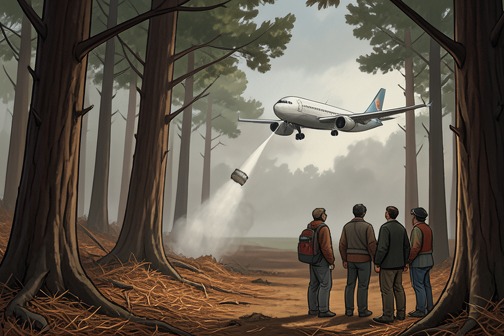
The 1956 [DDT](entity:object-recall-object-ddt-1c2031137c06) spraying of western forests was intended to control spruce budworm; the following summer, an immense spider-mite outbreak afflicted almost the entire treated area and left Douglas firs brown and shedding their needles. The episode turned a forest-protection campaign into a larger ecological crisis, and its resemblance to earlier outbreaks after insecticide use made the damage look less like an isolated accident than a recurring consequence of chemical intervention.
## The Spraying and Its Unintended Result
In 1956, the [United States Forest Service](entity:organization-recall-organization-united-states-fo-3009080c549c) sprayed about 885,000 acres of forest with DDT in an effort to control spruce budworm. The scale was immense, but the intended target was not the only organism affected by the treatment. By the next summer, observers surveying the forests from the air could see vast blighted areas where Douglas firs were turning brown and dropping their needles. The forests appeared scorched.
The damage was not confined to a few scattered sites. Almost all the sprayed area was affected, while the account notes that the same damage was not evident elsewhere. The contrast tied the outbreak closely to the geography of treatment: the mite devastation followed the sprayed forest, not simply the presence of trees or the passage of a bad season. A measure taken to protect forests from one insect had been followed by a problem described as worse than the budworm damage it was meant to prevent.
## A Sudden Forest-wide Infestation
The summer of 1957 brought what the book calls the most extensive and spectacular spider-mite infestation in history. From above, the scale of injury became legible as a pattern across the forest: great brown areas, needle loss, and Douglas firs visibly deteriorating. The aerial survey made the damage more than a collection of local complaints; it showed a landscape-wide reversal of the spraying program’s stated purpose.
The account also describes what mite feeding does to trees and shrubs. A mild infestation produces a mottled, salt-and-pepper appearance; when mite populations are heavy, foliage yellows and falls. In the western forests, that progression culminated in the browning and needle loss visible from the air. The detail matters because it identifies the outbreak not as an abstract rise in insect numbers but as a direct transformation of forest foliage and condition.
## Earlier Outbreaks and a Recurring Pattern
Foresters searching for precedents remembered other spider-mite scourges, though none as dramatic. Trouble had occurred along the Madison River in Yellowstone Park in 1929, in Colorado twenty years later, and in New Mexico in 1956. Each outbreak followed forest spraying with insecticides. The earlier cases gave the 1957 devastation a history: the western forests were the most spectacular instance of a pattern that had appeared in several places and years.
The 1929 episode is a significant contrast within that record. It took place before the DDT era and involved lead arsenate, not DDT. The repeated association was therefore not limited to one recently introduced chemical. By placing DDT-era damage alongside an earlier outbreak after lead arsenate spraying, the narrative broadens the question from the properties of a single poison to the ecological consequences of insecticide use more generally.
## Ecological Significance
The intended target and the unexpected outbreak together expose the limits of treating a forest as a problem that can be solved by attacking one pest in isolation. The Forest Service’s application was directed against spruce budworm; the following summer, spider mites, described as a problem worse than the damage from the target insect, spread across nearly all the treated land. The sequence makes the forest itself part of the story: a large intervention was followed by a second, extensive disturbance whose visible cost fell on the trees the program was meant to protect.
The episode also gains force from recurrence. The 1929, 1949, and 1956 outbreaks, each reported after insecticide spraying, make the 1957 infestation in [Montana](entity:location-recall-location-montana-a4c636ab2f04) and neighboring western areas more than a dramatic singular disaster. In the book’s argument, this chain of cases challenges confidence in broad chemical control: the treatment’s consequences could extend beyond its intended target, and forest damage could become most conspicuous only after the spraying had ended and the next summer’s infestation had arrived.
Event 32
1959年蔓越莓除草剂污染事件
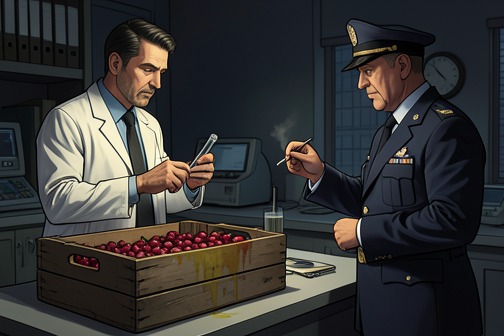
The 1959 cranberry herbicide contamination episode centered on aminotriazole residues on marketed berries and the dispute that followed their seizure by the [Food and Drug Administration](entity:organization-recall-organization-food-and-drug-ad-284249899b35). It brought together two issues the book treats as inseparable: the chemical’s demonstrated cancer-causing effects in laboratory rats and the public challenge to the significance of that evidence when contaminated food entered the market.
## Background and Contamination
Aminotriazole, a weed killer, had caused thyroid cancer in test animals. In 1959, a number of cranberry growers misused the chemical, producing residues on some berries that were marketed. The episode was therefore not presented simply as a question about a chemical’s theoretical hazard: the residues connected a known experimental concern to a food product offered to consumers.
The book does not specify the quantity of contaminated berries, the growers involved, or the exact circumstances of the misuse. It does establish the central sequence: use of aminotriazole by growers, residues on some marketed cranberries, and their later seizure by the Food and Drug Administration. That order matters; contamination had occurred before the public dispute over the chemical’s safety took shape.
## Seizure and Public Dispute
The Food and Drug Administration seized contaminated cranberries, and the seizure prompted controversy. The dispute extended beyond the immediate action against the berries: whether aminotriazole was in fact cancer-producing became widely contested. The account notes that even many medical men challenged that characterization, despite the available experimental findings.
This contrast gives the episode its defining tension. Residues had been found on marketed food, while the carcinogenicity of the herbicide was disputed in public. The book does not describe the specific arguments made by the growers, the agency’s detailed enforcement process, or the ultimate disposition of every affected product; it places emphasis instead on the gap between the controversy and the scientific evidence it says was already clear.
## Experimental Evidence and Significance
The Food and Drug Administration released scientific facts indicating that aminotriazole was carcinogenic in laboratory rats. In the described experiment, rats received the chemical in drinking water at a concentration of 100 parts per million—given as one teaspoonful of chemical in ten thousand teaspoonfuls of water. The account uses this evidence to rebut the widespread challenge to aminotriazole’s cancer-producing nature; it does not claim that the rat findings alone establish a specific human health outcome from eating the cranberries.
Within the book’s larger discussion of environmental cancer risks, the episode shows how a food-residue controversy can turn on the interpretation and public communication of experimental evidence. The particular concern here was not an acute poisoning claim, but the presence of a weed killer associated with thyroid cancer in test animals on some marketed berries. Its significance lies in the collision between that evidence, contested public understanding, and the regulatory seizure that made the contamination a visible issue.
Event 33
二战时期盟军在意大利的 DDT 灭虱行动
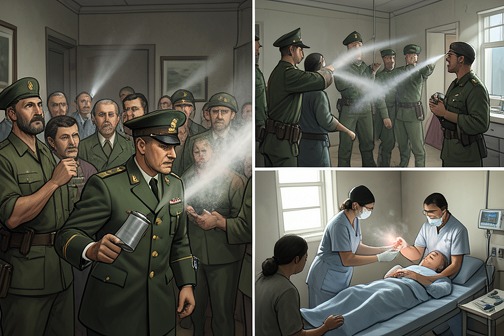
The Allied anti-typhus campaign in [Italy](entity:location-recall-location-italy-85c2492cd54b) in 1943 was an early medical use of modern insecticides: the Allied Military Government dusted enormous numbers of people with [DDT](entity:object-recall-object-ddt-1c2031137c06) and successfully attacked typhus. The episode also begins a compact history of chemical control’s reversal: within a year, mosquitoes and flies were showing resistance, and the insecticides used to sustain control soon faced resistance of their own.
## Emergency Use and Immediate Success
In 1943, during the [Second World War](entity:time-recall-time-second-world-war-80275f3e28b5), the Allied Military Government launched a campaign against typhus in Italy by dusting enormous numbers of people with DDT. The book identifies this as probably the first medical use of modern insecticides. It describes the attack as successful, presenting the intervention as a striking demonstration of the immediate public-health promise attributed to the new chemicals.
The campaign was followed in 1945 by extensive application of residual sprays to control malaria mosquitoes. The move from dusting people against typhus to spraying for mosquitoes extended chemical control from an emergency assault on disease to continuing efforts against its insect vectors.
## Resistance and the Limits of Chemical Control
The early success did not last without complication. Only a year after the residual spraying began, houseflies and mosquitoes of the genus Culex showed signs of resistance. The chronology gives the reversal particular force: the chemical method had produced good control, but the target insects began to withstand it almost immediately.
In 1948, chlordane was introduced as a supplement to DDT. It provided good control for two years, but by August 1950 chlordane-resistant flies had appeared. The sequence—DDT use, resistance, a supplementary chemical, renewed control, and resistance again—illustrates how a successful chemical intervention could generate pressure for further chemical measures without securing a lasting solution.
## Place in the Book’s Wider Argument
The episode appears in a broader account of pesticide resistance and the expanding use of persistent poisons after the war. Its importance lies not only in the scale of the 1943 dusting or its immediate success, but also in the rapid appearance of resistance after the subsequent spraying campaigns. In the book’s chronology, Italy offers an early warning that chemical control may change the conditions of the problem it is meant to solve: the insects remain, but become harder to control with the chemicals already in use.