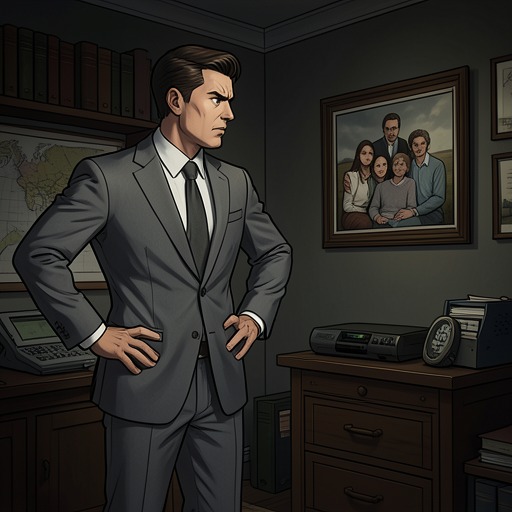
Susan Jeffries
SpontaneousSusan Jeffries is the estranged mother of Duan Jeffries, Terrence Jeffries, and Olivia Jeffries Westmoreland, and the woman whose departure fractured the Jeffries family. In Duan’s account, her abandonment was not followed by remorse or a wish to reconnect: when he found her as an adult, she made clear that she had never wanted children and did not want a relationship with them. The encounter turned his search for closure into a renewed confirmation of rejection, leaving forgiveness unresolved.
Identity and Family Rupture
Susan was married to Orin Jeffries and had three children with him. She left the household when Duan was twelve; Terrence was ten and Olivia was three. The ages place the break at a moment when all three children were still growing up, but Duan’s recollection particularly emphasizes the family roles that followed: as the oldest, he felt responsible for Terrence, while Olivia tried to take their mother’s place. He describes Orin as having to take on both parental roles without complaint, and says the abandonment left its mark on all three children, especially their father.
The separation also remained part of how Duan understood the family’s history long afterward. At Terrence’s wedding in Chicago, he reflected on the love he saw among other couples and on his father’s later marriage to a devoted administrative assistant. He regarded Orin as a man who deserved a good woman’s love, especially after what the mother of his children had put him through. The contrast is telling: Duan could recognize examples of lasting love around him while still carrying the consequences of his own mother’s departure.
The Search for Susan
Duan did not see Susan for almost eighteen years. A few days before his thirtieth birthday, after celebrating the opening of his investigative firm, he used his professional skills to find her. He told himself that he wanted closure, but his hopes were more specific: he wanted her to see him and feel remorse or shame for not even calling to learn how her children were doing. The search therefore carried an expectation that discovery might make an old absence answerable.
That expectation was disappointed. Duan recalls that Susan showed annoyance at being bothered, rather than remorse or shame. She told him she had left for a reason, had never wanted children, did not consider herself motherly, and did not want to renew a relationship with any of the children. The meeting gave Duan a direct answer, but not the acknowledgment he had hoped to receive. It also confirmed Terrence’s earlier certainty: after Duan returned to Atlanta, Terrence taunted him that he had known what the search would find. Terrence had not wanted to see Susan himself and had chosen to accept her departure at face value.
Estrangement and Its Afterlife
The adult consequences of Susan’s departure appear chiefly through Duan’s memories and judgments, rather than through scenes narrated from Susan’s perspective. He says he tried to forgive her and had sought her out in part to tell her that he had done so. After meeting her, however, he concluded that she did not deserve his forgiveness, or Terrence’s, Olivia’s, or Orin’s. His language registers not only anger at the original abandonment but also the injury of finding no regret when he returned to confront it.
Duan initially keeps this history guarded. When Kimani Cannon asks about the painful part of his past, he studies his nearly empty coffee cup and avoids discussing it, saying the subject can wait for another day. Later, while walking with Kim, he describes the search and Susan’s response in detail. He explains that his anger began when she left and that, as the oldest child, he felt he had Terrence to deal with while Olivia tried to fill the maternal role. His account gives the rupture a practical as well as emotional dimension: Orin had to care for the children alone, and the siblings each had to live with the absence in their own way.
Narrative Significance
Susan’s importance in the story lies less in an independently developed present-day role than in the lasting effects of her absence. Duan’s account links her departure to his anger, his admiration for Orin, and his difficulty forgiving someone who has given him no reason to believe reconciliation is wanted. The gap between Duan’s hope for remorse and Susan’s stated refusal makes the search for closure a reversal: finding her ends uncertainty about whether she wants contact, but does not heal the hurt that prompted the search.
The disclosure also changes Duan’s intimacy with Kim. He recognizes that he has kept his relationship with his mother, or lack of one, bottled up and has never discussed it this way with another woman. With Kim, the conversation comes without the anger or guilt he had anticipated, and he allows her to feel the pain of his childhood as he listens to hers. Susan remains outside that developing relationship, but the history of her abandonment becomes something Duan can share rather than keep sealed away.