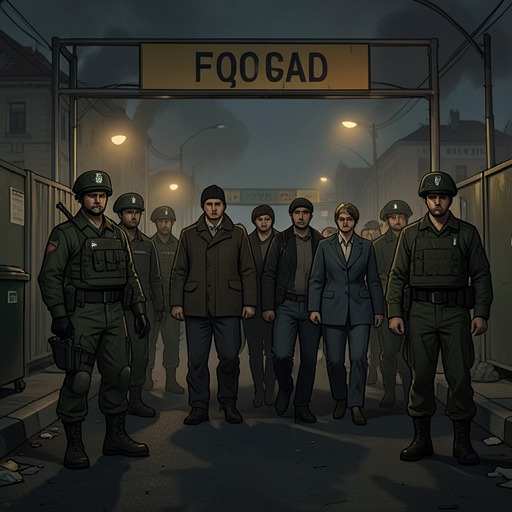
CISG Recommendation for Gradual Disclosure
StrangersThe CISG Recommendation for Gradual Disclosure is the Contact Impact Study Group’s proposal to manage public knowledge of extraterrestrial contact through concealment or a slow, carefully staged disclosure. Its stated concern is that sudden revelation could overwhelm society; the proposal’s authority, however, is challenged by characters who believe humanity can face the truth without such prolonged preparation.
The Recommendation and Its Rationale
In a discussion with Colonel Leland Falkirk, Lieutenant Horner supports the CISG’s position that the public should be prepared slowly if the discoveries are made known, suggesting a period of about ten years. Falkirk gives the underlying rationale: he expects disclosure to bring chaos and political and social upheaval, as the CISG report predicts. In this view, gradualism is not merely a communications strategy; it is a means of limiting the destabilizing consequences of a revelation about humanity’s place in the universe.
The proposal also permits concealment where possible. Father Stefan Wycazik describes the CISG position as holding that contact should be hidden if it can be, and that any news released should be broken over ten or even twenty years. This extended timetable makes disclosure a matter of managed transition rather than a single announcement, keeping the public’s readiness at the center of the policy.
Dispute Over Disclosure
The recommendation is presented as influential, not universally accepted. Father Stefan rejects its comparison between contact with humanity and historical contact between advanced and primitive cultures: he argues that this encounter would be between one highly advanced civilization and another even more advanced one, and that people are ready for it. Parker agrees with his rejection of the CISG’s caution. Their exchange turns the proposed timetable into a dispute over how humanity should be understood: as too fragile to absorb the news at once, or as capable of meeting another civilization directly.
Falkirk’s later defense of secrecy reveals how the rationale for withholding information can harden. He argues that public disclosure would invite political interference and obstruct a campaign he believes is necessary to protect humanity from annihilation. His claim goes beyond the CISG’s gradual-preparation proposal: the fear of upheaval becomes part of a larger security argument for controlling what the public knows. The distinction matters because the novel places a cautious disclosure policy alongside more coercive efforts to contain the truth, without treating them as identical.
Significance
The recommendation gives the novel a concrete form for the conflict between public knowledge and perceived collective safety. Its ten-to-twenty-year horizon implies that disclosure can be controlled by those who decide what the public is ready to hear; Father Stefan’s response challenges that assumption by insisting that readiness need not be manufactured through prolonged concealment. The disagreement remains consequential because the characters’ competing judgments concern not only the timing of disclosure, but also who has the authority to make that choice.