Shenkfield evacuation and quarantine order
StrangersThe Shenkfield evacuation and quarantine order is the official account of why Interstate 80 closed and the Tranquility Motel emptied during the summer before last. Presented as an emergency response to a chemical spill, it explains where guests supposedly went and why the motel shut down. But its carefully repeated details sit beside fractured memories, military secrecy, and a later plan to reuse the same public explanation for a far more violent purpose. The order works both as a story told to the people affected and as an instrument for controlling what they can know.
The official account
In Elko County, Nevada, Faye Block retrieves the motel registry for Friday and Saturday, July 6 and 7, and opens it to the guest lists. Her account is precise: a truck carrying dangerous chemicals to Shenkfield overturned a few miles away; authorities closed the interstate; roadblocks went up; and guests were ordered to leave the danger zone. The motel remained closed until Tuesday, when the Army had brought the situation under control. Ernie Block adds that Shenkfield was an isolated testing ground for chemical and biological weapons, making the cargo especially hazardous.
The evacuation story gives the guests a seemingly orderly route out of danger. They left in their own cars. Ned and Sandy Sarver were allowed to go to their trailer near Beowawe, Nevada, because it lay outside the quarantine area. Faye and Ernie say they stayed with friends, Elroy and Nancy Jamison, at a small ranch in the mountains ten miles northeast of the motel. In their account, the Army needed more than three days to clean up the spill and did not allow them back until Tuesday morning. The motel’s eleven rented rooms, none of them paid for because nobody stayed, make the evacuation sound like a verifiable administrative fact rather than a rumor.
The registry also places Dom Corvaisis among the guests: his signature is seventh on the list, alongside a Mountainview, Utah, address to which he was moving. He remembers checking in, but not leaving that night in response to an evacuation order. Instead, his recollection of the period is thin and uncertain, and he insists that he was at the motel. The discrepancy is not simply between memory and paperwork; Faye’s and Ernie’s account seems to come out in stiff, rehearsed phrases, as though they are reciting a script. Their shared certainty therefore makes the official story feel less reassuring, not more.
Secrecy behind the roadblocks
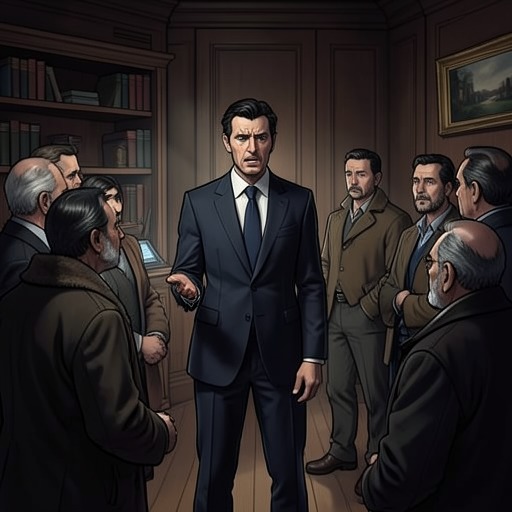
Dom proposes that the people at the motel may have been exposed to a chemical or biological agent intended for Shenkfield. In his theory, the Army and the United States federal government failed to evacuate them in time, then used the motel as a treatment site, decontaminated them, erased their memories, and supplied false ones to protect the military from lawsuits and the disclosure of classified information. This is a hypothesis raised by the characters, not a confirmed account of what happened. Its force lies in how many details it connects: the guests’ psychological troubles, the drugged people in Polaroid photographs, and the oddly different memories assigned to Dom and the Blocks.
The theory also runs into problems. Ernie points out that his and Faye’s memories, like those of the Jamisons and the Sarvers, fit the evacuation explanation, while Dom’s do not. That mismatch could itself suggest memory manipulation, but it makes the supposed programming risky and inconsistent. The possibility of biological contamination is also difficult to reconcile with the guests returning after only three days, since an infection might spread. Dom consequently revises the speculation toward a chemical agent that could be washed off or flushed from the body. Neither objection resolves the mystery; each narrows one explanation while leaving the larger uncertainty intact.
Newspaper coverage lends the emergency a public record. Reports describe the closure, quarantine, and eventual reopening of I-80, while the military’s conduct reveals how much authority it exercised in practice. Army units attached to Shenkfield secured a ten-mile stretch of highway before informing the Elko County sheriff or Nevada State Police. Local authorities complained that the Army excluded them from managing the crisis and from planning for the possibility that wind might spread the danger. The Army, in effect, trusted its own personnel to control what could be seen and known inside the quarantine zone.
The choice to use DERO forces makes the security measures still more suggestive. Ginger Weiss reasons that a DERO company was required because ordinary soldiers could not be trusted with whatever highly classified sight lay within the zone. If the emergency involved only an overturned truck and leaking cargo, she argues, the special force would have had no necessary secret to guard. The evidence supports suspicion of advance knowledge and concealment, but does not establish what the military was protecting or whether the reported spill occurred as described. The order’s central tension remains: its public details are concrete, while the event they supposedly explain stays out of reach.
A reusable cover story
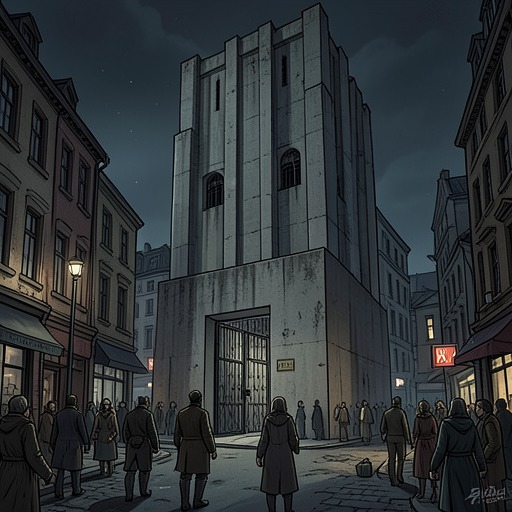
The quarantine order later becomes more than a remembered explanation. Leland Falkirk decides to close I-80 under the pretense of a toxic spill, isolate the Tranquility Motel, take its witnesses into custody, and transport them to the Thunder Hill Depository. There, behind the facility’s blast doors, he plans to detonate two five-megaton backpack nuclear weapons. He means to destroy the witnesses and the site he regards as the source of an existential threat, while accepting his own death as part of the operation. The earlier language of evacuation and contamination is thus repurposed: what once supposedly moved guests away from danger will now draw witnesses into confinement.
Falkirk’s decision grows out of a conflict over what the cover-up is meant to achieve. Foster Polnichev argues that containment has become untenable if it requires killing the Halbourgs, the Tolks, and witnesses in Nevada; in his view, the power appearing in people such as Emmy Halbourg may be a historic development rather than evidence of an enemy. Falkirk rejects that interpretation. He believes disclosure would invite political interference and compromise humanity’s survival. Where Polnichev sees a cover-up whose human cost has become indefensible, Falkirk treats the danger as so absolute that secrecy and mass killing appear necessary to him.
The machinery of repression extends beyond the Nevada witnesses. The Salcoe family, who had rented two rooms at the motel on the night in question, are being held incommunicado in Monterey by the Federal Bureau of Investigation and the Central Intelligence Agency while another program of memory repression and alteration is imposed on them. The earlier conditioning has begun to fail, and officials fear that the experience was too profound to suppress permanently. Falkirk regards the operation as increasingly unmanageable, with too many agencies and too many people involved, but proceeds with his military assignment all the same. The repeated effort to manufacture silence exposes the weakness behind the apparent certainty of the official narrative.
Meaning and consequences
The order’s power depends on making extraordinary control sound like routine protection. Roadblocks, evacuation instructions, a prolonged highway closure, and a return only after an all-clear can all be described as prudent responses to hazardous cargo. Yet the military’s exclusion of civilian authorities, the special security force, the witnesses’ incompatible memories, and the later plans for renewed confinement make that account politically charged. The order does not prove that the original emergency was fabricated; it shows how a plausible emergency can authorize secrecy and how the same explanation can be redeployed to conceal a new operation.
The dispute also turns on who gets to define danger. Falkirk’s claim that the species faces annihilation transforms secrecy into a supposed duty and disagreement into a threat to survival. Polnichev’s willingness to end the cover-up contests that premise by pointing to the people who would be killed to maintain it. General Bob Alvarado, meanwhile, rejects the authority of General Riddenhour and the politicians aligned with the operation, and intends to carry the news to the world. The official order therefore stands at the intersection of competing acts: securing a quarantine, controlling witnesses, protecting classified information, and deciding whether the public is entitled to know what the government says it must fear.