Government Policy of Concealing Extraterrestrial Contact and Erasing Memories
StrangersThe Government Policy of Concealing Extraterrestrial Contact and Erasing Memories is the clandestine effort to hide the arrival of an extraterrestrial ship by controlling both what the public can learn and what witnesses can remember. Presented first as a frightening theory about a toxic spill and military brainwashing, it becomes an actual program of sedation and memory alteration. Its failure exposes a conflict within the government: some officials treat secrecy as essential to human survival, while others conclude that repression has become more dangerous than disclosure.
Scope and Cover Story
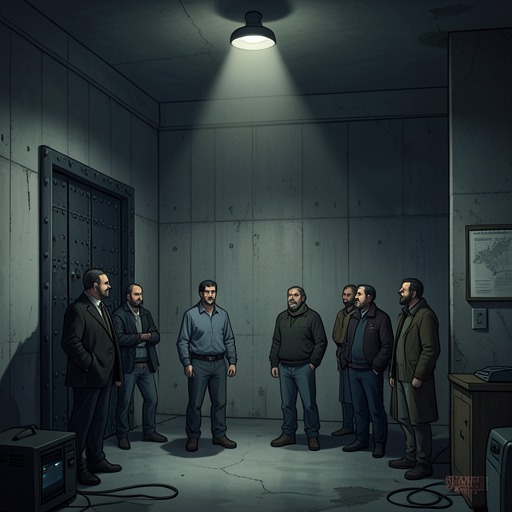
The policy joined two forms of concealment. Before civilians could understand what had happened, authorities used the story of a toxic spill and evacuation to explain the closure of I-80 and the presence of military personnel near the Tranquility Motel. Dom initially imagines that the witnesses may have been contaminated by a chemical or biological weapon intended for Shenkfield, then decontaminated at the motel and given false memories. At that stage, this is a hypothesis rather than a verified account; its force comes from the way it seems to explain both the witnesses’ psychological problems and the drugged people in the Polaroid photographs.
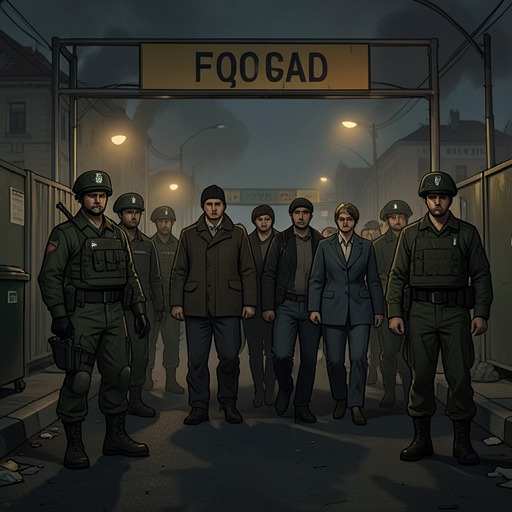
The later account confirms that civilian witnesses were deliberately sedated and placed on a memory-wipe program, though it does not establish Dom’s proposed contamination or decontamination as fact. The cover story was also part of a wider effort to conceal the ship’s approach. As the object drew nearer, its symmetrical form and unusual spectrographic readings made a meteorite explanation doubtful. Rather than risk destroying what appeared to be a vessel, officials began randomly jamming Soviet high-atmosphere radar and creating electronic false targets to hide its advance. Defense computers eventually gave thirty-eight minutes’ warning that the impact point would be in Elko County—just enough time to close I-80 and call in the DERO troops.
Sedation and Memory Modification
The memory program was intended to make witnesses unable to disclose what they had seen. According to Miles Bennell, three people entered the vessel, but officials did not know that anything important had happened inside it. The three emerged as DERO troops and scientific observers arrived; after the witnesses were arrested, they were sedated and taken back to the Tranquility Motel. There was no thorough debriefing. The civilians were moved directly from sedation into the drug program used for the memory wipe, leaving potentially valuable evidence uncollected as well as depriving the witnesses of a chance to explain their experience.
The intervention proved difficult to sustain. The Central Intelligence Agency’s brainwashing specialists, ordinarily used in covert foreign operations, had been borrowed for the Tranquility operation and had promised reliable repression. Instead, memory blocks began to deteriorate. Officials attributed the breakdown to the unusually profound and shattering nature of the experience, whose forbidden memories continued to press against the imposed barriers. The response was not to abandon the program: the specialists proposed another three-day session, which they claimed would ensure the witnesses’ silence.
That escalation reached the Salcoe family. After their memory blocks deteriorated, the Federal Bureau of Investigation and Central Intelligence Agency held them incommunicado in Monterey and subjected them to another program of memory repression and alteration. The operation was illegal, and the family was moved to a safe house when Parker Faine broke into the residence and escaped. Even officials who wanted secrecy could see that repetition did not amount to control: a new round of conditioning demanded further confinement, while the possibility of escape and renewed memory loss remained.
Competing Government Responses
The policy never operated as a single, unified government decision. The Federal Bureau of Investigation, Central Intelligence Agency, DERO personnel, military leaders, researchers, and political officials all became involved, creating what Leland Falkirk recognized as a problem of too many agencies and too many chiefs. Their disagreement concerned both the evidence and the acceptable cost of containment. Foster Polnichev argued that the miraculous cures associated with Brendan Cronin and Winton Tolk, and the telekinetic abilities of Dominick Corvaisis and Emmy Halbourg, pointed toward benefits rather than a spreading infection. He and other officials believed disclosure might now be preferable to further suppression.
Falkirk rejected that judgment. Convinced that the witnesses and even the personnel at Thunder Hill might be infected or no longer human, he saw secrecy as secondary to protecting the species from annihilation. When the policy seemed to require killing the Halbourgs, the Tolks, and the Nevada witnesses, Polnichev judged the cost of containment too high. Their clash reveals that the government’s response is not simply a settled plan to conceal information: it is a struggle over who gets to define the threat, whether the evidence warrants extraordinary violence, and whether public disclosure can still be prevented.
Escalation, Evasion, and Failure
After the conference call turned against him, Falkirk decided to act without the agreement he had sought. He planned to close I-80 under the toxic-spill pretense, take the Tranquility witnesses to the Thunder Hill Depository, and destroy the witnesses, himself, and the facility with two five-megaton backpack nuclear weapons. He cast this as eliminating the principal source of contamination, while expecting Maxwell D. Riddenhour to pursue the remaining possible sources afterward. The plan shows the final logic of the policy at its most extreme: when memory alteration and surveillance appear insufficient, containment becomes custody, and custody becomes a proposed mass killing.
At the same time, officials inside Thunder Hill were quietly undermining the cover-up. General Bob Alvarado handled postcards with gloves so as to leave no fingerprints, intending to direct Jack Twist toward the witnesses and their mental problems. Miles Bennell separately sent photographs to Dominick Corvaisis and the Blocks. Alvarado recognized that Falkirk’s apparent cooperation did not mean the witnesses would be brought back for study; he believed Falkirk intended to kill them and the Thunder Hill personnel as well. The disclosure effort thus depended not only on open disagreement but on covert acts by people within the institutions enforcing secrecy.
The policy’s moral and practical failure is measured by what it tries to erase. The memory program treats witnesses as objects to be sedated, altered, transferred, and silenced, while the people involved increasingly recognize that the encounter may be humanity’s greatest historical event. Father Stefan Wycazik rejects the assumption that first contact must be concealed for a decade or two, arguing that humanity is ready to face another advanced civilization. At the ship, Jorja experiences the arrival as the lifting of a lid from a dark box; Sandy finds that the sight diminishes the power of the terror she had carried since childhood. Against such consequences, the cover-up’s promise of safety becomes harder to defend. Its attempt to seal away the encounter instead helps turn memory, disclosure, and the right to understand what happened into central stakes of the story.