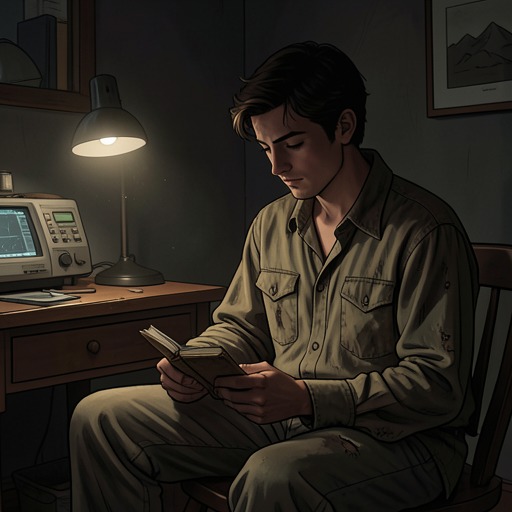
Father Benson
TemptationFather Benson is the Catholic priest who runs the conversion camp where Colton is sent after his parents discover he is gay. Though he is not Mormon, he presides over a program shaped by the religious terror shared by its young residents. His role makes him the human authority behind an effort to treat Colton’s identity as an affliction, and the camp’s methods leave consequences that persist long after Colton escapes.
Identity and Role
Colton later identifies Father Benson to Marcel as a Catholic priest who ran the camp his parents sent him to. Colton explains that his parents acted after realizing he was gay and that the camp’s stated purpose was to make him not gay. Father Benson is therefore not a family member or a religious leader from Colton’s own household; he is the adult in charge of the institution to which the family delegates its attempt to change him.
The distinction between Father Benson’s Catholic affiliation and the religious background Colton associates with his family does not soften the camp’s function. Colton recalls that its residents shared a fear of Outer Darkness and had been raised in terror of what would happen if they could not get themselves right. In that setting, Father Benson directs a program whose coercion draws power from the shame and religious anxiety already surrounding the children.
The Camp and Its Methods
Colton’s account begins with enforced isolation. After he is left alone in his room, the electricity is cut and nearly everything is removed, leaving a mattress and a Bible. He is then taken away in a van. The deprivation continues for three days: bland food, water, only three bathroom breaks, and no explanation of what will happen next. These conditions establish the camp’s control through uncertainty as well as through its later treatment of him.
The chronology becomes difficult for Colton to measure. He describes weeks, perhaps months, spent in darkness, kept weak and cold, with repeated tests intended to elicit a response to images the camp’s staff assumed he desired. Father Benson’s authority is linked directly to those practices: while Colton is still recovering from treatment, the priest discusses him over the phone as a problem child whom the camp cannot help. Colton’s exhaustion and inability to respond as expected do not bring the testing to an end.
Colton later tells Marcel that the priest used electricity in an effort to cure what the camp called his affliction. The treatment leaves scars and nerve damage, with areas of his body remaining unusually sensitive and others numb. Colton describes his anger at his own body during the camp and the impossible demand imposed on him: bodily reactions were treated as evidence against him, while the punishment did not make his identity disappear. The damage is presented not as a temporary episode but as a continuing physical consequence of Father Benson’s program.
Colton’s Escape and the Aftermath
Colton eventually decides that he must cross the camp’s chain-link fence. He cannot know what awaits beyond it, but believes that remaining under the camp’s control will leave him trapped in its basement, pit, or box. His escape is a turning point in the balance between the institution’s power and his own agency: he acts without certainty that the outside world will be safe, because staying has become intolerable.
The consequences endure beyond the escape. Years later, Colton still cannot explain exactly why he ran at that particular moment, even though he remembers the necessity of getting out. When he tells Marcel about the camp, his speech falters and his breathing shakes; he pauses, then continues. In another conversation, he takes Marcel’s hand and guides it to the scarred areas before explaining the lasting nerve damage and its cause. The disclosure makes visible a history he has carried into adult life and gives Marcel a clearer account of the harm behind Colton’s vulnerability.
Narrative Significance
Father Benson’s characterization is conveyed primarily through the institution he controls and the consequences Colton recounts, rather than through an extended portrait of the priest’s private life. The available account does not establish what Father Benson believes beyond his participation in the camp’s effort to change Colton, or what becomes of him after Colton escapes. His narrative significance lies instead in the contrast between the camp’s promise of correction and its actual results: coercion does not change Colton’s identity, but it does leave lasting bodily harm, fear, and trauma.
The story also places the camp’s cruelty within a wider structure of rejection. Colton says that his parents sent him there, while the other children are described as similarly frightened and isolated. Later, his foster-care history does not qualify him as independent for financial-aid purposes because his parents never legally lost custody. That administrative consequence is distinct from Father Benson’s actions, but it underscores how parental authority continues to shape Colton’s options even after the camp is behind him. Against these forms of control, Colton’s escape and his decision to tell Marcel what happened are acts of self-determination: neither erases the past, but both make it possible for his experience to be named rather than imposed on him.