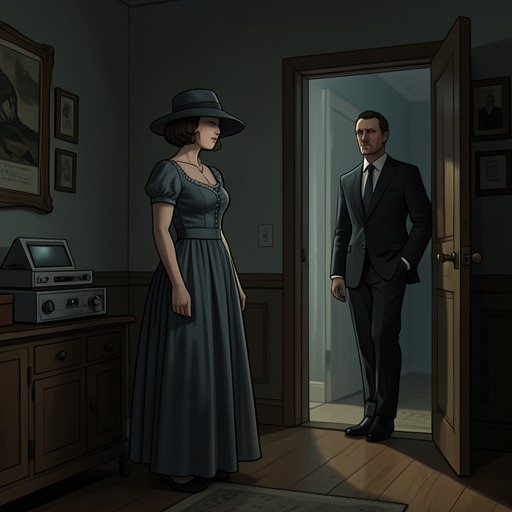
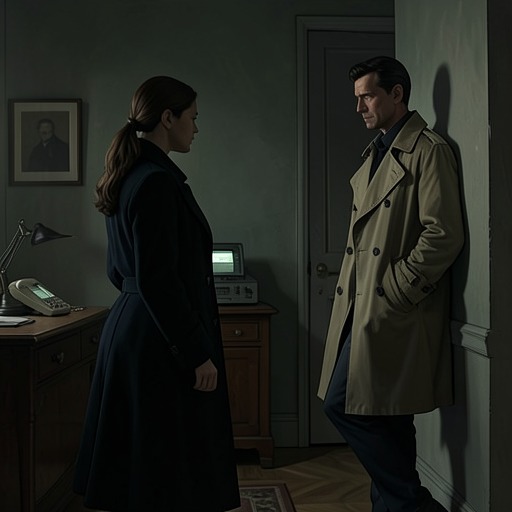
Event 1
Nico Peterson’s disappearance
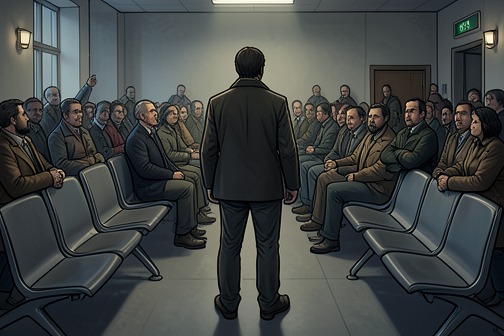
[Nico Peterson’s disappearance](entity:event-recall-event-nico-peterson-s-disappe-b09fe677be1f) is the mystery that sets [Clare Cavendish](entity:character-recall-character-clare-cavendish-b98680ac20a6)’s investigation in motion, but it is defined less by a witnessed departure than by the traces of a life abruptly left unattended. He stops answering, disappears without saying goodbye, and leaves behind circumstances that suggest absence without explaining its cause. The uncertain timeline and Clare’s reluctance to summon the police keep the event suspended between a private vanishing and a possible crime.
## Background and Last Sightings
Clare tells [Philip Marlowe](entity:character-recall-character-philip-marlowe-4cdb66984662) that Nico had been her lover and had disappeared rather mysteriously two months earlier, without even saying goodbye. Her account places the loss within a relationship, but offers no farewell, explanation, or confirmed destination. Nico’s departure is presented as a sudden severing of contact rather than a scene anyone can reconstruct directly.
The last encounter Clare can identify took place about a month before her account, on a Sunday afternoon at the [Cahuilla Club](entity:location-recall-location-cahuilla-club-a0520850d415). Her husband was occupied in a strenuous polo match, and Nico seemed much as usual, though she recalled him as perhaps more distracted and nervous than normal. She stresses that this impression may only have taken shape in hindsight. At the time, he gave no clear sign that he was about to leave. The memory thus supplies a possible change in manner, but not a reliable warning or explanation.
A second account offers a different measure of Nico’s absence. A man living in a rundown shack across the street says Nico used to visit, pass the time, and give him a smoke. He estimates that he last saw him six or seven weeks earlier, but did not witness him depart. One day, he simply noticed that Nico was gone. The estimates do not align into an exact date: Clare speaks of a disappearance two months before, remembers seeing Nico roughly a month before, and the neighbor places his last sighting six or seven weeks earlier. Together they establish a narrowing trail of reported contact, not a definitive chronology.
## The House and the Decision Not to Report
Clare’s concern grows through small, accumulating signs. She telephones Nico repeatedly and gets no answer, then visits his house. The milk delivery has not been canceled, and newspapers are piling up on the porch. These ordinary services make the absence legible: someone who had left in a planned, orderly way might have arranged for them to stop. Clare also recalls that Nico was careful in some respects, making the untouched routine at the house seem unlike him.
Despite those signs, Clare does not go to the police. She believes the authorities would not have been appropriate because Nico was shy of them and would not have thanked her for directing them toward him. That decision makes the disappearance harder to classify. Her account does not establish whether she is protecting his wishes, responding to what she knows about him, or simply avoiding an intervention she expects him to resent; the text presents her stated reason without resolving those possibilities. What is clear is that the first response to his absence remains private: calls, a visit to the house, and an attempt to understand what Nico would have wanted.
## Investigation and Uncertainty
The story introduces the mystery through Marlowe’s office and Clare’s testimony rather than through Nico’s departure. On a slow summer Tuesday, the detective watches a woman cross near Cahuenga and [Hollywood](entity:location-recall-location-df7336761502) before she enters his office. The contrast between the stillness of his workday and the arrival of a client gives way to a case whose decisive event has already happened offstage. Nico is absent from the opening inquiry, and the reader receives his disappearance through other people’s memories and evidence.
That structure matters because the accounts describe different kinds of knowledge. Clare remembers an intimate connection and a final meeting; the neighbor remembers casual visits and only realizes later that they have stopped. Neither sees Nico leave. His disappearance therefore has no single eyewitness who can fix its moment or meaning. The milk and newspapers show neglect, the reported nervousness may be significant or retrospective, and the six- or seven-week estimate remains approximate. Each detail sharpens the question while withholding a settled answer.
The case later becomes more troubling when Clare reports seeing Peterson in [San Francisco](entity:location-recall-location-san-francisco-8a14902ce523) even though he is supposed to be dead. Marlowe tells [Joe Green](entity:character-recall-character-joe-green-c464a0b0903b) about her sighting and subsequently wonders whether bringing Joe into the matter betrayed Clare’s trust. Joe reports that a dead man had Peterson’s wallet and had been identified at a scene. These details do not confirm how Nico vanished or establish what happened to him; instead, they make the disappearance part of a larger uncertainty over whether he is missing, presumed dead, or alive under circumstances not yet explained.
## Significance
The event’s force comes from the gap between everyday evidence and the extraordinary conclusion people may draw from it. A porch crowded with newspapers and a canceled milk order never made are concrete signs, but they cannot say whether Nico chose to disappear, was prevented from returning, or met some other fate. The people who knew him can provide only separate fragments: a former lover’s last recollection and a neighbor’s gradual realization that a familiar visitor has stopped coming.
By withholding a witnessed departure and an immediate police inquiry, the novel turns absence itself into the investigative problem. Clare’s personal history with Nico makes the disappearance emotionally charged, while Marlowe’s later unease over disclosing her sighting shows that the search also tests his obligations to his client. The mystery begins with a man who has left no goodbye and a household that still expects his return; subsequent claims about a sighting and a body deepen, rather than settle, the question of what his absence means.
Event 2
The presumed hit-and-run involving Nico Peterson
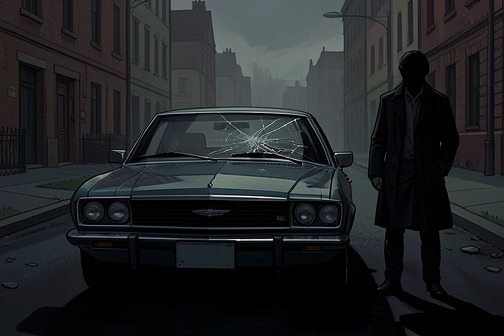
[The presumed hit-and-run involving Nico Peterson](entity:event-recall-event-nico-peterson-31ac3b533359) is the event that gives his disappearance an official ending while leaving the central question of his identity unresolved. On [April 19](entity:time-recall-time-4-19-7965758be02e), a man wearing Peterson’s clothes and carrying his wallet was found beside [Latimer Road](entity:location-recall-location-latimer-road-9eab7ed9408d) in [Pacific Palisades](entity:location-recall-location-cbe4ec5f2180). The death was classified as a hit-and-run, but the driver remained unknown. Later, [Clare Cavendish](entity:character-recall-character-clare-cavendish-b98680ac20a6)’s insistence that she had seen Peterson alive in [San Francisco](entity:location-recall-location-san-francisco-8a14902ce523) turned the accepted account into the principal mystery facing [Philip Marlowe](entity:character-recall-character-philip-marlowe-4cdb66984662).
## Circumstances and Official Account
The death occurred sometime between eleven at night and midnight on April 19, on Latimer Road in Pacific Palisades, within [Los Angeles](entity:location-recall-location-los-angeles-11eff639bdf5) County. The vehicle and its driver were not identified. A medical report attributed the death to blunt-force trauma and recorded multiple serious injuries. In the file Marlowe examined, the official description was precise about the location, time range, and physical cause of death, but could offer no account of who had been driving or why the collision occurred.
The body was identified at the scene by [Floyd Hanson](entity:character-recall-character-floyd-hanson-5e5f96067d9a), manager of the [Cahuilla Club](entity:location-recall-location-cahuilla-club-a0520850d415). [Joe Green](entity:character-recall-character-joe-green-c464a0b0903b) later told Marlowe that Peterson’s wallet had been found in the dead man’s pocket. These details supported the official identification, but they did not independently establish that the dead man was Peterson. The distinction matters: the investigation had a body, personal effects, clothing, and a witness who identified the man, yet no identified driver and no resolution of Clare’s later claim.
## The Night at the Cahuilla Club
The account of the hours before the discovery connected the death to the Cahuilla Club. Clare had been there that night and remembered Peterson as drunk and disruptive. She said that Hanson’s men escorted him out. About an hour later, a hat-check girl arrived with her boyfriend and reported finding a man dead beside the road. The couple had gone back to the club and fetched Hanson, who contacted the authorities.
The sequence gives the official story a chain of witnesses, but not an uninterrupted account of Peterson’s movements. Clare placed Peterson inside the club and saw him removed; the couple discovered the body later; Hanson identified it and reported the discovery. The known interval between those moments leaves the hit-and-run itself unwitnessed in the evidence Marlowe receives. Neither the couple nor the club manager supplied an account of the vehicle or its driver.
## Investigation and the Identity Problem
The next morning, Joe called Marlowe with the news that the man he had been asking about was dead. Joe said the death had occurred on April 19, near the Palisades, and that the body was in Woodlawn; he even had the plot number. When Marlowe later examined the file, it documented the collision and injuries, while the photograph at the scene reinforced the starkness of the official record. The investigation, however, had not advanced beyond the conclusion that an unknown driver had struck the deceased.
The case’s apparent certainty was challenged by Clare’s account. She had not merely heard that Peterson might have survived: she said she had seen him on [Market Street](entity:location-recall-location-market-street-605cd9a3257b) in San Francisco a couple of months after the date on which he was supposed to have died. Her confidence persisted despite her own earlier presence at the club, the identification by Hanson, and her having seen the body loaded for removal. For Marlowe, that clash between direct-seeming experience and corroborated death evidence made simple reassurance impossible. He remained suspicious that something was being withheld, without yet having proof that the body was not Peterson.
## Consequences and Narrative Significance
Marlowe’s response also affected his relationship with his client. He had told Joe about Clare’s sighting, and afterward questioned whether bringing the police into the matter had betrayed her trust. He considered telling Clare that she must have been mistaken, but recognized that the existing evidence was already known to her and had not changed her belief. His uncertainty was therefore both investigative and professional: the official account pointed one way, while his client’s conviction and the unexplained gaps kept the case open.
The supposed death functions as more than a report of a fatal collision. It establishes why Peterson is treated as dead, supplies the particulars that make that conclusion credible, and simultaneously exposes how much the conclusion depends on identification rather than knowledge of the driver or a complete account of events. Clare’s reported sighting reverses the apparent finality of the case without disproving the evidence at hand. The hit-and-run thus becomes the boundary between an accepted public version of Peterson’s fate and the unresolved possibility that the man officially buried under his identity was someone else.
Event 3
Clare Cavendish sees Nico Peterson in San Francisco
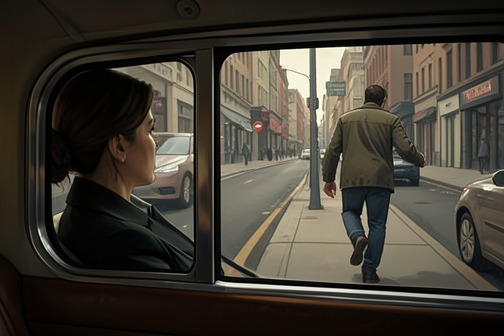
[Clare Cavendish](entity:character-recall-character-clare-cavendish-b98680ac20a6)’s sighting of [Nico Peterson](entity:character-recall-character-nico-peterson-5ffb47d561a4) in [San Francisco](entity:location-recall-location-san-francisco-8a14902ce523) is the first concrete indication that the man presumed dead may have been alive after his disappearance. On a crowded stretch of [Market Street](entity:location-recall-location-market-street-605cd9a3257b), Clare sees Nico walking in his familiar hurried manner but cannot reach him before he is gone. Her certainty about his identity is matched by her failure to act, and the scene’s later connection to her claim that she was present when his death occurred makes the sighting a hinge between apparent fact and unresolved mystery.
## The Reported Sighting
Clare places the encounter on Market Street in San Francisco, where she was riding in a taxi on business for her firm. Nico was on the sidewalk, moving along in the characteristic hurry she recognized. She imagines he was on his way to see somebody, but presents that as a guess, not knowledge: she has no conversation with him and does not discover where he is going. The sighting establishes his presence in the city, not the purpose of his journey or what happened afterward.
The timing gives the encounter particular force. Clare dates it to the Friday of the previous week, before she came to see [Philip Marlowe](entity:character-recall-character-philip-marlowe-4cdb66984662). When he checks that sequence, she confirms it. Her report is therefore not a distant recollection from an unspecified period: it places Nico in San Francisco shortly before Clare’s approach to the investigation. The account supplies a date and a recognizable location, while leaving the larger chronology of Nico’s disappearance unsettled.
## Recognition and Inaction
Philip Marlowe tests whether Clare could be sure of the person she saw. She answers without hesitation that she was sure it was Nico. Her confidence is not based on a conversation or an encounter at close range described in the account; it rests on recognizing him as he walked. That distinction leaves room for the detective’s scrutiny while making clear that Clare herself does not present the sighting as a resemblance or a guess.
Nico disappears from her view before she can decide what to do. Clare considers that she might have told the driver to turn around, but the street was crowded and she did not expect that a pursuit would have much chance of succeeding. More immediately, she describes herself as numb and paralyzed by surprise. The taxi offers a possible means of following him, yet neither the traffic nor her own response allows that possibility to become an action. She sees a man she believes should not be there and lets the moment pass without speaking to him.
When Marlowe asks whether the sight shocked her, Clare distinguishes surprise from shock. In her view, nothing Nico did could really shock her, even the prospect of his return from the dead. The distinction conveys her familiarity with his capacity to behave unexpectedly, but it does not explain what she knew about his circumstances. Her remark emphasizes how extraordinary the sighting is while presenting her reaction as a response to Nico’s established unpredictability.
## Relation to the Reported Death
The scene gains a second meaning through a later question. As Marlowe is about to leave, he recalls that he has not asked how Clare learned of Nico’s death. She answers casually that she was there when it happened. The statement directly links her to the event treated as Nico’s death, but the account gives no further particulars about what she witnessed, when she was there, or how that experience fits the Market Street sighting. It therefore sharpens the contradiction without settling it.
The order of disclosure matters. Clare first tells Marlowe that she saw Nico alive in San Francisco, then, in a later exchange, says she was present when his death occurred. The first report challenges the presumed finality of Nico’s death; the second complicates the credibility and completeness of the story surrounding it. Neither statement, by itself, explains whether the man on Market Street was truly Nico or what Clare means by being present when he died. The reader is left with two assertions that pull against one another.
## Narrative Function
The sighting changes the investigation from a search for an absent man into a question about the status of a supposedly dead one. Its evidence is intimate but limited: Clare recognizes Nico, fixes the encounter to a particular Friday and street, and describes why she did not follow him. She cannot provide a conversation, a destination, or a subsequent trace. This combination makes her certainty consequential without making it conclusive.
The scene also turns on a small missed opportunity. Clare could have asked the driver to turn back, but the crowded street and her paralysis of surprise prevent pursuit. The detail does not prove that following Nico would have succeeded; Clare herself doubts it. Instead, it marks the instant when a possible encounter becomes an unverified sighting. Her later remark about witnessing his death makes that lost chance more charged: she appears connected both to Nico’s apparent survival and to the event said to have ended his life, while the precise relation between those facts remains unrevealed.
Event 4
Gómez and López attack Marlowe and abduct Lynn Peterson
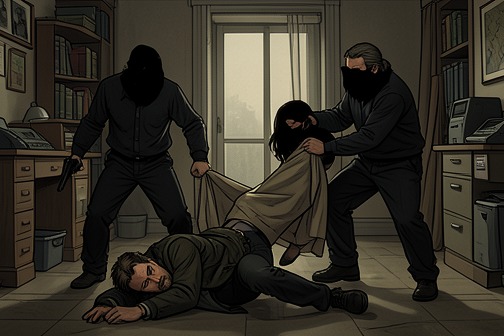
[Gómez and López attack Marlowe and abduct Lynn Peterson](entity:event-recall-event-g-mez-l-pez-marlowe-lyn-934609c89c62) in an abrupt assault that transforms [Philip Marlowe](entity:character-recall-character-philip-marlowe-4cdb66984662)’s inquiry into a personal and immediate crisis. The two men interrupt Marlowe as he is weighing whether to tell Lynn what [Clare Cavendish](entity:character-recall-character-clare-cavendish-b98680ac20a6) reported about seeing [Nico Peterson](entity:character-recall-character-nico-peterson-5ffb47d561a4) in [Frisco](entity:location-recall-location-d0db84fe8c04). They identify Lynn despite the name she is using, overpower Marlowe, and take her away. When he wakes, the extensive search of the house suggests that her abduction and their search for something inside it are connected, though he cannot yet determine what they wanted or where they have taken her.
## Background and Interruption
Before the attack, Marlowe is questioning Lynn about a man who had visited her. He has just asked whether the visitor gave his name when he notices a car outside, but gives it little attention. His attention is on whether to share information from Clare Cavendish: she said she saw Nico Peterson moving through the crowds on [Market Street](entity:location-recall-location-market-street-605cd9a3257b) in Frisco. Marlowe is unsure whether revealing this account is safe, and has not decided what to say when Lynn looks past him and a man enters through the back door with a gun. A second man follows. Their arrival interrupts the conversation before Marlowe can disclose what Clare Cavendish told him.
The intruders are later called [Gómez](entity:character-recall-character-g-mez-846b4ada92bd) and [López](entity:character-recall-character-l-pez-b2e76c6f5614) by Marlowe, who admits that he never learns their actual names. He assigns Gómez the role of the more calculating partner and López that of the physical enforcer. Their contrasting appearances make the pair legible to him even in the confusion: Gómez is short and solidly built, wearing a powder-blue double-breasted suit and an incongruously illustrated tie; López is lean, dressed in a conspicuous Hawaiian shirt, old white deck pants, and sandals. Gómez carries a large silver-plated automatic, while Marlowe reads López’s restless manner as that of a knife user. Their entrance gives immediate physical force to the threat that had until then been only an interruption in questioning.
## Recognition and Escalation
Gómez first presents himself and his partner as police, then turns to Lynn and challenges the name Cavendish. Lynn begins to protest but says nothing further when Gómez makes clear that he knows the name is not hers. The exchange establishes that the intruders have identified her through the assumed name rather than being misled by it. They do not explain how they know who she is, and the scene leaves their source of information undisclosed.
López approaches Lynn and presses her for her real name. When he makes an unwanted physical advance, Marlowe intervenes, taking López’s wrist and elbow and wrenching his arm free of Lynn. López produces a small knife in his other hand. Marlowe tries to keep his voice conciliatory while warning López to leave Lynn alone; at the same time, he is conscious that his own .38 Special remains in its holster and that reaching for it could provoke either attacker. The episode shows how quickly his attempt to protect Lynn narrows his options: Gómez has the gun, López the knife, and the detective cannot safely draw his own weapon.
## The Assault and Abduction
Gómez demands Marlowe’s wallet. Marlowe begins to object, but Gómez strikes him across the face with the gun. Marlowe stays upright, though he is hurt and disoriented. When Gómez orders him to stop speaking, Marlowe pretends to reach for a handkerchief and instead moves toward the spring closure of his holster. Before he can act, López knocks him unconscious from behind. Marlowe cannot identify exactly what López uses, and his account marks a break in his awareness rather than supplying a view of what happens next.
Marlowe’s waking account establishes the outcome through absences and damage rather than through a witnessed departure. His wallet is still there, but the holster is empty. Lynn is nowhere in the kitchen, living room, or bedroom. Given López’s behavior and the attackers’ recognition of her, Marlowe does not doubt that they took her with them. He does not know their destination and considers that they may already be heading toward the border. The episode therefore leaves the abduction’s route and immediate purpose unknown, while making clear that Lynn is no longer at the house and that Marlowe cannot pursue the men from what he has seen.
## Search and Aftermath
The house has been systematically torn apart. The attackers have emptied drawers and closets, opened the sofa and pulled out its stuffing, and cut into the bedroom mattress. Marlowe infers that they were searching for something and suspects they did not find it, but the object remains unidentified. The destruction consequently adds a second unresolved line to the abduction: the men have taken Lynn, and their search suggests that they came with an objective inside the house as well.
Marlowe is left without a reliable lead on the attackers. He did not see their car, despite an earlier description from a neighbor, and the telephone is dead. He briefly considers wiping the receiver but abandons the idea because his fingerprints are already throughout the rooms. Instead of treating concealment as useful, he acknowledges that he has already discussed Peterson with [Joe Green](entity:character-recall-character-joe-green-c464a0b0903b) and intends to contact him again about Lynn. His next step is therefore to return to the investigation and report the new disappearance, despite his weakened condition.
The scene’s decisive turn is from uncertain inquiry to direct danger. Marlowe’s hesitation over disclosing Clare Cavendish’s sighting is overtaken by an attack whose perpetrators already know Lynn’s identity. Their assault removes her from the investigation’s scene, takes Marlowe’s weapon, and leaves the house stripped apart without revealing what they sought. By limiting the account to Marlowe’s interrupted perception and later reconstruction, the episode makes the missing information part of its suspense: the reader knows that Lynn has been taken and that something was sought, but not where she is or what the search was meant to recover.
Event 5
Clare Cavendish commissions Marlowe to investigate Nico Peterson
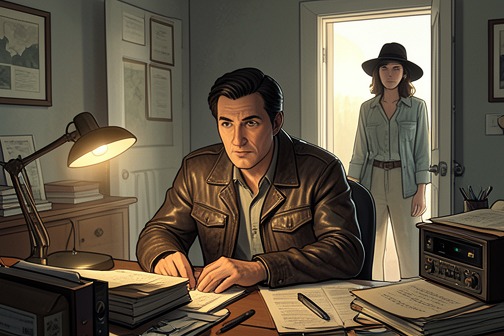
[Clare Cavendish](entity:character-recall-character-clare-cavendish-b98680ac20a6) commissions [Philip Marlowe](entity:character-recall-character-philip-marlowe-4cdb66984662) to investigate [Nico Peterson](entity:character-recall-character-nico-peterson-5ffb47d561a4) after reporting that she saw the man, presumed dead, alive in [San Francisco](entity:location-recall-location-san-francisco-8a14902ce523). The request sets the novel’s central inquiry in motion: what begins as a private search for a missing lover becomes a case involving an uncertain death, dangerous violence, and Marlowe’s growing suspicion that his client’s account is incomplete.
## The Commission and Its Circumstances
The encounter begins during a quiet summer Tuesday in Marlowe’s office, when business has been lean. His recent work has included a week as a bodyguard for a visiting businessman and recovering a rare coin collection for an elderly woman, a job arranged through [Bernie Ohls](entity:character-recall-character-bernie-ohls-16f1e7a1a29c). Against this ordinary professional background, a woman crosses at Cahuenga and [Hollywood](entity:location-recall-location-df7336761502) and enters Marlowe’s office without knocking. The contrast between the slow day and the case that follows gives the commission the quality of a sudden interruption in an otherwise stalled routine.
Marlowe later describes the initial request as familiar: Clare came to his office asking him to find her missing boyfriend. He had reservations, but accepted the assignment. At first, the apparent problem seemed to be the commonplace disappearance of a man who had withdrawn from a relationship rather than explain himself. That assumption mattered because it gave the case a simple shape: an absent boyfriend, a concerned client, and a private detective asked to locate him.
## A Report That Changes the Case
The commission’s decisive complication is Clare’s claim that she saw Nico alive on [Market Street](entity:location-recall-location-market-street-605cd9a3257b) in San Francisco. Until then, Marlowe says, his client and everyone else believed Nico was dead; his stated assignment was to investigate the death because there was a question about whether it had actually occurred. Clare’s reported sighting therefore changes the inquiry from a search for a missing man into an investigation of a presumed death and a possible concealed identity.
Marlowe makes clear that his knowledge at this point is limited. He has spoken to a few people, including Nico’s sister, but that conversation lasted only a few minutes before two men from the south interrupted it. His account emphasizes how little he can establish directly, even as the case begins to attract violence. In retrospect, the sighting is the hinge on which the assignment turns: without it, Nico’s presumed death might have remained settled; with it, Marlowe is sent back onto a trail whose facts do not fit together.
## The Investigation Broadens
As Marlowe recounts the case to Clare, he describes a sequence of reversals. He accepts the search, learns that Nico has supposedly died, and then has to reconsider that conclusion when Clare says she saw him walking in San Francisco. He resumes the investigation, only to find that people are being killed and that he himself has more than once nearly been killed. The commission thus carries consequences well beyond locating its subject: it draws Marlowe into a widening chain of danger and makes the original explanation increasingly difficult to accept.
Later, Marlowe’s working reconstruction supplies a possible criminal background to the missing-person case, though he presents much of it as inference rather than established fact. He suspects that Nico, a rich man’s son who had failed in the agenting business, became involved with the wrong people. Marlowe believes Nico may have taken a valuable shipment of contraband being carried from [Mexico](entity:location-recall-location-mexico-6f79111cb935) in a suitcase for [Lou Hendricks](entity:character-recall-character-lou-hendricks-5af8df2f5f81), and suspects that [Floyd Hanson](entity:character-recall-character-floyd-hanson-5e5f96067d9a) helped provide a substitute corpse to support Nico’s apparent death. He further supposes that [Wilberforce Canning](entity:character-recall-character-wilberforce-canning-f473f1d5548b) may have believed Nico was dead, while [Gómez](entity:character-recall-character-g-mez-846b4ada92bd) and [López](entity:character-recall-character-l-pez-b2e76c6f5614) came north to reclaim the goods they considered theirs. These theories make the commission’s original question—where Nico is—part of a larger one about who staged his disappearance and who stands to recover the missing shipment.
## Trust, Doubt, and the Unfinished Account
The assignment also tests Marlowe’s professional loyalty. After telling [Joe Green](entity:character-recall-character-joe-green-c464a0b0903b) that Clare had reported seeing Nico alive, Marlowe sits alone and wonders whether he has betrayed her confidence by bringing the police into the matter. He recognizes that involving Joe may have been an attempt to break a deadlock, but still questions whether he should have followed Nico’s trail further before sharing the information. The private commission therefore creates a conflict between discretion toward a client and the practical need to pursue a case that has become dangerous.
By the time Marlowe confronts Clare, he no longer accepts the simple missing-boyfriend explanation. He asks her to level with him because the case has changed from what it seemed at the start, and he believes she is the piece that does not fit. His suspicion is sharpened by their personal involvement: he recalls that she has been in his bed, while also insisting to himself that a wealthy woman like Clare is not someone he is suited to. Attraction and distrust coexist, complicating the professional relationship without resolving its central uncertainty.
The commission’s significance lies in its refusal to stay within the boundaries Clare’s first request appears to set. Her report gives Marlowe a reason to reopen the question of Nico’s death; the ensuing danger forces him to question both the facts and the person who hired him. Yet the investigation does not deliver a clean exchange of service for certainty. Clare never pays Marlowe for the work he was hired to do, and the case leaves him with a sharpened suspicion rather than a fully reconciled account of her motives.
Event 6
Lynn Peterson is abducted and murdered
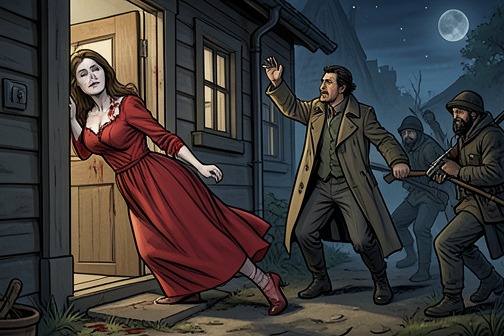
[Lynn Peterson](entity:character-recall-character-lynn-peterson-b221e94f1540)’s abduction and murder transform [Philip Marlowe](entity:character-recall-character-philip-marlowe-4cdb66984662)’s search for her supposedly dead brother into an investigation shadowed by a killing he could not prevent. The men who take her appear to be pursuing [Nico Peterson](entity:character-recall-character-nico-peterson-5ffb47d561a4) over a debt; after Lynn is found dead, Marlowe must face both his connection to the case and his inability to protect her.
## Causes and Abduction
Before the attack, Marlowe tells [Joe Green](entity:character-recall-character-joe-green-c464a0b0903b) that the Mexican men had already been seen watching the Peterson house, looking through its windows. He suspects Nico owed them a substantial amount of money, though this is Marlowe’s inference rather than confirmed knowledge. The men’s interest in the house therefore precedes Lynn’s appearance and links the abduction to their pursuit of her brother.
When Marlowe is at the house, Lynn is preparing drinks. Armed men enter through the back door, strike Marlowe, and take her away. He later tells Joe that there was no time to ask Lynn why the men were looking for Nico. The attack leaves Marlowe injured and the reason for the gunmen’s interest unresolved; his suspicion of a debt offers a likely motive, not an answer established by Lynn herself.
## Discovery at [Encino Reservoir](entity:location-recall-location-encino-reservoir-980531663acd)
After the abduction, Joe Green summons Philip Marlowe to Encino Reservoir, directing him along Encino Avenue and telling him to turn at a no-entry sign. The news that the missing woman has been found shifts the case from a search to the confirmation of a death. On the drive, Marlowe thinks of [Clare Cavendish](entity:character-recall-character-clare-cavendish-b98680ac20a6), whom he had recently frightened and angered, and of his own earlier confrontation with the armed men. He wonders whether keeping his temper might have prevented them from taking Lynn, while recognizing that this is uncertain; the possibility nevertheless gives his arrival an added weight of personal guilt.
At the reservoir, Lynn is identified through her driver’s license, though the condition of her body makes recognition difficult. The violence inflicted on her is described as severe, and the medical examiner indicates that her throat was cut before she died. Marlowe’s recollection of seeing her at the Peterson house—standing by the sink with an ice tray and telling him where to find the Canada Dry—sets an ordinary moment of hospitality against the fate that followed. The contrast makes the discovery more than a case detail: the woman he had only just met is now dead, and the men who took her have turned his search for Nico Peterson into an inquiry inseparable from her murder.
## Investigation and Responsibility
Lynn Peterson’s death also turns Marlowe from an investigator into a person the authorities have reason to examine. [Bernie Ohls](entity:character-recall-character-bernie-ohls-16f1e7a1a29c) points to the sequence that connects him to the case: Marlowe had been searching the Peterson house for Nico, Lynn appeared, armed men took her after knocking Marlowe down, and she was later found dead. Marlowe insists that he had met Lynn only that day and rejects the implication that he was involved, but he understands that Ohls is doing his job. He warns that pursuing the connection will waste time; Ohls regards Marlowe’s presence in the chain of events as a sufficient link to investigate.
That suspicion compounds Marlowe’s private sense of failure. He had already questioned whether calling Joe Green about Clare Cavendish’s sighting of Nico betrayed Clare’s trust, and whether he should have followed the lead longer before bringing the police in. After the abduction, he wonders whether a cooler response to the gunmen might have prevented them from taking Lynn, while admitting that this is only a possibility. The investigation therefore leaves him caught between professional judgment and personal accountability: he cannot know whether different choices would have changed Lynn’s fate, but he cannot treat her murder as merely another clue in the search for her brother.
## Narrative Presentation
The news reaches Philip Marlowe through Joe Green’s abrupt, joking exchange with him: Joe first answers Marlowe’s account of having stepped away with a sarcastic remark, then says the missing woman has been found and gives directions to Encino Reservoir. The shift from banter to the practical instruction to come and see makes the revelation arrive as a change in the conversation’s register before Marlowe encounters its full meaning. Because the episode is narrated through Marlowe’s immediate reactions, the earlier ordinary image of Lynn Peterson at the sink remains close to the later discovery, while the investigation’s language of leads and connections is made to carry the weight of a particular person’s death.
Event 7
Marlowe and Clare Cavendish’s brief affair
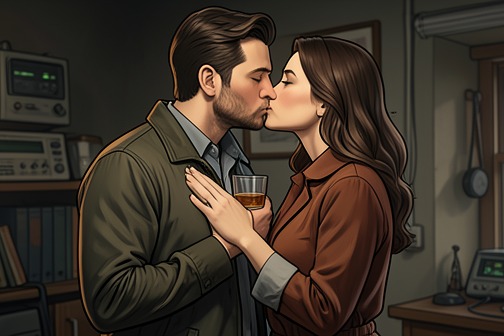
[Marlowe and Clare Cavendish’s brief affair](entity:event-recall-event-3d1fbddecb96) is an encounter in which physical closeness briefly seems more important than the dangerous business that brought them together, only for that concealed danger to bring the intimacy to an abrupt halt. The affair begins in mutual attraction and ends, at least in the scene shown, with Clare driving away after learning what Marlowe has kept from her. Its turn from tenderness to wariness makes the boundary between his work and his private life impossible to ignore.
## Attraction and Unequal Worlds
The intimacy begins with a kiss whose initiative neither can clearly claim: Marlowe recalls that he kissed Clare, that she kissed him, or that they reached for each other at once. Her hands rest against his chest without pushing him away; he puts his arms around her and feels her shoulder blades. The uncertainty over who began the kiss matters less than the shared physical movement. For a moment, attraction precedes explanation.
Afterward, Marlowe offers Clare a drink, and she asks for whiskey with water and no ice. The small exchange follows a meeting in which they have already tested one another verbally, but the shift into physical closeness does not remove his self-consciousness. When he lies beside her, he is not at ease. He thinks of the difference between them: Clare has class and money, is married to a polo player, and drives an Italian sports car. Having made love to a woman he regards as far above his station, he cannot settle into the assumption that their intimacy means they belong in the same world.
His comparison of himself to a solitary skiff against a grand cruise ship gives that unease a social and emotional shape. He presents himself as content with a solitary life, while Clare’s world appears to him crowded with attendants, maintenance, and polished display. The image is his own defensive self-description, not proof that he feels no desire for connection: his response to her touch and the unease he feels beside her show how strongly the encounter has unsettled that pose.
## The Bedroom and Its Unease
The bedroom makes the contrast between glamour and awkwardness more intimate. Clare touches the bruise on Marlowe’s cheek and comments on the heat of his skin before asking whether there is a bed in the house and whether the housekeeper would mind their lying down. Marlowe answers thickly, and notices that his voice is unsteady when he offers her a drink. The physical details register an attraction that neither needs to explain before acting on it; they also keep his injury, and the violence surrounding his work, close to the scene of tenderness.
After they have made love, an unremarkable lamp becomes the focus of Marlowe’s attention. Its shade bears crudely painted roses, an object he has long meant to discard but has allowed to remain in the room. He looks at its jam-like flowers while thinking about the woman beside him and asking himself what she is doing in bed with him. The lamp does not resolve his discomfort; its familiar, shabby presence emphasizes the distance between his home and the expensive life he associates with Clare. Intimacy has brought her into his room, but it has not dissolved his awareness of their unequal circumstances.
Clare’s question about whether he sleeps with all his clients brings the relationship’s professional frame into their private moment. Marlowe replies that he sleeps only with the female ones. The exchange is playful, but it keeps the client relationship visible even as they have crossed its usual boundary. Their attraction is neither separated from the investigation nor made secure by it: the intimacy takes place within a relationship that began as paid work, and Marlowe still decides what information to disclose as her investigator.
## The Withheld Incident
The break begins when Marlowe tells Clare that something happened that day. He recounts going to [Nico Peterson](entity:character-recall-character-nico-peterson-5ffb47d561a4)’s house to search it, [Lynn Peterson](entity:character-recall-character-lynn-peterson-b221e94f1540) arriving while he was there, and Mexican men coming to the house. He gives her a brief account without embellishment. The evidence conveyed in the conversation is limited to that outline, but its emotional consequence is immediate: Clare listens closely, then asks why he did not tell her earlier.
Marlowe answers that other things had been happening. Clare points back to their evening together and the bedroom, unable to understand how he could have kept the incident from her through their intimacy. He rejects the idea that he was deliberately withholding it and says that what was happening between them seemed more important. His explanation exposes the mismatch in their understanding of the night. He has treated the affair as the immediate priority; she experiences the delayed disclosure as a failure to trust her with what could put him in danger.
Clare then asks who the Mexican men were. Marlowe reassures her that one of them has no idea who she is or whom Marlowe is working for, and says the man will never know unless Marlowe is put before a grand jury, which he considers unlikely. His answer is a professional calculation meant to contain the risk, but it cannot undo the fact that Clare has only now learned about the episode. She says she is frightened, with wonderment mixed into her fear: she seems unable to understand how she has found herself caught up in such a mess.
## Withdrawal and Rupture
Marlowe tries to touch Clare’s arm, but she draws back as though his fingers would soil her coat sleeve. The gesture sharply reverses the earlier physical ease. A moment before, his hands had been around her back; now even attempted reassurance is refused. Clare says she must go home and turns away coldly. The exchange does not establish every later stage of their relationship, but within this encounter it marks the collapse of the closeness they had just shared.
Marlowe follows her down the redwood steps. Clare gets into her car, starts the engine almost at once, and drives away in exhaust smoke that stings his mouth and nostrils. He remains on the steps, clearing his throat and reproaching himself for how he handled the evening. His self-reproach ties the end of the affair to his own choices: he let the private encounter take precedence over telling Clare about a dangerous event, and then failed to persuade her that his silence had not been a deliberate betrayal.
The sequence makes the affair’s brevity a matter of structure as well as duration. A kiss, a drink, a shared bed, and a conversation about the case follow one another within the same evening; the disclosure does not arrive later as an unrelated complication but enters the bedroom scene and changes its meaning. The bruise Clare touched, first a point of tenderness, belongs to the same violent world that she learns about and fears. Marlowe’s private and professional selves cannot be kept apart simply by deciding which seems more important in the moment.
Event 8
Marlowe discovers Canning is the Peterson siblings' father
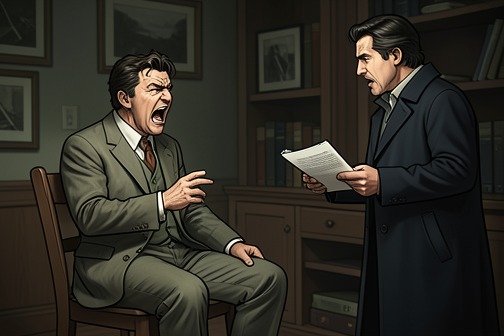
[Wilberforce Canning](entity:character-recall-character-wilberforce-canning-f473f1d5548b)’s disclosure that [Lynn Peterson](entity:character-recall-character-lynn-peterson-b221e94f1540) and [Nico Peterson](entity:character-recall-character-nico-peterson-5ffb47d561a4) were his children turns an interrogation into a reckoning with the family history behind their estrangement. Made while [Philip Marlowe](entity:character-recall-character-philip-marlowe-4cdb66984662) is bound and being questioned about Lynn’s death, the revelation connects Canning’s ruthless talk of killing to a private loss he has neither reconciled nor fully acknowledged. It explains the siblings’ surname and recasts Canning’s earlier questions about Lynn, while his own account leaves responsibility and grief entangled with contempt.
## The confrontation and its stakes
Before disclosing the family connection, Canning rebukes Marlowe for probing too closely and insists that killing can be necessary, presenting it as the elimination of people he considers undeserving of life. He then turns the questioning to Lynn. Marlowe says that he met her and thought her decent; Canning stresses that Marlowe was the last person to see her alive apart from the two men at the door. The exchange places Lynn’s death at the center of the encounter, but Canning’s posture is not merely that of a questioner gathering information: the statement that follows makes her death personal.
Canning asks whether Marlowe knew Lynn, then tells him that she was his daughter. The admission interrupts the interrogation with a fact Marlowe takes time to absorb. Canning watches for his reaction, and a momentary expression of sorrow crosses his face before he turns away toward the pool. The grief is brief and difficult to separate from the controlled manner of the disclosure. Marlowe does not pretend to have an answer; he acknowledges that he is surprised and does not know what to say. The scene shifts from tactical questioning to an unexpected account of kinship and loss, without making Canning’s confession an apology.
## The siblings’ identity and their mother
Marlowe follows the revelation with a practical question: if Lynn was Canning’s daughter, was Nico his son as well? Canning confirms that both were his children. That confirmation establishes a relationship that had not been apparent from the siblings’ name. When Marlowe asks why Canning’s daughter was called Peterson, Canning explains that Lynn took her mother’s surname, though he says he does not know why.
Canning describes his marriage in bitter, self-accusing terms. As he tells it, his wife married him for his money, left after he stopped her spending, and later ran away with a man he describes as a confidence trickster. He says he is not proud of that part of his life and offers his youth and infatuation as context, not as a full defense. His account is only Canning’s version of the marriage; the scene supplies no independent account from his wife or children. The surname explanation thus opens a family history while leaving its other perspectives absent.
## A father’s estrangement
Canning’s acknowledgment of paternity does not bring him closer to either child in the way he speaks about them. He describes Lynn and Nico disparagingly, attributes their character to their mother, and treats their deaths as compatible with his condemnation of them. Marlowe tells him he is sorry and distinguishes what he knows: he never met Nico, while Lynn seemed all right to him. He also asks why Canning did not attend Lynn’s funeral. Canning answers by dismissing her rather than explaining his absence, making the question expose the distance between biological relation and care.
As Canning resumes pacing, he admits that he was not a perfect father. He says the children first ran wild and then left, and that he made no effort to find them. By the time he recognized that there might have been something to make right, he believed it was too late. He says Lynn hated him and supposes Nico did too, though Nico had needed things from him. Canning does not explain what those things were, and he does not answer Marlowe when asked. That silence leaves an important part of the father-son relationship unresolved even as Canning confirms it.
## Meaning of the revelation
The event changes the meaning of Canning’s interest in Lynn: the man speaking about the dead woman is not only a powerful interrogator but her estranged father. His own account establishes that he knew of the siblings’ lives and departures, yet did not pursue them; it also shows that he reads their estrangement through blame, including blame directed at their mother. His brief visible sorrow sits beside that harsh judgment, not in place of it.
Marlowe’s responses keep the disclosure grounded in the immediate encounter. Bound and physically weakened, he nonetheless asks about the sibling relationship, the surname, and the funeral, bringing out facts Canning had not volunteered. The revelation does not settle what happened within the family or explain Nico’s unspecified dependence on his father. Instead, it supplies a clear relation and a damaged history while preserving the gaps in Canning’s account. Lynn and Nico are revealed as siblings and Canning’s children; the distance between them remains the defining consequence of the confession.
Event 9
Hanson's suicide while in custody
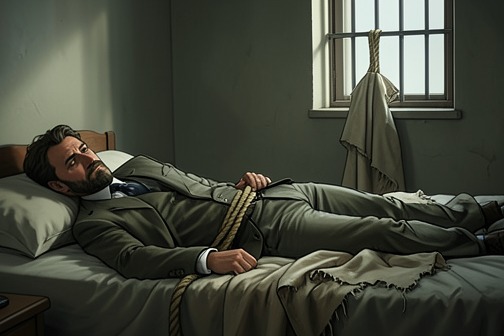
[Floyd Hanson](entity:character-recall-character-floyd-hanson-5e5f96067d9a)’s suicide while in custody is reported to [Philip Marlowe](entity:character-recall-character-philip-marlowe-4cdb66984662) in a late-night telephone call and later becomes part of his attempt to make [Clare Cavendish](entity:character-recall-character-clare-cavendish-b98680ac20a6) face the human cost of the case. The immediate report is brief, but Marlowe’s account supplies its circumstances: Hanson made a rope from a torn bedsheet, attached it to a window bar, and died in a cell where the window was too low for him to hang clear of the floor. The death is presented not as an unexplained accident but as a deliberate act whose effort and duration trouble those who hear of it.
## Circumstances and Discovery
The call comes after a punishing day. Philip Marlowe has gone to Barney’s Beanery and drunk six bourbons; [Travis](entity:character-recall-character-travis-ad440e929598), the bartender, refuses to serve him more, takes his car keys, and helps him into a cab. Marlowe eventually reaches home and falls asleep fully clothed. In the middle of the night, the telephone jolts him awake. Disoriented, he initially mistakes its ring for a fire alarm and has trouble opening the front door before answering.
[Bernie Ohls](entity:character-recall-character-bernie-ohls-16f1e7a1a29c) tells him that Floyd Hanson has just been found in his cell, hanging from a window bar. Hanson has torn a bedsheet into strips and twisted them together to make a rope. Because the window is not high enough, he cannot simply drop clear of the floor; the circumstances require him to keep his feet on the ground and his knees bent while he dies. The detail makes the death sound laborious rather than sudden. The report gives no motive for Hanson’s act, and neither the call nor Marlowe’s later account supplies one.
## The Call and Its Immediate Aftermath
Bernie Ohls initially treats Hanson’s death with bleak humor, remarking that another potential source of information will no longer speak. His joke does not amount to indifference: his laughter is described as lacking enjoyment. Philip Marlowe answers that Ohls is all heart, but the exchange quickly turns from gallows humor to Marlowe’s condition. Ohls hears that Marlowe is drunk, and Marlowe struggles to make himself understood before the two men laugh again.
Even while intoxicated, Marlowe shifts the conversation to Bartlett, the older man he had shot in the knee during his own ordeal. Ohls says Bartlett is in a coma, has lost a great deal of blood, and is receiving transfusions; whether he will survive remains uncertain. Marlowe insists that Bartlett had nearly drowned him, while Ohls reproaches him for the severity of the shooting. The call thus places Hanson’s death beside another uncertain life, but it does not establish a direct connection between the two men’s fates. Instead, it shows how one piece of bad news arrives amid a wider sequence of violence and injury.
## Marlowe’s Later Account to Clare Cavendish
When Philip Marlowe later speaks with Clare Cavendish, he lists Hanson’s death among the events she must confront. Clare asks what he means about Hanson, because the newspaper had presented a different account. Marlowe rejects the newspaper’s implication of an accidental death and recounts the bedsheet, the window bar, and the low window. He emphasizes the time and determination required by the method, forcing the death out of the newspaper’s compressed public version and into a concrete account of a person’s final actions.
Clare’s response is immediate: her face turns ashen, and she expresses pity for Hanson. Marlowe watches her, uncertain whether she is acting, then uses the death to press her about what she knows. He places it within a catalogue of the case’s brutality: [Lynn Peterson](entity:character-recall-character-lynn-peterson-b221e94f1540) has died painfully, two Mexican men have been beaten to death, and [Wilberforce Canning](entity:character-recall-character-wilberforce-canning-f473f1d5548b) has fled the country. Hanson’s suicide is therefore not offered as an isolated revelation. In Marlowe’s argument, it is one part of the accumulating damage that makes it impossible for Clare to treat the investigation as a tidy or distant affair. Her reaction suggests that the corrected account has made the death newly real to her, though the scene does not establish what she previously knew about Hanson.
## Consequences and Narrative Significance
Hanson’s death has an immediate investigative consequence: as Bernie Ohls’s dark joke implies, a man who might have supplied information is no longer available to speak. The evidence does not disclose what Hanson could have revealed, or whether his death was intended to conceal anything. The narrative leaves that uncertainty intact rather than assigning him a motive. Later, when Philip Marlowe calls Ohls about the [Cahuilla Club](entity:location-recall-location-cahuilla-club-a0520850d415) case, there is no trace of Wilberforce Canning, Bartlett remains unable to speak in a coma, and the two dead Mexican men have not been identified. Those unresolved circumstances keep Hanson’s death within a larger aftermath marked by missing testimony and uncertain outcomes.
The event also exposes the gap between a public report and the physical circumstances Marlowe recounts. The newspaper account Clare has seen reduces Hanson’s death to an apparent accident; Marlowe’s fuller description changes its meaning by establishing that Hanson acted deliberately. His account does not explain why, but it insists on the work and endurance involved. That insistence matters in a novel where violence can be absorbed into case files, headlines, and investigators’ cynical exchanges. The scene briefly interrupts that flattening: a quip about lost testimony gives way to the difficult particulars of the death, and later the same particulars become a way of making Clare recognize the human consequences surrounding her.
Event 10
Nico Peterson’s suspected staged death
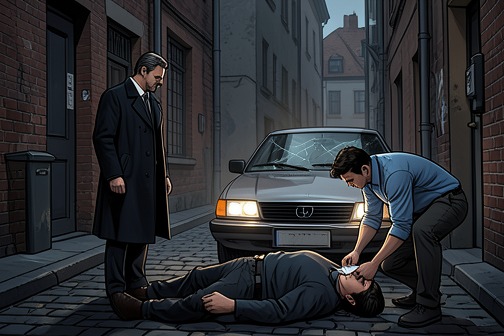
[Nico Peterson’s suspected staged death](entity:event-recall-event-0d64cfce0791) is the hinge on which [Philip Marlowe](entity:character-recall-character-philip-marlowe-4cdb66984662)’s investigation turns. What first appears to be a documented hit-and-run becomes a question of identity: who died on [Latimer Road](entity:location-recall-location-latimer-road-9eab7ed9408d), who recognized the body, and whether Peterson was alive after the date on which he was officially pronounced dead. Marlowe develops a possible explanation involving a substitute corpse and a valuable shipment, but the account leaves that reconstruction as a theory rather than a proven solution.
## The reported death
[Joe Green](entity:character-recall-character-joe-green-c464a0b0903b) tells Marlowe that Peterson died on [April 19](entity:time-recall-time-4-19-7965758be02e) in the [Pacific Palisades](entity:location-recall-location-cbe4ec5f2180), near a local club, and that the death was recorded as a hit-and-run. Joe has consulted the records closely enough to offer the cemetery plot number, making the death sound not merely reported but administratively settled. The confidence of the announcement contrasts with Marlowe’s later doubts about the identity behind it.
Marlowe obtains the county file and finds a more precise account. It places the incident on Latimer Road in Pacific Palisades, within [Los Angeles](entity:location-recall-location-los-angeles-11eff639bdf5) County, sometime between eleven at night and midnight on April 19. The driver is listed as unknown. The file’s official description establishes that a person died after being struck by a vehicle, but it does not establish for Marlowe that this person was [Nico Peterson](entity:character-recall-character-nico-peterson-5ffb47d561a4). A recorded death and a secure identification are not the same thing.
## Gaps in identification
When Marlowe questions the man who was at the scene and called the police, the man clarifies that he did not officially identify the body. He believes Peterson’s sister did so at the morgue the following day. Elsewhere, Marlowe’s account treats [Lynn Peterson](entity:character-recall-character-lynn-peterson-b221e94f1540) as the person shown the body and as the person who identified it as her brother. The distinction matters: the identification rests on Lynn’s recognition, while the scene witness’s presence and call to the police may have helped support the account without formally confirming the dead person’s identity.
Marlowe makes the weakness of that chain explicit by asking about Peterson’s identity. The man insists that there could be no doubt: he saw the body at the roadside, and Lynn expressed no doubts when she saw it at the morgue. But Marlowe has a conflicting piece of information: someone had recently seen Peterson alive. That sighting does not by itself prove that the dead person was someone else, but it makes the established account unstable. The case shifts from asking how Peterson died to asking whether he died at all.
## A possible substitute corpse
Marlowe’s proposed reconstruction grows from details associated with the [Cahuilla Club](entity:location-recall-location-cahuilla-club-a0520850d415). [Floyd Hanson](entity:character-recall-character-floyd-hanson-5e5f96067d9a) was among the first people at the roadside and gave an initial identification. The club, Marlowe has learned, employed people described as loners and drifters, individuals with little history or prospect of support elsewhere. That hiring practice supplies a possible pool of people whose identities might be difficult to verify. A club employee’s reference to the group as the [Lost Boys](entity:expression-recall-expression-lost-boys-cda57f0d8d70) also gives Marlowe a phrase to connect with Hanson, whom he associates with the Captain Hook figure in Peter Pan.
Marlowe and Joe consider whether the body identified as Peterson’s could have belonged to one of those club workers. In their tentative scenario, Peterson might have killed a club employee, exchanged clothes with him, and arranged for the body to be left at the roadside in a condition that would obstruct recognition. Hanson’s early presence and preliminary identification could then have helped the substitution pass as Peterson’s death. Marlowe urges Joe to question Hanson again, reasoning that a closer interrogation might reveal the whole arrangement. The sequence is an inference constructed from circumstances, not a confirmed account of what happened.
## Motive and unresolved questions
Marlowe’s later review of the case gives the theory a possible financial motive. He understands Peterson as the son of a wealthy man who had failed to prosper in the agenting business and may have become involved with dangerous associates. Marlowe suspects that Peterson had diverted a suitcase of contraband being transported from [Mexico](entity:location-recall-location-mexico-6f79111cb935) for [Lou Hendricks](entity:character-recall-character-lou-hendricks-5af8df2f5f81); if the shipment was worth a great deal, faking a death could offer a way to escape those searching for it. He also suspects that Hanson assisted Peterson by providing a substitute body, while believing that [Wilberforce Canning](entity:character-recall-character-wilberforce-canning-f473f1d5548b) did not know about their arrangement and accepted Peterson’s death as genuine.
In the same provisional account, Marlowe considers [Gómez](entity:character-recall-character-g-mez-846b4ada92bd) and [López](entity:character-recall-character-l-pez-b2e76c6f5614) to be the shipment’s original owners, come north to recover the goods Peterson took. These explanations link the questionable death to the missing contraband and to the people pursuing it, but Marlowe marks them as suspicions rather than settled facts. He is also unable to accept [Clare Cavendish](entity:character-recall-character-clare-cavendish-b98680ac20a6)’s explanation that she hired him simply to find a faithless boyfriend who had first pretended to be dead and then appeared alive. Her place in the affair remains the puzzle he cannot fit into his reconstruction.
The suspected staging therefore rests on a conflict between official closure and incomplete knowledge. The date, location, hit-and-run classification, and morgue identification give the death a solid public record; the uncertain identity of the body, Hanson’s role, the club’s transient workforce, and the later sighting reopen it. Marlowe’s theory makes the evidence intelligible without conclusively resolving it. Peterson’s death remains both a documented event and a possible disguise for escape.
Event 11
The Cahuilla Club case is covered up as Canning flees the United States
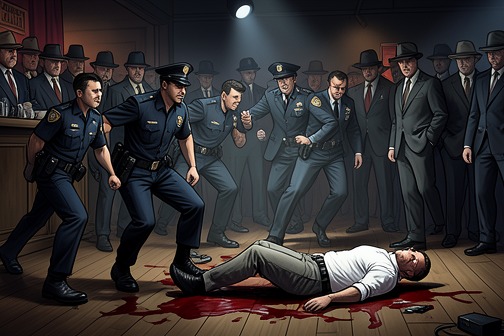
The [Cahuilla Club](entity:location-recall-location-cahuilla-club-a0520850d415) case is covered up as [Wilberforce Canning](entity:character-recall-character-wilberforce-canning-f473f1d5548b) flees the United States in the aftermath of a raid that exposes multiple deaths and Canning’s role in the violence. The episode turns an attempted investigation into a contest over what can be publicly known: arrests and evidence reach the authorities, but the newspaper account recasts the events, Canning escapes, and [Harlan Potter](entity:character-recall-character-harlan-potter-84383d7ff561)’s influence helps suppress the fuller story.
## The raid and its immediate aftermath
After [Philip Marlowe](entity:character-recall-character-philip-marlowe-4cdb66984662) escapes the club, he contacts [Bernie Ohls](entity:character-recall-character-bernie-ohls-16f1e7a1a29c), whose men raid the Cahuilla Club. They find Bartlett by the pool, incapacitated by blood loss. The officers must make their way through a crowd of drunken [Shriners](entity:organization-recall-organization-shriners-caae67ed70d0) on the grounds, an unruly setting that contrasts with the controlled account of events that will later appear in print.
[Floyd Hanson](entity:character-recall-character-floyd-hanson-5e5f96067d9a) is arrested at his apartment in [Bay City](entity:location-recall-location-bay-city-259719032541) while packing to leave. Ohls remarks that the amount Hanson was trying to take with him may have cost him the time needed to get away. His capture gives the investigators access to information about the deaths at the club. Under questioning, Hanson explains that Bartlett tortured two Mexican men for information and then killed them on Canning’s orders. He also offers to show investigators where the bodies were left, in a lime pit on the club grounds. The raid thus produces a record of violence and a witness connecting it to the club’s owner, even as the principal figure behind the operation is already beyond reach.
## Canning’s escape
Ohls tells Marlowe that Canning has fled. When officers reach Canning’s house in Hancock Park, the staff report that he returned in a hurry, appearing as though he had been caught in a sudden downpour, and immediately ordered a bag packed and a car brought to take him to the airport. The account places his departure after the club events but before the officers can question or arrest him.
The Sheriff’s office checks passenger lists, while Ohls’s men circulate Canning’s photograph among airline staff. One check-in employee thinks she recognizes him, but cannot remember the name he used or the destination listed on his ticket. Investigators learn that the flight went directly to Toronto, with a further leg to London, England; they do not establish which destination Canning intended to reach. The office therefore directs attention to the manifest for the Air Canada night flight to Toronto. The search gives the authorities a route to pursue, but the false name and uncertain onward destination leave Canning’s whereabouts unresolved.
## The public account and its omissions
The next morning, Marlowe reads the newspaper’s version of the incident. It describes two unidentified intruders breaking into the club and being tackled by security staff, with two deaths resulting. Bartlett is not named. The report identifies the club manager as Floyd Hanson, but says he later died accidentally while in police custody. It also reports that Canning left for an undisclosed destination abroad.
This account preserves fragments of what happened—the club, two deaths, Hanson’s involvement, and Canning’s departure—while changing their meaning and withholding identifying details. It presents the violence as an encounter initiated by intruders and treats Hanson’s death as accidental. The report therefore does not merely omit information: it arranges the surviving facts into a version that obscures responsibility and makes the case appear less connected than the investigators’ findings indicate. Marlowe understands the scale of the suppression through the difference between what Ohls’s investigation has uncovered and what the front page allows readers to believe.
## Potter’s influence and the truth about Hanson
Ohls identifies a connection that helps explain why the report is so carefully limited: Canning is a close business associate of Harlan Potter. Marlowe immediately understands the implication. He had already worried that informing [Joe Green](entity:character-recall-character-joe-green-c464a0b0903b) about [Clare Cavendish](entity:character-recall-character-clare-cavendish-b98680ac20a6)’s claim to have seen [Nico Peterson](entity:character-recall-character-nico-peterson-5ffb47d561a4) alive might have betrayed her trust; now the investigation’s facts are confronting a wider power structure in which the truth can be contained before it reaches the public.
Marlowe later corrects the newspaper’s account to Clare Cavendish. Hanson did not die accidentally, he tells her: he tore a sheet into a makeshift rope, attached it to a window bar, and deliberately hanged himself, despite the window’s low height. Clare has read the report and reacts with shock when she learns the truth, expressing pity for Hanson. The contrast makes the cover-up personal as well as institutional: the false account hides the circumstances of a death from the public and from someone seeking to understand the chain of events.
## Consequences and significance
The official response is divided between what the investigators know and what can be made to stick publicly. Bartlett and Hanson are found or arrested, the two men’s deaths are traced to orders from Canning, and investigators attempt to follow Canning’s flight. Yet the newspaper reduces the club violence to an incident, leaves Bartlett unnamed, misstates Hanson’s death, and gives no destination for Canning beyond abroad. Canning’s escape and the report’s omissions leave the central question of accountability open.
The episode also alters the meaning of Marlowe’s case. He had been considering whether his decision to bring Ohls into the Peterson investigation had compromised Clare’s confidence. By the time he speaks with her again, the case has widened into a sequence of abduction and murder, killings at the club, Hanson’s suicide, and Canning’s flight—events whose connections are real, but whose public presentation is being actively narrowed. The cover-up makes the gap between evidence and public narrative part of the outcome: the authorities can recover bodies and identify perpetrators, while wealth and business ties help determine which version enters the newspaper.
Event 12
Murder of Sylvia Lennox
The murder of Sylvia Lennox sets in motion [Terry Lennox](entity:character-recall-character-terry-lennox-c498a510bbb4)’s flight and [Philip Marlowe](entity:character-recall-character-philip-marlowe-4cdb66984662)’s involvement in it. The account does not establish who killed Sylvia or describe the circumstances of her death; its emphasis is on the consequence that follows, as Terry leaves the country while facing the prospect of taking the blame.
## The Murder and Its Immediate Aftermath
Terry’s wife had been murdered, and suspicion had gathered around him to the point that it appeared he might be held responsible. The narrative supplies no further particulars about the crime itself. Instead, it makes the murder the hinge between Terry’s life in California and the escape that Marlowe helps arrange.
The day after the murder, Marlowe drove Terry to the airport in [Tijuana](entity:location-recall-location-tijuana-47bb9d0aad74). Terry caught a flight south, beginning a disappearance that would involve a staged suicide in [Otatoclán](entity:location-recall-location-otatocl-n-40b5633a59f7), plastic surgery, and a new identity. The chronology is clear even where the case remains obscure: the murder comes first; flight follows the next day.
## Marlowe’s Involvement and the Flight
Terry’s escape had immediate consequences for Marlowe. When Marlowe returned from taking him to Tijuana, [Joe Green](entity:character-recall-character-joe-green-c464a0b0903b) was waiting. The authorities treated Marlowe as an accessory, and Joe’s superior, Gregorius, roughed him up. Marlowe spent a couple of nights in jail before the report of Terry’s supposed suicide led to his release. The episode put both his freedom and his professional reputation at risk.
Marlowe later regarded the debt between them as real: he had helped Terry leave, and had paid for that help. Terry’s later account of the escape from his former life involved [Mendy Menendez](entity:character-recall-character-mendy-menendez-67c76f55ab5a) and Randy Starr, wartime companions who helped him disappear and acquire a new identity. The story of their wartime bond included Terry saving the group after a mortar shell landed in their foxhole, but Marlowe did not know how much of Terry’s continuing account to believe. That uncertainty shadows the story of the flight from the start.
## A Crime Obscured by Reinvention
The murder’s significance in the narrative is bound up with the identities that follow it. After Sylvia’s death, Terry fled to [Mexico](entity:location-recall-location-mexico-6f79111cb935), faked his suicide, underwent plastic surgery, and became a man Marlowe encountered only briefly before he disappeared again. When Terry later reappears, Marlowe recognizes how little certainty he has about the person beneath these successive versions of himself. He had discovered that Terry was not the man from Salt Lake City he had claimed to be, but Paul Marston, born in Montreal; even that discovery did not settle who Terry had been before.
The murder itself therefore remains a fixed point in a shifting account. It is the known cause of Terry’s flight, but it does not resolve his guilt or explain the full story of his identity. The staged suicide that followed further separated the public record of Terry’s fate from the life he continued elsewhere.
## Marlowe’s Retrospective Judgment
The murder also frames Marlowe’s later reassessment of Terry. Marlowe does not commemorate the man who died after Terry’s return as the friend he once knew: in his view, that earlier Terry had already been lost. He had thought of Terry as a gentleman, despite his drinking, his relationships, and the company he kept; he also recognizes that Terry ultimately cared for no one but himself.
Marlowe rejects Terry’s explanation that the war had emptied him of everything alive as too neatly romantic. He instead wonders whether Terry’s years in Mexico, his dependence on Mendy, and the life he built there had worn away the decency beneath his polished manner. Sylvia’s murder is not explained by that judgment, but it marks the beginning of the chain of flight, concealment, and compromised loyalty through which Marlowe comes to question the man he had helped escape.
Event 13
Terry Lennox's staged suicide
[Terry Lennox](entity:character-recall-character-terry-lennox-c498a510bbb4)’s staged suicide in [Otatoclán](entity:location-recall-location-otatocl-n-40b5633a59f7) gave him a way to disappear from the consequences of his wife’s murder and begin again under an altered face and name. Yet the escape did not settle who he was: the account of his reinvention is layered with borrowed identities, loyal allies, and stories that [Philip Marlowe](entity:character-recall-character-philip-marlowe-4cdb66984662) never fully trusts.
## Causes and Background
After Terry’s wife was murdered and he appeared likely to take the blame, he fled to [Mexico](entity:location-recall-location-mexico-6f79111cb935). Marlowe later acknowledges that he helped him escape. The flight culminated in the staged suicide at Otatoclán, which made it possible for Terry to vanish from his former life rather than face the case against him.
Terry’s appearance had already been shaped by a story of wartime injury. He had told Marlowe that a mortar blast and subsequent capture by the Germans left his face badly altered. Marlowe presents this as an account Terry had spun, not as a history he can verify. The staged death was followed by a far more deliberate transformation: Terry underwent expert plastic surgery and took on a new identity.
## The Staged Death and Reinvention
The supposed suicide was part of an escape, not an end. After it, Terry disappeared from Marlowe’s life; Marlowe saw him once under his new identity before losing track of him again. When Terry later reappeared, Marlowe recognized the man he had known, but also registered how completely his face had changed. That return made the earlier disappearance newly legible as one stage in an ongoing act of self-reinvention.
The new identity did not resolve the question of Terry’s original one. Marlowe eventually discovered that he was not Terry Lennox of Salt Lake City, as he had claimed, but Paul Marston, a Canadian born in Montreal. Even this revelation leaves the history open: Marlowe wonders who Terry may have been before that name and who he might become next. The sequence turns the staged suicide into more than a false report of death; it is a hinge between identities whose truth is never fully secured.
## Allies and the Limits of the Account
[Mendy Menendez](entity:character-recall-character-mendy-menendez-67c76f55ab5a) and Randy Starr helped Terry disappear and establish a new identity. Their loyalty was linked, in the account Marlowe had heard, to a wartime episode: the three men had shared a foxhole in France when a mortar shell landed, and Terry supposedly saved them by grabbing it and throwing it away. Marlowe treats this as a continuing story rather than settled fact, making the origin of their debt another uncertain layer in Terry’s history.
After his reinvention, Terry remained in contact with Mendy and said that they were both based in [Acapulco](entity:location-recall-location-acapulco-2920abf70957). His flight therefore did not sever every connection; it replaced his former life with a more distant one sustained by old allies. For Marlowe, who had helped him escape and later encountered him again, the episode leaves a distinction between recognizing a familiar person and knowing the truth of his identity.
Event 14
Nico Peterson's staged death
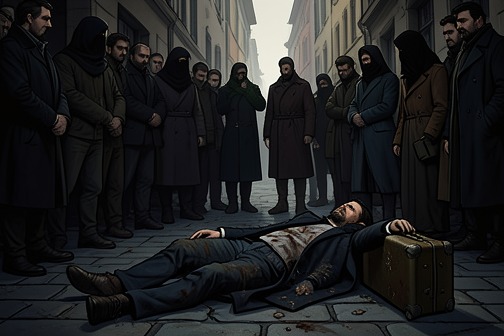
[Nico Peterson's staged death](entity:event-recall-event-nico-peterson-s-staged-1210d9528eb1) was a substitution designed to make his disappearance look like a fatal hit-and-run. An unidentified club worker's body, dressed in Nico's clothes, was left on [Latimer Road](entity:location-recall-location-latimer-road-9eab7ed9408d) while Nico escaped north with a suitcase. The later account of the scheme unsettles the official record of his death: the body had been reported, examined, and identified, yet the identification had been part of the deception.
## The Official Account
The apparent death was dated [April 19](entity:time-recall-time-4-19-7965758be02e). [Joe Green](entity:character-recall-character-joe-green-c464a0b0903b) told [Philip Marlowe](entity:character-recall-character-philip-marlowe-4cdb66984662) that Nico had died that night in a hit-and-run near a club in [Pacific Palisades](entity:location-recall-location-cbe4ec5f2180), and said that he was buried at Woodlawn. The report Marlowe later examined placed the collision on Latimer Road, between eleven o'clock and midnight, and recorded blunt-force trauma as the cause of death. It also included a photograph taken at the scene. These details gave the presumed death the authority of a police file and a burial record, even though the victim's identity was false.
The identification chain appeared to reinforce that conclusion. A witness who had been at the scene told Marlowe that he had not officially identified the body; he believed Nico's sister had done so at the morgue the following day. When Marlowe challenged him, he emphasized that he had seen Nico on the road and that Nico's sister had expressed no doubts. Marlowe's contrary information—that someone had recently seen Nico alive—made the confidence of those accounts itself a source of suspicion.
## How the Substitution Was Arranged
Nico later told Marlowe that the body had belonged to a roustabout who worked at the [Cahuilla Club](entity:location-recall-location-cahuilla-club-a0520850d415). He denied killing the man and said he had not asked [Floyd Hanson](entity:character-recall-character-floyd-hanson-5e5f96067d9a) about the body's origin; he had assumed the man had died naturally because he saw no marks. The account therefore establishes the body's substitution and Hanson's participation, but does not establish who caused the roustabout's death.
Hanson helped Nico put the body into Nico's suit behind the clubhouse. They then carried it in a wheelbarrow to the road. Nico had spent the evening acting drunk and making sure people saw him, so that witnesses would connect the apparent victim with the person they had watched at the club. [Clare Cavendish](entity:character-recall-character-clare-cavendish-b98680ac20a6) was among those present. The staged scene depended not only on clothing but on the manufactured continuity between Nico's public appearance and the body found afterward.
Nico had also arranged the aftermath with his sister, [Lynn Peterson](entity:character-recall-character-lynn-peterson-b221e94f1540). He said that he had fixed it with Lynn to identify the body and arrange for cremation. Those plans were meant to close off further scrutiny and complete the appearance of a confirmed death; the account establishes the arrangement, not whether every planned step was carried out. Once the body had been left by the road, Nico drove away in a car he had parked farther down the road, with the suitcase in its trunk, and headed north.
## Exposure and Unresolved Details
The scheme was revealed during Marlowe's questioning of Nico, turning what had been treated as a settled death into a concealed escape. The surviving official details—date, location, medical cause, photograph, and family identification—did not prove that Nico had died. Instead, the confession showed how each could be made to support a false identity when the body, clothing, witnesses, and planned disposition were coordinated.
Important uncertainties remain. Nico said that he did not know who the roustabout was and had not asked Hanson about him. Although Marlowe inferred that Hanson must have killed the man, Nico's account did not confirm that inference. Nor does the confession establish that Lynn knew the body was not her brother; it establishes that Nico had arranged for her to identify it and plan a cremation. The deception is clear, but responsibility for the roustabout's death and the full extent of the other participants' knowledge are not.
## Narrative Significance
The staged death makes identity a matter of evidence and procedure rather than appearance alone. A suit, a body placed on a road, a witness's recollection, a sister's identification, and an official file combined to make the false conclusion persuasive. The story first presents those records as confirmation, then reveals that they were elements in Nico's escape plan. The reversal does not erase the evidence; it changes what the evidence can be said to establish. Nico's supposed death is thus both a practical disguise and a test of how readily a documented account can be mistaken for the truth.
Event 15
Peterson's diversion of Menendez's heroin shipment
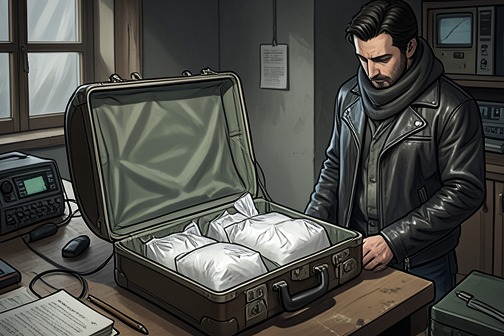
[Peterson's diversion of Menendez's heroin shipment](entity:event-recall-event-peterson-s-diversion-of-a2eb8938282f) turns a routine courier arrangement into a dangerous breach of trust: [Nico Peterson](entity:character-recall-character-nico-peterson-5ffb47d561a4) takes a load intended for [Lou Hendricks](entity:character-recall-character-lou-hendricks-5af8df2f5f81)'s distribution network and tries to sell it on his own. The independent deal fails before it can provide him with an escape. By the time Peterson explains the scheme to [Philip Marlowe](entity:character-recall-character-philip-marlowe-4cdb66984662), the shipment has become both valuable contraband and a liability he cannot safely unload.
## Shipment and division of labor
The heroin moves through a chain connecting [Mendy Menendez](entity:character-recall-character-mendy-menendez-67c76f55ab5a), who operates from [Mexico](entity:location-recall-location-mexico-6f79111cb935), with Hendricks, who handles distribution. Menendez sends a consignment every couple of months or so; Peterson says he carried deliveries for Hendricks a few times, describing the work as easy money. His role gives him access to the shipment, but it does not make him an independent participant in the business. The arrangement depends on each person performing a defined task, with Hendricks responsible for getting the drugs into circulation.
Peterson's account identifies the diverted load as ten keys of heroin concealed in the false bottom of a suitcase, divided among twenty cellophane bags. The hidden compartment makes the shipment portable and concealable, but it also makes the suitcase a concentrated risk: Peterson is carrying a large quantity that belongs to a criminal network, not merely keeping an unrecorded share. When Marlowe asks what the case contains, Peterson first tries to resist answering; under pressure, he reveals the false bottom and then confirms that the substance is heroin. The disclosure exposes the scale and nature of the crime behind his disappearance.
## The independent sale fails
Peterson says he decided to keep the shipment and arrange his own sale through an acquaintance in [Frisco](entity:location-recall-location-d0db84fe8c04). The acquaintance claimed that, for a cut, he could place the drugs with the mob without asking questions. Peterson's intended advantage was straightforward: avoid returning the consignment to Hendricks, find a buyer with enough reach to take it, and leave with money. But the plan relied on an intermediary who proved unavailable before the sale could happen.
Peterson explains that the acquaintance met a fatal end after his wife caught him cheating: she shot him in the face and then killed herself. The abruptness of this account leaves Peterson without the contact on whom the scheme depended. He is left with the heroin and no replacement buyer. The failed deal is therefore not a completed transfer or a successful escape, but a diversion that strands him with the very cargo he had hoped to turn into a fortune.
Peterson's own response reveals how quickly imagined profit gives way to helplessness. He acknowledges that he could not sell the heroin to the mob himself because he lacked the necessary contacts. He also admits that he was too frightened to attempt it. The plan's failure is not only practical: it brings Peterson back into the reach of the organization whose shipment he has taken, while removing the one intermediary he believed could protect his interests.
## Exposure and fear of retaliation
The prospect of returning the drugs does not appear safe to Peterson either. He believes Hendricks would take the shipment back and then have one of his men torture him, beginning by pulling out his fingernails. His reasoning gives the diversion its immediate stakes: the drugs are dangerous to retain, but surrendering them would not, in Peterson's view, undo the betrayal or guarantee his survival. The choices he describes narrow to an attempted independent sale that has already failed and a return to a network he expects to punish him.
Peterson says that hearing about Lynn made him more frightened. He does not explain further in this exchange, so the account establishes her as part of the pressure closing around him without specifying exactly what he had learned or when. He describes a growing sense that things were closing in and says he knew what would happen if Hendricks got hold of him. His explanation thus links the lost buyer, the retained heroin, and his fear of retaliation to the circumstances in which Marlowe finds him.
## Significance in the investigation
The diversion makes clear that Peterson's predicament is not simply a matter of hiding from Hendricks: he has taken a substantial shipment and tried to redirect it into another criminal market. His admission also explains why the suitcase matters. Its false bottom conceals a quantified load of heroin, and Peterson's account connects that load to Menendez's supply and Hendricks's distribution operation. The apparent private disappearance therefore opens onto a larger trafficking arrangement.
The episode also sharpens the contrast between Peterson's initial confidence and his eventual fear. He once treated courier work as easy money and imagined that an intermediary could convert the stolen shipment into a safe fortune. Instead, the intermediary is dead, Peterson has no contacts of his own, and the drugs remain in his possession while Hendricks's retaliation looms. The failed diversion reveals the difference between taking a shipment and controlling the network needed to sell it. In Marlowe's investigation, that difference turns Peterson's account into both an explanation of the suitcase and a measure of how precarious his position has become.
Event 16
Murder of Lynn Peterson
[Lynn Peterson](entity:character-recall-character-lynn-peterson-b221e94f1540)’s murder is the consequence of her involvement in [Nico Peterson’s disappearance](entity:event-recall-event-nico-peterson-s-disappe-b09fe677be1f) and of a search for him that escalates into violence. By identifying the body officially recorded as Nico’s, she helped make his presumed death appear settled; when men were sent to find him, that concealed arrangement placed her in danger as well.
## Background and the False Identification
Nico’s death was treated as a hit-and-run on [Latimer Road](entity:location-recall-location-latimer-road-9eab7ed9408d) in [Pacific Palisades](entity:location-recall-location-cbe4ec5f2180), sometime between eleven at night and midnight on [April 19](entity:time-recall-time-4-19-7965758be02e). The police file recorded severe injuries and blunt-force trauma, while the driver remained unknown. Lynn identified the body at the morgue the following day. Those official details gave the death an apparently firm documentary basis, but Marlowe later questioned whether the body’s identity had been established correctly after [Clare Cavendish](entity:character-recall-character-clare-cavendish-b98680ac20a6) reported seeing Nico alive in [San Francisco](entity:location-recall-location-san-francisco-8a14902ce523).
The investigation eventually establishes Lynn’s part in the deception: she was involved with Nico and had identified the body. The available account does not specify exactly how she participated beyond that identification, or when and where she was killed. What it does establish is that her connection to Nico’s staged disappearance made her a consequential witness to the story behind his presumed death.
## The Search for Nico and Lynn’s Murder
Marlowe recounts that he went to the club to ask about Nico, where he spoke with [Floyd Hanson](entity:character-recall-character-floyd-hanson-5e5f96067d9a). Later, the two Mexican enforcers who had killed Lynn arrived looking for Nico. Their pursuit was linked to [Mendy Menendez](entity:character-recall-character-mendy-menendez-67c76f55ab5a)’s decision to send them after him. [Terry Lennox](entity:character-recall-character-terry-lennox-c498a510bbb4) later explained that he had expected Mendy to wait until Clare had spoken with Marlowe and Marlowe had time to locate Nico. Instead, Mendy’s impatience and distrust led him to dispatch the men to begin their own search.
Terry said he had not known Mendy was sending them, and regretted that Lynn had been murdered, although he had never met her. He recognized that she did not deserve to die. His account connects the killing to a chain of decisions rather than presenting it as an isolated act: Clare’s sighting brought Nico’s supposed death back into question; Mendy’s response sent armed pursuers into the search; and Lynn, already involved in Nico’s concealment, became one of its victims. The evidence does not establish that the enforcers killed her for a particular disclosure, so their precise motive remains unstated.
## Aftermath and the Collapse of the Cover Story
After killing Lynn, the two men continued looking for Nico. Marlowe says that Nico’s father, [Wilberforce Canning](entity:character-recall-character-wilberforce-canning-f473f1d5548b), and the butler, Bartlett, seized them; the men were subsequently killed. Their deaths closed off another part of the trail while drawing Marlowe into the violence surrounding the search. When he returned to the club during the episode, Canning had him forced into a swimming pool in an effort to make him reveal what he knew about Nico’s whereabouts.
Lynn’s identification of the body thus carries consequences beyond the initial false certainty of Nico’s death. It ties her directly to the effort to make his disappearance credible, while the renewed search for him exposes her to retaliation and leaves a trail of further killings. The official record and the people who helped sustain it do not resolve the mystery; instead, they become part of the danger produced by Nico’s absence.
## Narrative Significance
The murder sharpens the novel’s distinction between a recorded fact and a reliable one. A body, a police file, and a sister’s identification seem to settle Nico’s identity, yet Clare’s sighting forces Marlowe to reopen the question. Lynn’s role makes that uncertainty costly: the person who helped confirm the apparent death is also a victim of the effort to locate the supposedly dead man.
The event also reveals the unequal reach of the search. Mendy can send men to pursue Nico, while the consequences fall on people connected to him, including Lynn, whose precise reasons and circumstances remain only partly described. Her death gives the mystery a human cost without supplying a full account of her final moments; the narrative’s emphasis remains on the fragile evidence surrounding Nico’s identity and on the violence unleashed when others try to control what that evidence means.
Event 17
Killing of the two Mexican enforcers at the Cahuilla Club
The killing of the two Mexican enforcers at the [Cahuilla Club](entity:location-recall-location-cahuilla-club-a0520850d415) exposes the violence surrounding the search for [Nico Peterson](entity:character-recall-character-nico-peterson-5ffb47d561a4) and implicates his father, [Wilberforce Canning](entity:character-recall-character-wilberforce-canning-f473f1d5548b). The event is recounted later by [Philip Marlowe](entity:character-recall-character-philip-marlowe-4cdb66984662), whose return to the club during the killings leads to his own coercive interrogation.
## Causes and Background
Marlowe went to the Cahuilla Club to ask about Peterson and spoke with [Floyd Hanson](entity:character-recall-character-floyd-hanson-5e5f96067d9a), who proved unhelpful. Later, two Mexican men arrived looking for Peterson. Marlowe identifies them as the men who had killed Peterson’s sister, Lynn. Their search brought them into the hands of Peterson’s father and Bartlett, the butler.
## What Happens
As Marlowe recounts it to Peterson, Canning and Bartlett seized the two men and forced information from them. Marlowe made the mistake of returning to the club while this was underway. He was then dunked in the swimming pool to pressure him into disclosing what he knew about Peterson and his supposed whereabouts. The account establishes that Marlowe was caught up in the same effort to obtain information that had targeted the two enforcers.
## Consequences and Aftermath
Marlowe tells Peterson that Canning had killed the men or arranged their deaths. Peterson appears amused by the news that his father is on the run and speculates that Canning has gone to Europe, where he has money hidden, and is operating under a false name. His confidence that Canning will not be found leaves the killing tied to a wider flight from accountability. Because the episode reaches the reader through Marlowe’s later report, the violence is not staged directly; its significance emerges through the connections it reveals among the men seeking Peterson, Canning’s household, and Marlowe’s investigation.
Event 18
Shooting of Terry Lennox
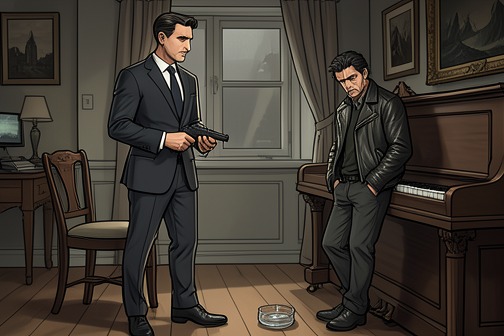
## The Shooting at [Langrishe Lodge](entity:location-recall-location-langrishe-lodge-9028da3aded9)
The shooting occurs during a confrontation at Langrishe Lodge, where [Everett Edwards III](entity:character-recall-character-everett-edwards-iii-b97e887ad4ff) is holding a gun while [Terry Lennox](entity:character-recall-character-terry-lennox-c498a510bbb4) taunts him about their past. Marlowe tries to interrupt the confrontation and persuade Everett to hand over the weapon. Everett instead laughs at the intervention and makes clear that he expects someone to be hurt. He invokes the pair’s shared past in [Acapulco](entity:location-recall-location-acapulco-2920abf70957), drawing Terry directly into the exchange.
Terry then lunges from the piano stool and reaches for a glass ashtray on the floor beside a chair. He appears to intend to throw it at Everett, but the movement leaves him poorly positioned to do so. Everett steps toward him, points the gun, and fires. The confrontation turns at once from threat to irreversible violence: Terry’s attempt to act is cut short, and he falls to the floor.
Everett seems poised to shoot again, but Marlowe reaches him and takes the gun away. Everett offers little resistance; he stands trembling and looks down at Terry. Clare enters moments later, sees the scene, pushes past her brother, and kneels beside Terry, lifting his head into her lap. When she looks toward Marlowe and the gun, he indicates that he did not shoot Terry. Clare’s response confirms the personal cost of the killing: Marlowe recognizes that she had truly loved Terry, and, after a stunned silence, she begins to cry.
## Immediate Aftermath and the Earlier Death Record
Marlowe does not call [Bernie Ohls](entity:character-recall-character-bernie-ohls-16f1e7a1a29c) after the shooting. Tired of their recent friction, he phones [Joe Green](entity:character-recall-character-joe-green-c464a0b0903b) instead. Joe is on duty and reaches Langrishe Lodge about twenty minutes later, accompanied by two patrol cars. The change of caller matters: a private confrontation in a wealthy family’s home now passes into police hands, though Joe is visibly less at ease there than in the street-level encounters he knows.
Everett is taken away in handcuffs, still wearing pajamas and loafers. The narrator considers the criminal consequences ahead of him, including the possibility of a sentence at San Quentin, while acknowledging that his family’s money might secure a lawyer capable of finding a legal escape. That uncertainty places the arrest within the book’s wider contrast between formal justice and the privileges wealth can bring; the account does not establish what legal outcome follows.
Clare remains stunned. A patrolman wraps a blanket around her shoulders and leads her from the room without resistance. Her bloodied dress and composed bearing register the shock of the scene without resolving it: Terry is dead, Everett has been arrested, and she has lost the man she loved. When [Dorothea Langrishe](entity:character-recall-character-dorothea-langrishe-f82c5f0abe2a) arrives after her son and daughter have been taken away, she appears unable to understand what has happened. Her bewilderment leaves the household’s violence without a consoling family explanation.
The shooting also gives a final, unsettling weight to the earlier record of [Nico Peterson](entity:character-recall-character-nico-peterson-5ffb47d561a4)’s supposed death. Joe had told Marlowe that Nico died in a hit-and-run on [April 19](entity:time-recall-time-4-19-7965758be02e) near a club in the [Pacific Palisades](entity:location-recall-location-cbe4ec5f2180), and the police file placed the collision on [Latimer Road](entity:location-recall-location-latimer-road-9eab7ed9408d) between eleven at night and midnight. Yet Everett had acknowledged that he was not the official identifier at the scene; according to him, Nico’s sister identified the body at the morgue the next day. Marlowe had already challenged the certainty of that identification by raising the report that Nico had been seen alive. Against that unresolved history, the killing at Langrishe Lodge closes one violent confrontation without settling the case that brought Marlowe into the household.
## The Failure of a Grand Scene
The shooting’s aftermath strips away the dramatic form Everett Edwards III appears to have expected. Marlowe considers whether Everett wanted a spectacular confrontation, complete with speeches and staged heroics, rather than the abrupt, ordinary violence that actually unfolded. That contrast makes the scene’s setting matter: Joe Green, accustomed to more familiar forms of police work, finds himself out of place in the Langrishe household, where a family crisis has become a criminal investigation. The episode exposes a gap between imagining violence as theater and confronting its consequences. No grand design resolves the encounter; its consequences are instead immediate and practical, as the police take control and the family is left to absorb what has happened.
## A Different Kind of Certainty
The shooting gives the narrative a witnessed death against which the uncertainty surrounding Nico Peterson’s presumed death remains unresolved. Marlowe is present as the violence turns into an irreversible event, then prevents a second shot and brings the police into the room. That sequence establishes what happened to Terry without depending on a disputed identification or a record assembled after the fact. But its certainty is strictly local: the shooting settles the immediate confrontation, not the questions about Nico that first drew Marlowe into the investigation.