Cardinal Spada
The Count of Monte CristoCardinal Spada, a wealthy Roman nobleman of the fifteenth century, was poisoned by Pope Alexander VI and his son Caesar Borgia after a dinner invitation, but his hidden treasure on the Island of Monte Cristo became the central fortune that Edmond Dantes discovers and uses to execute his elaborate revenge.
Identity and Background
Cardinal Spada, whose full name was Caesar Spada, was one of the noblest and richest of the Roman nobility during the papacy of Alexander VI. He was a cardinal of the Holy See, and his family wealth had passed into a proverb, with the phrase "as rich as a Spada" commonly heard in Rome. The cardinal was the last of the princes of that name, and his household included a secretary, the Abbe Faria, who later became the tutor and companion of Edmond Dantes in the Chateau d'If. Spada was a prudent man, greatly attached to his only nephew, a young captain of the highest promise named Guido Spada.
The Borgia Conspiracy
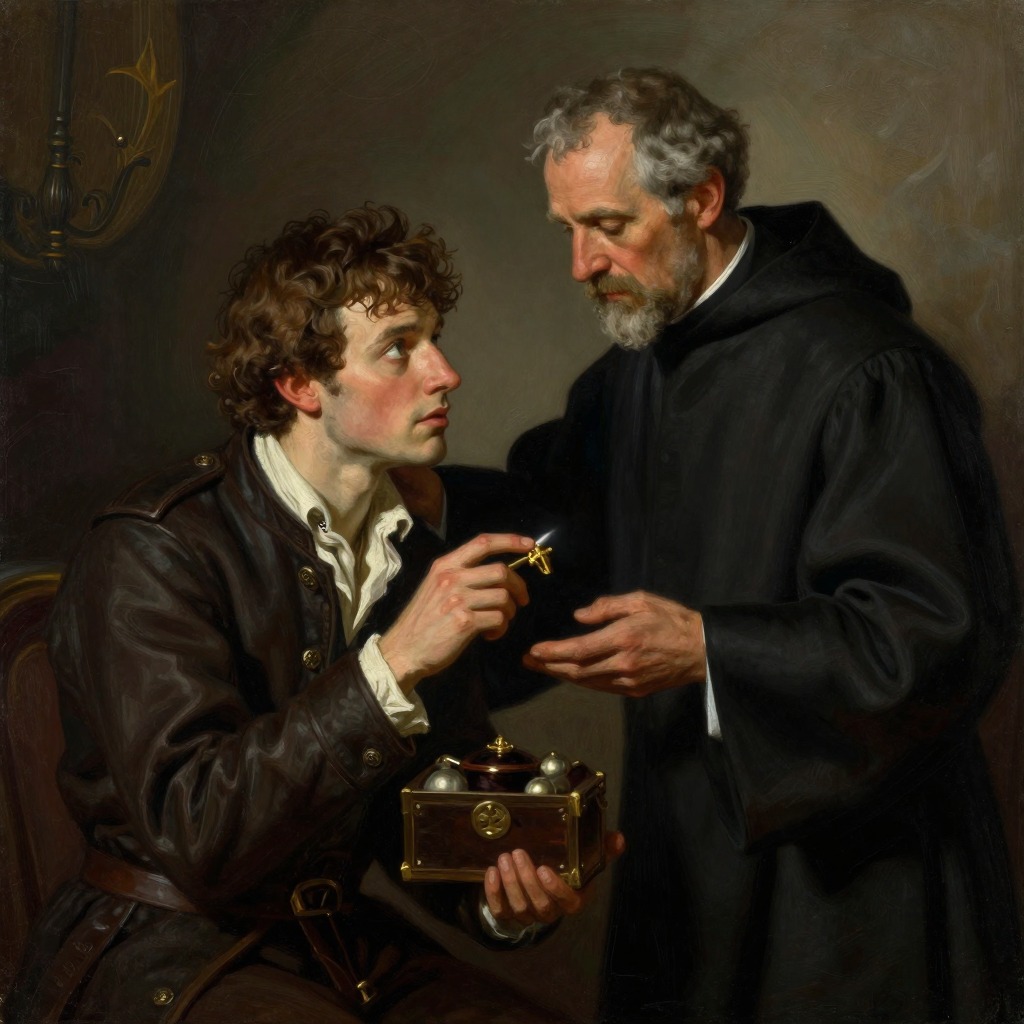
Pope Alexander VI, needing money to purchase all Italy and to bring matters to an end with Louis XII of France, devised a scheme to make two cardinals from among the richest men of Rome. He chose Giovanni Rospigliosi, who held four of the highest dignities of the Holy See, and Caesar Spada. Both paid for being cardinals, and eight other persons paid for the offices the cardinals held before their elevation, bringing eight hundred thousand crowns into the coffers of the speculators. The pope then heaped attentions upon the new cardinals, conferred upon them the insignia of the cardinalate, and induced them to arrange their affairs and take up their residence at Rome. Then the pope and Caesar Borgia invited the two cardinals to dinner. Caesar proposed using either a key with a small iron point that pricked and killed the user, or a ring with a lion's head that bit the hand and caused death within twenty-four hours. But Alexander VI replied that an indigestion declares itself immediately, while a prick or a bite occasions a delay of a day or two, and so the cardinals were invited to dinner. The table was laid in a vineyard belonging to the pope, near San Pierdarena. Spada, knowing what such invitations meant, took paper and pen and made his will, then sent word to his nephew to wait for him near the vineyard, but the servant did not find him. Spada set out about two o'clock to San Pierdarena. The first sight that attracted his eyes was that of his nephew, in full costume, and Caesar Borgia paying him most marked attentions. Spada turned pale, realizing the snare was well spread. During dinner, Spada's nephew drank a glass of wine placed for him by the pope's butler, and Spada himself was pressed to taste another bottle. An hour later a physician declared they were both poisoned through eating mushrooms. Spada died on the threshold of the vineyard; the nephew expired at his own door, making signs which his wife could not comprehend.
The Hidden Treasure
Before his death, Cardinal Spada wrote a will bequeathing to his nephew his coffers, books, and his breviary with gold corners. The pope and Caesar Borgia searched for the inheritance but found only a few thousand crowns in plate and ready money. The nephew, before he expired, told his wife to look well among his uncle's papers for a will. The family searched even more thoroughly but found nothing. The celebrated breviary remained in the family, handed down from father to son, preserved with superstitious veneration. It was an illuminated book with beautiful Gothic characters, so weighty with gold that a servant always carried it before the cardinal on days of great solemnity. The treasure, which Spada had buried in the caves of the small Island of Monte Cristo, consisted of ingots, gold, money, jewels, diamonds, and gems, amounting to nearly two millions of Roman crowns. The hiding place was described in a document written with sympathetic ink, which only appeared when exposed to fire. The document, dated 25th April, 1498, declared that the treasure was in the farthest angle of the second opening in the caves, and that it was to be raised from the twentieth rock from the small creek to the east in a right line.
Legacy and Discovery
The Spada family continued in doubtful ease, and the secret of the treasure was lost for centuries. The last Count of Spada, whose secretary was the Abbe Faria, died in poverty, bequeathing to Faria his library of five thousand volumes and the famous breviary. Faria, while reading the breviary one day, accidentally discovered the hidden document when he used an old paper as a marker and set it alight, revealing the yellowish characters. He reconstructed the incomplete text and learned of the treasure on Monte Cristo. Faria was arrested at Piombino before he could recover it, and spent the rest of his life in prison. In the Chateau d'If, he befriended Edmond Dantes and revealed the secret to him, making Dantes his sole heir. After Faria's death, Dantes escaped, found the treasure, and used its immense wealth to become the Count of Monte Cristo, executing his elaborate revenge against those who had wronged him. The treasure thus became the engine of the novel's plot, enabling Dantes to transform himself from a poor sailor into a mysterious, all-powerful figure who could manipulate the lives of his enemies.