Heloise de Villefort
The Count of Monte CristoHeloise de Villefort, the second wife of the formidable king's attorney Gerard de Villefort, is a figure of chilling contradiction. To the world, she presents the perfect image of a refined, intelligent, and devoted mother and wife. Yet beneath this polished exterior lies a calculating and remorseless poisoner, driven by a fierce, almost pathological, love for her son, Edward, and a consuming ambition to secure his future at any cost. Her role in the novel is that of a secret, domestic nemesis, whose crimes form a dark counterpoint to the Count of Monte Cristo's more public and theatrical acts of vengeance.
Identity and Introduction
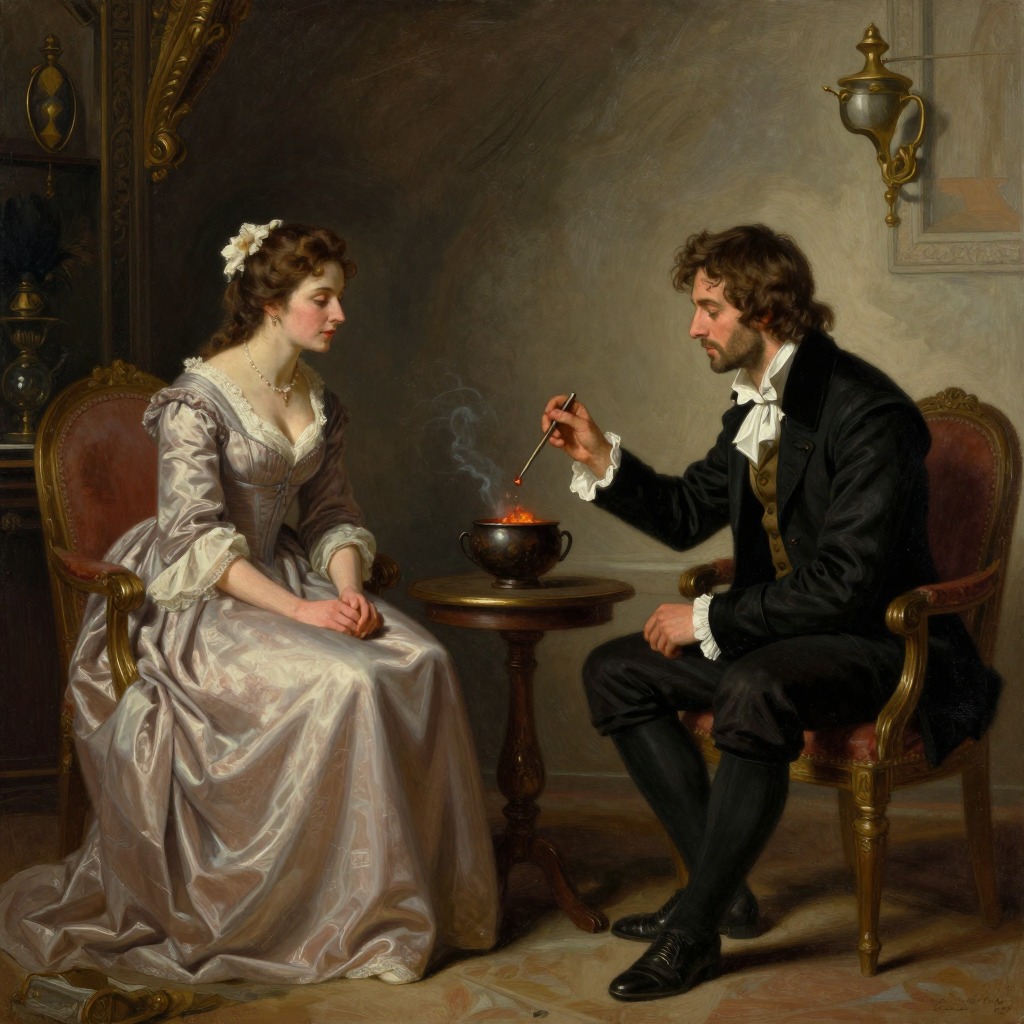
Heloise is introduced as a woman of considerable charm and intellect, well-versed in the social graces of Parisian high society. She is the daughter of M. de Servieux, the king's chamberlain, and was previously married to Colonel the Marquis de Nargonne before becoming the Baroness Danglars' friend and, later, Madame de Villefort. Her conversation reveals a keen, if morbid, interest in the sciences, particularly chemistry and toxicology. She engages the Count of Monte Cristo in a detailed discussion about poisons, the Mithridatic method of building immunity, and the art of administering undetectable toxins, displaying a knowledge that is both academic and, as the plot unfolds, disturbingly practical. This early scene establishes her as a woman of dangerous curiosity and intellectual ambition, one who regrets not being a man so that she could have been a great chemist like Flamel or Cabanis.
The Poisoner's Motive and Method
Heloise's primary motive is a fierce, possessive love for her son, Edward. She sees Valentine, her step-daughter, as the primary obstacle to Edward's future wealth. Valentine stands to inherit a vast fortune from her mother's parents, the Saint-Merans, and from her grandfather, Noirtier. Heloise, who has no fortune of her own, systematically sets about eliminating these impediments. She begins by poisoning the Marquis and Marquise de Saint-Meran, whose deaths are attributed to natural causes. She then attempts to poison Noirtier, but fails because the old man's system has been gradually acclimated to brucine by his physician, M. d'Avrigny. Her next victim is the servant Barrois, who accidentally drinks the lemonade intended for Noirtier. Finally, she turns her attention to Valentine, administering a series of increasingly potent doses of poison. Her method is one of cold, calculated patience, using her knowledge of chemistry to create a pattern of deaths that appear to be a run of terrible misfortune.
Relationships and Conflict
Heloise's most significant relationship is with her son, Edward, a spoiled and cruel child who mirrors her own amorality. Her actions are entirely dedicated to him, and her final, desperate act is to take his life rather than leave him alone in the world. Her relationship with her husband, Villefort, is one of mutual suspicion and cold formality. He is a man dedicated to the law, and she is a woman who operates entirely outside of it. The central conflict of her story arc is with the Count of Monte Cristo, who, having deduced her crimes, manipulates events to expose her. He engages her in a conversation about poisons, subtly encouraging her to continue her murderous path, and ultimately arranges for Villefort to confront her with the evidence of her guilt. Her final confrontation is with Villefort, who, acting as a judge, condemns her to death, offering her the choice of the scaffold or suicide.
Change and Ending
Heloise's trajectory is one of a gradual, confident descent into evil, followed by a sudden, catastrophic collapse. She is a woman who believes herself to be supremely clever and in control, but she is ultimately outmaneuvered by the superior intelligence and foresight of Monte Cristo. When Villefort confronts her in her room, she is stripped of all her social armor. Her composure shatters, and she reveals herself as a coward, begging for her life. In a final, horrifying act of twisted maternal love, she poisons herself and her son, Edward, leaving a note that reads, "You know that I was a good mother, since it was for my son's sake I became criminal. A good mother cannot depart without her son." This act completes her transformation from a calculating socialite into a figure of pure, monstrous despair, leaving Villefort to discover the two bodies and descend into madness.
Thematic Significance
Heloise de Villefort serves as a dark mirror to the Count of Monte Cristo. Both are intelligent, patient, and use poison as a tool of vengeance. However, where Monte Cristo's vengeance is a calculated, almost divine, punishment for past wrongs, Heloise's is a selfish, greedy act of domestic ambition. She represents the corruption that can fester within the most respectable of families, a poison that is all the more terrifying for being hidden behind a smiling face. Her story underscores the novel's themes of justice and retribution, demonstrating that no crime, however cleverly concealed, can escape the hand of fate or the watchful eye of a higher power. Her ultimate fate—the death of her son and her own suicide—is a stark illustration of the principle that the sins of the mother can destroy the child, and that a love twisted into selfishness can become the most destructive force of all.