Eugenie Danglars
The Count of Monte CristoEugenie Danglars, the only daughter of the immensely wealthy banker Baron Danglars and his wife Hermine, is a young woman of striking beauty and formidable independence. From her first appearance, she is distinguished by a haughty, self-possessed demeanor that sets her apart from the conventional society beauties of Paris. Her character is defined by a fierce commitment to personal liberty and a profound disdain for the mercenary marriage market into which her father seeks to thrust her.
Identity and Artistic Ambition
Eugenie is described as beautiful, but her beauty is of a marked and decided character, more akin to the huntress Diana than to a soft Venus. She has raven-black hair, a firm brow, and a dark mole at the corner of her mouth that accentuates an expression of self-dependence. Her true passion is music; she is a perfect linguist, a first-rate artist, and composes music herself. She is devoted to her studies, often practicing with her schoolfellow, Mademoiselle Louise d'Armilly, a talented singer. Eugenie's ambition is not for a wealthy marriage but for a life as an independent artist, free from domestic cares and the caprices of any man. She is rumored to be under the almost paternal interest of a principal composer, who encourages her to cultivate her voice as a source of future wealth and independence.
Opposition to Marriage and the Danglars-Morcerf Engagement
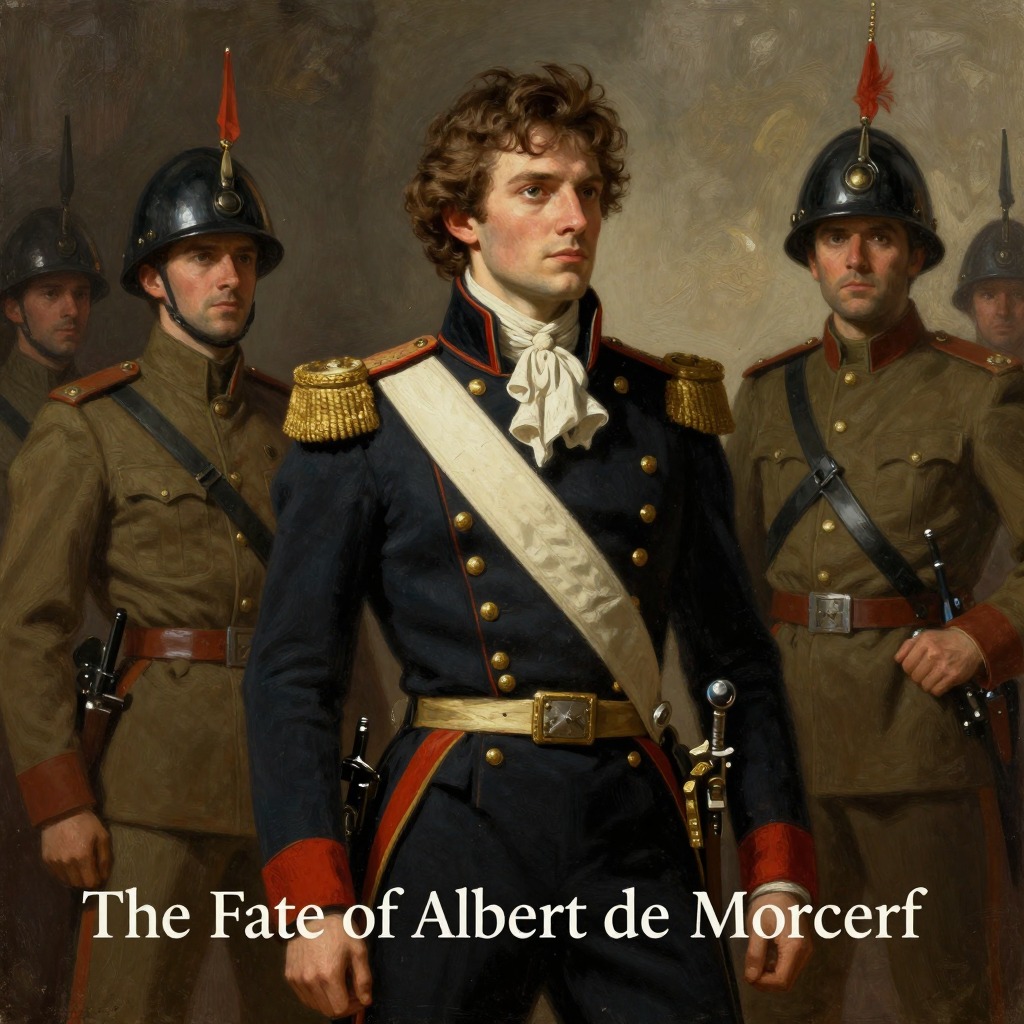
Eugenie's first major conflict arises from her father's plan to marry her to Albert de Morcerf. She makes no secret of her repugnance to the match. In a private conversation with Valentine de Villefort, she confesses that she loves no one, dislikes the very idea of being married, and would infinitely prefer leading an independent and unfettered life. She even wishes her father might lose his fortune so she could become an artist like her friend Louise. This engagement is eventually broken off when the Count of Monte Cristo exposes the treachery of Albert's father, Fernand Mondego, a development Eugenie views not with regret but as a fortunate escape from a dishonored man.
The Cavalcanti Engagement and the Contract Signing
Following the collapse of the Morcerf match, Danglars, facing financial ruin, arranges a new marriage for Eugenie with the supposed Italian prince, Andrea Cavalcanti. Eugenie, however, is not a passive pawn. In a tense scene with her father, she confronts him directly. She declares she will not marry Cavalcanti, stating her reasons with cold logic: she loves no one and sees no need to encumber her life with a perpetual companion. Danglars, desperate, reveals his impending bankruptcy and explains that the marriage is necessary to restore his credit, as Cavalcanti's promised fortune of three million francs will save him. Eugenie, after extracting a promise that she will be left entirely free in her person, coldly agrees to the marriage, seeing it as a means to an end. The contract signing is a grand affair, but it is dramatically interrupted when a police commissioner arrives to arrest Andrea Cavalcanti, revealing him to be the escaped galley-slave and murderer Benedetto.
Escape and Independence
The scandal of the contract signing provides Eugenie with the perfect pretext for her long-planned escape. While the household is in chaos, she and Mademoiselle d'Armilly execute a meticulously prepared plan. Eugenie, demonstrating remarkable resourcefulness and courage, cuts off her magnificent black hair and dresses in a man's traveling costume, using a passport procured for her by the Count of Monte Cristo under the name "M. Leon d'Armilly, artist." With 23,000 francs in banknotes and a jewel-box of pearls and diamonds, the two young women flee Paris in a post-chaise, heading for Brussels. Eugenie's final act is one of complete self-determination; she abandons her family, her name, and her expected social role to pursue a life of artistic freedom, leaving her father to face his ruin alone.