M. d'Avrigny
M. d'Avrigny is the trusted family physician of the Villefort household, a man of considerable medical skill and unwavering moral principle. He is present at the deathbeds of the Marquis and Marquise de Saint-Meran, of the servant Barrois, and of Valentine de Villefort, and it is he who, through careful observation and chemical analysis, identifies each death as the result of poisoning rather than natural causes. His role shifts from healer to investigator, and finally to accuser, as he pieces together the pattern of crimes that have devastated the procureur's family.
Medical Authority and the Detection of Poison
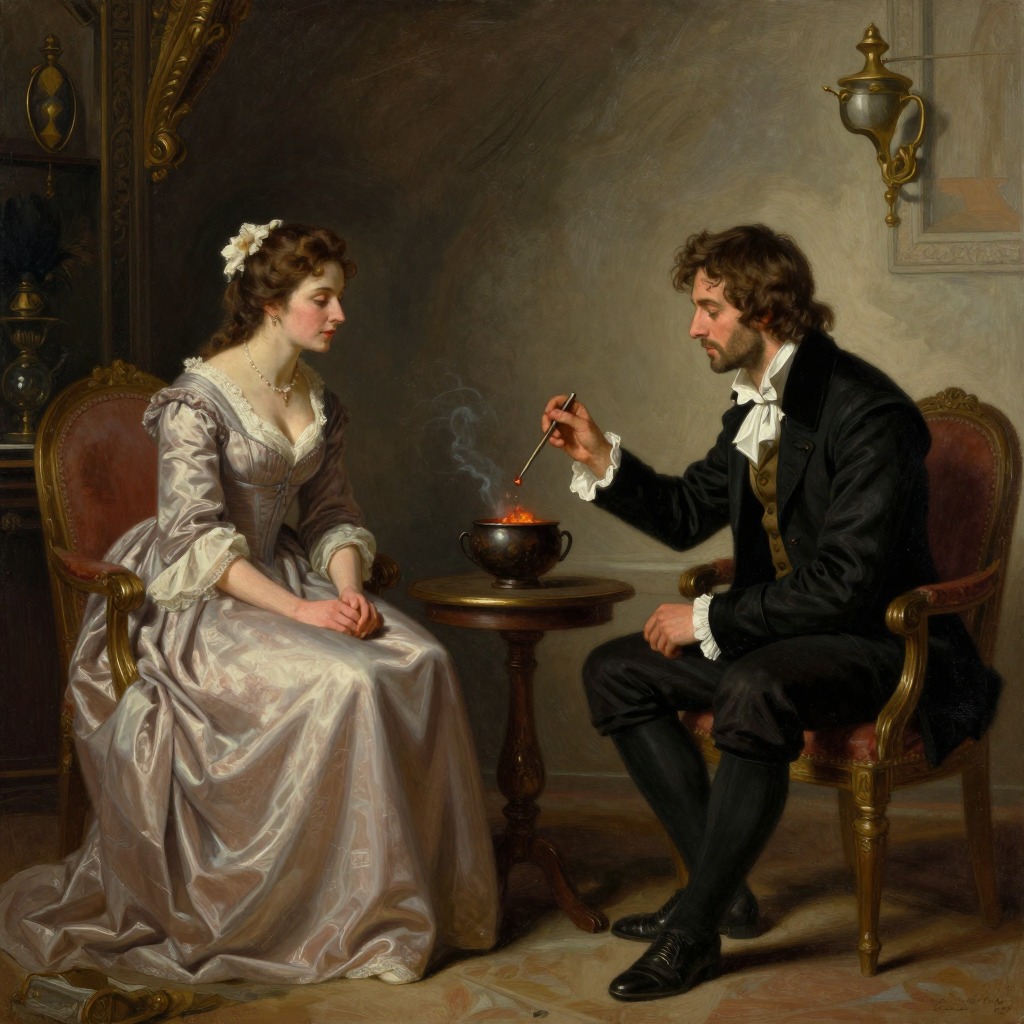
D'Avrigny is introduced as a physician of exceptional diagnostic acumen. He is a friend of the family and had attended Valentine's birth, and he has a daughter of his own, Madeleine, whose fragile health gives him a personal understanding of a parent's fears. When the Marquise de Saint-Meran dies suddenly after a brief illness marked by convulsions and tetanus-like symptoms, d'Avrigny is the first to suspect foul play. He confides his suspicions to Villefort in a nocturnal walk through the garden, stating that the symptoms of tetanus and poisoning by vegetable substances are identical, and that he is "thoroughly convinced that not only did her death proceed from poison, but I could also specify the poison." He identifies the agent as brucine or strychnine, and warns that the same hand may strike again. When Barrois dies after drinking lemonade intended for Noirtier, d'Avrigny conducts a decisive chemical test: he pours a sample of the remaining lemonade into syrup of violets, which turns green, confirming the presence of a powerful alkaloid poison. This experiment, performed in Villefort's presence, leaves no room for doubt.
Confrontation with Villefort and the Accusation
After the death of Barrois, d'Avrigny confronts Villefort directly, laying out the chain of murders with relentless logic. He declares that the poisoner has killed M. de Saint-Meran, Madame de Saint-Meran, and Barrois, and that the intended victim of the lemonade was Noirtier himself. He then names the culprit: "Mademoiselle de Villefort is the culprit — she is the poisoner! To you, as the king's attorney, I denounce Mademoiselle de Villefort, do your duty." When Villefort protests, d'Avrigny insists that the evidence is overwhelming and that Valentine must be brought to justice. He offers Villefort a terrible choice: either denounce his daughter or, if she has killed three people, give her poison himself to save the family's honor. Villefort, desperate, begs for mercy, and d'Avrigny, moved by the father's anguish, agrees to wait — but on a terrible condition: if anyone else falls ill in the house, he will never return. He leaves Villefort with the warning that the poisoner will strike again, and that the next victim may be Villefort himself, or his son.
The Final Crisis and the Limits of Medical Power
When Valentine is struck down by a fourth poisoning, d'Avrigny is called too late. He finds her apparently dead, and his examination of the glass confirms that a new, more potent narcotic has been used. He is present when Maximilian Morrel, in his grief, denounces the crimes and demands justice. D'Avrigny supports Morrel's accusation, stating that he unites with him in demanding justice and that his own conscience is burdened by having "encouraged a murderer by my cowardly concession." He then assists in the examination of the body by the district doctor, and it is he who recommends that the nearest priest, the Abbe Busoni, be summoned to pray over the dead. Throughout the crisis, d'Avrigny acts as the voice of medical and moral authority, but his power is ultimately limited: he can diagnose the crime, but he cannot prevent it. His final role is to bear witness to the catastrophe and to support those who seek the truth.