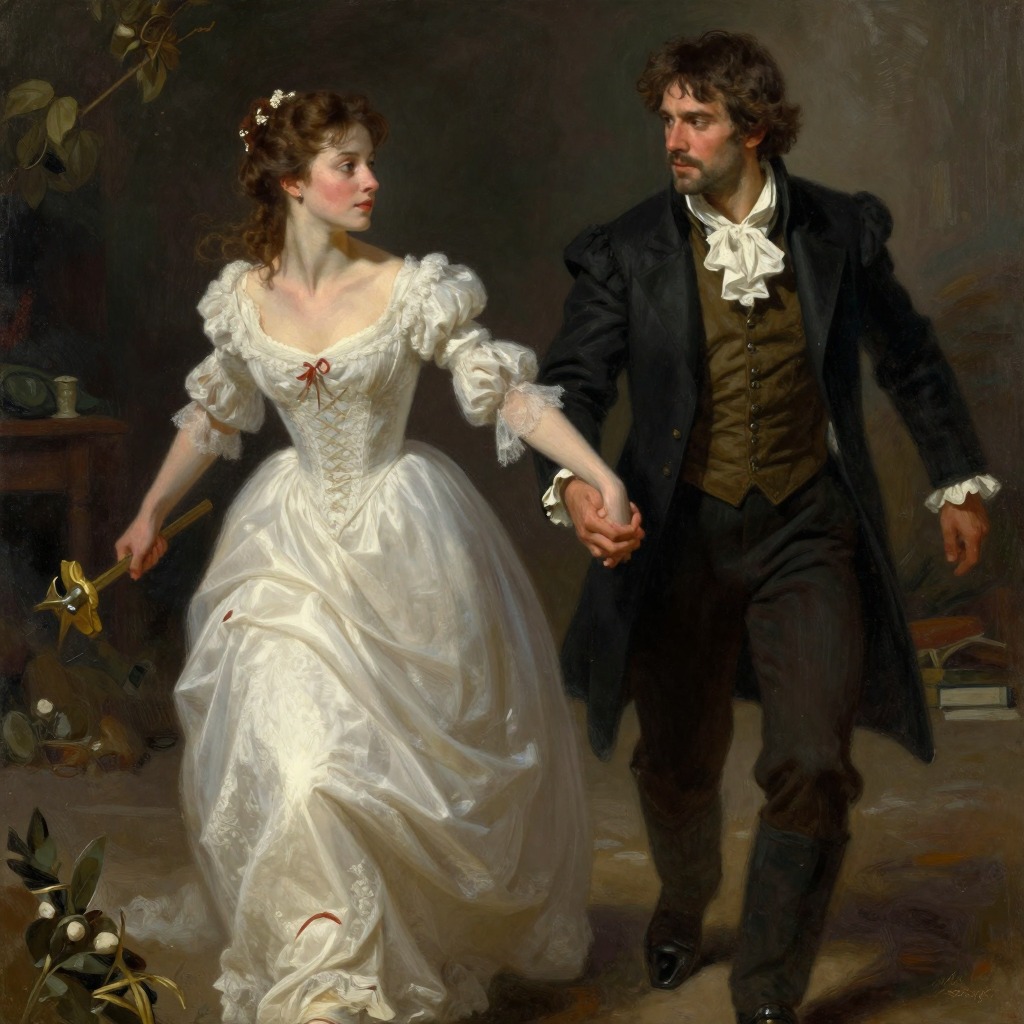
Mademoiselle Louise d'Armilly
Mademoiselle Louise d'Armilly occupies a singular position in the Danglars household: she is at once a paid companion, a musical collaborator, and the closest confidante of Eugenie Danglars. Though not formally received in society as an equal, she is treated with far more kindness and consideration than a governess would typically receive, and her presence is tolerated by the banker's family because of her indispensable role in Eugenie's artistic life. She is described as a young woman without fortune whose talent promises to develop into remarkable powers as a singer, and it is rumored that she is the object of almost paternal interest from one of the principal composers of the day, who encourages her to spare no pains in cultivating her voice as a potential source of wealth and independence.
Musical Partnership and Daily Life
Louise and Eugenie spend their days practicing together, the former at the piano and the latter singing, in a routine that has made them inseparable. Eugenie, who professes to be entirely devoted to the study of music, pursues it with indefatigable perseverance, assisted by her schoolfellow. The two young women are frequently seen seated together at the piano, accompanying themselves with one hand each in a duet, a practice they have perfected through long familiarity. On the evening of the failed contract-signing at the Danglars' mansion, Louise is present in the drawing-room, and when Eugenie retires to her room after the scandal of Andrea Cavalcanti's exposure, Louise follows her, paler and more disturbed than her companion.
The Flight from Paris
It is Louise who has procured the means for their escape. Three days before the planned wedding, she had obtained a man's passport from the Count of Monte Cristo, who, understanding her fears about travelling as a woman, undertook to procure it for her. The passport is made out in the name of "M. Leon d'Armilly, twenty years of age; profession, artist; hair black, eyes black; travelling with his sister." Louise herself has added the phrase "travelling with his sister" to the document. She has also purchased a post-chaise three days in advance and arranged for it to be sent to a specific location. When Eugenie decides to flee on the night of the contract-signing rather than on the wedding night, Louise is ready. The two young women pack a trunk containing twenty-three thousand francs in banknotes and an equal value in pearls, diamonds, and jewels, and Eugenie cuts off her magnificent black hair and dresses in a man's complete costume. Louise, dressed in a violet silk travelling cloak, accompanies her friend through the darkened house, past the sleeping porter, and into the street, where a porter carries their luggage to a waiting post-chaise. Eugenie gives the postilion the destination of Fontainebleau as a ruse, then alters their course toward Brussels.
Significance and Thematic Role
Louise d'Armilly functions as both a practical enabler and an emotional anchor for Eugenie's rebellion against the constraints of fashionable society. Her own modest circumstances and artistic ambitions mirror Eugenie's desire for a life of independence and creative freedom, and their partnership represents a deliberate rejection of the marriage market that their families have tried to impose on them. The two young women, whom everyone might have thought plunged in grief, burst out laughing as they clear away the traces of their escape, and Louise expresses admiration for Eugenie's courage, saying she could almost respect her. Their flight to Brussels, and from there to Italy, where Louise intends to make use of Monte Cristo's letters of introduction to theatre directors, constitutes a decisive break with the world of Parisian high society and a commitment to the precarious but autonomous life of artists.