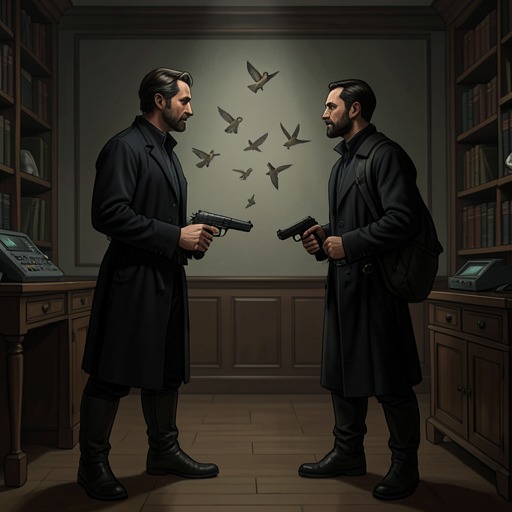
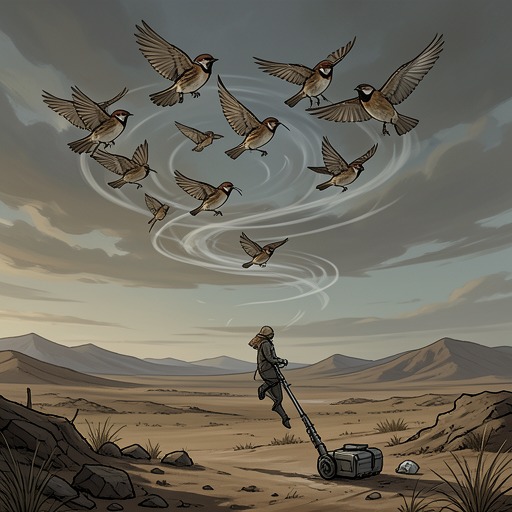
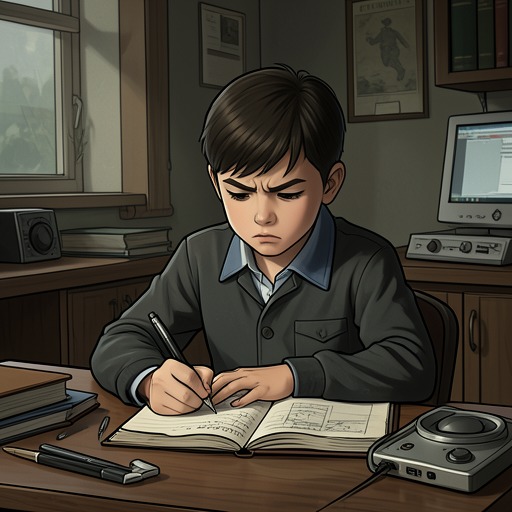
Event 1
The birth of George Stark
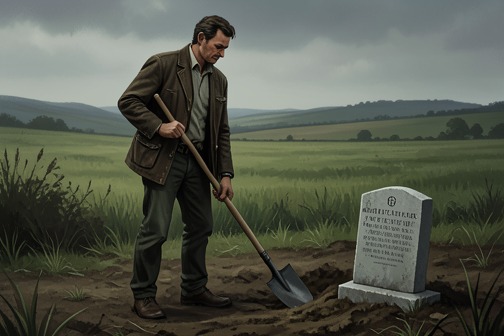
[The birth of George Stark](entity:event-recall-event-ae7d06ce556d) begins as a deliberate solution to [Thad Beaumont’s writer’s block](entity:state-recall-state-thad-beaumont-s-writer-5dfca331c499): Beaumont wants an identity separate from his own, one capable of carrying a different kind of book. Inspired by crime writer Donald E. Westlake’s pseudonym Richard Stark and the ruthless criminal Parker, Beaumont creates a commercially successful crime novelist whose fictional independence becomes increasingly difficult to distinguish from his own. In retrospect, the origin story is both a history of pen-name publishing and the first step toward the novel’s unsettling convergence of invented identity and real violence.
## A Separate Authorial Identity
Beaumont recalls that finding the name mattered because the right identity might break the writer’s block he was struggling with. He had been reading the career of Donald E. Westlake, who wrote comic social novels under his own name and a much harder series about Parker as Richard Stark. For Beaumont, the distinction offered a model: one author could write through identities that seemed to belong to different imaginative worlds.
The reference was not merely to a second byline. Westlake had described writing his own books on sunny days and letting Stark take over on rainy ones. Beaumont connected that division to his own difficult period between 1973 and early 1975. He was drawn in particular to Parker’s narrow, relentless purpose: a professional thief with little apparent life beyond robbery, moving through other criminals with machine-like persistence. That model helped him imagine the voice of Alexis Machine, protagonist of the first and last [George Stark](entity:character-recall-character-george-stark-adef5aad1430) novels.
Beaumont says the first version of *Machine’s Way* initially seemed too derivative to publish. About a quarter of the way through, however, the book found its own rhythm and the material began to cohere. Asked whether George Stark had begun to speak through it, Beaumont accepts that description as close enough. The account leaves the boundary deliberately unstable: Stark starts as a chosen literary device, yet Beaumont describes the writing process as if the invented author acquired a voice of his own.
## The First Book and Its Method
Beaumont began *Machine’s Way* on the night in 1975 when he came up with the name. He put a sheet of paper into his typewriter, then pulled it back out. Although he had typed all his other books, he says George Stark apparently did not share that preference. Beaumont instead found an old notebook and wrote with pencils from a jar on his desk.
The difference in method became part of the identity. Beaumont recalled starting to write and next realizing that Liz was telling him it was midnight and asking whether he was coming to bed. Liz remembered waking at 11:45, finding him out of bed, and assuming he was writing; because she could not hear the typewriter, she became frightened. She was relieved when she learned what had happened. Her memory supplies an intimate counterpoint to Beaumont’s account: the new authorial voice first appeared not as a public revelation but as a silent, unexplained change in the household’s nighttime routine.
When Beaumont looked back through the notebook, he found sixteen pages without a single scratch-out and discovered that he had sharpened three-quarters of a new pencil down into shavings. He did not ordinarily write that way: his hand tired, and he felt unable to work without a typewriter. He tried using Stark’s pencils himself after Stark was dead, but it did not work for him. The material distinction between Beaumont’s typewriter and Stark’s longhand thus became a compact emblem of the separate identity he had set out to create.
## The Public Success of the Pen Name
*Machine’s Way* appeared in June 1976 through the smaller [Darwin Press](entity:organization-recall-organization-darwin-press-c8940d5616c9), while Beaumont’s books under his own name had been published by Dutton. The novel became that year’s surprise bestseller, reaching number one across the country, and was made into a successful film. The distinction between the two authorial identities therefore had a practical foundation in publishing: separate names, publishers, and audiences, even though Beaumont was the writer behind both.
The secret was known to a limited circle. Beaumont says his agent knew, as did the agent’s then-wife, who remained a full partner in the business, senior executives and the comptroller at Darwin Press, and the Internal Revenue Service. The copyright was registered to George Stark, but Stark’s longhand created a problem when it came time to endorse checks. For about a year and a half, Beaumont and Liz waited for someone to expose the arrangement; nobody did. The elaborate concealment depended not on perfect separation but on people who knew remaining silent.
That silence held for another ten years, during which Stark published three more novels. None matched the spectacular success of *Machine’s Way*, but all made their way onto bestseller lists. In the crime-fiction world described by the novel, the books also attracted readers who valued precisely the hard-edged genre Beaumont had chosen to write under the pseudonym. [Dodie Eberhart](entity:character-recall-character-00cfbfe601ac), a crime-novel reader and Stark fan, regarded him as the best in that field and had followed his books from *Machine’s Way* and *Oxford Blues* through *Riding to Babylon*. Stark’s invented identity had become legible to readers as a distinctive authorial career.
## Ending the Charade and Its Afterlife
The pen name brought Beaumont money as well as relief from the limits of his public career. He recalls that Stark’s earnings meant he could leave teaching if he chose and continue paying the mortgage; he thought of that financial freedom as his “f-you money.” Yet Stark was also running out of things to say. Beaumont wanted to write his own books again, and Liz, his agent, and perhaps Stark’s editor recognized that the pseudonymous series was nearing its end.
Keeping the secret would have left open the temptation to write another profitable Stark novel. Beaumont therefore decided to end the charade by going public. When the secret later became a source of suspicion in the murder investigation, Thad could point out the apparent weakness of a motive attributed to him: after he had exposed his own identity as Stark, killing a would-be blackmailer made little practical sense. The publishing history that began as a private division of authorial identity had become entangled with public evidence and the interpretation of crime.
The origin story also casts Stark’s fictional violence against the conventions that first inspired him. Beaumont compares Parker to a programmed machine, driven by a single objective, and Dodie Eberhart’s account of her taste in crime fiction places Stark among stories of robbery, violence, and criminal loyalties. Later, an actual attacker associated with Stark’s world waits for [Michael Donaldson](entity:character-recall-character-michael-donaldson-d2a165224fb6) in the hallway outside his apartment and attacks with a straight razor. The resemblance between the hard crime books and events in the real world does not make the fictional origin a simple explanation for the murders; it shows how the novel makes genre, pseudonym, and violence press against one another. George Stark is born as Beaumont’s means of separating two kinds of writing, but the story ultimately makes that separation the very thing that can no longer be trusted.
Event 2
Thad Beaumont publicly reveals George Stark's identity
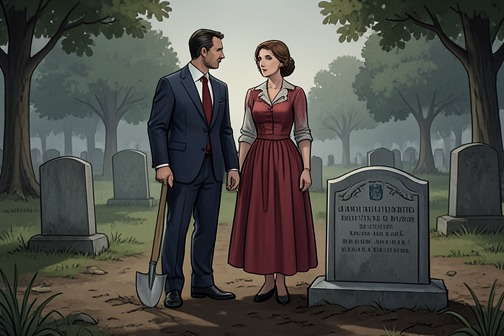
[Thaddeus “Thad” Beaumont](entity:character-recall-character-thaddeus-thad-beaum-e6877a255de4)’s public revelation that he wrote as [George Stark](entity:character-recall-character-george-stark-adef5aad1430) ends a long-running pen-name arrangement and recasts a private publishing secret as a public spectacle. The disclosure joins the practical history of a successful second identity to a darker irony: the man presented to readers as fictional would later become a threat in the real world.
## The Two Names and Their Public Story
The magazine profile frames the revelation through a deliberately staged image: Thad and [Elizabeth “Liz” Beaumont](entity:character-recall-character-02c6ea449a26) stand in a graveyard with a spade and pick, beside a freshly arranged grave and a gravestone bearing the dates 1975–[1988](entity:time-recall-time-1988-b48846afea21) and the epitaph “[Not a Very Nice Guy](entity:expression-recall-expression-not-a-very-nice-gu-1b1f27e66338).” The image presents the couple as gravediggers at the burial of George Stark, although the scene and the other photographs in the article were posed. The false gravestone had traveled from [New York City](entity:location-recall-location-7a11f2949ca3) to the Beaumonts’ summer home in [Castle Rock, Maine](entity:location-recall-location-castle-rock-maine-b058a7d430a3), turning Thad’s explanation into a visual joke that readers could grasp at a glance.
The article’s basic account was that Thad, a respected literary novelist, had also written one major bestseller and three successful follow-up novels under the name George Stark. His first novel, The Sudden Dancers, had been nominated for the National Book Award in 1972, but he had published only one more novel under his own name. The contrast between the relatively limited attention to Thad’s literary career and the celebrity surrounding Stark made the exposure a story about authorship as well as fame: the bestselling writer was not a separate person, but an identity Thad had made and maintained.
## Why Thad Created George Stark
In recounting the pen name’s origin, Thad explained that choosing the right name had mattered because he wanted an identity separate from his own, one that might break the writer’s block he was struggling with. He drew on the example of Donald E. Westlake, who wrote crime novels under the name Richard Stark. Those books followed Parker, a professional thief with few interests beyond robbery, and offered Thad a model of a sharply differentiated crime-writing identity.
The connection was not only the name. Thad recalled Westlake’s distinction between writing his own books on sunny days and letting Stark take over on rainy ones. For Thad, the period from 1973 to early 1975 had been rainy. He also described Parker as resembling a killer robot, driven by a single purpose and a repeated demand for his money. That hard, narrow characterization helped explain the appeal of the George Stark persona and the criminal world of its novels. The first Stark book, Machine’s Way, initially seemed so close to its model that Thad feared publishing it would amount to plagiarism; about a quarter of the way through, he said, it found its own rhythm.
## From Secret to Publishing Success
Machine’s Way appeared in June 1976 through the smaller [Darwin Press](entity:organization-recall-organization-darwin-press-c8940d5616c9), while Thad’s books under his own name had been published by Dutton. The crime novel unexpectedly reached number one on bestseller lists across the country and became a hit film. The successful book established Stark as more than a workaround for writer’s block: it created a profitable literary identity with its own publisher, readership, and public presence.
The secret was known to a small circle. Thad’s agent, [Rick Cowley](entity:character-recall-character-rick-cowley-d63a609dd605), knew, as did Rick’s then-wife [Miriam Cowley](entity:character-recall-character-miriam-cowley-0fce84de9ebb), senior executives and the comptroller at Darwin Press, and the Internal Revenue Service. The copyright was registered to George Stark, but the arrangement had a practical complication: Stark could write novels in longhand yet could not endorse checks. Thad and Liz expected someone to reveal the truth, and for roughly a year and a half they waited for the secret to leak. It did not. Stark then published three more novels over the following ten years. None matched the first book’s extraordinary success, but each reached the bestseller lists, while the secret remained intact.
## Why Thad Went Public
Thad said that the Stark identity had served him for a long time. The income gave him what he called “f—you money”: he could imagine leaving teaching while continuing to pay the mortgage. That freedom was one reason the arrangement endured, even as the gap between his two authorial identities widened.
Eventually, Thad wanted to return to writing his own books, while Stark was running out of things to say. Thad, Liz, his agent, and perhaps Stark’s editor all recognized that the persona’s creative resources were fading. Thad also knew that secrecy left open the temptation to write another Stark novel simply because it would make money. He described going public as the way to end that profitable charade decisively, likening the choice to driving a stake through Stark’s heart. The publication of the secret was therefore both an artistic decision and a means of closing off a lucrative option that he did not trust himself to resist.
## Exposure, Blackmail, and the Afterlife of the Name
The disclosure came amid pressure from [Frederick Clawson](entity:character-recall-character-e64a06b7a55b), whose suspicions about Thad’s identity grew out of his unusual overlap of interests: he was a law student, a part-time bookstore clerk, a dedicated Stark reader, and one of the few fans who had also read Thad’s novels. After deciding that Stark and Thad were the same person, Clawson contacted Darwin Press and asked the editor, Ellie Golden, directly. She dismissed the idea and refused to provide the address of the man pictured on the Stark books. Clawson’s later blackmail threat forced Thad and his allies toward public exposure. Thad refused to yield to the threat, but chose to disclose the secret himself rather than let Clawson control the story.
The publicity carried an immediate commercial reversal. Thad observed that the revelation could make him look like a suspect after Clawson’s death: it offered an apparent motive, since Clawson had threatened him and Stark’s books earned far more than his teaching salary. He argued that killing a blackmailer after voluntarily revealing the secret would make little sense, and that Stark’s career was already nearing its end. In the publishing market, however, exposure revived interest: the [People](entity:organization-recall-organization-people-9afd23e695ff) article increased sales across the Stark novels, Riding to Babylon had a chance to return to the bestseller list, and Dutton planned to bring The Sudden Dancers and Purple Haze back into print. What had begun as an attempt to bury Stark as a pen name instead made both names more visible.
The article’s graveyard tableau makes the contradiction legible: a fictitious author is ceremonially buried, but the act of announcing his end circulates his identity again. Thad’s public explanation could settle who had written the books, but it did not make the boundary between author and character secure. In the larger story, George Stark is not only a marketable pseudonym whose secret is exposed; he becomes a fictional identity that crosses into reality, giving the public revelation an ominous significance beyond the publishing scandal.
Event 3
Homer Gamache murder
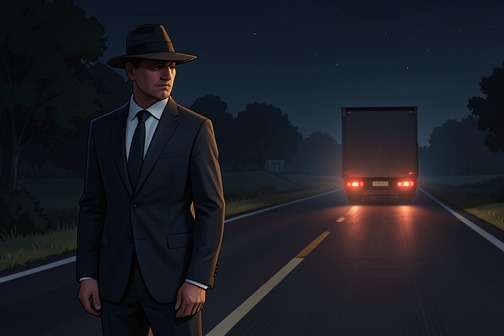
[Homer Gamache murder](entity:event-recall-event-a537915ecb1c) is the killing of [Homer Gamache](entity:character-recall-character-ed36090a1fbf), an older man who stops for a hitchhiker near his home and does not return. The crime’s meaning emerges in stages: a witness reports a late-night pickup, the missing truck makes the encounter ominous, and Sheriff [Alan Pangborn](entity:character-recall-character-alan-pangborn-313ce7d30e69) reconstructs how the stranger exploited Homer’s trust and disability before stealing the vehicle.
## The roadside encounter
At about a quarter to one in the morning, Mrs. Arsenault saw a man standing by the road and looking toward her lighted window. His direction of travel was uncertain, but when Homer’s truck appeared, the stranger raised his thumb in the familiar gesture of a hitchhiker. Mrs. Arsenault saw Homer stop; the truck’s taillights flashed, and the man ran to the passenger side and climbed into the cab. The moment was brief, but it supplied the last known account of Homer alive.
The circumstances made the pickup unsettling in retrospect. The hitchhiker wore a suit and tie, and the encounter took place in a remote area at an hour when an ordinary traveler would more likely have found shelter for the night. Mrs. Arsenault knew Homer had lived nearby for nearly thirty-five years. She reasoned that he was not simple-minded, so his decision to take a stranger seemed more likely to reflect drink or an impulse to help than poor judgment. The truck had picked up its passenger no more than three miles from Homer’s own dooryard, yet Homer never made it home.
## Discovery and reconstruction
Pangborn considered the simplest explanation first: a half-drunk older man had stopped to help a stranger, who attacked him and took his truck. He imagined the hitchhiker using an ordinary pretext to get Homer to pull over, then dragging him from the cab and leaving him in a roadside ditch. The stolen truck, which could be traced through its license plate, and the marks left by Homer’s shoes helped establish the movements Pangborn believed had occurred.
The killing was not simply a fatal blow followed by theft. Once the attacker had pulled Homer from the truck, he discovered that Homer had only one functioning arm and a prosthesis. At the bottom of the ditch, the stranger wrenched the prosthetic arm away and used it to kill him. Pangborn understood that the assailant had recognized Homer’s disability during the attack and made it part of the violence. The investigation would bring the coroner and state-police personnel to the scene, but the physical evidence had already given Pangborn a grim outline of the crime.
## The victim and the brutality of the crime
Pangborn’s private anger centers not on an abstract victim but on the life Homer had been leading: an older man, impaired by drink that night, with one sound arm and a bowling league night as one of his remaining pleasures. Pangborn thinks the attacker could have struck him once in the cab and left him alive; he even considers whether Homer might have survived until help came. That imagined alternative makes the murder’s excess impossible to separate from its practical motive. Taking the truck could explain an assault, but it could not explain why Homer had to be killed in this particular way.
Homer’s prosthesis is therefore both a concrete detail of his life and a defining element in Pangborn’s reconstruction. The evidence establishes that the attacker used it as a weapon after discovering Homer’s impairment; it does not establish that Homer’s disability caused the encounter or made him responsible for what followed. Rather, the sequence shows the assailant turning a bodily difference into an opportunity for violence. Pangborn’s response keeps the focus on the person whose life was taken, not merely on the evidence left behind.
## Place in the larger case
The murder becomes one of the first links by which the stranger’s movement can be followed. In a later conversation, [Thad Beaumont](entity:character-recall-character-thad-beaumont-98cafe7409b7) sketches the elaborate alibi the sheriff might have suspected: an identical twin could have remained at a party in [Castle Rock](entity:location-recall-location-castle-rock-01d0b06559db) while Thad drove Homer’s truck away, abandoned it at a Connecticut rest stop, obtained another car, went to [New York City](entity:location-recall-location-7a11f2949ca3), and traveled onward to [Washington, D.C.](entity:location-recall-location-washington-d-c-2a63ac520a1d), before returning to [Ludlow](entity:location-recall-location-ludlow-2371257641e7). Thad’s account is explicitly a hypothetical reconstruction, not an established account of events; its function is to expose how the evidence might implicate him and how far an imagined double could complicate the question of identity.
The killing also connects the case to the hard-boiled crime fiction associated with [George Stark](entity:character-recall-character-george-stark-adef5aad1430). Thad explains that the fictional professional thief Parker, created under the pen name Richard Stark by Donald E. Westlake, pursues a single objective with the relentlessness of a programmed machine; he compares that model to Alexis Machine, the central character in the George Stark novels. The resemblance places Homer’s murder beside a fictional tradition of instrumental, goal-driven violence. But the scene Pangborn reconstructs resists reducing Homer to a prop in that pattern: his ordinary generosity, his neighborhood ties, and his bowling night give the crime a human cost that the criminal’s single-mindedness ignores.
Event 4
Discovery of the grave hole at Homeland Cemetery
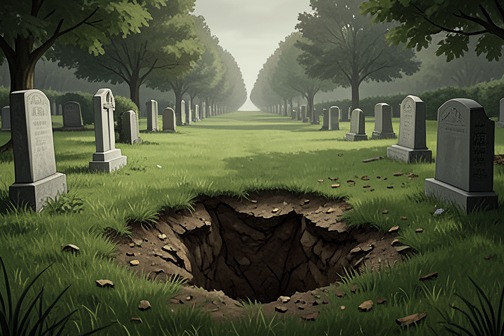
The discovery of the grave hole at Homeland Cemetery is the first concrete sign that someone has emerged from the earth and left the cemetery. Groundskeeper Digger Holt initially treats the damage as a familiar nuisance, but the hole’s shape, the marks in the wet soil, and the purposeful trail away from it lead him to a far less ordinary explanation. The scene also returns to the plot where a false grave marker had been staged for a story about [Thad Beaumont](entity:character-recall-character-thad-beaumont-98cafe7409b7), joining a recent publicity stunt to the unexplained event now unfolding there.
## Setting and discovery
Homeland is the largest and prettiest of the town’s cemeteries. Its central lane is broad enough to resemble a road, crossed by four narrower lanes with grass growing between the wheel tracks. Digger drives up the central avenue, passes two intersections, and brakes at the third when he spots a ragged opening in the grass. Dirt lies scattered around it. He recognizes the general kind of mess: teenagers or late-night visitors sometimes dig shallow holes for a prank, but this excavation does not fit that pattern.
The opening has no squared edges or rectangular outline. It tapers unevenly into a cone and is deeper than the holes Digger expects from casual grave-digging. What makes it especially unsettling is the impression it gives of a person buried alive, coming to, and clawing a way out with bare hands. Digger tries to dismiss that interpretation as a prank, but the absence of a coffin or disturbed headstone does not resolve the problem: this particular plot was not occupied by a buried customer.
## The plot and its earlier use
The six-plot section belongs to the town’s First Selectman, Danforth “Buster” Keeton. Only two plots in it contain bodies, those of Buster’s father and uncle, and their headstones remain undisturbed. Digger knows the section for another reason: it is where a New York photography crew had placed a false gravestone while preparing a story about Thad Beaumont.
That earlier setup had been arranged in the spring. Thad, who had a summer home on [Castle Lake](entity:location-recall-location-castle-lake-1d470bc64a62), asked Digger in an embarrassed manner whether a photographer could use the cemetery for a staged image. Digger agreed after hearing that the work was for [People magazine](entity:organization-recall-organization-people-magazine-e2b8810c0d61). The fake marker had since been removed, but the photographer’s high-heeled shoes had left fading round marks in the sod. Those old marks establish the site’s recent history; when Digger notices fresher impressions among them, the cemetery’s staged image and the new disturbance occupy the same patch of ground.
## Reading the tracks
The damp grass preserves evidence that would otherwise have dried and crumbled away. In the loose dirt near the hole, Digger sees a footprint beside a nearly dish-sized circular depression. Farther back are short grooves made by fingers that first slipped and then caught in the soil. Beyond the first impression, he finds more footprints, including one partial print where dirt fell from a shoe onto the grass.
Digger has spent his life tracking and hunting. Though he tries to talk himself out of what the marks imply, he can read their arrangement: a person in the hole has braced both hands against the dirt and pushed upward, the fingers slipping as the loose earth gave way. The circular depression suggests a knee taking the person’s weight after the climb. A foot then came down beside it, and the person stood and left. The prints appear to belong to a large adult; Digger estimates that the feet would need to be at least size twelve if they belonged to a child.
## The departure and its implications
The tracks continue across the cemetery, widely spaced but not suggesting a run. Their maker appears to have moved quickly and with purpose. About forty yards farther on, Digger finds a large flower basket kicked aside, directly along the apparent route. The person could have gone around it but did not, a small detail that makes the departure seem forceful and unhesitating rather than confused.
The path angles toward the low wall between the cemetery and the main road. Digger briefly imagines a large, confident figure striding through the cemetery and moving the basket without breaking pace. That image is his reconstruction from the tracks, not a direct sighting: he sees no person emerge. Still, the combination of the ragged hole, the hand marks, the knee-like depression, and the trail outward leaves him with a sequence that ordinary vandalism cannot comfortably explain. The event turns Homeland from a place where a false grave had recently been arranged into the apparent starting point of a living person’s escape from the ground.
Event 5
Frederick Clawson murder
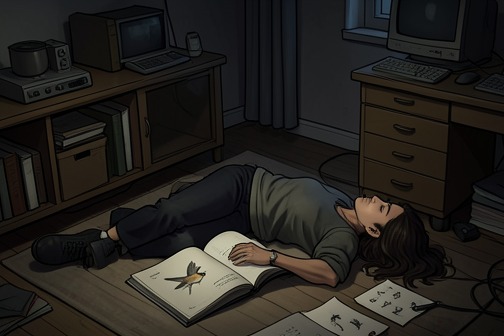
[Frederick Clawson](entity:character-recall-character-e64a06b7a55b)’s murder transforms a blackmail scheme into a crime scene arranged like one of [George Stark](entity:character-recall-character-george-stark-adef5aad1430)’s novels. Discovered by Clawson’s landlady, [Dodie Eberhart](entity:character-recall-character-00cfbfe601ac), in [Washington, D.C.](entity:location-recall-location-washington-d-c-2a63ac520a1d), the killing links a page from a [People magazine](entity:organization-recall-organization-people-magazine-e2b8810c0d61) article about [Thad Beaumont and George Stark](entity:relation-recall-relation-thad-beaumont-and-ge-e9523fecc436) to a message invoking the sparrows. Its staging makes the boundary between Stark’s fictional violence and the murders being investigated increasingly difficult to hold.
## Background and Stakes
Clawson had presented himself to Dodie as a successful figure with money due, persuading her to tolerate four consecutive late rent payments. She was not simply an indifferent landlord: she was devoted to hard-boiled crime fiction and considered George Stark one of its best practitioners. She had followed Stark’s novels from *Machine’s Way* and *Oxford Blues* through *Riding to Babylon*, which appeared to be the last.
That familiarity gives Dodie a pointed perspective when she enters Clawson’s apartment. She knows the conventions of the books whose author’s identity had become the subject of the [People](entity:organization-recall-organization-people-9afd23e695ff) story, and she recognizes how closely the scene resembles an act by Alexis Machine, the central character of the first and last Stark novels. The crime does not merely take place alongside the fiction; its arrangement invites a reader of that fiction to interpret it through Stark’s violent world.
## Discovery of the Crime
Dodie notices that something is wrong before seeing the room itself. A disturbed cushion and the sound of a radio unsettle her; common sense urges her to leave, but curiosity leads her to look inside. Her attention fixes on a precise collection of objects: two Amstel beer bottles, one empty and one partly full; an ashtray marked CHICAGOLAND!; two unfiltered cigarette butts, despite Clawson’s not smoking cigarettes; and a small box of push-pins lying on its side, with pins scattered across the glass coffee table.
Some of the pins have fallen onto an open copy of People featuring the story about Thad and George Stark. From where Dodie stands, she can see an upside-down image of the Beaumonts shaking hands across Stark’s gravestone. The page was the story Clawson had believed would never appear in print, and which he had expected would make him moderately wealthy. Its presence at the scene therefore connects the murder both to the article that threatened his expectations and to the public revelation of Stark’s identity.
Dodie finds Clawson tied to a living-room chair, with his clothes in a heap beneath the coffee table. The murder has been staged with extreme violence, and his severed tongue is pinned to the wall. Blood runs down the wallpaper beneath it. Another push-pin, with a bright green head, fixes the second page of the People article to his chest; the page includes a photograph of [Liz Beaumont](entity:character-recall-character-liz-beaumont-375a970a0439) offering Thad a pan of brownies. The details make the article more than incidental evidence: the killer has incorporated its images into the display.
Above the tongue, written in blood, are the words “THE SPARROWS ARE FLYING AGAIN.” The message turns the scene into an explicit sign, joining the birds’ ominous recurrence to Stark’s fictional methods. Dodie’s immediate comparison is to something Alexis Machine might do. The recognition comes from her reading, but the murder itself makes that recognition part of the evidence the story asks its characters and readers to confront.
## Aftermath and Investigative Significance
Dodie faints, then regains consciousness less than three minutes later. Unable to stand at first, she crawls to the apartment door and locks it, securing the bolt and police bar before calling for help. She remains inside with the body because she fears the alternative. When officers arrive, she refuses to let them in until one slides identification under the door; only then does she proceed cautiously to the kitchen phone and contact the police.
The discovery is subsequently reported to Thad and Liz by [Alan Pangborn](entity:character-recall-character-alan-pangborn-313ce7d30e69), who identifies Clawson as the second murder victim connected to the investigation. Pangborn says that a page from the People article was found in Clawson’s apartment and appeared to have been used as a symbol in a highly ritualized killing. Liz recognizes Clawson’s name, while Thad has no clear understanding of why the crimes are connected. The scene Dodie found thus becomes a bridge between Clawson’s attempted exploitation of Stark’s exposed identity and the wider series of murders bearing Stark’s signature.
The murder also sharpens the novel’s conflict between an ordinary evidentiary investigation and a pattern that resembles genre fiction made real. Thad points out that someone appears to have planted his fingerprints and questions whether the prints meet the standards for admissibility in [Maine](entity:location-recall-location-63a11a4e2b26). His challenge does not explain Clawson’s death, but it exposes the danger of treating a deliberate resemblance as a straightforward solution. The People article, the staged page, and the sparrow message offer an interpretation while leaving the killer’s identity and the mechanism linking the crimes unresolved at the point of discovery.
## Investigative Context
The murder enters the investigation as more than a second killing: it tests whether the apparent clues can be reconciled with ordinary police procedure. Alan Pangborn tells [Thad Beaumont and Liz Beaumont](entity:relation-recall-relation-thad-beaumont-and-li-a4a016beaf02) that Frederick Clawson has been killed in Washington, D.C., and that the People article about Thad and George Stark was found in Clawson’s apartment. One page appears to have been used as a symbol in what Pangborn describes as a highly ritualized murder. Liz’s immediate recognition of Clawson’s name confirms that the dead man was not a stranger to the Beaumonts, while Thad says he does not understand what is happening and Pangborn asks him for help rather than arresting him.
The available physical evidence points back toward Thad in a way that makes the case seem almost deliberately constructed. In the separate investigation of [Homer Gamache](entity:character-recall-character-ed36090a1fbf)’s death, fingerprints attributed to the perpetrator were found on Homer’s truck, including an unusually clear print on the rearview mirror, rolled in blood. When the prints were processed through a graphics computer, Thad’s service record came back. Thad counters that fingerprints often appear only as partial or smudged impressions and asks what threshold is required for their admission. Pangborn answers that Maine requires six perfect points of comparison. The print evidence is therefore both a concrete basis for suspicion and a reason to question how the incriminating pattern was produced.
Thad voices the suspicion that Pangborn may have imagined a twin as an explanation for the apparent impossibility of the evidence: one man could have attended the party in [Castle Rock](entity:location-recall-location-castle-rock-01d0b06559db) while another committed the killings and traveled between locations. His elaborate hypothetical is not an account of what occurred; it exposes the contortions required to make the evidence fit an ordinary explanation. Pangborn says he already knows what a check of the birth records would show, and that Thad seemed truthful. The exchange leaves the prints unexplained while making clear that the sheriff does not regard Thad’s apparent connection to the murders as proof of guilt.
The murder also draws on the criminal fiction that shaped Clawson’s own chosen public identity. Before his death, Dodie Eberhart understood George Stark’s books as hard-boiled crime novels about bank robbers, violence, and men with narrowly fixed aims. Thad, discussing the creation of the Stark pseudonym, describes the character Alexis Machine as resembling a programmed machine, driven by a single purpose. That literary lineage gives the staged killing a recognizable fictional grammar: Dodie sees the scene and thinks of something Machine might do. Yet resemblance is not identification. The novel makes the resemblance vivid while keeping the question of how Stark’s fictional methods have entered the real investigation unresolved.
## Clawson’s Death and the Stark Fiction
The evidence surrounding Clawson’s murder gains its force from the gap between what the characters can establish and what the scene seems to mean. Dodie Eberhart knows George Stark’s crime novels intimately: she had followed them from *Machine’s Way* and *Oxford Blues* through *Riding to Babylon*, and regarded Stark as one of the best writers in the hard-boiled tradition she loved. She had also tolerated four late rent payments because Clawson claimed money was coming. Her familiarity with the books makes her more than the first witness; it gives her a literary frame for reading the crime, even as that frame cannot tell her who committed it.
That frame has a specific origin in the way [Thad Beaumont](entity:character-recall-character-thad-beaumont-98cafe7409b7) created Stark. Thad says the separate identity helped him escape writer’s block, and that the name drew on Donald E. Westlake’s Richard Stark pseudonym and its novels about Parker, a professional thief with little beyond robbery to define him. Thad remembers the division between Westlake’s sunny-day writing and Stark’s rainy-day work, and describes Parker as almost a killer robot whose single aim is to recover his money. He later identifies Alexis Machine as the central character of the first and last Stark novels. Dodie’s thought that Clawson’s murder resembles something Machine would do therefore joins a witness’s knowledge of the novels to the author’s account of the fictional tradition behind them.
The apparent literary pattern is not, however, a solution to the case. Pangborn tells Thad and Liz that Clawson has been killed in Washington, D.C., and that a page from the *People* article about Thad and Stark was found in the apartment, apparently used as a symbol in a highly ritualized murder. Liz recognizes Clawson’s name, while Thad says he does not understand the situation; Pangborn asks for his help rather than arresting him. The article and the staging make the murder look like a message about Stark’s exposure, but they do not by themselves establish the killer’s identity or explain how the fictional pattern has become part of the real investigation.
The investigative trail surrounding Clawson’s murder reaches beyond his apartment, where the People article and the sparrow message make the killing look like a piece of Stark fiction. In the parallel inquiry into Homer Gamache’s death, police found the perpetrator’s fingerprints on Homer’s truck, including an exceptionally clear print on the rearview mirror, rolled in blood. When the prints were entered into a graphics computer, Thad Beaumont’s service record came back. Thad questioned whether prints could be so conveniently complete, noting that ordinary impressions were often partial or smudged; Alan Pangborn explained that Maine required six perfect points of comparison for a print to be admissible. The evidence connected Thad to the crimes while leaving the circumstances of that match open to suspicion.
Thad tested the limits of an ordinary explanation by imagining an identical twin who could have attended a party in Castle Rock while another version of him committed the murders and traveled between states. He presented this as a deliberately absurd reconstruction, not as an account of actual events. Pangborn said that a birth-record check would tell him what he already suspected, and that Thad had seemed truthful. The exchange did not solve the apparent contradiction between the prints and Thad’s alibi; it established that the sheriff treated the evidence as troubling without taking it as proof of guilt.
The novel also places the murder beside the literary history of George Stark. Thad had chosen the separate identity partly to break his writer’s block, drawing on Donald E. Westlake’s Richard Stark pseudonym and the hard-edged novels about Parker, a professional thief defined by robbery. He recalled Westlake’s division between sunny-day writing under his own name and rainy-day writing as Stark, and likened Parker to a machine programmed around a single aim. Alexis Machine, the central figure of the first and last Stark novels, carries that mechanical criminal logic into the fiction Dodie Eberhart knows so well. Her recognition of Clawson’s staged death as something Machine might do gives the scene a legible genre pattern, but the pattern remains an interpretation, not an answer to who killed Clawson or how Stark’s fictional world has entered the investigation.
Event 6
Thad Beaumont becomes a murder suspect after a fingerprint match
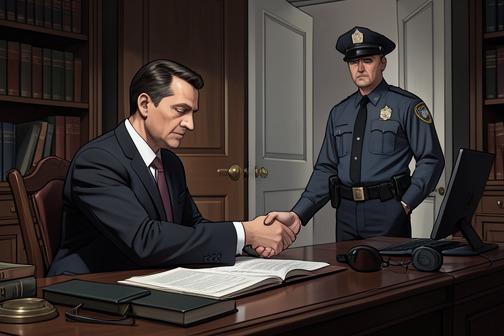
[Thad Beaumont becomes a murder suspect after a fingerprint match](entity:event-recall-event-thad-beaumont-0792c1d36ca3) when Sheriff [Alan Pangborn](entity:character-recall-character-alan-pangborn-313ce7d30e69) visits the Beaumont home and identifies him as a person of interest in [Homer Gamache](entity:character-recall-character-ed36090a1fbf)’s killing. The encounter turns the police investigation into a crisis of identity: Thad has a party alibi, but investigators say the prints left by the murderer are exactly his, and the available evidence strains ordinary explanations.
## The police arrive at the Beaumont home
Thad is upstairs in his study, writing, when the police come to the house. Liz is in the living room with their twins, William and Wendy. Since Thad’s public appearance in [People magazine](entity:organization-recall-organization-people-magazine-e2b8810c0d61), unfamiliar visitors have been calling at the house, so Liz has made a habit of checking who is outside before opening the door. This time she finds Pangborn and two state troopers.
Pangborn addresses Thad by his full name, without the courtesy title, and Thad notices the change in the room’s emotional temperature: curiosity gives way to puzzlement and then worry. Thad recognizes Pangborn as the sheriff of [Castle County](entity:location-recall-location-castle-county-4a03b82fcfdd) and offers his hand, mentioning that the Beaumonts have a place on [Castle Lake](entity:location-recall-location-castle-lake-1d470bc64a62). Pangborn refuses to shake it. He takes a card from his back pocket and reads a version of the [Miranda warning](entity:rule-recall-rule-miranda-warning-57f265489ca9), explaining that he has come to question Thad about a capital crime and intends to take him to the Orono [State Police](entity:organization-recall-organization-state-police-f1fda5cf27fd) Barracks.
Thad objects that he has no idea what is happening and refuses to go without an explanation, saying the police will need an arrest warrant if they intend to take him. His anger grows as Pangborn continues to regard him with suspicion. Liz is frightened, and one of the twins begins to cry. The stated reason for the questioning is the murder of Homer Gamache; Thad’s immediate response is to ask who Gamache is.
## The alibi and the case against Thad
Pangborn asks Thad to account for his whereabouts between 11 p.m. on May 31 and 4 a.m. on June 1. The question initially seems to offer a way out: Liz remembers that the relevant Tuesday night was the night of a party at their house. She says the Beaumonts had a houseful of people, and Thad confirms it. Liz estimates that at least 25 guests were present. The gathering appears to support an alibi, though Pangborn warns that a good alibi can itself arouse suspicion.
After speaking with the state troopers, Pangborn returns and tells Thad that Gamache was killed between 1 and 3 a.m. on June 1. The medical examiner’s findings and an eyewitness account support that time window. Gamache was killed with his own prosthetic arm. His truck was found two nights earlier in a rest-stop parking lot on I-95 in Connecticut, near the New York border.
The truck yields several fingerprints attributed to the perpetrator. One was preserved in gum that the person had taken from his mouth and pressed onto the dashboard; another, on the rearview mirror, was exceptionally clear and was left in blood. When those prints were entered into the [Armed Services Records and Identification](entity:organization-recall-organization-armed-services-r-846de179e59f) graphics computer, Thad’s service record—and, Pangborn says, Thad’s own fingerprints—came back as a match.
Pangborn insists that this is not a loose or approximate identification. He has examined the computer sheets and overlays, and says the match is exact. That conclusion collides with the party alibi and with Pangborn’s own impression of Thad: he later admits that every instinct tells him Thad is telling the truth. He says that if the identification proves to be wrong, he will personally seek out the person responsible at the records office.
## Thad challenges the fingerprint explanation
Thad asks why the evidence points to him, rather than accepting the identification as a simple clerical mistake. He raises the possibility that the quality of the prints itself is suspicious and draws on research he did for his [George Stark](entity:character-recall-character-george-stark-adef5aad1430) novels. He asks how many comparison points are required before fingerprints can be admitted as evidence. Pangborn answers that [Maine](entity:location-recall-location-63a11a4e2b26) requires six perfect comparisons.
The exchange shifts the problem from whether the police have a match to what such a match can mean. Pangborn treats the identification as unusually strong, while Thad sees a reason to question how the prints could be so complete and so precisely his. Neither the party nor the sheriff’s personal judgment resolves that contradiction. The fingerprint evidence implicates Thad in a murder he denies committing, while the circumstances suggest that a straightforward mistake may not account for what the police have found.
## An identical twin as a dark hypothesis
Thad tests the case against him with a deliberately elaborate possibility: perhaps an identical twin hosted the party while Thad went to [Castle Rock](entity:location-recall-location-castle-rock-01d0b06559db), killed Gamache, and left his prints on the truck. In Thad’s mock reconstruction, the supposed twin then takes the truck to the Connecticut rest stop, steals another car, drives to New York, abandons the vehicle, and travels to [Washington, D.C.](entity:location-recall-location-washington-d-c-2a63ac520a1d), before killing [Frederick Clawson](entity:character-recall-character-e64a06b7a55b) and returning to [Ludlow](entity:location-recall-location-ludlow-2371257641e7). He adds, with grim humor, that Liz might have been part of the deception too.
Liz is caught off guard and laughs briefly; Pangborn responds with open surprise. The moment does not establish that such a twin exists, nor does it clear Thad. Instead, Thad’s absurdly detailed scenario gives verbal form to the case’s central impossibility: the evidence appears to place him where he says he was not, and to give another person his fingerprints. Pangborn says he already knows what checking the birth records would show, though the exchange does not make the explanation public or settle the investigation.
## The investigation remains unresolved
The event leaves Thad under suspicion despite his party-night alibi and Pangborn’s sense that he is telling the truth. The case is anchored in physical evidence—the prints on Gamache’s truck, including the clear blood print on the rearview mirror—but that evidence seems to identify Thad with an exactness that ordinary doubt cannot easily undo. Thad’s questions about the six-comparison rule sharpen rather than eliminate the mystery, and his twin hypothesis points toward the hidden double at the heart of the story.
The wider narrative later places this police puzzle beside further evidence that unsettles ordinary explanations. Voice-print results arrive and prove astonishing, but the immediate account does not disclose their conclusion. Pangborn also receives a report from [Fuzzy Martin](entity:character-recall-character-fuzzy-martin-bfaf46db1719) about a message reading “[HIGH-TONED SON OF A BITCH](entity:expression-recall-expression-high-toned-son-of-7bbecbabbec0)”; he tells himself that the report proves nothing supernatural, then recalls the fingerprints, the voice prints, and the sparrows crashing into the windows of [Bergenfield County Hospital](entity:location-recall-location-bergenfield-county-h-18500b22b0b2). Those later details do not resolve the original charge at this point. They deepen the pressure on Pangborn’s rational skepticism and on the reader’s understanding of why Thad’s identity has become a matter of evidence.
Event 7
The sparrows return and trigger automatic writing
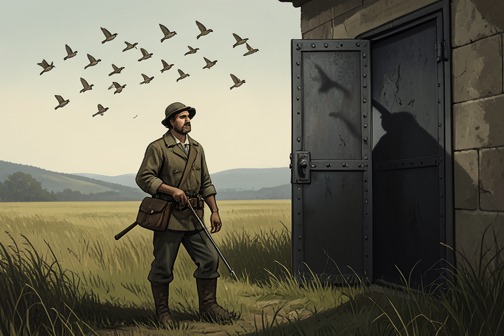
The sparrows’ return and the automatic writing it triggers mark the moment when [Thad Beaumont](entity:character-recall-character-thad-beaumont-98cafe7409b7)’s childhood neurological history begins to recur as a present supernatural crisis. A sound once associated with agonizing headaches and a mass of twin tissue in his brain comes back without the headache; instead, it overwhelms his perception, briefly displaces him into the past, and leaves a warning written across the manuscript in a hand he cannot remember using. The episode joins a medical explanation to an increasingly uncanny pattern, and makes the birds—not merely a remembered symptom, but an active presence in the novel’s unfolding events—the signal of [George Stark](entity:character-recall-character-george-stark-adef5aad1430)’s return.
## The Childhood Warning and Its Medical History
In [1960](entity:time-recall-time-1960-8dc3d301e9f9), when Thad was a boy, severe headaches developed over the course of several months. They began mildly in August, became monstrous by the return to school in early September, and by October had grown so painful that he feared not only that he might die, but that he might not. Before the headaches, he often heard a phantom sound like the distant cheeping of thousands of small birds, which he imagined as sparrows gathered on telephone wires and rooftops. His mother took him to Dr. Seward, and a later operation revealed that the mass in his prefrontal lobe was not a cancerous tumor: it was part of his twin, incompletely absorbed before birth, whose tissue had begun growing again.
The adult Thad understands the bird sound as a sensory precursor to the childhood headaches and seizure. He describes it as an auditory warning associated with his brain tumor, rather than one of the more familiar sensory precursors involving smells. That history gives the sound two competing meanings when it returns: it can suggest a recurrence of the childhood condition, but it also carries an older, more disturbing significance that medical language alone does not settle.
## The Sound Returns in [1988](entity:time-recall-time-1988-b48846afea21)
The first recurrence arrives amid a day already unsettled by the police and their certainty in an accusation against Thad. During a conversation with [Alan Pangborn](entity:character-recall-character-alan-pangborn-313ce7d30e69), the bird sound suddenly fills Thad’s mind. Its familiarity reaches back nearly thirty years, and he touches the small scar on his head as the shiver intensifies. Inwardly, he calls on George Stark to provide him with an alibi, an appeal that links the strange sensation to the identity Thad had tried to separate from himself.
That evening, while proofreading the manuscript of The Golden Dog in his study, Thad hears the birds again. This time he sees them as well: thousands of sparrows crowding roof peaks and telephone wires, then lifting together into a darkening spring sky. The vision carries him momentarily back to the frightened boy who expected another headache and wondered whether the tumor had returned, perhaps malignantly. A guttural voice that does not seem to be his own says, “Gonna hook back north, hoss.” Then the birds vanish, and Thad finds himself again in 1988, in his study, with his wife, children, and typewriter. No headache follows. The expected bodily crisis does not arrive, but the experience has already crossed beyond an ordinary memory or symptom.
## [Automatic Writing](entity:concept-recall-concept-52131c32ee4f) and the Stark Connection
Looking down at the manuscript, Thad discovers large capital letters slashed across its neat lines: “THE SPARROWS ARE FLYING AGAIN.” The act is as unsettling as the message. He has no memory of writing it and no memory of exchanging his Scripto pen for one of the [Berol Black Beauty pencils](entity:object-recall-object-berol-black-beauty-pen-8a83c1552e8d). The Berols belong to an earlier period of his life, and he has stopped using them; after writing the message, he puts the pencil back in its jar and hides the manuscript in a drawer. His hand is unsteady as he does so.
The scene makes the return of the birds legible as both a sensory event and an act of involuntary inscription. Thad’s mind supplies the vision and his hand supplies the words, but his conscious self cannot account for either. The exact phrase turns an otherwise private episode into a warning that can be read and remembered. It also recalls the public burial of George Stark: when Liz calls out that someone is back, Thad’s first terrified thought is Stark, although Stark is supposedly dead and had never existed as a real person in the first place. The bird message therefore binds the returning symptom to the threat Thad most fears.
## Recognition, Denial, and Investigation
Thad does not immediately tell Liz what has happened. Fear that the childhood tumor has returned—and that it might now be malignant—helps seal his lips; the interruption of the doorbell and Liz’s exclamation that someone is back intensify the association with Stark. In the first instant before reality reasserts itself, Thad is certain that she means George. The episode is thus followed not by a settled explanation but by a collision between a plausible medical fear and the impossible return Thad senses in the birds.
When the sound recurs, Thad reports two episodes to Dr. Hume, who orders cranial X-rays and a CAT scan. Thad withholds the trance, the words written during it, and the writing found on a murder victim’s apartment wall in [Washington, D.C.](entity:location-recall-location-washington-d-c-2a63ac520a1d); he tries to dismiss the whole matter as if it were already a dream. Hume nevertheless takes the report seriously. This medical consultation preserves the distinction between what Thad tells a doctor—the familiar auditory warning, without renewed headaches—and what he conceals: an altered state and writing he cannot remember producing.
The novel later supplies further context for that distinction. [Dr. Pritchard](entity:character-recall-character-pritchard-191e872eb876) explains that Thad’s childhood mass was his incompletely absorbed twin and that such tissue usually remains inert, while the earlier account identifies renewed growth and intracranial pressure as causes of the headaches and seizure. The medical history can account for the childhood crisis and for why Thad recognizes the sound, but the 1988 recurrence comes without the old headache and produces a message tied to Stark. The return therefore reopens the medical explanation without allowing it to contain everything that follows.
## From Private Omen to Collective Presence
The sparrows’ significance expands beyond Thad’s hearing and writing. Later, at Gold’s Junkyard and Auto Supply, sparrows cover the dead cars and trucks across the back ten acres; [Rawlie DeLesseps](entity:character-recall-character-rawlie-delesseps-886879ef4a7f) and Thad see a silent multitude that has arrived without Thad hearing it. Rawlie connects sparrows, loons, and especially whippoorwills with psychopomps, guides of the dead, giving the birds a folkloric meaning that anticipates their eventual function.
The flock’s conduct is rendered as more than a human projection. A sparrow lands on Alan Pangborn’s shoulder, hops onto his hand, and pauses with its beak poised over his palm before rejoining the others. The birds fill nearby trees and crowd the area, yet appear not to approach [Lake Lane](entity:location-recall-location-lake-lane-867679f55fae) too closely; Thad senses the road itself has become a barrier of birds, and a sparrow on his car’s hood seems to regard him with dispassionate curiosity. At the end, Thad recognizes the flock as George Stark’s escort back to the land of the dead. What began as a sound associated with a boy’s illness has become a collective force that acts in the present, resists human control, and carries the story’s threat toward its conclusion.
Event 8
Thad Beaumont publicly reveals George Stark's true identity
[Thad Beaumont publicly reveals George Stark's true identity](entity:event-recall-event-thad-beaumont-george-st-71854c86604f) when he and [Liz Beaumont](entity:character-recall-character-liz-beaumont-375a970a0439) disclose that the bestselling crime novelist was Thad writing under a separate name. The announcement ends a long, lucrative concealment and gives Thad a way to abandon a persona he had come to see as exhausted. It also turns his choice into a national media story, with consequences for his books, his public image, and the murder investigation surrounding the disclosure.
## Background: Two Literary Identities
Thad was already a recognized literary writer: his first novel, *The Sudden Dancers*, had been nominated for the National Book Award in 1972. But the attention and money belonged largely to [George Stark](entity:character-recall-character-george-stark-adef5aad1430), the name under which Thad had written a major bestseller and three successful follow-up novels. To readers of crime fiction, Stark seemed to be a separate, prolific author; to the publishing industry, the arrangement depended on keeping Thad’s authorship concealed.
The two names represented more than different covers. Thad had adopted a pseudonym while struggling with writer’s block, believing that an identity separate from his own might let him write again. In discussing the choice, he connected “George Stark” to Donald E. Westlake’s Richard Stark books, whose protagonist Parker is a professional thief with a narrow, relentless purpose. Thad saw a parallel between that stripped-down criminal character and Alexis Machine, the central figure in the Stark novels. The allusion helps explain the hard-edged commercial identity Thad had built, but it does not make that identity a different writer: the books, and the author behind them, were one and the same.
## The Secret Becomes Public
The pseudonym’s first major success was *Machine’s Way*, published by [Darwin Press](entity:organization-recall-organization-darwin-press-c8940d5616c9) in June 1976. It reached number one on bestseller lists and became a hit film. Thad later described waiting for someone to discover that he was Stark. The secret was shared within a limited circle: his agent knew, as did people at Darwin Press, and the practicalities of the arrangement could not be entirely separated from Thad’s real identity. Yet he and Liz waited about a year and a half for the deception to be exposed, and no one did.
The silence lasted for years. George Stark published three further novels, none matching the extraordinary success of *Machine’s Way* but each making a strong showing on bestseller lists. The arrangement brought Thad money and freedom: he called the income his “f—you money,” because it meant he could leave teaching if he wished while continuing to pay the mortgage. Its success also kept the concealed identity in circulation, supported by the publisher, the agent, and readers who believed Stark was a separate man.
The pressure to reveal the truth came from [Frederick Clawson](entity:character-recall-character-e64a06b7a55b), a law student and bookstore clerk who was both a devoted Stark reader and familiar with Thad’s own books. Clawson investigated the connection, contacted Darwin Press, and eventually sent Thad and Liz a letter and photographs that they recognized as an attempt at blackmail. Thad had already wanted to end the arrangement. Stark was running out of things to say, while Thad had begun a serious new book of his own, *The Golden Dog*. As Liz recounted it, the couple discussed Clawson’s material at length; after the initial anger, they saw the threat as hastening a decision that was already taking shape.
## Disclosure and Its Immediate Consequences
Thad and Liz decided to go public rather than submit to Clawson’s demands. They first gave the story to Jerry Harkavay of the Associated Press in [Maine](entity:location-recall-location-63a11a4e2b26) and to *Publishers Weekly*. The account then circulated nationally, and *[People](entity:organization-recall-organization-people-9afd23e695ff)* magazine approached them. Their disclosure did not include everything Thad knew or wanted to say: he was determined not to make Clawson the center of the story. As Thad put it to Liz and his agent, Clawson was not the story but the person forcing them to tell it.
Clawson sent one more angry letter, complaining that Thad and Liz had treated him unfairly and asserting that he had done the work while Thad had merely written the books. After that, he stopped communicating with them. His complaint laid bare the conflict behind the blackmail: he wanted recognition in a story whose central fact was that Stark’s work had been Thad’s all along. Thad’s public admission made Clawson’s secret useless as leverage, though it did not resolve the violence that followed. When [Alan Pangborn](entity:character-recall-character-alan-pangborn-313ce7d30e69) discussed the disclosure in relation to the killings, Thad acknowledged that its timing could make him appear to have a motive for killing Clawson, while arguing that killing a blackmailer after revealing the secret would make little sense.
The disclosure also had immediate commercial effects. Thad feared his agent, [Rick Cowley](entity:character-recall-character-rick-cowley-d63a609dd605), might resist ending a pseudonym that earned the agency substantially more than Thad’s work under his own name. Instead, Rick supported the decision and recognized that publicity could benefit both the Stark backlist and Thad’s books. The *People* story did help sales: *Riding to Babylon* had a chance of returning to the bestseller list, sales of the Stark novels rose, and Dutton planned to bring *The Sudden Dancers* and *Purple Haze* back into print. The exposure ended the secret without ending the market value attached to it.
## Return, Motive, and Narrative Irony
For Thad, public disclosure was a practical defense against the temptation to write another Stark novel for money. He described the persona as a paper creation that he had enjoyed, but he wanted to write his own books again and believed Stark had reached the end of his material. Going public was his way of making the profitable option harder to resume. The decision thus joined a professional change to a personal one: Thad was not simply identifying the author behind a pseudonym; he was trying to recover room for the work he wanted to write.
The episode also complicates the story told by the media. The public version made a clean celebrity revelation out of a more tangled sequence involving a long-running publishing arrangement, Clawson’s investigation, and Thad and Liz’s prior wish to stop. Thad recognized the irony of criticizing *People*’s staged photographs while noticing that interview subjects, novelists especially, also arrange events to suit what audiences expect. Disclosure reveals the truth of Stark’s authorship, but the public presentation remains a constructed story. That distinction matters in a novel where fiction crosses into reality: George Stark was not an independent person, yet the name had acquired its own readership, income, and apparent life in the world of publishing.
Event 9
George Stark's fictitious funeral and gravestone unveiling
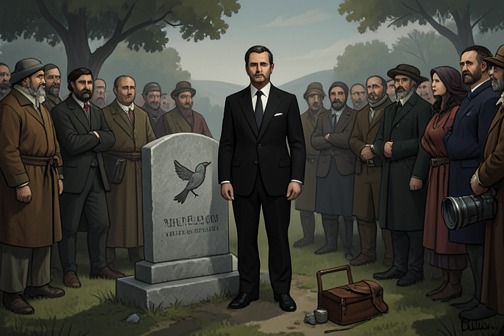
[George Stark's fictitious funeral and gravestone unveiling](entity:event-recall-event-george-stark-e7789a88a842) turn [Thad Beaumont](entity:character-recall-character-thad-beaumont-98cafe7409b7)'s attempt to put his pseudonym behind him into a public act with consequences he could not control. The grave is meant to mark the end of a writing identity; once a man claiming to be Stark appears, the same marker becomes a clue linking the fiction to the danger confronting Thad and his family.
## The pseudonym behind the burial
Thad chose the name [George Stark](entity:character-recall-character-george-stark-adef5aad1430) while trying to overcome writer's block. He wanted an identity separate from his own, and the model was Richard Stark, the pen name used by crime novelist Donald E. Westlake for a series about Parker, a professional thief. Thad recalled Westlake's account of writing under different names in different moods: those years felt to him like rainy days, and Stark seemed an identity suited to them.
The model also supplied a recognizable criminal mode. Thad described Parker as nearly a programmed machine, driven by the single aim of getting his money. He recognized a related quality in Alexis Machine, the central figure in the first and last George Stark novels. That borrowed tradition helped shape Stark as a hard-edged crime writer, but it did not make the fictional identity harmless: Thad's own wife, Liz, later said the four books had made her increasingly uneasy about him.
## A public farewell and an uncertain grave
The gravestone was not simply a private gesture. A woman had arranged the false marker, and an article in [People](entity:organization-recall-organization-people-9afd23e695ff) reported where it stood and where George Stark had been buried. When Thad raised this detail with [Alan Pangborn](entity:character-recall-character-alan-pangborn-313ce7d30e69), Alan recognized its importance: if the man calling himself Stark believed he was Stark, beginning at Stark's grave made sense. Because the photographer connected to the article was in New York, Alan immediately considered whether she might also be in danger.
The stone's inscription made the burial unmistakably connected to Thad's public account of the pseudonym. Liz reminded Alan that the words on it, where a conventional epitaph might have appeared, were the phrase Thad had given a wire-service reporter: “NOT A VERY NICE GUY.” The marker thus carried both the name of the supposedly buried author and Thad's own concise judgment of the identity he had created.
## The truth behind the farewell
When Thad finally told Alan that the name belonged to a pseudonym that had somehow come to life, Liz supported him with knowledge of the history the magazine story had left out. She said Thad had talked about getting rid of Stark well before the public account suggested. Thad corrected her estimate: he had begun talking about it after the first book, not merely a few books before the last one. Their disagreement about the count underscored how long the problem had been present in their marriage.
Liz also described the relief she had felt when Thad decided to kill Stark as a literary creation. She had cried when he made that decision because the character had become a source of fear within their household. In retrospect, she regarded [Frederick Clawson](entity:character-recall-character-e64a06b7a55b)'s intervention as having forced Thad's hand, although she regretted the fact that Clawson was dead. The fictitious funeral and stone therefore marked an attempted ending that had mattered deeply to the family, but had not settled the danger attached to Stark.
## The grave as a plot hinge
The event's significance reverses when the burial place becomes a possible point of origin for Stark's return. What had been staged as an ending is reread as the first place a supposed Stark might seek out. The shift is characteristic of the novel's entanglement of crime fiction and real violence: Thad's invented criminal identity borrows the conventions of the genre, while Alan uses the grave and the published story as practical clues in assessing an actual threat.
The marker also holds together two accounts that cannot initially be reconciled. To the public, it commemorates a fictional author whom Thad had exposed and put to rest; to Thad and Liz, it is evidence of the identity that has escaped its author; and to Alan, it is a plausible lead requiring investigation. The funeral's apparent finality thus becomes part of the suspense: the name has been buried, but the grave does not guarantee that its occupant will remain there.
Event 10
Homer Gamache is murdered
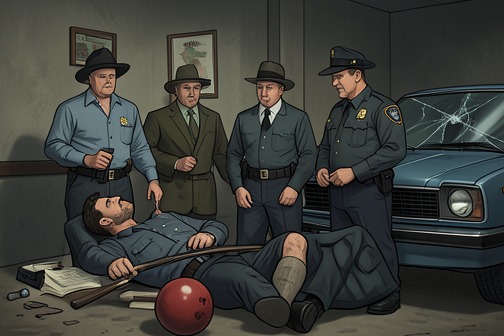
[Homer Gamache](entity:character-recall-character-ed36090a1fbf)’s murder is the first killing in the case that draws [Thad Beaumont](entity:character-recall-character-thad-beaumont-98cafe7409b7)’s own identity and his pen name, [George Stark](entity:character-recall-character-george-stark-adef5aad1430), into the same explanation. Homer’s predictable routine makes the possibility of a deliberate, personal encounter more troubling than a random roadside crime, while Thad’s account of an imagined twin impersonating him reveals the extraordinary shape the investigation has taken.
## Homer and the circumstances of the killing
Homer had retired from full-time caretaking after the Beaumont family bought its house, but he continued to take on occasional jobs. His connection to the family was therefore more than a passing acquaintance: he remained part of the practical life around their [Castle Rock](entity:location-recall-location-castle-rock-01d0b06559db) home. That familiarity gives the murder a personal dimension and supplies the police with a reason to consider whether the killer knew Homer rather than simply encountered him by chance.
[Alan Pangborn](entity:character-recall-character-alan-pangborn-313ce7d30e69)’s working theory is that a hitchhiker killed Homer. The crucial question is why Homer stopped: was the killer merely the first person he encountered who would offer a ride, or had he selected Homer because Homer was connected to Thad? Pangborn emphasizes that Homer bowled on a regular night and followed the same route home, making his movements unusually predictable. Routine, ordinarily a mark of everyday life, becomes a possible mechanism for targeting him.
The police believe Homer may have stopped because he recognized the hitchhiker as Thad. Thad accepts that this is the suspicion, and notes that his familiar tweed suit—with brown suede elbow patches—would have reinforced the appearance of an author setting out to commit a country murder. The detail turns an ordinary item of clothing into part of the case’s apparent evidence: someone could make the crime point toward Thad by adopting the recognizable appearance associated with him.
## The investigation and the twin hypothesis
When Thad asks Pangborn to admit what he had imagined, he sketches an elaborate alibi built around an identical twin. In this hypothetical version, the twin hosts a party, sleeps with Liz, and keeps Thad’s appointments while Thad drives Homer’s truck to a Connecticut rest stop, takes another car to New York, and travels onward to [Washington, D.C.](entity:location-recall-location-washington-d-c-2a63ac520a1d) After killing [Frederick Clawson](entity:character-recall-character-e64a06b7a55b), he returns to [Ludlow](entity:location-recall-location-ludlow-2371257641e7), sends the twin away, and resumes his life. Thad adds that the explanation could be extended to make Liz a participant in the deception.
The scenario is deliberately extravagant, but it draws out the logic of the police’s suspicion: Thad appears to be implicated in acts committed in different places and at different times, and an imagined double could reconcile those conflicting appearances. Liz laughs at the account, briefly and with surprise, while Pangborn looks at Thad with open astonishment. The exchange does not establish that a twin carried out the murders; it shows Thad recognizing and voicing the impossible explanation that the case seems to invite.
Thad later asks the more unsettling question: whether the man who killed Homer and Clawson might believe himself to be George Stark. That possibility shifts attention from impersonation as a simple disguise to the unstable boundary between Thad and the fictional identity he created. Homer’s murder thus becomes not only a crime under investigation but a clue to the killer’s understanding of himself.
## George Stark and the crime-fiction pattern
The name George Stark was devised as a separate identity that could help Beaumont escape writer’s block. Beaumont explains that the model included Donald E. Westlake’s use of the pen name Richard Stark, whose books followed Parker, a professional thief with little apparent life beyond robbery. Beaumont recalls the idea that Westlake wrote under his own name on sunny days and as Stark on rainy ones; for Beaumont, the period from 1973 to early 1975 had been rainy.
The connection is more than a naming anecdote. Beaumont describes Parker as almost a programmed machine, driven by the repeated demand for money, and the interviewer identifies Alexis Machine as the central figure in the first and last George Stark novels. [Dodie Eberhart](entity:character-recall-character-00cfbfe601ac), a crime-novel enthusiast and Stark’s landlord, regards Stark’s books as uncompromising crime fiction about robbery, gun violence, and abusive relationships. These details establish the violent genre pattern attached to the Stark identity, without making the fictional novels a literal explanation for Homer’s death.
The contrast between fiction and investigation is sharpened by Thad’s description of the suspect’s apparent performance: the well-dressed writer in the country at one in the morning, wearing the suit associated with Thad. The case seems to borrow the recognizable signs of a crime story, but the possibility that the killer thinks he is Stark makes the relationship between author, persona, and criminal act more than a matter of costume. The murder’s significance lies in how it makes a constructed literary identity appear to operate in the world outside the page.
## Consequences and significance
Homer’s habitual route gives Pangborn a plausible reason to think the killer could have planned for him, while the apparent resemblance to Thad draws the author into the investigation. The case also links Homer’s death to Frederick Clawson’s murder: Thad explicitly raises the possibility that one person committed both while identifying as Stark. The evidence here presents that as a question, not a settled finding.
The murder therefore marks a turning point in the story’s central uncertainty. A familiar local man’s routine may have made him vulnerable; Thad’s public identity may have furnished the killer with a disguise or target; and George Stark, first conceived as a separate writing identity, becomes a possible self-description for the murderer. The investigation cannot be contained within ordinary questions of opportunity and motive, because the suspect’s relationship to a fictional persona may itself be part of what the crime reveals.
Event 11
Frederick Clawson is murdered
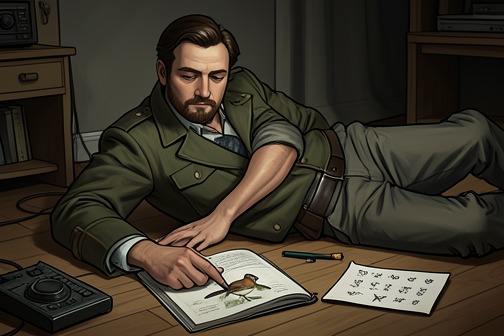
[Frederick Clawson](entity:character-recall-character-e64a06b7a55b)’s murder occurs after the public exposure of [George Stark](entity:character-recall-character-george-stark-adef5aad1430) as a pseudonym used by [Thad Beaumont](entity:character-recall-character-thad-beaumont-98cafe7409b7). The killing converts that literary scandal into a real criminal investigation: physical evidence points toward Thad, while a message left at the scene connects the crime to the story’s supernatural pattern of sparrows.
## Background and Motive
Clawson had been involved in the business surrounding Stark’s books, and he resented being excluded when Thad and Liz made the pseudonym’s identity public. After the revelation attracted attention from publishers and national media, Clawson sent the couple another angry letter, accusing them of ingratitude and insisting that he had done the work while Thad had merely written the books. Thad’s response that Clawson had now signed off for good is corrected by [Alan Pangborn](entity:character-recall-character-alan-pangborn-313ce7d30e69): someone else had ended Clawson’s life. The distinction makes clear that the disclosure did not end the conflict; it preceded a murder whose motive remains uncertain.
The crime’s literary background is more than a dispute about credit. Thad had chosen the name George Stark to give himself an identity separate from his own while trying to break a period of writer’s block. He drew on Donald E. Westlake’s Richard Stark pen name and its Parker novels, whose protagonist is portrayed as an impersonal, single-minded professional thief. Thad recognized a similar quality in Alexis Machine, the central character of the Stark novels, and described the recurring pattern of a robber being robbed. The fictional mode thus supplies a recognizable vocabulary for the violence, but the available evidence does not establish that the books alone explain Clawson’s death.
## Discovery and Evidence
Pangborn tells Thad and Liz that Washington police have withheld one piece of physical evidence from the Clawson investigation, a common practice intended to distinguish genuine knowledge from false confessions. The hidden detail is a phrase written on the wall of Clawson’s apartment in the victim’s blood: “[The sparrows are flying](entity:expression-recall-expression-the-sparrows-are-f-f2555c0647cc) again.” Pangborn asks whether it means anything to them. The message turns the apartment into a link between Clawson’s death and the sparrow phrase already associated with the larger mystery, while leaving its meaning unresolved at this point in the investigation.
The investigation also presents evidence that appears to implicate Thad. In a conversation about the theory that he had an identical twin who could have hosted a party while Thad committed the crimes, Thad sketches a hypothetical route: the supposed twin would remain in [Castle Rock](entity:location-recall-location-castle-rock-01d0b06559db), while the killer drove [Homer Gamache](entity:character-recall-character-ed36090a1fbf)’s truck to a Connecticut rest stop, stole another car, went to New York, and then traveled to [Washington, D.C.](entity:location-recall-location-washington-d-c-2a63ac520a1d), before returning to [Ludlow](entity:location-recall-location-ludlow-2371257641e7). It is an imagined reconstruction, not proof that such a twin or sequence of events existed. Its importance lies in how it exposes the kind of elaborate explanation Pangborn might have entertained while trying to account for the evidence.
That evidence includes Thad’s fingerprints on Homer’s truck, found at a Connecticut rest stop near the New York border. Some prints were clear, including an impression on the rearview mirror made in blood; another had been formed from gum. The prints were sent to a graphics computer, and a service-record match identified them as Thad’s. Thad challenges the inference by asking whether the exceptionally clear prints themselves should arouse suspicion and by pointing out that fingerprints generally appear as partial or smudged impressions. Pangborn explains that [Maine](entity:location-recall-location-63a11a4e2b26) requires six perfect comparison points for a print to be admitted as evidence. The exchange separates a matching identification from the question of how such unusually complete prints came to be present.
## Consequences and Significance
After the public story about Stark reached the national wire and [People magazine](entity:organization-recall-organization-people-magazine-e2b8810c0d61), Clawson’s angry letter was the last communication the couple received from him. His murder changes the meaning of that ending: Clawson did not simply withdraw from the dispute, and Pangborn insists that his death involved another person. When he asks why anyone would resort to murder over a secret that had already come out, neither Thad nor Liz can identify a reason. The investigation therefore begins from a tension between an exposed pseudonym, a resentful associate, and a killing whose motive is still unknown.
The phrase left at the scene gives the murder a second consequence: it binds forensic procedure to an unexplained motif. Pangborn withholds it initially, then shares it only after asking the couple to keep it confidential. Later, another reported inscription—“[HIGH-TONED SON OF A BITCH](entity:expression-recall-expression-high-toned-son-of-7bbecbabbec0)”—leads him to consider whether Thad might be mentally unstable, but he cannot dismiss the possibility of something supernatural. He recalls the voice-print and fingerprint evidence and the hundreds of sparrows that struck the windows of [Bergenfield County Hospital](entity:location-recall-location-bergenfield-county-h-18500b22b0b2). Across these details, the investigation moves between ordinary evidentiary questions and signs that do not fit a straightforward account, without making Clawson’s killer or motive certain in this episode.
Event 12
Thad's first episode of sparrow-triggered automatic writing
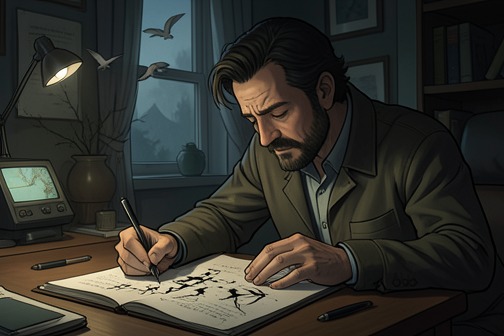
Thad’s first episode of sparrow-triggered automatic writing is the moment when a childhood symptom returns in adult life as an apparent connection to [George Stark](entity:character-recall-character-george-stark-adef5aad1430). The sound of sparrows, once associated with the illness that led to surgery on Thad’s brain, precedes a trance in which he writes words that alarm Liz because they match writing connected to a murder. The episode makes his medical past newly present without resolving whether the event is neurological, psychic, or supernatural.
## Childhood Symptoms and Medical History
In [1960](entity:time-recall-time-1960-8dc3d301e9f9), Thad’s headaches began mildly in August and intensified after school resumed in early September. By the end of that month he hoped he would die; by mid-October, as the pain worsened, he feared that he would not. The attacks left him lying in a darkened room, unable to do anything but wait for the agony to pass. Their onset was often marked by a sound only he could hear: the distant cheeping of what he imagined were thousands of small birds, which he thought might be sparrows gathered on telephone wires and rooftops.
The childhood symptoms had a physical explanation, though an extraordinary one. A mass in Thad’s prefrontal lobe was discovered after he suffered a seizure, and doctors operated on what they assumed was a tumor. The tissue proved to be part of Thad’s twin, incompletely absorbed before birth. Such absorption was described as fairly common, but retained tissue in the brain was rare; the mass had begun growing again, and the resulting intracranial pressure accounted for the headaches and convulsion. This history gives the later bird-sound a clinical precedent, but it does not explain the writing that follows it.
## The Adult Recurrence
Years later, Thad tells Liz that he had been working at his desk when the sparrow sound returned. It was the second recurrence that day, and this time it was much more intense. The episode interrupted his work on a new novel: six pages lay on top of the typewriter, his usual daily output when writing under his own name. The room’s ordinary details—the crowded oak desk, manuscripts and proofs, and the pages beside the typewriter—place the strange event in the routine setting of his writing life.
Liz studies the top sheet and recognizes its writing as the same as writing she has seen elsewhere. The fact that Thad produced it before [Alan Pangborn](entity:character-recall-character-alan-pangborn-313ce7d30e69) arrived is crucial to her reaction: the apparent match cannot be attributed to a later encounter with the sheriff. She insists on the order of events, repeating that Thad wrote it beforehand. The timing turns the page into more than an alarming resemblance; it suggests that the writing anticipated information or a pattern not yet presented to him in the scene.
## Trance, Pencil, and Uncertain Agency
Liz notices that Thad used one of George Stark’s pencils. Thad objects to treating the pencils as Stark’s property, insisting they are his, and resents the habit of speaking of Stark as a separate person. But the object makes the boundary between the two writers harder to ignore. Liz also points out that Thad has used the phrase [lie me an alibi](entity:expression-recall-expression-lie-me-an-alibi-e16bb50b1eb1), which she associates with Stark’s writing and has not heard Thad use outside a book. Thad initially considers calling it coincidence, then admits that he cannot be sure.
When Liz asks whether he was in a trance, Thad answers that he thinks he was. That reluctant acknowledgment distinguishes the event from deliberate composition: he has produced writing, but cannot confidently claim ordinary conscious control over it. His explanation remains partial. He reports the sound and the pages, recognizes the significance of their apparent connection to Stark, and concedes the trance, yet does not establish how the words came to him or what the experience means.
## From Private Symptom to Wider Pattern
The episode changes how Thad and Liz understand the old bird-sound. Thad later explains that it had been an auditory sensory precursor to the headaches caused by the brain mass; unlike more commonly reported sensory warnings such as smells, his had been birds, specifically sparrows. After the adult recurrences, he consults [George Hume](entity:character-recall-character-george-hume-b3ecfdbb03b9), reporting that the sounds have returned but that his headaches have not. He withholds the trance, what he wrote, and the writing found on a murder victim’s apartment wall. Hume nevertheless takes the recurrence seriously and orders cranial X-rays and a CAT scan. The medical inquiry therefore begins with a symptom Thad recognizes, while the most disturbing elements remain undisclosed.
Later scenes broaden the birds beyond Thad’s private perception. At Gold’s Junkyard and Auto Supply, sparrows cover the stacked vehicles in numbers so great that Thad and [Rawlie DeLesseps](entity:character-recall-character-rawlie-delesseps-886879ef4a7f) find them carpeting the back acreage; the flock is silent, and Thad has heard none of them arrive. Near the Williamses’ driveway, a bird lands on Alan Pangborn’s shoulder, hops onto his hand, and stops before pecking him. Alan sees sparrows filling the nearby trees, while their concentration on the slope seems to leave the lane comparatively clear. The birds thus appear as a coordinated presence that can approach people selectively, not merely as a sound accompanying Thad’s symptoms.
As Thad drives toward the house, the flock forms a sharply bounded barrier across the road. A sparrow settles on the hood of his Volkswagen and seems to regard him with dispassionate curiosity; he understands that reaching the house means driving over the birds. At the climax, the sparrows’ role becomes explicit: they have come to escort George Stark back to the land of the dead. The apparent symptom that once announced illness has become part of a larger supernatural pattern. The first automatic-writing episode does not itself settle whether Thad is linked to Stark through illness, psychic influence, or something beyond medical explanation, but it establishes the recurring birds as the sign through which those possibilities converge.
Event 13
Thad's sparrow-triggered trance in his university office
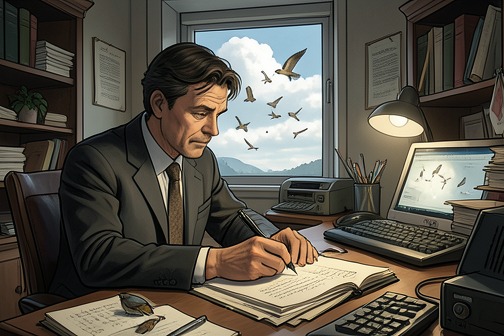
[Thad's sparrow-triggered trance in his university office](entity:event-recall-event-thad-299717fb958e) is a return of the blackout and automatic writing that connect his private visions to [George Stark](entity:character-recall-character-george-stark-adef5aad1430)’s violence. While clearing his office, Thad hears the birds build from isolated cries into a deafening chorus; white skies crowded with sparrows fill his mind, and his hand writes without his conscious direction. The page seems at first to be incoherent residue from a dream, but names and the word “Razor” later make the episode feel like an ominous warning. Its importance extends beyond Thad’s symptoms: the sparrows recur as a silent, coordinated presence in the physical world and finally serve as Stark’s escort back to the dead.
## The episode in Thad’s office
Thad is clearing a semester’s worth of clutter from his desk and shelves when the sparrows begin to cry inside his head again. A few separate twitters quickly swell into a chorus. In a vision, a white sky is cut by the silhouettes of houses and telephone poles; sparrows line the roofs and crowd the poles, poised as if awaiting a collective command. They then rise together in a dark, sky-covering cloud. The images place the birds not as scattered details but as a coordinated multitude, already governed by a shared impulse.
Thad staggers to his desk, finds his chair, and collapses into it. The noise fills his head as he draws a sheet of paper toward him. His eyes stare sightlessly at the ceiling, his head lolls back, and his pen moves back and forth and up and down as though on its own. He is not aware of what he is writing. The trance lasts less than five minutes from the first cries, but its physical aftermath is immediate: Thad is sweating heavily, and his left wrist throbs, even though the headache he expects does not come.
When he looks down, the writing is on the back of an order form for complimentary American Literature textbooks. He studies the scrawls and initially finds no coherent message. Some words seem to have come from his dream of Stark; others are disconnected gibberish. Thad whispers that it means nothing, rubbing his temples as he waits for either a headache or a pattern to emerge. Neither does. At this point, the page offers no clear explanation—only the unsettling fact that his hand has written while his conscious mind was absent.
## Destruction of the page and delayed recognition
Thad decides to stop trying to solve the words. Very slowly, he tears the order form into strips, then turns them lengthwise and tears them across again. The writing disappears into the wastebasket among the other material he has thrown away. He watches the pieces for almost two minutes, half-expecting them to reassemble and return to his desk, as if the scene could run backward. He then carries the basket down the hall, opens the stainless-steel incinerator panel beside the elevator, and empties the trash down the black chute. The act gives him a concrete way to reject the page, but it cannot prevent the written details from acquiring significance later.
When Thad tells Liz that he has had another episode, he identifies it as both a blackout and a trance. The sparrows came first, followed by the writing, and he says that he threw the paper away. He also recalls that Liz’s name and [Miriam Cowley](entity:character-recall-character-miriam-cowley-0fce84de9ebb)’s name appeared on it. The remembered names turn what he had dismissed as random writing into a disturbing connection between the trance and people in the immediate story. Thad breaks off as the implication begins to form, and Liz grabs his arm and asks what is wrong; his recognition is developing in the moment, not arriving as a complete explanation.
A later detail sharpens that recognition. When the telephone at home does not ring and instead gives only a busy signal, Thad considers whether Stark may have disconnected or cut the line, then remembers the word “Razor” among the words he wrote that afternoon. The word is linked in his mind to Miriam, whom he understands to have been cut. What began as gibberish on a discarded form now appears to have anticipated the manner of violence. The episode therefore changes in retrospect: the written page was not merely an inexplicable record of a blackout, but a fragmentary warning whose meaning Thad could not read when he first returned to himself.
## The sparrows beyond the vision
The birds’ recurrence in later scenes gives the office episode a wider narrative context. At Gold’s Junkyard and Auto Supply, Thad and [Rawlie DeLesseps](entity:character-recall-character-rawlie-delesseps-886879ef4a7f) look behind them and find the dead cars and trucks across the rear ten acres carpeted with sparrows. Thad has not heard them arrive. The birds occupy hoods, windows, roofs, exhaust pipes, grilles, engine blocks, joints, and frames; they remain silent while the two men look at them and the mass of birds looks back. Rawlie calls them psychopomps and asks what their appearance means. The scene translates the office vision’s flock into an overwhelming physical presence, but it supplies no human command or reassuring explanation.
When [Alan Pangborn](entity:character-recall-character-alan-pangborn-313ce7d30e69) encounters the birds near the Williamses’ A-frame, one lands on his shoulder. He brushes at it; it hops onto his hand and dips its beak as if to peck his palm, then stops. Alan lowers his hand, and the bird hops away to join the others. The encounter unsettles him precisely because the bird approaches, responds to his movement, and then withdraws without attacking. The flock’s behavior suggests a capacity to act in relation to particular people, but the scene leaves its purpose obscure.
Alan retreats up the Williamses’ driveway and along [Lake Lane](entity:location-recall-location-lake-lane-867679f55fae). The sparrows cover his car on the slope, yet none are on the lane where he stops. He thinks they do not want to get too close, at least not yet, and imagines the place as their staging area. Elsewhere, Thad finds the flock beginning less than twelve feet in front of his stopped Volkswagen, with a boundary so sharply drawn it seems ruled. A sparrow lands on the hood and peers in at him; he senses a frightening, dispassionate curiosity in its black eyes. The birds make the road itself into an obstacle: to reach the house, Thad knows he will have to drive over them. Their silence and their control of space turn the earlier, inward chorus into a threat that can direct human movement.
## Function and consequence
The office trance establishes an unstable boundary between vision and evidence. Thad returns to himself quickly and initially sees only disconnected words, yet the names he later remembers and the word “Razor” acquire force through their association with actual danger. The episode does not provide a complete account of what the birds know or how the writing works. Instead, it places Thad in the recurring position of receiving signs he cannot interpret until later events give them a shape.
The story’s final movement reveals the birds’ role in relation to Stark. As the flock floods the space around him, Thad recognizes that the psychopomps have come to escort Stark back to the land of the dead. The birds settle on Stark’s shoulders, arms, and head, then strike his chest in growing numbers while he twists beneath their beating wings and slashing beaks. In this ending, their gathering is not merely an echo of Thad’s mental disturbance: it becomes an action with a decisive consequence. The silent multitude that first entered his consciousness as a vision ultimately carries out the return to death that the vision could not yet explain.
Event 14
Michael Donaldson is murdered
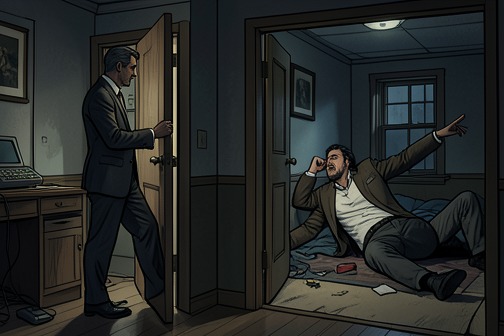
[Michael Donaldson is murdered](entity:event-recall-event-michael-donaldson-cdd60ca0e855) by [George Stark](entity:character-recall-character-george-stark-adef5aad1430) in the hallway of his [New York City](entity:location-recall-location-7a11f2949ca3) apartment building. Stark intends a quick ambush, but Donaldson’s unexpected evasions frustrate the plan and prolong the encounter. The killing becomes one of several attacks that [Alan Pangborn](entity:character-recall-character-alan-pangborn-313ce7d30e69) later recounts to [Thad Beaumont](entity:character-recall-character-thad-beaumont-98cafe7409b7) and Liz, while also exposing how the ruthless methods of Stark’s crime fiction have entered the story’s reality.
## Background and Intended Ambush
Stark waits around the corner from Donaldson’s apartment door on the building’s ninth floor. He has considered entering the apartment, as he had in an earlier attack, but decides against it because the locks appear more secure. Expecting the late hour to leave Donaldson sluggish and the residents asleep, Stark instead finds that his target is quicker than anticipated.
Stark’s plan is shaped by the brutal efficiency of the crime stories associated with his identity. Thad has described Richard Stark’s fictional robber Parker as almost mechanical: a figure driven by a single objective and moving through opponents without hesitation. Thad’s comparison of that model to Alexis Machine, the central character of the first and last George Stark novels, helps frame the killer’s matter-of-fact approach. Yet the hallway attack does not proceed with the clean inevitability of a crime-fiction set piece.
## The Attack and Its Reversals
As Donaldson searches for his keys, Stark steps out and attacks with a straight razor, intending to incapacitate him and prevent him from calling for help. Donaldson ducks enough to avoid the intended blow, and the plan immediately loses its controlled shape. He cries out, and Stark’s attempt to finish the attack quickly becomes a struggle in a public corridor.
Donaldson runs toward the elevators. Stark follows and makes another attempt to kill him, but Donaldson’s sudden movement turns the blow aside. The repeated failures exasperate Stark, while the noise raises the prospect that people in nearby apartments have called emergency services. When Donaldson falls near the elevator lobby, Stark attacks again, then completes the killing and leaves by elevator.
## Consequences and Narrative Significance
The murder is subsequently reported alongside the deaths of [Phyllis Myers](entity:character-recall-character-phyllis-myers-33eeb8df7b7e) and two police officers in New York City. Alan tells Thad and Liz that Donaldson was killed in the hallway of his apartment building, placing the attack within a broader series of gangland-style killings attributed to Stark. The account also mentions that the building’s doorman is dead, extending the consequences beyond Donaldson himself.
The scene’s place in a chain of related attacks makes Donaldson’s death both a specific crime and evidence of Stark’s widening violence. Its failed, improvised course contrasts with the single-minded criminal competence Thad associates with the fictional Parker. Stark’s invented crime-world identity supplies a recognizable pattern, but the actual episode resists that pattern’s smoothness: Donaldson’s evasions interrupt the planned sequence, and Stark’s frustration becomes part of the event’s character.
Event 15
Explosion at Rick Cowley's apartment
The explosion at [Rick Cowley](entity:character-recall-character-rick-cowley-d63a609dd605)’s apartment is a calculated attack that kills Rick and two communications technicians, kills one police officer, and permanently disables another. Its carefully planted messages transform a concealed trap into a direct warning to [Thaddeus “Thad” Beaumont](entity:character-recall-character-thaddeus-thad-beaum-e6877a255de4): [George Stark](entity:character-recall-character-george-stark-adef5aad1430) is still acting, and the sparrows are flying again. The blast also becomes part of a growing chain of evidence that unsettles [Alan Pangborn](entity:character-recall-character-alan-pangborn-313ce7d30e69)’s confidence in an ordinary explanation.
## Background and setup
Before the explosion, Rick had been taken away for questioning and returned to his apartment with police escorts. He was confused by the questions and tired from a morning that had not made sense to him. The officers noticed that the communications technicians who had been assigned to disable the phones were not waiting outside, as procedure required. Rick, with little patience left for their concern, took out his keys and started to unlock the door.
Rick mentioned that he ought to call Thad as soon as he got inside. The remark gives the moment a sharp, ordinary purpose: he is thinking about getting in touch with his friend, not about the danger waiting at the threshold. At the same time, the absence of the communications team is the immediate warning the officers have failed to resolve before he turns the key.
## The blast and its victims
One officer recognized the danger at the last instant and shouted for Rick to stop, but Rick had already begun unlocking the door. The explosion killed Rick and the communications technicians inside the apartment. One officer, standing closest to the door, was killed; another was farther back and shielded his face when his partner called out. He survived with serious injuries and was left stone deaf, ending his career with the [New York City Police Department](entity:organization-recall-organization-new-york-city-po-e17794d7f7c9).
The differing outcomes make clear that the door was not merely a route into the apartment but the mechanism of the attack. The police presence offered no protection against a trap that detonated as Rick entered, and the technicians assigned to disable the phones were already dead inside. The explosion therefore destroys both its intended target and the people whose task might have exposed or neutralized the danger.
## Messages and the threat to Thad
The technicians’ bodies carried separate notes pinned to their foreheads. One announced, “THE SPARROWS ARE FLYING AGAIN.” The other read, “MORE FOOL’S STUFFING. TELL THAD.” Together, the messages identify the blast as part of Stark’s campaign rather than an accident or an isolated attack: they make the dead men into messengers and point beyond Rick’s apartment to Thad.
The wording links a renewed threat to a phrase already charged by the story’s recurring sparrow motif. It also gives the attack a deliberate audience. Rick and the technicians are killed, but Thad is explicitly named as the person who must hear about it; the violence at the apartment is meant to reach him even when Stark is not present to confront him directly.
## Aftermath and wider significance
The bombing’s consequences extend beyond the deaths and the surviving officer’s permanent deafness. The messages announce the return of the sparrows, and elsewhere their numbers become impossible to dismiss: at Gold’s Junkyard and Auto Supply, the cars and trucks are carpeted with silent birds, while at [Lake Lane](entity:location-recall-location-lake-lane-867679f55fae) they appear to keep their distance from Alan, as though the area were a staging ground. Thad encounters a flock so dense that the birds seem to occupy the road itself. These later appearances develop the warning in the notes from a written threat into a force that visibly shapes events.
Alan’s response also changes as evidence accumulates. He initially tells himself that the strange report from [Fuzzy Martin](entity:character-recall-character-fuzzy-martin-bfaf46db1719) proves nothing supernatural; then he recalls the fingerprint and voice comparisons and the hundreds of sparrows crashing into the windows of [Bergenfield County Hospital](entity:location-recall-location-bergenfield-county-h-18500b22b0b2), and he begins to shake. The apartment explosion thus sits at the junction of police procedure and the novel’s uncanny logic: a booby-trapped door and dead witnesses are concrete facts, while the messages and the returning birds widen their meaning into a confrontation that ordinary investigation cannot comfortably contain.
Event 16
里克·考利遇害
[Rick Cowley](entity:character-recall-character-rick-cowley-d63a609dd605)’s death is the collapse of a protection plan: [George Stark](entity:character-recall-character-george-stark-adef5aad1430) rigs Rick’s apartment door, and the explosion kills him just as the people guarding the Beaumonts believe he is safe. [Alan Pangborn](entity:character-recall-character-alan-pangborn-313ce7d30e69) brings the news back to the family, turning a remote threat into a fresh and immediate loss.
## Causes and Background
Rick is among the people thought to be protected while Stark remains dangerous. The evidence does not establish the exact method by which Stark reached the apartment or set the trap, but it makes clear that he had ambushed the technicians working on Rick’s telephone, in the same manner as the technicians handling the Beaumonts’ line. Stark then booby-trapped Rick’s door. The telephone work that was meant to guard against danger thus becomes part of the circumstances surrounding an attack the protection effort fails to prevent.
## The Explosion and Its Discovery
Rick is killed when he turns his latchkey and the door explodes. The account presents the death as a sudden consequence of the concealed trap, rather than as a confrontation in which Rick has an opportunity to respond. Stark’s attack on the door also follows his earlier violence against [Michael Donaldson](entity:character-recall-character-michael-donaldson-d2a165224fb6), whom he attacked with a straight razor while waiting outside Donaldson’s apartment. Together, these incidents show Stark carrying his threat into victims’ homes and using the moment of arrival as an opening for violence.
Alan learns of the explosion less than three miles along the road toward Orono, when the report comes over the radio. He immediately turns back and carries the news to the Beaumonts. His return makes the fatal failure of the security arrangements known directly to the family, who had been waiting for further news.
## Consequences for the Beaumonts
Liz confronts Alan with the assurance he had given them that Rick was safe. Her voice and eyes are described as dull, and the narration notes that even her hair seems to have lost its luster. Alan acknowledges that he was wrong and apologizes. He is as shocked as Liz appears, but tries not to show it; the scene registers both the family’s grief and the collapse of their trust in the protection they had been promised.
Thad watches Alan with bright-eyed stillness and a humorless smile at the edges of his mouth. That reaction follows his earlier, ironic reconstruction of the authorities’ twin-based theory: in his imagined version, an identical twin could have taken his place in [Castle Rock](entity:location-recall-location-castle-rock-01d0b06559db), murdered [Homer Gamache](entity:character-recall-character-ed36090a1fbf), and left Thad free to kill [Frederick Clawson](entity:character-recall-character-e64a06b7a55b) in [Washington, D.C.](entity:location-recall-location-washington-d-c-2a63ac520a1d) The joke had exposed the absurdity of treating an imagined double as an explanation for the crimes; Rick’s actual death now gives the family a reality more disturbing than that elaborate theory.
## Narrative Significance
Rick’s death demonstrates the limits of police protection without suggesting that Alan knowingly misled the family: he admits that his assurance was wrong and returns as soon as he receives the radio report. The event also extends Stark’s violence beyond the Beaumont household and its immediate surveillance. A door, ordinarily a boundary between a home and the outside world, becomes the means of the attack, while the family learns of the death through the very officer who had assured them of Rick’s safety.
Event 17
乔治·斯塔克致电博蒙特家
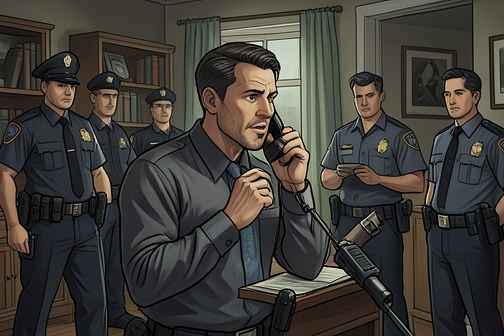
[George Stark](entity:character-recall-character-george-stark-adef5aad1430)’s call to the Beaumont home comes under police and federal surveillance, but it does not make him easier to explain. He announces that his killings are over and denies, in effect, the identity Thad already recognizes. The exchange leaves the authorities with a technically successful recording and Thad with the conviction that the caller is Stark—an unresolved collision between forensic evidence and lived knowledge.
## Background and setting
The call follows a week of violence and arrives shortly after state police technicians finish installing monitoring equipment on the Beaumonts’ telephones. The agents and investigators are still at the house; [Alan Pangborn](entity:character-recall-character-alan-pangborn-313ce7d30e69) has stepped away to speak with [George Hume](entity:character-recall-character-george-hume-b3ecfdbb03b9). The surveillance itself is less modern than its exterior suggests: beneath the Beaumonts’ Merlin phones, the technicians find [Ludlow](entity:location-recall-location-ludlow-2371257641e7)’s rotary-dial system. Stark calls less than five minutes after they declare the equipment ready, making the first monitored conversation an immediate test of what the machinery can establish.
The call also lands in a home where the official investigation has not caught up with Thad’s understanding. Federal agents have been questioning the household, and police protection remains in place, but Thad expects Stark to wait because he knows the family is home. When Thad takes the telephone and challenges the caller, the other people in the room turn toward him. For the investigators, the call is an unexpected intrusion into a police operation; for Thad and Liz, it confirms the danger they have been living with.
## The call and Stark’s claim
Stark says that the matter is over and claims to have killed his last victim that day. He identifies her as a young woman who had worked at [Darwin Press](entity:organization-recall-organization-darwin-press-c8940d5616c9) for the head of the accounting department and says she had first set Clawson’s coffee percolating. He predicts that police will find her at a place on Second Avenue in downtown New York, and describes leaving part of her on the floor and the rest on the kitchen table. His announcement does not offer a confession to the investigators in any useful, straightforward form; instead, Stark uses the call to report another killing, claim the spree has ended, and unsettle Thad by speaking as though he has acted on Thad’s behalf.
Stark presents himself as having taken revenge for Thad, casting Thad as too timid to do it himself. Thad rejects that framing. He knows Stark is lying about not being the caller, and understands that Stark is exploiting the authorities’ likely interpretation: they can hear the call, but they are predisposed to think Thad is delusional if he says the voice belongs to a separate, embodied George Stark. In Thad’s calculation, a claim that he has finally understood the situation could reassure the authorities and eventually weaken the protection around his family. The threat therefore operates on two levels: Stark taunts Thad directly while manipulating how the people listening will interpret Thad’s response.
## Thad’s response and the unresolved identity
Thad tells the caller that he hears the birds, though he does not yet know what they mean. He begins to threaten that he will understand them, but cannot say what will follow. Stark cuts off that unfinished challenge by insisting that, whatever Thad means, it no longer matters because the matter is over. The abrupt ending leaves Thad without an answer or a plan, and the narrative renders the separation from the caller as a return from their imagined meeting place to his own body.
Once the call ends, the technicians celebrate that their equipment worked. Thad tells Liz that the caller was Stark, despite the caller’s denial. She embraces him and says she knows. Their exchange establishes a private recognition that the monitored conversation has not secured publicly: the equipment has captured a voice, but Thad and Liz understand the call as contact with the same adversary who has been threatening them.
## Consequences and significance
The call makes the contrast between technical success and interpretive certainty central to the scene. The wiremen can confirm that the monitoring system functioned, yet that result alone cannot establish the caller’s identity as Thad understands it. The federal agents are present as witnesses, but their presence does not immediately make them allies in his account. The event thus extends the story’s recurring conflict between physical evidence and an explanation that conventional investigation cannot comfortably accept.
The wider investigation has already placed Thad under suspicion through fingerprints connected with [Homer Gamache](entity:character-recall-character-ed36090a1fbf)’s murder. Thad had challenged the logic of that evidence by asking whether the prints met [Maine](entity:location-recall-location-63a11a4e2b26)’s six-point admissibility rule, while his sarcastic reconstruction of an imagined twin exposed how strained an ordinary explanation could become. Against that background, Stark’s telephone denial is another contest over which account will be believed: the recorded voice and official assumptions, or Thad’s recognition of a real adversary. Later, the voiceprint results are described as astonishing, further complicating the evidence without resolving the meaning of the call in the moment.
Stark’s claim that the killings are over proves an unstable reprieve rather than a settled resolution. The conversation gives Thad and Liz a moment of mutual recognition, but leaves the danger, the investigation, and the question of how Stark can be heard yet denied by those around Thad intact. The call matters not because it ends the conflict, but because it exposes the gap between recording a threat and understanding what is making it.
Event 18
Darla Gates's death
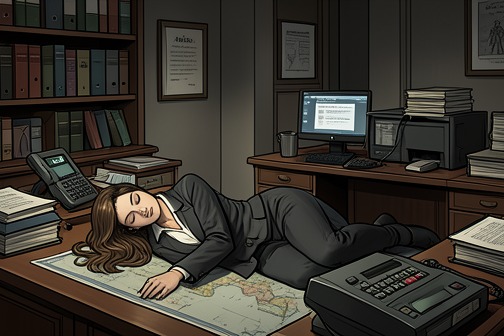
[Darla Gates's death](entity:event-recall-event-3181736509be) is the last murder [George Stark](entity:character-recall-character-george-stark-adef5aad1430) reports to [Thad Beaumont](entity:character-recall-character-thad-beaumont-98cafe7409b7) in a call that presents killing as both retaliation and a grotesque final update. Darla, an employee at [Darwin Press](entity:organization-recall-organization-darwin-press-c8940d5616c9), had helped [Frederick Clawson](entity:character-recall-character-e64a06b7a55b) expose Thad’s pen name; Stark identifies that assistance as the reason she was targeted. The subsequent police account confirms her death but understates what happened, and Thad refuses to accept its version. The episode closes the week of killings Stark describes while making clear that the harm reaches beyond its most visible antagonists.
## Background and Connection to the Exposure
Darla worked in the accounting department at Darwin Press. Stark describes her as the person who first set Clawson’s discovery in motion by telling him about Thad’s secret identity. Clawson then used that information in the conflict surrounding the exposure of Thad’s pen name. The evidence establishes Darla’s role as an informant in that chain, though it does not say what she knew about the later murders or whether she anticipated becoming a target.
Her connection to the case is indirect but consequential: she is not presented as one of its central public figures, yet Stark’s account makes her assistance to Clawson sufficient cause for reprisal. Darla’s death therefore extends the conflict outward, from the people who confronted Thad or Stark to someone whose earlier disclosure helped set the exposure in motion.
## Stark’s Announcement
During a telephone call to Thad’s home, Stark says that the killings are over and identifies Darla as the last victim. He refers to her as the young woman who worked for the accounting department’s boss at Darwin Press and says that she had been the one who first helped Clawson uncover the secret. His announcement is not a warning about a possible future attack: he speaks as if the killing has already happened and the police will find her at her downtown Second Avenue residence.
Stark’s casual presentation turns the call into a performance of control. He describes a week of activity, jokes about how busy he has been, and says that he intends to leave the city to go fishing. The announcement gives Thad information, but it also forces him to receive the news on Stark’s terms: as one more item in a criminal’s account of completed work. Darla’s death thus serves both as retaliation against a person linked to the exposure and as evidence of Stark’s command over the sequence of events he reports.
## Police Account and Thad’s Objection
When [Alan Pangborn](entity:character-recall-character-alan-pangborn-313ce7d30e69) later explains the state of the investigation, he says the [State Police](entity:organization-recall-organization-state-police-f1fda5cf27fd) do not believe Thad or Liz is directly responsible for the recent killings, although they reserve the possibility that either may have had an accomplice. Pangborn confirms that Darla is dead and says that she was badly mutilated but shot in the head first, so that she did not suffer. This is the official account as Pangborn presents it in the conversation; it is not the final word on what happened.
Thad immediately rejects that account as false. He argues that Stark would not have spared Darla after what he had done to Clawson, and identifies her as the original informant who let Clawson discover the secret. Thad also reasons that the money Clawson offered her could not have been substantial, given Clawson’s financial condition. His response links Darla’s death to her part in the exposure and contests the police account’s claim that she was killed without prolonged suffering. Liz interrupts before Pangborn can give the fuller version, so the scene leaves that dispute unresolved rather than supplying an independently verified description of the killing.
## Consequences and Narrative Significance
Darla’s death confirms that Stark’s reprisals are not confined to the people most directly engaged with Thad. A person who helped Clawson learn the truth about the pen name becomes a target in the widening chain of violence. The connection also gives the murder a specific motive within the account: Stark presents it not as an arbitrary act but as punishment for the disclosure that enabled Clawson’s role.
The episode’s narration deliberately places Stark’s boast beside Pangborn’s cautious report and Thad’s refusal to believe it. Readers first hear the killer claim that the final victim has been found, then receive a police summary that appears to soften the circumstances, and finally hear Thad challenge that summary on the basis of Stark’s established conduct and Darla’s connection to Clawson. The difference between those accounts matters: her death is confirmed, but the precise circumstances remain contested in the scene. That uncertainty does not weaken its narrative consequence. It marks the cost of the secret’s exposure and shows how Stark turns knowledge itself into a reason for retaliation.
Event 19
Thad and Stark’s voiceprint comparison
The voiceprint comparison between [Thad Beaumont and George Stark](entity:relation-recall-relation-thad-beaumont-and-ge-e9523fecc436) is an attempted forensic test of whether the two men can be distinguished by sound. Its result is strikingly inconclusive in the technical sense but powerful in its implications: two sheets of recorded voice patterns appear nearly identical, and their only visible differences occur at moments when Thad is emotionally strained. The comparison makes the uncertainty surrounding Stark harder to contain within ordinary investigative explanations.
## Background and stakes
Earlier evidence had already linked Thad to crimes attributed to Stark. Investigators found numerous fingerprints on [Homer Gamache](entity:character-recall-character-ed36090a1fbf)’s truck, including unusually clear impressions attributed to the perpetrator; one had been made in blood on the rearview mirror. When the prints were processed, Thad’s service record and fingerprints came back. Thad challenged the inference, asking whether the quality of the prints itself might be suspect and reminding [Alan Pangborn](entity:character-recall-character-alan-pangborn-313ce7d30e69) that [Maine](entity:location-recall-location-63a11a4e2b26) required six perfect points of comparison for a fingerprint to be admitted as evidence. The fingerprint evidence thus raised an unresolved question: was someone imitating Thad, or did the apparent match point to a more unsettling connection?
The voice comparison extends that inquiry from physical impressions to speech. By this stage, Thad has described Stark as a figure with a short fuse and a dangerous temperament, while also supplying specific identifying details: Stark is tall, broadly built, blue-eyed, and blond, and was born in New Hampshire before moving with his mother to [Oxford, Mississippi](entity:location-recall-location-b9ad172b45f4). Thad’s description gives the investigators a concrete profile, but the voice test bears on a more fundamental issue than appearance: whether Stark’s voice can be separated from Thad’s.
## The comparison and its result
The voice-print results arrived shortly after eight in the evening. Rather than the complicated graphs Thad expected, Pangborn showed him and [Liz Beaumont](entity:character-recall-character-liz-beaumont-375a970a0439) two sheets of plain white paper, each marked by a single line. The patterns were mostly irregular sine-waves, with occasional groups of spikes. Viewed side by side, they seemed identical or very close to it.
Pangborn placed one sheet over the other and held the pair to the light. The overlay made the resemblance immediately legible: the lines matched so closely that Liz remarked on their sameness. Pangborn then pointed out three small differences where the lower sheet showed through. All three occurred at spikes rather than along the otherwise closely matching wave pattern.
Those deviations corresponded to moments when Thad’s speech was stressed: his angry challenges and objections during the conversation under examination. Stark’s portions, by contrast, contained no comparable stress-points. Pangborn explained that officials were concentrating on the minute differences because they wanted to retain the assumption that two different people had spoken. Yet the pattern itself offered little support for a clean separation between the voices. Thad observed that Stark had sounded calm throughout, a contrast that helped account for why the few discrepancies appeared on Thad’s side of the comparison.
## The search for an alternative explanation
The authorities did not stop at visual comparison. After the expert in Augusta examined the prints, the recording was sent to Washington for further analysis. A copy of the tape was transported from Bangor on a commuter flight and examined with an audio enhancer, a device used to determine whether a person had spoken the words in question or whether the voice being heard came from a tape recording.
Pangborn acknowledged that officials at [State Police](entity:organization-recall-organization-state-police-f1fda5cf27fd) Headquarters did not really believe the two prints represented different voices, despite the small variations. The technical follow-up gave them a possible alternative to confront: perhaps Stark’s side of the exchange had been recorded in Thad’s voice and played back. Thad understood that logic and suggested the enhancer had been used in the hope that Stark’s contribution would turn out to be a recording made by him. The test therefore did not simply compare two speakers; it also tested whether an apparent second voice could be explained as a technological reproduction.
## Consequences and significance
The comparison left investigators caught between what they could see and what they wished to conclude. The small deviations offered a limited technical foothold, but their concentration at Thad’s stress-points made them less persuasive as evidence of two separate speakers. The near-identity of the voice patterns, together with the search for a recording-based explanation, kept open the possibility that Stark’s speech was somehow Thad’s own voice rather than an independently produced one.
The result also gives the novel’s broader identity conflict a measurable form. Stark’s voice carries a trace of a Southern accent, and when he later speaks to Thad by telephone, the accent remains while the performed country-bumpkin quality has disappeared. The voice can be modified in its social presentation, but the comparison suggests that beneath those changes the vocal pattern remains extraordinarily close to Thad’s. In a plot already testing the boundary between the author and the figure created under his pen name, the sheets of matching lines turn that boundary into a problem of evidence: the more closely investigators examine the voices, the less securely they can treat them as separate identities.
Event 20
Stark threatens Thad at Dave’s Market
[Stark threatens Thad at Dave’s Market](entity:event-recall-event-2cfc1b309c95) is the [June 10](entity:time-recall-time-june-10-8af64248c3e0) telephone confrontation in which [George Stark](entity:character-recall-character-george-stark-adef5aad1430) forces [Thad Beaumont](entity:character-recall-character-thad-beaumont-98cafe7409b7) to resume writing under the Stark name and makes the lives of Thad’s family the price of refusal. The scene’s decisive turn is that Thad answers the threat with information Stark does not possess: the sparrows and the writing left at the murder scenes. Their exchange makes the coercion reciprocal in one narrow but consequential way—Stark can endanger Thad’s family, while Thad can unsettle him with evidence of their unexplained connection.
## Setting and Call
Two days after Stark’s previous call, Thad goes to Dave’s Market, a small local store a mile and a half from the [Beaumont house](entity:location-recall-location-beaumont-a8361b11d7b6). He is there on a Friday evening to buy Pepsi, chips, and dip; a trooper assigned to protect the family accompanies him. The date is June 10, and it is half past six, with summer daylight still in the sky. The ordinary errand and the visible security detail make the phone call’s intrusion especially plain: Stark reaches Thad not in isolation, but during a brief attempt to carry on with daily life under police protection.
The call comes while Thad stands beside the Megabucks computer, whose green screen announces that the lottery went unwon the previous week and now stands at four million dollars. After noting the absence of birds, Thad takes the phone from Rosalie and greets the caller as George. He has recognized Stark before asking whether the call concerns a message from his wife. The exchange begins with Thad’s recognition, not uncertainty.
## A Demand for Another Novel
Stark tells Thad it is time to start a new book, specifically another Stark novel. Thad refuses and points out that George Stark is dead. Stark rejects that claim and orders him to produce at least thirty pages of manuscript within a week. He presents the demand as a deadline backed by violence, not as a negotiation about writing.
Stark lays out the order in which he intends to attack the family: the children first, then Thad’s wife, and finally Thad. He threatens prolonged suffering for the children and describes a brutal death for Thad. The threat is designed to make the writing demand immediate and personal; Thad’s refusal would, in Stark’s account, expose his family to harm before Stark turns on him. Stark ends by urging him to sharpen his pencils and imagine the children injured, turning the tools of authorship into a reminder of the violence he promises.
## Thad’s Counterknowledge
Rather than answer the threat with another denial, Thad challenges Stark about the writing found at the murder scenes. He asks how Stark could have written the messages on [Frederick Clawson](entity:character-recall-character-e64a06b7a55b)’s and [Miriam Cowley](entity:character-recall-character-miriam-cowley-0fce84de9ebb)’s walls without knowing about them. Stark says there was nothing written on either wall. His insistence that he knows nothing about the messages is the first visible weakness in the call: beneath his forceful voice, Thad senses bewilderment and fear.
Thad advances a disturbing explanation. He thinks he may have been present, in some part, while Stark acted, and that he may have written the messages himself. He further suggests that he alone knows about the sparrows. The claim does not resolve how the two men are connected, but it reverses the scene’s balance: Stark’s command depends on intimidation, while Thad’s knowledge exposes a gap in Stark’s own awareness. Thad tells him to consider that gap before trying to pressure him further.
## Threat, Connection, and Stakes
The call leaves the central danger intact. Stark repeats that Thad must start another book and frames the threat against the family as the best advice he can offer. He says he is not dead and does not want to be dead. Those assertions make his demand more than a bid to revive a discarded pen name: Stark presents the new novel as a condition of his continued existence, while threatening to make Thad pay for refusing.
The scene’s pressure therefore runs in two directions without becoming an equal contest. Stark controls the immediate threat and sets a one-week deadline; Thad, by bringing up the sparrows and the wall messages, demonstrates knowledge that Stark lacks and raises the possibility that some part of him participated in Stark’s acts. The ordinary market setting, the trooper’s presence, and the starkly domestic stakes—children and wife—keep the supernatural uncertainty tied to concrete danger. The call ends without agreement or safety: Thad has challenged Stark’s understanding, but Stark’s ultimatum remains in force.
Event 21
Wendy falls from the stairs as the twins develop matching bruises
[Wendy falls from the stairs as the twins develop matching bruises](entity:event-recall-event-dba5a62a147f) is the domestic accident that turns an ordinary lapse in supervision into evidence of a startling connection between the Beaumont twins. Wendy’s fall initially seems like a narrowly avoided injury; by evening, the matching mark on William’s thigh has made [Thad Beaumont](entity:character-recall-character-thad-beaumont-98cafe7409b7) reconsider what the twins share and what he has understood about the sparrows.
## The fall
Earlier that afternoon, [Liz Beaumont](entity:character-recall-character-liz-beaumont-375a970a0439) had set William and Wendy down to play in a bright patch of sunlight. After their confident crawling and unsteady attempts to stand, William pulled himself up at the coffee table, seized Liz’s teacup, and spilled its cold dregs over himself. When he toppled backward, the cup struck his mouth and made his lower lip bleed. Liz carried him upstairs to soothe and clean him, leaving Thad to watch Wendy.
Thad’s promise to keep an eye on his daughter did not prevent the next accident. While he idly exchanged one magazine for another, Wendy crawled to the staircase and climbed to its third step. Holding a spindle, she rose shakily to her feet. When she saw Thad, she grinned and made an expansive gesture, which tipped her body forward over the drop. Thad tried to reach her, but his foot caught on an armchair; he fell, and his attempt to catch Wendy from his knees missed by about two feet. Her right leg struck the first stair riser before her head hit the living-room carpet.
Wendy screamed, and Thad swept her into his arms. The immediate danger made the accident frightening, but the narrative soon shifts from the fall itself to the unusual mark it leaves. By the twins’ late-nap wake-up at seven that evening, a bruise on Wendy’s upper thigh had turned dark purple and taken on a distinctive mushroom shape.
## A second bruise
While Liz changed William at the other changing table, she called Thad over to look. He had just removed Wendy’s diaper and carried her to their son. William had sat down hard after pulling over the teacup, but, as far as Thad knew, he had not injured his leg. Yet his right upper thigh bore a bruise matching Wendy’s in location, shape, and color.
Thad looked at the mark for a long time before acknowledging how strange it was. The resemblance was not merely a similar bruise appearing by coincidence: William had not undergone the fall that had injured his sister. The connection makes the accident a revelation rather than only a mishap. Thad tells Liz that the twins share their bruises too, extending their relationship from observable sibling closeness to a physical correspondence neither parent can account for.
## What the injury reveals
The sight of the two marks gives Thad a sudden, quiet shift in understanding. He describes a great white light seeming to go off behind his eyes, and says that he thinks he understands a little about the birds and what the next step should be. The scene does not explain the full nature of that insight, but it ties his new recognition directly to William’s matching bruise: the twins’ shared physical experience becomes a clue in Thad’s effort to interpret the sparrows.
The moment also changes the scale of the book’s supernatural pattern. What first appears as a family’s private and inexplicable bond occurs in a story where sparrows gather in immense numbers, remain silent, and seem to act with purpose. Later, at Gold’s Junkyard and Auto Supply, Thad and [Rawlie DeLesseps](entity:character-recall-character-rawlie-delesseps-886879ef4a7f) find the stacked cars and trucks carpeted with birds that have arrived without being heard. Near the Williamses’ driveway, a sparrow lands on [Alan Pangborn](entity:character-recall-character-alan-pangborn-313ce7d30e69)’s shoulder, hops onto his hand, and stops short of pecking him; Alan observes that the flock seems to be holding back, as if the area were a staging ground. These later encounters do not explain the twins’ bruises, but they echo the episode’s central disturbance: living beings are connected by forms of agency and communication that ordinary observation cannot easily explain.
## From family bond to supernatural pattern
The fall itself is accidental, and Thad’s failure to catch Wendy is specifically physical: he is clumsy, catches his foot on the chair, and reaches from the floor too late. The supernatural revelation comes afterward, through the matching injury. That contrast keeps the scene grounded in the ordinary responsibilities and hazards of caring for two newly mobile children even as it opens onto a larger, stranger pattern.
The twins’ synchronized bruises also supply Thad with a point of recognition before the final confrontation with [George Stark](entity:character-recall-character-george-stark-adef5aad1430). At the end, he understands that the psychopomps have come to escort Stark back to the land of the dead; the sparrows settle on Stark and strike at him in growing numbers. The later outcome makes the birds’ supernatural role explicit, while the earlier bruise scene records Thad’s first partial understanding of what their presence means. It is a small domestic discovery with a large narrative consequence: an injury shared by two infants helps Thad read the birds as agents rather than background creatures.
Event 22
Thad contacts Stark through automatic writing
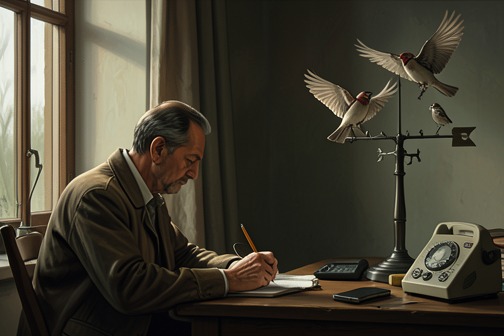
[Thad contacts Stark through automatic writing](entity:event-recall-event-b75a9020ae81) in a scene where an experiment in communication becomes an involuntary encounter with both a living flock and another mind. The sparrows’ arrival confirms that Thad’s visions are not merely private, while his hand’s unbidden account of [Miriam Cowley](entity:character-recall-character-miriam-cowley-0fce84de9ebb)’s murder gives him direct access to Stark’s knowledge. Their connection is reciprocal and perilous: each can reach into the other’s experience, and each ultimately turns that contact against the other.
## The attempt to make contact
Thad turns to a fresh page in his journal, sets aside his pen, and takes a Berol pencil. Fear has already made the act feel consequential, but he proceeds, printing a declaration at the top of the page: [The sparrows are flying](entity:expression-recall-expression-the-sparrows-are-f-f2555c0647cc) again. The phrase joins the birds’ return to the reason for his experiment: he believes the birds are flying again because he and Stark are twins. Writing begins as a deliberate effort to test that connection, not as a normal act of composition.
At the window, a sparrow appears and is joined by others. The birds multiply along the carriage house, gathering on its weathervane until their weight makes it swing. Thad recognizes that they are real, and his study gives way to a vision of the [Ridgeway](entity:location-recall-location-ridgeway-3e3954731f2c) section of [Bergenfield](entity:location-recall-location-bergenfield-ecf6dfd10c3c), where he grew up. The silent neighborhood is covered with sparrows: they line roofs and telephone wires, fill trees, and gather on cars and familiar places from his childhood. In the vision, the birds seem to wait for a command. Their overwhelming presence turns the experiment from an attempt to reach Stark into an encounter with a force Thad had not understood.
## Writing from the other mind
Thad’s body falls into a trance as the pencil begins moving across the journal. The writing bears his hand, but he experiences neither its words as his own nor normal sensation in his right hand. The pencil reproduces the indented paragraph opening characteristic of Stark’s writing, then begins a narrative about Miriam Cowley’s murder. What Thad receives is not a broken impression but a coherent account, recognizably produced by a writer whose fiction has reached millions of readers.
The discovery changes the meaning of the contact. Thad has succeeded in reaching Stark, but the connection is not a controlled exchange: he has tapped into Stark’s mind, just as Stark has apparently reached into his. The writing exposes Stark’s knowledge of the murder and demonstrates that the act of writing can transmit material between them. The pencil and journal are no longer simply Thad’s tools; they become the surface on which Stark’s thoughts appear.
## A reciprocal struggle
Later, Thad asks through the writing why Stark wants to return to writing and whether the desire is important enough to kill people. The pencil hesitates and jerks before it responds, making the exchange seem strained rather than fluent. The contact breaks into action when Stark takes control of Thad’s arm and drives the pencil into the web of his left hand. The pain ends Stark’s immediate hold, but the incident makes clear that the mental connection can become physical danger.
The struggle also runs in the opposite direction. Stark writes a furious rejection of the sparrows and of Thad’s intrusion, then drives a pen into his own right hand. At that instant, Stark feels Thad making the corresponding movement with the Berol pencil in [Maine](entity:location-recall-location-63a11a4e2b26). The two actions mirror one another across distance: each man’s attempt to hurt himself is linked to the other’s, and the shared pain breaks the immediate trance without simply erasing the awareness between them.
## The sparrows and the limits of control
The birds’ later appearances make the scene’s recognition of their reality consequential beyond Thad’s study. At Gold’s Junkyard and Auto Supply, sparrows cover the stacked cars and trucks without making a sound; [Rawlie DeLesseps](entity:character-recall-character-rawlie-delesseps-886879ef4a7f) identifies them as psychopomps and asks Thad what their presence means. Near the Williamses’ driveway, one bird lands on [Alan Pangborn](entity:character-recall-character-alan-pangborn-313ce7d30e69)’s shoulder, moves onto his hand, then hops away. The flock’s proximity to Alan and its refusal to behave as a simple human-directed force underscore its independence.
On the road toward the lake house, Thad encounters a sharp boundary where the flock begins and realizes the birds have become the road itself: reaching the house will require driving over them. In the final confrontation, their role becomes explicit. Thad understands that the psychopomps have come to escort Stark back to the land of the dead, and they gather on Stark and overwhelm him. The automatic-writing episode thus foreshadows the birds’ decisive intervention while establishing a limit to human control: Thad can make contact with Stark, and the flock can answer the unfolding conflict, but neither can be reduced to a safe instrument of the other’s will.
Event 23
Stark demands a new novel from Thad at the university
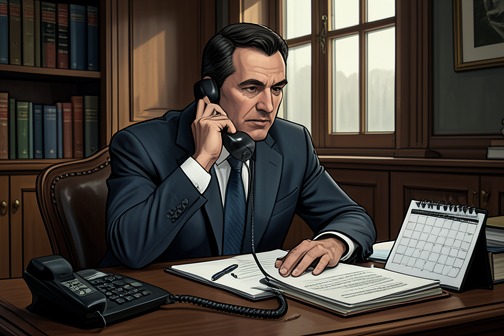
[George Stark](entity:character-recall-character-george-stark-adef5aad1430)’s demand for a new novel reaches a turning point at the [University of Maine](entity:location-recall-location-cca813d57deb): after missing Stark’s one-week deadline, [Thad Beaumont](entity:character-recall-character-thad-beaumont-98cafe7409b7) calls him from an untapped telephone in his university office and refuses to begin the book. The exchange makes their struggle over authorship inseparable from a struggle over survival. Thad believes Stark is coming apart, but the sparrows have shown him that the threat extends beyond Stark himself.
## The deadline and the return to the university
Stark had called on the evening of [June 10](entity:time-recall-time-june-10-8af64248c3e0) and given Thad a week to get started on a novel about an armored-car heist. The week passed without Thad beginning it. By the morning after the deadline, he was acutely aware that time had run out; the book’s possible shape had become clearer to him with each passing day, but he had still done nothing. His failure was not simply a delay in a writing project: Stark had connected the demanded work to the safety of Thad and those close to him.
Thad went to his office in the English-Math Building both to collect Honors files and to use a telephone he believed was not tapped. He also understood that a call was only one way to contact Stark. Earlier, Thad had established a psychic channel by injuring himself under Stark’s influence, an experience that left him with more than physical pain. The coming of the sparrows had shown him that forces greater and less comprehensible than Stark were involved. He increasingly understood the birds as a sign of death, though he did not know who was in danger.
## The telephone confrontation
At the office, Thad picked up the telephone and addressed Stark. Stark reminded him that the week was over and that he had done nothing. Thad acknowledged that he had missed the deadline, but rejected the premise that more time would change his answer: whether Stark gave him a week, a month, or ten years, Thad would not write the novel. He told Stark that he considered him dead and expected him to remain so.
Thad then turned the conversation toward Stark’s condition. The phrase “[Losing cohesion](entity:expression-recall-expression-losing-cohesion-9731532e5e9e),” which Stark had previously written in Thad’s journal through their intrusive connection, gave Thad a basis for arguing that Stark was deteriorating. He suggested that Stark’s demand for new writing came from a need to keep himself from breaking down. Rather than accept that explanation, Stark replied that his condition was irrelevant and pressed Thad to start by nightfall. He warned that Thad would suffer if he did not, and that Thad would not be the only one harmed.
## Their connection and the stakes of authorship
The call reveals a contest over writing in which neither side can treat the novel as a merely literary object. Stark’s demand follows the logic of the crime fiction that shaped his identity: Thad describes the figure behind Stark’s books as a programmed, single-minded killer, whose repeated concern is getting his money. The comparison helps explain Stark’s relentless pursuit of the new manuscript, but the present threat has escaped the bounded world of a crime story. His ultimatum reaches into Thad’s family and makes the cost of refusal immediate.
The connection also works in both directions. Thad can use what Stark has written into his journal to interpret the phrase about losing cohesion, while Stark can reach through the connection to make Thad’s body act against him. That contact has already brought the sparrows into Thad’s awareness, expanding the conflict beyond a duel between writer and creation. Thad’s refusal is therefore not a confident escape from danger: he is trying to test Stark’s weakness while recognizing that a mistake could cost more than his own life.
## Aftermath and narrative significance
Stark ends the call without resolving the confrontation. Thad replaces the handset and turns to find Harrison and [Manchester](entity:character-recall-character-manchester-a73b21845647) standing behind him. The scene closes with the deadline still in force: Stark has renewed his demand for work by nightfall, and his warning places other lives at stake, while Thad remains unwilling to comply.
The university call sharpens the novel’s central reversal between authorship and control. Thad once sought a separate identity as a way to break his writer’s block; now the identity he helped create insists that its author keep writing. Yet the telephone exchange does not simply cast Thad as a helpless captive of his fictional double. He confronts Stark with evidence of deterioration and refuses the demanded work, even as the cost of their mental connection and the appearance of the sparrows make clear that the conflict exceeds the terms of a private bargain.
Event 24
George Stark’s attack on the Beaumont home
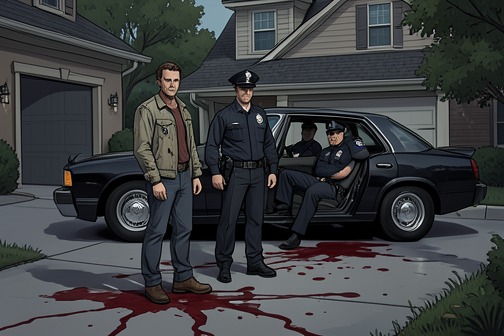
[George Stark’s attack on the Beaumont home](entity:event-recall-event-george-stark-s-attack-o-296b948deda6) is the point at which his violence reaches [Thad Beaumont](entity:character-recall-character-thad-beaumont-98cafe7409b7)’s family directly. After killing two [Maine State Police](entity:organization-recall-organization-maine-state-poli-3b51b5e01a8f) officers in the driveway, Stark enters the house and compels Liz and the twins to go with him, using Wendy as leverage. The attack makes the conflict over authorship and identity a physical siege of the family home: Thad’s fictional double no longer threatens from a distance but controls the family’s movements and demands their cooperation.
## The attack reaches the family home
Stark appears in the Beaumont driveway disguised as a helpless, badly injured man. When [State Police](entity:organization-recall-organization-state-police-f1fda5cf27fd) officers Tom Chatterton and Jack Eddings respond, he uses their attempt to help him to kill them. The encounter is swift, and Eddings’s confusion gives Stark the advantage: he fails to understand what is happening before Stark attacks him as well. The officers’ deaths remove the immediate protection of the police presence and leave Stark free to approach the house.
Stark puts both officers into their cruiser and leaves the scene looking, at a distance, deceptively ordinary. A passing tanker driver sees the police car and checks his speed, mistaking the driveway for a speed trap. That brief, mundane misreading sharpens the danger: the violence has happened in plain view, but an outsider sees only a familiar roadside scene and continues on.
## Liz and the twins become hostages
Liz comes downstairs from a nap to answer the doorbell. She has no remembered dreams of Stark, yet the sight of his ruined face seems unnervingly familiar. Rather than allowing her to refuse him or escape, Stark makes clear that he will hurt the children if she does not cooperate. He demands that she hand over one of the twins while he moves the police car, proposing the child as collateral against her flight.
Liz initially resists when Stark reaches for Wendy. She then lets her go, crying, and warns Stark that she will kill him if he harms the girl. Stark answers that he recognizes Liz’s determination and insists that Wendy will be safe so long as Liz cooperates. The exchange establishes the terms of the abduction: Liz cannot protect the children by openly fighting him, so she must weigh each possible act of resistance against the danger to them.
Stark carries Wendy outside, leaving Liz to watch from the window. For a time he stands beside the cruiser with the baby in his arms, apparently motionless. Liz later understands that he may have been trying to reach Thad through their mental connection and determine whether Thad intended to comply or had another plan. Stark then gets into the cruiser and drives away with Wendy, while the bodies of the two officers remain in the back.
## Forced departure and covert resistance
The abduction continues through the neighboring property rather than along an open escape route. Stark makes Liz move quickly across the side yard, through the greenbelt, and across the Clarks’ yard to their garage. Liz carries the children and refuses Stark’s offer to take one of them. His insistence on speed, and his ability to control the route, keep the family together while limiting their opportunities to get away.
At the garage, Stark opens the door with a narrow metal tool taken from his wallet, then hot-wires the Clarks’ Volvo wagon by joining exposed wires beneath the dashboard. Liz notices how close she is to an opportunity to use the scissors she has kept within reach, but decides not to act yet: she has seen how quickly Stark reacts to surprises and fears for the twins. Her restraint is not surrender. As Stark prepares to drive, she stealthily touches the scissors, resolving to look for a later chance rather than simply wait for Thad to rescue them.
## Significance
The attack reverses the apparent protection of an ordinary home. A police cruiser in the driveway and a neighbor’s garage offer no security once Stark has killed the officers and taken control of the family’s route. The domestic setting becomes a chain of constrained choices: Liz must cooperate to reduce immediate danger to the twins, while quietly preserving the possibility of resistance.
The episode also gives physical form to the novel’s collision between crime fiction and lived reality. Stark’s identity began as a separate name adopted by Thad Beaumont, but here the author’s family confronts the violence associated with that identity directly. The story has already associated Stark’s crime novels with a relentless criminal who pursues a single objective; in the attack, that hard-edged fictional model is no longer confined to books. It determines the movements, threats, and risks of a real household, while Liz’s cautious decision to keep the scissors close supplies a countercurrent of agency within the hostage situation.
Event 25
Thad evades his police escort
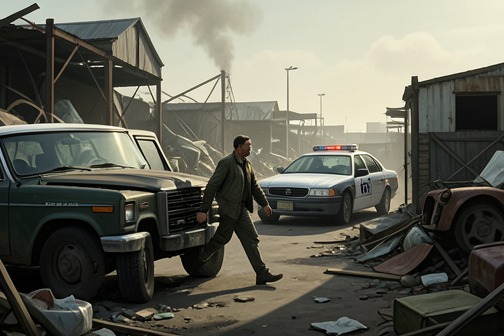
[Thad Beaumont](entity:character-recall-character-thad-beaumont-98cafe7409b7)’s escape from his police escort turns the act of imagining a story into a practical means of survival. With Harrison and [Manchester](entity:character-recall-character-manchester-a73b21845647) following him and [George Stark](entity:character-recall-character-george-stark-adef5aad1430) threatening his family, Thad breaks from the route he is expected to take, hides the conspicuous Suburban in Gold’s junkyard, and disguises it as wreckage. The maneuver buys him a chance to act, but its urgency comes from the lives at stake: Liz and the twins may be killed if he fails.
## The plan takes shape
As Thad turns left onto College Avenue and leaves the campus behind, he tells himself to pretend that what is happening is a book he is writing—and that he is a character in it. The thought interrupts the panic that had been churning through his mind. Instead of being trapped inside an immediate crisis, he can picture people and events as things he might arrange, much as he arranges characters on paper in his study. The fragments of a possible plan settle into a form he believes might work.
The imaginative shift does not make the danger less real. Thad understands that failure could put him in protective custody while leaving Liz and the children exposed to Stark. As he approaches the school zone, his fear returns physically, like a hot wire in his gut. He checks the rearview mirror: the brown Plymouth carrying Harrison and Manchester is still two cars behind. For a moment, he considers stopping and telling Harrison plainly that Stark has his family and that the sparrows are still flying. Instead, he proceeds with the escape.
## Breaking the escort
At a busy four-way stop, Thad joins the line of southbound traffic and keeps checking the Plymouth’s position. The intersection’s ordinary, awkward turn-taking supplies an opening: a Grant’s Dairy tanker is about to cross east-west just as Thad can move north-south. He waits until the tanker rolls across and blocks the Plymouth from his mirror, then floors the Suburban’s accelerator.
Thad takes a right onto a short street, drives quickly through it, and makes successive turns to return to Route 2 roughly a quarter of a mile north of the intersection. He has deliberately doubled back. If the tanker concealed his turn, Harrison and Manchester may still be heading south, unaware that he has left their route. Thad does not assume the deception will last: he doubts Manchester might catch on, but recognizes Harrison as less likely to be fooled.
He cuts across a narrow gap in traffic, forcing a southbound Ford to brake, and heads back toward Gold’s. The risk of attracting a passing police officer matters less than getting the vehicle off the road. He watches the rearview mirror through the half-mile drive to the junkyard entrance; the Plymouth remains out of sight when he turns in.
## Disappearing into Gold’s
Gold’s is a sprawling automobile junkyard, its rows holding nearly twenty thousand cars in various stages of decay. Thad’s gray Suburban with brilliant red sides is conspicuous enough to stand out on the road, but inside the yard he hopes its size will be less of a liability. It is Saturday, near the lunch hour, and he enters through an open gate marked for employees, conditions that make it less likely he will be noticed immediately.
He drives between wrecked cars stacked two and sometimes three deep. The setting offers concealment, but the Suburban’s appearance remains a problem: it is too large and too bright to pass as part of the wreckage. Thad decides that hiding it is not enough; he has to make it look damaged.
## Making the Suburban a wreck
Thad finds a rusty motor-mount on the oily ground and uses it to batter the vehicle. Singing snatches of “John Wesley Harding” under his breath, he thinks of the extra time even a little camouflage might give him—and of that time as potentially decisive for Liz and the twins. He throws the heavy metal part into the driver’s side, denting it deeply, then strikes the grille hard enough to break its plastic. He raises the hood slightly, giving the Suburban another mark of damage.
He throws the motor-mount once more, sending it through the windshield. The impact pains him despite the necessity of the act. His wounded hand has begun bleeding through its bandage, but he cannot stop to deal with it. When he judges that the Suburban now looks sufficiently like the other wrecks, the escape has changed from a fast drive to a calculated act of concealment: Thad has sacrificed the vehicle’s intact condition to make it disappear in plain sight.
## After the break
Thad walks back along the row toward the gate and the retail parts shop, where he remembers seeing a pay telephone. Halfway there, he stops singing and listens—not for an approaching car, but to his own body. The crawling, itching sensation that had been troubling him has disappeared. The immediate evidence of pursuit is also absent: the brown Plymouth was nowhere to be seen on his return to Gold’s. But his escape remains a precarious interval, not a resolution. He has evaded Harrison and Manchester for the moment and hidden the Suburban; the larger danger to Liz and the twins, held by George Stark, is still what drives him onward.
Event 26
Thad summons the sparrows
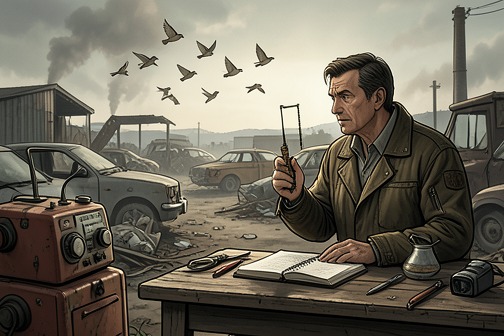
[Thad summons the sparrows](entity:event-recall-event-thad-summons-the-sparro-2adfa72034db) as psychopomps: first at Gold’s Junkyard and Auto Supply, where he asks the birds to find [George Stark](entity:character-recall-character-george-stark-adef5aad1430) and watches them depart west, and later, in the decisive confrontation at the lake house, when he uses a bird-call and written words to set their flight in motion again. The event links Thad’s investigation of a childhood mystery to the supernatural force that ultimately carries Stark away.
## Folklore and the First Encounter
Thad’s attempt to understand the birds begins with a question about [Rawlie DeLesseps](entity:character-recall-character-rawlie-delesseps-886879ef4a7f)’s Folk Myth seminar. When Rawlie tells him that he may have found what Thad was looking for, he turns to Barringer’s *Folklore of America* and explains that sparrows, loons, and whippoorwills are regarded as psychopomps—conductors between the living and the dead. Loons and whippoorwills are said to gather near an impending death and guide the newly dead onward. [Sparrows](entity:creature-recall-creature-sparrows-34c247d90ca9) have a more unsettling role: in Barringer’s account, they are outriders of the deceased, guiding lost souls back into the land of the living. Rawlie calls them harbingers of the living dead.
That account gives Thad a framework for the birds, but it does not explain his own connection to them. At Gold’s Junkyard and Auto Supply, he drives among wrecked cars and begins seeing sparrows on roofs, trunks, engines, and a windshield. They remain in place as he passes. When he notices dried blood inside a damaged Datsun and finds more birds gathered nearby, the folklore stops being an abstract possibility and becomes an immediate question: what do the sparrows want with him?
Thad asks the birds what they want. In response, he seems to hear a single collective voice in his mind, telling him that the question is reversed: he is the owner, the bringer, and the knower. Thad does not understand the answer, but its repeated titles establish an unusual relation between him and the flock. The birds do not merely appear around him; they identify him as someone with a part to play in their movement.
## The Summons at the Junkyard
The gathering grows until the wrecked vehicles on the junkyard’s back ten acres are carpeted with sparrows. The flock has arrived without Thad hearing it come, and it remains completely still. Rawlie recognizes the birds as the psychopomps and asks what their presence means. Thad replies that he is only beginning to understand.
The birds’ attention is selective. Rawlie claps his hands, but the flock does not stir; it is Thad, rather than Rawlie, whom the sparrows watch. Thad then gives a quiet command: find George Stark and fly. The birds rise together into a dark cloud, turn in the sky, and head west. Their departure is a concrete response to Thad’s request, not merely a sign that he has recognized them. The summons makes the flock an active participant in the search for Stark.
The flight briefly merges with the onset of Thad’s earlier trances: for him, past and present seem to entwine as the birds vanish. The scene thus connects his present command to the recurring visions that have accompanied his experiences of the sparrows. It also turns Rawlie’s folklore into practical knowledge: the birds have gathered around Thad, answered him in some fashion, and gone where he directed them.
## The Flock Returns
The sparrows appear again as [Alan Pangborn](entity:character-recall-character-alan-pangborn-313ce7d30e69) approaches the Beaumont lake house. They occupy the roof and surrounding trees of the Williams family’s cottage, as well as the rocks and dock by the shore; there are hundreds. They remain silent and watch Alan. When he moves, more birds arrive and settle in the trees, surrounding him while leaving the woods beside [Lake Lane](entity:location-recall-location-lake-lane-867679f55fae) clear. A sparrow lands on his shoulder and then his hand before returning to the driveway. The birds’ measured proximity gives the flock a presence independent of the people trying to interpret it: they approach, watch, and hold their ground without responding like ordinary startled birds.
Thad encounters the gathering on the road as he drives toward the house. A sparrow settles on the hood of his Volkswagen and peers through the window. He understands that reaching the house means driving over the birds covering the road. The flock has become not only an omen or a means of tracking Stark but a physical barrier between Thad and his destination.
## The Final Call and Its Consequence
At the lake house, Thad prepares for another summons while George Stark is absorbed in writing. Thad takes the bird-call Rawlie gave him and keeps it cupped in his hand. He writes three declarations in his notebook: he is the bringer, the knower, and the owner. As he writes, the birds’ movement overhead stops, and the room seems to listen. The repeated words recall the collective message Thad heard at the junkyard, but now he writes them deliberately, making his role part of the confrontation with Stark.
Thad then writes *PSYCHOPOMPS*, circles it, and adds *THE SPARROWS ARE FLYING*. He blows the bird-call, whose note is followed by the sound of the flock rising outside. Stark stops writing and recognizes the danger too late. The summoned birds are not simply tracking him now: they have come as his escort back to Endsville, the land of the dead. Their arrival reverses the direction established at the junkyard. There, Thad sent them west to find Stark; here, they reach Stark and carry out the passage associated with their folkloric role.
The event’s significance lies in the change from interpretation to agency. Rawlie’s account names the sparrows’ traditional function, the junkyard scene establishes their selective attention to Thad, and the later summons brings that function to bear on Stark. Thad can call the psychopomps and direct them, but their power is not reduced to a human instrument: the flock’s gathering, silence, and final return give the birds an independent force in the story’s resolution.
Event 27
Pritchard reveals Thad’s absorbed twin
Pritchard reveals that [Thad Beaumont](entity:character-recall-character-thad-beaumont-98cafe7409b7) had an absorbed twin: during a call with [Alan Pangborn](entity:character-recall-character-alan-pangborn-313ce7d30e69), the surgeon explains that Thad’s childhood brain mass was not an ordinary tumor but surviving tissue from a second fetus. The disclosure supplies a medical history for Thad’s severe headaches and seizure, and gives new weight to the story’s recurring question of whether one person can contain two selves.
## The revelation to Pangborn
Pangborn contacts Pritchard while investigating [Homer Gamache](entity:character-recall-character-ed36090a1fbf)’s murder in [Castle County](entity:location-recall-location-castle-county-4a03b82fcfdd). He is trying to assess Thad as a possible witness, but hesitates because Thad is famous and appears to be exhibiting symptoms Pritchard once treated. Pangborn begins by asking whether the old brain tumor might have returned. Pritchard immediately recognizes the patient as [Thaddeus Beaumont](entity:character-recall-character-thaddeus-beaumont-274fe9b86454) and doubts that the symptoms indicate a recurrence.
When Pangborn asks what happened during the original operation, Pritchard asks to tell the story in his own way. He recalls that Thad eventually suffered a seizure, after which doctors found a small mass in the prefrontal lobe. They operated on the assumption that it was a tumor; what they found, Pritchard says, was Thad’s twin. The change in Pangborn’s understanding is immediate: a medical question about a possible recurrence has opened onto a highly unusual account of Thad’s beginnings.
## What the operation found
Pritchard places Thad’s case within the broader phenomenon of fetal twin absorption. Twins, he explains, are often absorbed in utero, but incomplete absorption is rare. In Thad’s case, some tissue from the other twin retained its integrity and became entwined with the tissue that formed Thad’s brain. Its location in the prefrontal lobe was unusual, as was its later growth.
Pritchard believes the remaining tissue became active not long after Thad turned eleven. Normally, he says, such tissue remains inert; in this instance it began to grow, eventually creating the pressure associated with Thad’s childhood symptoms. The surgeons removed it successfully. His account describes an operation with a concrete medical result—the mass was excised—but leaves the origin and renewed growth of the tissue strikingly strange.
Pangborn asks whether Thad had somehow eaten a brother. Pritchard allows that the other twin could have been a sister, but suspects it was a brother, reasoning that absorption may be less common in fraternal twins. He qualifies this as statistical inference rather than established fact. His explanation distinguishes the prenatal process from an intentional act: he presents it as a biological imperative, not as murder. The identity of the twin is therefore partly known and partly unresolved; the surviving tissue was real, while its sex remains Pritchard’s informed conjecture.
## The childhood symptoms return
The explanation connects the operation to the illness Thad endured in [1960](entity:time-recall-time-1960-8dc3d301e9f9). His headaches began in August and intensified by September into episodes so severe that he could only lie in a darkened room. He sometimes hoped he would die, then feared the pain might not kill him. The symptoms culminated in the seizure that led to the discovery and removal of the mass.
The bird sounds belong to the same medical history. Before the headaches, Thad heard what seemed to be the distant cheeping of many small birds and imagined sparrows gathering on telephone lines and rooftops. Years later, he identifies the sound to Liz as his auditory sensory precursor: a warning associated with the brain condition, rather than a smell of the sort commonly reported by people with brain tumors.
When the sounds recur, Thad makes an appointment with Dr. Hume. He reports two episodes resembling the bird sounds that preceded his illness, but says the headaches have not returned. He does not tell Hume about his trance, what he wrote during it, or the writing found at a murder victim’s apartment in [Washington, D.C.](entity:location-recall-location-washington-d-c-2a63ac520a1d) Hume nevertheless takes the recurrence seriously and orders cranial X-rays and a CAT scan. The medical past thus becomes active again, but the evidence does not equate the returning sounds with a confirmed return of the removed tissue.
## A second self and a story of doubles
Pangborn’s response carries the revelation beyond diagnosis. After hearing that part of another twin remained within Thad, he thinks of Thad as having always been two men: one living in the ordinary world and one creating worlds. The thought links Pritchard’s biological account to the novel’s central tension between Thad and [George Stark](entity:character-recall-character-george-stark-adef5aad1430), the separate identity Thad adopted to escape writer’s block.
Thad’s own account of choosing the name George Stark makes that connection more specific. He had wanted an identity separate from his own, and took inspiration from crime writer Donald E. Westlake’s Richard Stark pseudonym and its professional thief, Parker. Thad describes Parker as nearly a killer robot, driven by one overriding aim; the interviewer connects that model to Alexis Machine, the central figure in the George Stark novels. This history does not prove that the prenatal twin caused Stark’s existence. Instead, the episode places two kinds of doubling beside each other: the biological remnant Pritchard removed and the authorial identity Thad created, which becomes dangerously real within the story.
That distinction matters to the murder investigation as well. Thad jokingly sketches a theory in which an identical twin could have hosted his party while Thad committed Gamache’s murder, then taken his place in the rest of his life; Liz laughs, and Pangborn is openly surprised. The imagined alibi plays on the very secret the reader now knows, but it is not evidence that a surviving twin is living outside Thad. Pritchard’s revelation concerns tissue absorbed before birth, not a second adult who could have acted in Thad’s place.
## Consequences and significance
The event changes the meaning of Thad’s childhood illness by giving its cause an identity: what doctors first called a tumor was tissue from the twin that had not been fully absorbed. It also gives Pangborn a clinical history against which to consider Thad’s symptoms, while leaving the more recent bird sounds and trance unexplained by a confirmed diagnosis. The old operation offers a grounded account of the headaches and seizure, but does not settle the present mystery.
Pritchard’s explanation also works as a revelation about divided identity without collapsing metaphor into medical fact. The unabsorbed twin is a physical remnant with a documented history of growth and surgical removal; George Stark is a writing identity that Thad deliberately fashioned and that the novel treats as an independent threat. Their resemblance lies in the story’s pattern of the one becoming two, not in a demonstrated causal link. By making Pangborn hear the medical account before he fully understands the supernatural conflict, the scene lets an intimate biological history unsettle an investigation—and makes the idea of a second self both literal in one sense and unresolved in another.
Event 28
The 1960 Bergenfield County Hospital sparrow attack
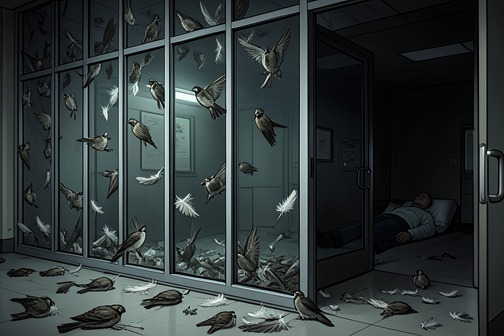
[The 1960 Bergenfield County Hospital sparrow attack](entity:event-recall-event-the-1960-bergenfield-co-ccf7280b76c9) is the extraordinary real-world counterpart to [Thad Beaumont](entity:character-recall-character-thad-beaumont-98cafe7409b7)’s childhood bird hallucinations: as he recovered from surgery on October 28, [1960](entity:time-recall-time-1960-8dc3d301e9f9), a vast flock struck the hospital’s glass façade, leaving hundreds of dead birds. The close timing between the attack and Thad’s awakening connects his medical history to the novel’s later, increasingly ominous sparrow visitations, while leaving open whether the coincidence admits any ordinary explanation.
## Medical Background
In 1960, Thad suffered worsening headaches, often preceded by a sound he recognized as sparrows. The pains became so severe that he lay in a darkened room waiting to die; eventually he had a seizure, and doctors operated on a mass in his prefrontal lobe. They initially assumed it was a tumor, but [Dr. Pritchard](entity:character-recall-character-pritchard-191e872eb876) later explained that the tissue was part of Thad’s twin, incompletely absorbed before birth. Though such absorbed tissue was not unheard of, its location and renewed growth were unusual. Pritchard speculated that the growth spurt might have been triggered by the early onset of puberty.
The bird sound belonged to the symptoms that preceded the operation. Years later, Thad described it as an auditory sensory precursor: while smells such as pencil shavings or freshly cut onions could precede neurological symptoms in other cases, his warning was birds—specifically sparrows. He had heard and imagined them during the months before his diagnosis, but the hospital incident gave that private experience a startling physical echo.
## The Hospital Attack
At just past two in the afternoon on October 28, an extremely large flock flew into the west side of [Bergenfield County Hospital](entity:location-recall-location-bergenfield-county-h-18500b22b0b2). The Intensive Care Unit was then located on that side, where Thad had been taken after surgery. The impact broke many windows, and hospital maintenance workers collected more than three hundred dead birds. Flying glass cut two people in the Hirschfield Wing.
The west façade was almost entirely glass, and an ornithologist proposed that sunlight reflected from it had attracted the flock. He also offered a possible account of the birds’ mass collision: flocking birds might follow one another in a form of group coordination, so that one bird’s flight toward the glass drew the rest after it. The explanation could account for the flock’s behavior without resolving why the incident would become so tightly associated with Thad’s sensory experience.
## Timing and Witnesses
Pritchard had finished checking Thad’s vital signs and left to play golf; he did not witness the attack himself. He later compared the hospital reports with Thad’s chart. The flock hit the building at about 2:05 p.m., and Thad woke at 2:10, perhaps slightly earlier. An intensive-care nurse thought the sound of breaking glass might have woken him.
When Pritchard questioned Thad the following day, the boy remembered the birds clearly. He said he had seen them as well as heard them, covering houses, lawns, and streets throughout [Ridgeway](entity:location-recall-location-ridgeway-3e3954731f2c), the [Bergenfield](entity:location-recall-location-bergenfield-ecf6dfd10c3c) section where he lived. The attack therefore entered the case not merely as a strange local incident but as an event whose time and imagery overlapped with Thad’s account of his own awakening. Pritchard found the match memorable precisely because the child’s precursor had not been birds in general, but sparrows.
## Later Recollection and Significance
Years afterward, Pritchard recounted the episode to [Alan Pangborn](entity:character-recall-character-alan-pangborn-313ce7d30e69) while explaining the unusual history of Thad’s operation. His account puts medical evidence and uncanny recurrence beside each other: the absorbed twin supplied a physical cause for the childhood headaches and seizure, while the sparrow attack remained a documented event with a plausible ornithological explanation and an unsettling coincidence of timing. Pritchard had never spoken of it for years, but he considered the overlap with Thad’s symptoms difficult to forget.
The later narrative gives that coincidence renewed force. [Sparrows](entity:creature-recall-creature-sparrows-34c247d90ca9) return in overwhelming numbers: at Gold’s Junkyard and Auto Supply, they carpet the stacked vehicles without making a sound; near the Williamses’ driveway, one settles on Alan’s shoulder, hops onto his hand, then leaves him unharmed. Their presence can seem organized and selective, as if they were gathering at a staging area, yet no human character can confidently say what governs them. When Thad drives toward the house, a bird peers through the windshield, and the flock fills the road ahead. The childhood hospital attack thus stands at the start of a pattern in which the sparrows are more than a remembered symptom: they become agents in the conflict between Thad and [George Stark](entity:character-recall-character-george-stark-adef5aad1430).
At the end, Thad recognizes the birds as psychopomps—guides of the dead—coming to escort Stark back to the land of the dead. Sparrows settle on Stark’s shoulders, arms, and head before striking him in a cloud of feathers and beaks. The hospital incident does not explain that supernatural role, but its precise convergence with Thad’s recovery foreshadows the recurring association between the birds and death. What began as a flock breaking glass beside a child’s hospital bed becomes part of the novel’s larger image of a nonhuman force whose movements exceed human control.
Event 29
Alan Pangborn is captured by George Stark
[George Stark](entity:character-recall-character-george-stark-adef5aad1430) captures [Alan Pangborn](entity:character-recall-character-alan-pangborn-313ce7d30e69) on the wooded slope above the Beaumonts’ driveway, converting Alan’s attempt to reach the family into a hostage situation. The encounter confirms that Stark is real, places the sheriff under armed control, and carries the threat directly to Liz and the twins.
## Approach to the Beaumont House
Alan moves down the eastern slope of [Castle Lake](entity:location-recall-location-castle-lake-1d470bc64a62) toward the Beaumont [summer house](entity:location-recall-location-beaumont-castle-rock-857401491d79), using the road and its branching driveways to keep track of his route. From a position about twenty yards above [Lake Lane](entity:location-recall-location-lake-lane-867679f55fae), he reaches the fifth turn-off beyond the Williamses’ and checks behind him for the sparrows he believes have been following him. He cannot see them and briefly considers that he may have imagined them, but continues toward the house.
The approach requires Alan to work down the hill slowly and quietly. He cannot see the Beaumonts’ driveway from where he is, and his progress leaves him exposed as he descends. Stark comes up behind him and puts a gun to his ear. Alan’s attempt to reach the family unseen ends before he can get down to the house: Stark has found him first and dictates what happens next.
## Stark Revealed
The man holding Alan at gunpoint is unmistakably George Stark, the figure whose existence had seemed impossible. Stark’s face is badly deteriorated, and his appearance suggests more than ordinary decay; nevertheless, Alan recognizes him. The sight makes the truth immediate: Stark is not a false lead or an invention, but a physical danger standing over the sheriff on the hillside.
Stark’s condition contrasts with his relaxed manner. He jokes about his appearance, speaks to Alan familiarly, and maintains control of the encounter. The contrast does not lessen the threat. Stark tells Alan that a wrong move will cost him his life and will also endanger the woman and children at the house. He says he has nothing to lose, making clear that Alan cannot count on Stark’s self-preservation to restrain him.
## Disarmament and Forced Entry
Alan accepts Stark’s threat and drops his gun into the roadside brush. Stark orders him toward the [Beaumont house](entity:location-recall-location-beaumont-a8361b11d7b6), following behind as they descend to the road, cross it, and continue down the driveway. The house stands out from the hillside on heavy wooden pilings; nearby, Stark’s black Toronado is parked by the door. These details mark the destination as both a family refuge and a place Stark has already reached and occupied.
At the house, Liz calls out to ask whether Alan is all right. Her question establishes that she is present and aware of his arrival, but Alan’s capture means he cannot enter as a free ally. Stark has taken scissors from her and placed them on a bedside table beyond the twins’ reach. He orders Alan to cut Liz’s legs free while leaving her wrists alone, which she is nearly able to free herself. The sheriff is thus made to participate in Stark’s control of the household even as he has been disarmed and remains under threat.
## The Capture Turns the House into a Hostage Scene
Stark brings Alan down the Beaumonts’ driveway under threat, with the sheriff’s gun left behind in the roadside brush. The approach ends at a house set on heavy pilings above the slope, with Stark’s black Toronado parked beside the door. Alan has reached the family, but not in the protective role he intended: Stark controls his movements and uses his presence to extend the hostage situation inside.
## Why the Capture Matters
The encounter turns Alan’s attempted rescue into an enforced extension of Stark’s hold over the Beaumont household. Alan comes down the hill as a sheriff moving toward people in danger; once disarmed, he is made to approach them under the captor’s direction and then ordered to assist in keeping Liz restrained. The reversal is immediate and practical: his presence at the house offers no protection while Stark controls the weapons, the route, and the terms of movement.
The scene also resolves the uncertainty surrounding Stark’s existence. The man Alan recognizes is the same George Stark whose identity and reality had seemed impossible, and the recognition becomes explicit when Alan accepts that what he is seeing is true. Stark’s physical deterioration does not make him less capable of imposing danger; instead, his casual humor and apparent composure sit beside a direct threat against Alan, Liz, and the children. The capture therefore joins revelation to crisis: the impossible figure is physically present, and the family’s safety is now bound to Alan’s obedience.
## Why the Capture Matters
The encounter converts Alan’s attempt to protect the Beaumont family into a means of extending Stark’s control over them. Alan descends as a sheriff trying to reach people in danger; once disarmed, he must approach under his captor’s direction and is ordered to help free Liz’s legs while she remains otherwise restrained. His arrival does not restore safety: Stark controls the weapon, the route into the house, and what Alan is permitted to do there. The reversal makes the capture consequential beyond the hillside, carrying the threat into the family’s home and placing Alan inside the hostage crisis.
Event 30
Thad Beaumont brain surgery
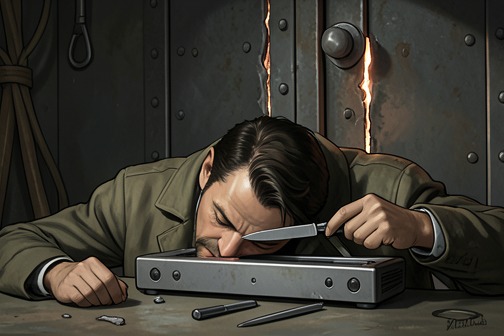
[Thad Beaumont](entity:character-recall-character-thad-beaumont-98cafe7409b7)’s brain surgery in [1960](entity:time-recall-time-1960-8dc3d301e9f9) removed tissue that doctors initially mistook for a tumor but identified as part of a twin he had absorbed before birth. The operation relieved a medical crisis, yet its explanation returned years later with new significance: it linked Thad’s early headaches and the sound of sparrows to the uncanny events surrounding [George Stark](entity:character-recall-character-george-stark-adef5aad1430).
## Symptoms and Discovery
In August 1960, when Thad was eleven, headaches began and worsened through the start of school. By late September they had become prolonged episodes of extreme pain; by mid-October, he feared the pain might not kill him. The attacks were often preceded by a sound he alone could hear: what seemed to be many small birds. He sometimes imagined sparrows gathering on rooftops and telephone lines. His mother took him to Dr. Seward.
The symptoms eventually culminated in a seizure. Doctors found a small mass in Thad’s prefrontal lobe and operated on the assumption that it was a tumor. Instead, they discovered foreign tissue that had grown again after remaining dormant. The mass’s location and renewed growth were unusual, and the resulting pressure inside Thad’s skull was sufficient to account for his headaches and seizure.
## The Diagnosis
[Dr. Pritchard](entity:character-recall-character-pritchard-191e872eb876) explained that a child born as a singleton may have begun as one of twins, with one fetus absorbed by the other. In Thad’s case, the absorption had been incomplete: part of the other twin remained in his prefrontal lobe. Pritchard described such tissue as generally inert and said that this case was rare, both because of its location and because the tissue had resumed growing. He considered early puberty a possible trigger for that growth.
The operation therefore changed the meaning of the mass without making its biological explanation supernatural: the immediate cause of the crisis was intracranial pressure, while the tissue itself was an extraordinary remnant of Thad’s development before birth. In later conversation, Pritchard summarized the discovery by saying that the presumed tumor had turned out to be Thad’s twin.
## Symptoms Recalled Years Later
As an adult, Thad recognized that the bird sounds had been an auditory sensory precursor associated with the headaches and the brain mass. He distinguished them from more common sensory precursors, such as smells, and specified that the birds he heard were sparrows. This recollection retrospectively tied a seemingly peripheral symptom to the 1960 illness and operation.
When the sounds recurred, Thad made an appointment with Dr. Hume. He reported two recent episodes of the bird sounds that had preceded his earlier headaches, but said the headaches themselves had not returned. He did not initially tell Hume about his trance state, what he had written during it, or the writing found on a murder victim’s apartment wall in [Washington, D.C.](entity:location-recall-location-washington-d-c-2a63ac520a1d) Hume nevertheless treated the recurrence seriously and ordered cranial X-rays and a CAT scan at Eastern [Maine](entity:location-recall-location-63a11a4e2b26) Medical Center.
## The Operation’s Later Significance
The surgery became relevant to the conflict with George Stark when [Alan Pangborn](entity:character-recall-character-alan-pangborn-313ce7d30e69) told Thad and Liz that Dr. Pritchard remembered the unusual operation. Alan explained that what Pritchard had removed from Thad’s head was Stark. Thad and Liz reacted with shock; Stark appeared comparatively unmoved. The medical history thus supplied a bodily origin for the connection between the writer and the figure who had become physically real.
Alan withheld one part of Pritchard’s account: the sparrows’ attack on the hospital. Thad had not mentioned the birds, and Alan considered that silence significant, leaving open whether they had disappeared before Thad arrived or whether Thad did not want Stark to know about them. The operation’s later retelling therefore did more than disclose a diagnosis: it joined Thad’s childhood symptoms, the twin tissue, and Stark, while preserving uncertainty about the sparrows’ role.
Event 31
The Beaumont lake house hostage crisis
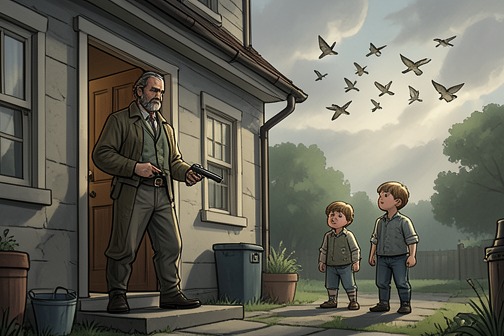
[The Beaumont lake house hostage crisis](entity:event-recall-event-19b0cf0e3f93) is the armed confrontation in which [George Stark](entity:character-recall-character-george-stark-adef5aad1430) holds [Liz Beaumont](entity:character-recall-character-liz-beaumont-375a970a0439) and the twins at the family’s lake house while waiting for [Thad Beaumont](entity:character-recall-character-thad-beaumont-98cafe7409b7). Stark turns a domestic space into leverage: he makes [Alan Pangborn](entity:character-recall-character-alan-pangborn-313ce7d30e69) conceal what is happening, threatens the children to control both men, and insists that Liz and Alan leave before he and Thad begin their final contest. The crisis makes the conflict between a writer and his embodied alter ego literal, with the twins’ safety caught between them.
## Causes and Background
The confrontation grows out of the unusual relationship between Thad and Stark: Stark is not simply a rival using a pen name but a force with an independent physical presence, connected to the identity Thad created to escape writer’s block. Thad had chosen the name George Stark in the course of searching for an identity distinct from his own. The name also carried a literary model: Thad describes Donald E. Westlake’s Richard Stark persona and its crime novels about Parker, a professional thief whose single-mindedness resembles a programmed machine. In Thad’s account, that hard, goal-driven criminal mode informs Alexis Machine, the central character of the first and last George Stark novels.
That background gives the lake house standoff a further irony. Stark’s fictional world treats robbery and violence as the work of men who pursue their aims without hesitation; now Stark brings that ruthless logic into Thad’s home and uses the people closest to the writer as instruments of control. The threat is not just that Stark may harm the family, but that he can dictate the conditions under which Thad must face him.
## Stark Controls the House
Alan is already inside the house when Stark confronts him. Stark says he can use the sheriff and asks whether the [State Police](entity:organization-recall-organization-state-police-f1fda5cf27fd) sent him to investigate. Alan explains that [Fuzzy Martin](entity:character-recall-character-fuzzy-martin-bfaf46db1719) called him, and tells Stark what he did after the call. Stark accepts the account, remarks that he thought he had seen a glint from the farmhouse, and judges that Alan’s honesty improves his prospects of surviving. He then announces that they will act after the babies have been fed.
Stark’s control depends on preventing Alan from turning an ordinary police contact into a signal for help. Standing beside the only working telephone in the house, he checks that Alan knows what to say and warns him not to leave a secret message for the dispatcher. A routine call is made dangerous by the fact that Stark is listening for any attempt at coded resistance; Alan has to speak as Stark directs while avoiding a move that might put the children at risk.
The threat becomes especially immediate when Stark holds William and toys with him while keeping a pistol close. Alan hears Stark’s warning that Thad must not discover that one of his twins has been killed, because Stark wants Thad to remain useful. Stark later presses the gun against William again and says Alan should remain nervous: if the sheriff tries to get clever, a child may be hurt. The baby’s laughter and ordinary dependence do not lessen the danger; they sharpen the contrast between the children’s vulnerability and Stark’s deliberate use of them as hostages.
## Thad Arrives; The Standoff Narrows
Liz responds to the pressure of the house in a different way. When offered soup, she turns aside as it is put into the wastebasket, her face held in revulsion. Stark answers with placid reassurance that the children will soon be better and that their father will arrive. He is still drinking the soup when Thad pulls in behind the wheel of Rawlie’s Volkswagen ten minutes later. The arrival fulfills Stark’s expectation and changes the crisis from a waiting game into a direct confrontation.
Once Thad is there, Stark makes the family’s captivity explicit. He tells Liz that she and the sheriff may leave because the matter is now between “the boys,” but refuses to let her take the babies: they are “insurance.” Thad tells her the children will be fine and observes that they like Stark. Liz answers in a low, hateful voice that she has noticed. The exchange shows how Stark has made even the twins’ apparent ease around him part of the emotional trap: their attachment does not make them safe, and Thad’s reassurance cannot undo Liz’s awareness of the danger.
Stark reinforces the threat to Alan by comparing any attempt at resistance to Jonestown, warning that everyone could be carried out dead. He orders the sheriff to keep the children in mind and not to improvise. Alan says he understands. Stark then directs him to shut the door on his way out, marking the end of the family’s immediate presence in the room and the beginning of the encounter he has demanded with Thad.
## The Contest Begins
As Liz and Alan prepare to leave, Thad picks up a pencil. He turns toward them, but for a moment Stark seems to look out through Thad’s face. The gesture joins the crisis’s domestic and creative strands: the pencil is an instrument of authorship, while the man who originated in a chosen writing identity now stands as an apparent presence sharing the author’s body and decisions. Stark says it is time; Thad agrees. The scene closes with Liz and Alan sent out and the twins left behind as Stark’s insurance, while Thad and Stark prepare to continue alone.
The crisis therefore turns on competing forms of control. Stark commands the room with a weapon and hostage threats, but his struggle with Thad is also bound to writing, identity, and the character Thad once made separate from himself. The account of Thad’s earlier crime-fiction model helps explain the shape of Stark’s single-mindedness, while the final pencil gesture brings the struggle back to the act of creation. At the threshold of their private contest, the family has been removed from the room but not from the stakes: the twins remain the reason neither man can treat the confrontation as an abstract battle between author and character.
Event 32
The sparrows’ flight and George Stark’s death
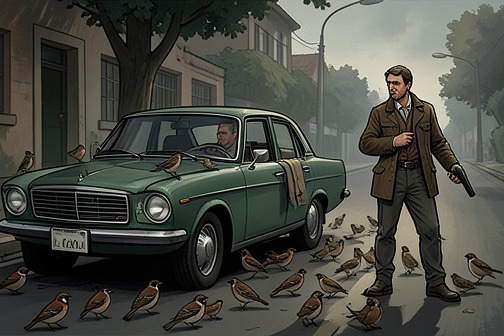
[The sparrows’ flight and George Stark’s death](entity:event-recall-event-george-stark-be4a61b33ad3) bring the novel’s supernatural pursuit to its decisive end: the silent flock becomes a force no human can command, converging on Stark and carrying him away as an escort to the land of the dead.
## Causes and Gathering
The birds’ final intervention has been foreshadowed by their uncanny scale and apparent selectivity. At Gold’s Junkyard and Auto Supply, Thad and [Rawlie DeLesseps](entity:character-recall-character-rawlie-delesseps-886879ef4a7f) find the back ten acres of stacked cars and trucks carpeted with sparrows. The flock has appeared without a sound, and its stillness makes its sheer number feel less like an ordinary migration than a collective, watchful presence. Rawlie recognizes the birds as psychopomps and asks Thad what their arrival means.
Near the Beaumonts’ summer refuge, the flock’s behavior seems bounded but purposeful. [Sparrows](entity:creature-recall-creature-sparrows-34c247d90ca9) land on [Alan Pangborn](entity:character-recall-character-alan-pangborn-313ce7d30e69), and one hops from his shoulder to his hand before stopping short of pecking him. Their numbers fill the visible trees, yet they remain concentrated around the house and Alan’s car rather than advancing along [Lake Lane](entity:location-recall-location-lake-lane-867679f55fae). Alan suspects the area is a staging ground. Later, on the road, Thad encounters a sharply defined edge to the flock: a sparrow lands on his Volkswagen’s hood and studies him with dispassionate curiosity. The birds have become the road itself, making the final approach to the house an encounter with a boundary he already understands he must cross.
## The Call and the Invasion
During the confrontation with Stark, Thad raises the bird-call Rawlie gave him and writes the word “PSYCHOPOMPS” on a blank sheet, circling it before adding “THE SPARROWS ARE FLYING.” The written words, the call, and the flock’s response meet in a single turning point. Stark stops writing and realizes, belatedly, what is happening. Thad blows the bird-call; it gives a strange squeal, then splits in his mouth when Stark reaches for it, cutting Thad’s lips. Its sound has already been answered: outside, the feathered rustle swells into a roar, and the sparrows take flight.
They enter the study through the open door as a river, then a flood. Stark recognizes the birds as his escort back to Endsville, the land of the dead, and tries to fight them off with the straight razor. The flock settles on his shoulders, arms, and head, striking his chest in ever greater numbers. The struggle turns the room into a threshold between the house and the darkness waiting beyond it: Stark’s resistance is fierce, but the birds keep coming, and his own weapon cannot make them retreat.
## Death, Removal, and Closure
The attack becomes an execution that is both bodily and supernatural. Stark disappears beneath a living mass of birds; blood seeps through the shifting feathers, while the sound of flesh being torn from bone makes plain that the flock is not merely restraining him. Thad whispers that they have come for Stark, and the sight confirms the birds’ role as psychopomps: not simply a swarm surrounding a victim, but escorts carrying him back to the dead.
The sparrows consume Stark with brutal thoroughness. His eyes are gone, his nose and forehead stripped away, and ribs protrude through the remnants of his skin. Birds gather at his feet, squabbling over the pieces of his body, while the flock continues its attack. Yet the scene’s purpose exceeds destruction: the birds are also trying to lift him. Liz cries out to Alan that they are raising Stark, and the barely human shape rises on a cushion of sparrows, unsteady as it moves across the study toward the enormous hole torn through the east wall.
Outside, the flock lifts Stark above the treetops. The sky is black with birds, and their streams converge on a central darkness shaped like a struggling man. For a moment the figure pauses over the trees; then it moves into the dark sky and vanishes from view. The movement reverses the direction of the invasion: sparrows pour back out through the house’s shattered openings and rise from the driveway, trees, and Rawlie’s Volkswagen, all streaming toward the darkness that has taken Stark away.
The people left behind are alive, but the house bears the marks of the passage. Liz sits with the twins in her lap, rocking and comforting them; Wendy pats her mother’s tear-stained face, while William plucks a feather from her hair. Thad joins Alan at the hole and says Stark is gone. When Liz asks whether he is dead, Thad confirms it and declares the book closed on [George Stark](entity:character-recall-character-george-stark-adef5aad1430). His answer ends the immediate pursuit, while the birds’ departure supplies the final image of a death that has been carried beyond ordinary human reach.
## The Flock’s Agency and the Meaning of Its Departure
The birds’ conduct makes their supernatural role more than a name supplied by Rawlie. Earlier, tens of thousands had silently carpeted the wrecked vehicles at Gold’s Junkyard and Auto Supply; later, on the road to the house, they formed an abrupt boundary, and one perched on Thad’s Volkswagen to regard him with what he sensed as dispassionate curiosity. Around Alan, a sparrow moved from his shoulder to his hand and stopped before pecking him. These encounters suggest a collective presence that can approach, watch, and act without behaving like a flock under human direction. At the climax, that latent agency becomes unmistakable: the birds answer Thad’s call, recognize Stark as their charge, and carry him away.
Their apparent selectivity does not make them safe or domesticated. Alan sees them fill the trees and gather around the house, while Thad finds that they have made the road itself impassable; neither man can determine the flock’s full reach or compel it to move. Thad’s bird-call summons a response, but the call is destroyed in his mouth, and the birds’ arrival quickly exceeds anything he can manage. The episode thus distinguishes calling the psychopomps from controlling them: Thad can participate in the event, but the flock performs its own work and decides Stark’s passage.
The ending joins physical destruction to a departure that exceeds the room and the house. The birds tear Stark apart, then lift what remains through the study’s breach and into a man-shaped darkness in the sky. After he disappears, they stream out through the shattered openings and rise from the driveway, the trees, and Rawlie’s Volkswagen toward that darkness. Thad’s confirmation that Stark is dead gives the scene a human closure, but the image of the flock carrying him beyond sight leaves the means of that death irreducibly supernatural: the pursuer is not merely defeated by his opponent, but removed by a power that neither character owns.