
The Government Inspector
Overview
Nikolai Gogol’s The Government Inspector, also known in English as The Inspector General, is a five-act satirical comedy. It was first published and staged in 1836, with its premiere at the Alexandrinsky Theatre in Saint Petersburg; Gogol later revised the play, and a revised edition appeared in 1842. Its central device is a mistaken identity, but the confusion exposes far more than one traveler’s opportunism. In a provincial town, officials so fear an approaching government inspection that they convince themselves an ordinary visitor must be the inspector they dread.
The mayor summons the leading local officials after hearing that an inspector from Saint Petersburg is coming incognito, carrying secret instructions. The judge, the head of charitable institutions, the school inspector, the postmaster, and other officials have reason to fear scrutiny: they neglect their duties, misuse their authority, and know how easily their conduct could be exposed. Two landowners, Bobchinsky and Dobchinsky, report that they have seen a young official from the capital at the local inn. The visitor, Khlestakov, is in fact a minor civil servant stranded without money after spending recklessly and losing at gambling. The townspeople mistake his predicament for the disguise of a powerful investigator.
The mayor welcomes Khlestakov into his home, while the officials compete to ingratiate themselves and offer him money in the hope of protecting their positions. At first Khlestakov does not fully understand the reason for their attention. Once he recognizes their mistake, however, he accepts their hospitality and loans, and embellishes his importance through extravagant boasts. The mayor and his family vie for his favor, while the local officials privately seek to buy his goodwill. Khlestakov eventually leaves town. A letter he has written to a friend, mocking the people he met, is intercepted when the postmaster opens it. The officials learn that they have been deceived and ridiculed. Then comes the final blow: a message announces the arrival of the real inspector, and the characters are left frozen in a famous closing tableau.
Background and themes
Gogol developed the play from a plot idea associated with Alexander Pushkin. Gogol had asked Pushkin for an amusing, distinctly Russian anecdote suitable for a comedy, and Pushkin reportedly told him of a real case in which a traveler had been mistaken for an important official. Gogol transformed the anecdote into a sustained portrait of a whole administrative community. The play was written under Nicholas I, when direct public criticism of government was constrained. Comedy gave Gogol a means to expose corruption and incompetence through performance, exaggeration, and the officials’ own fearful reactions.
The play’s satire targets bribery, neglect of public responsibilities, abuse of power, and the system of favors that connects local officials. Yet the mistaken identity works because the officials are already prepared to believe in it: each is more concerned with concealing misconduct than serving the town. Their deference to imagined authority is inseparable from their contempt for those beneath them. Khlestakov is a beneficiary of their panic, but also a mirror for their assumptions and desires. His inflated stories find an eager audience because the officials want to see a powerful figure whose favor can be purchased. The ending’s abrupt shift from laughter to paralysis leaves the threat of genuine accountability unresolved, making the final image part of the play’s enduring force.
Reception and legacy
The play’s 1836 premiere attracted attention at the highest levels; Nicholas I saw it and is said to have remarked that everyone had been ridiculed, himself included. The Government Inspector became a landmark of Russian comic drama, helping to redirect comedy toward pointed social observation rather than mere amusement. Its officials are at once particular comic characters and recognizable participants in a wider culture of self-protection, favoritism, and fear. The play has continued to invite theater, film, and other adaptations in many settings. Its enduring status rests on the precision of its theatrical construction: a false inspector reveals a real, collective corruption, and the arrival of the true inspector turns a farce into a reckoning.
About the Author
Origins and education
Nikolai Vasilyevich Gogol was born on March 31, 1809 (March 19 in the Russian calendar then in use), in Sorochintsi, in what is now Ukraine and was then part of the Russian Empire. He grew up in a Cossack family on a country estate. Ukrainian rural life, folklore, local customs, and Cossack traditions formed an important background to his early imagination and later writing. He studied at the Nizhyn Gymnasium of Higher Sciences, where he developed literary interests and ambitions that extended to the theater. In 1828, he moved to Saint Petersburg, hoping to establish a career. The capital proved difficult: he held minor government jobs and occasionally wrote for periodicals, while an early literary effort, the poem Hans Küchelgarten, published in 1829, met with failure.
Alexander Pushkin was a formative friend and supporter. Pushkin encouraged Gogol’s literary ambitions and supplied ideas that helped shape some of his writing, including the anecdotal premise associated with The Government Inspector. Gogol also briefly held a professorship in medieval history at the University of Saint Petersburg, though the appointment was unsuccessful. After leaving that position, he devoted himself more fully to writing.
Major works and literary career
Gogol first attracted broad notice with writing rooted in Ukrainian settings and folk culture. The stories collected as Evenings on a Farm Near Dikanka began appearing in 1831 and brought together rural color, humor, and fantastic events. Mirgorod and Arabesques followed in 1835, demonstrating the range of his narrative interests. Taras Bulba, a historical tale of Cossack life, appeared in Mirgorod and was later revised. His short story The Nose uses absurdity to expose the fixations of rank and status; The Overcoat, published in 1842, follows the vulnerable life of a low-ranking clerk and became one of the most influential works in Russian literature.
The Government Inspector premiered in 1836 and established Gogol as a major dramatist. Its farce about provincial officials who mistake a poor young visitor for a government inspector is also a sustained satire of corruption and fear of authority. Gogol left Russia in 1836 and spent time traveling in Europe while continuing to write. In 1842, he published the first part of Dead Souls, alongside The Overcoat. Dead Souls follows Chichikov, a schemer who buys the names of deceased serfs still listed in official records, and uses the premise to portray a broad range of Russian society. Gogol planned further parts, but the work remained incomplete. The Inspector, Dead Souls, and The Overcoat are among the works most closely associated with his lasting reputation.
Later years and legacy
Gogol’s religious concerns intensified in his later years, and he became increasingly troubled by his own writing. In 1847 he published Selected Passages from Correspondence with Friends, a work that expressed regret about aspects of his earlier literary career and provoked strong responses. He experienced a severe personal and physical crisis and burned part of the manuscript for a continuation of Dead Souls. Gogol died in Moscow on March 4, 1852, at the age of forty-two.
Writing in Russian while drawing deeply on his Ukrainian background, Gogol brought together folklore, grotesque invention, comedy, and close attention to social behavior. His humor often turns unsettling: absurd situations expose vanity, indifference, fear, and the workings of institutions. He is widely regarded as a foundational figure in Russian literature and an important precursor of realism, as well as a leading figure associated with the natural school. His influence can be traced through later Russian writers, including Fyodor Dostoevsky and Anton Chekhov, and his works have continued to inspire theater, film, and other adaptations. His standing rests both on his imaginative range and on his ability to make the ordinary absurdity of social life reveal deeper moral and human weaknesses.
StoryFlow
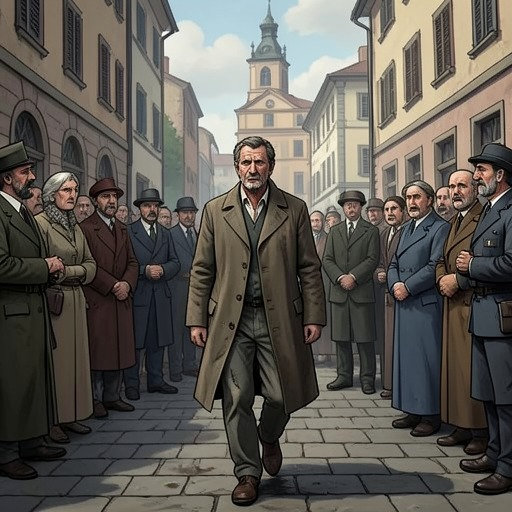
The False Inspector's Arrival
This thread follows the town's fearful construction of a government inspector from an ordinary, stranded clerk.
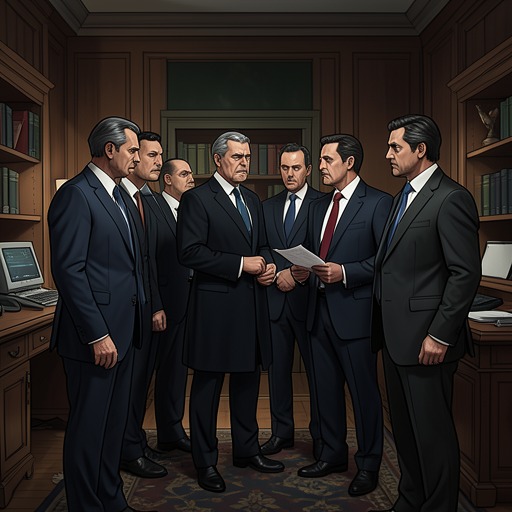
The Town's Cover-Up
This thread traces how the municipal officials try to disguise their negligent and corrupt departments once inspection seems imminent.
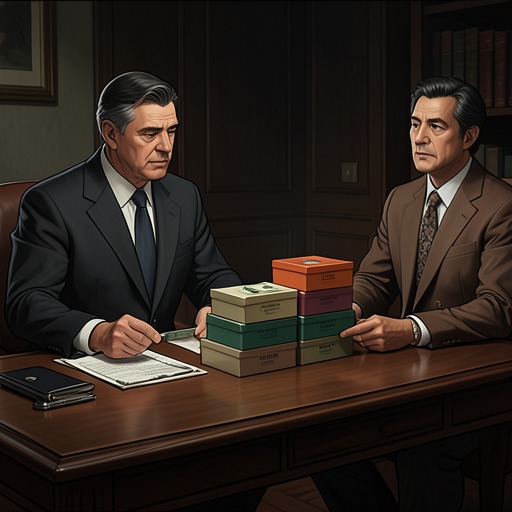
The Bribe Economy
This thread tracks the officials' routine corruption, their escalating payments, and the collapse of their confidence when the deception is revealed.
