Event 1
Tony Curran’s murder
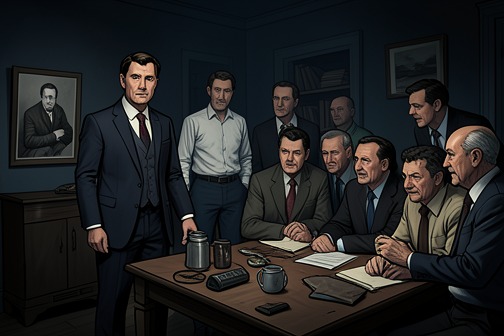
[Tony Curran’s murder](entity:event-recall-event-tony-curran-s-murder-6cf41d7f7d50) is the violent hinge between a business betrayal and the Thursday Murder Club’s first active investigation of a real killing. Curran is struck at home with a spanner after [Ian Ventham](entity:character-recall-character-ian-ventham-dd9e7fb2264a) has cut him out of a lucrative development deal. The scene leaves a photograph beside his body, while the investigation turns to the dispute, the timing of the decision, and people whose movements make them look suspicious.
## Causes and Background
Curran and Ventham had been partners in [The Woodlands](entity:location-recall-location-the-woodlands-5436555a67da) development. The original arrangement allocated seventy-five per cent to Ventham and twenty-five per cent to Curran, but Ventham changed the terms and excluded his partner entirely. The loss was substantial: [Elizabeth](entity:character-recall-character-elizabeth-83df578df81e) tells [Donna De Freitas](entity:character-recall-character-donna-de-freitas-b0c875579a5d) that Curran had expected to receive millions from the project. The development’s next phase, [Hillcrest](entity:location-recall-location-hillcrest-4d9b26d57138), promised an even larger conflict, according to the club’s expert.
The timing makes the exclusion especially consequential. Ventham signed the papers removing Curran from the deal before a consultation meeting; the meeting was followed by a mysterious row, and the account of the investigation places the murder immediately after that sequence. Curran had received the news of his exclusion on the day he was killed. To the investigators, the lost payday gives him a reason to threaten Ventham and gives Ventham a possible reason to fear retaliation. [Donna](entity:character-recall-character-donna-230485550224) raises the possibility that Ventham struck first, but this remains a theory rather than a conclusion established in the evidence here.
Before the attack, Curran considers waiting: nothing needs to happen that night, and he can let Ventham believe he has won before acting. The narration thus establishes that Curran has his own plan, but does not equate that plan with the murder that follows. The distinction matters: the business dispute supplies a plausible field of motive, not a proven answer to who killed him.
## The Attack at Home
Curran is in his kitchen when he hears a noise too late to avoid the approaching spanner. The blow strikes his left temple, and he falls onto the marble floor. The birds in the garden briefly stop singing and then continue; the narration’s small pause sets the ordinary life outside against the sudden finality inside. Curran dies at the scene.
After the attack, the killer places a photograph on the worktop beside the walnut kitchen island. The image is not explained at this point, but its deliberate placement turns an otherwise private killing into a scene containing a conspicuous clue. The contrast between the domestic kitchen, the carefully placed photograph, and the blunt-force attack gives the investigators more than a corpse to explain: they must also determine why the photograph was left there and whom it implicates.
## Discovery and Investigation
Curran’s wife finds him at home. News of his death reaches [Ibrahim Arif](entity:character-recall-character-ibrahim-arif-a86ec0feb8bc) through a chain of informal contacts: Elizabeth has heard from [Ron Ritchie](entity:character-recall-character-ron-ritchie-2d882cb527dc), who heard from [Jason Ritchie](entity:character-recall-character-jason-ritchie-7df707091da6), who heard from a source not yet documented. The early report identifies the essential facts as a death in the kitchen and blunt-force trauma to the head. Elizabeth then asks Ibrahim to take charge of a task involving Ron and to lie to a senior police officer, signalling that the club is prepared to work outside ordinary investigative rules as it pursues the case.
For Ibrahim, the case marks a break from the old files and private consultations that usually fill his morning. He understands that this is not an exercise in reviewing an unsolved historical case: there is a current victim and a killer somewhere beyond the club. The murder therefore gives the Thursday Murder Club a practical purpose, while Elizabeth’s request makes clear that its members’ inquiry may involve deliberate concealment from the police.
The financial documents sharpen the investigators’ reconstruction. Elizabeth directs Donna to the appendix explaining the original division of The Woodlands, then prompts her to ask when Ventham changed the arrangement. The answer links the signed papers to the consultation, the row, and the killing; the projected loss of millions gives the dispute a concrete stake. Donna’s suggested theory—that Curran threatened Ventham and Ventham retaliated—emerges from that chronology, but the evidence does not establish it as the solution.
A photograph also draws suspicion toward Jason. He acknowledges that police have a picture of him left by the body, as well as other evidence. He denies killing Curran, while telling Ron that he would admit it if he had done so and that Ron would understand there had been a reason. Ron asks whether Jason can prove his innocence. Later, Jason explains why the circumstances look incriminating: he had been to Curran’s home on the day of the death, received a photograph that morning, and learned through a WhatsApp group that Curran had been found dead that afternoon. He also knows that police have records of his call to Curran’s phone. The timing and scene photograph make suspicion understandable without establishing guilt.
## Aftermath and Narrative Significance
Elizabeth eventually gives [Chris Hudson](entity:character-recall-character-chris-hudson-cd3fb8979c98) and Donna the file assembled for the investigation. [Joyce](entity:character-recall-character-joyce-830d04161bf1)’s diary records that [Joanna](entity:character-recall-character-joanna-3d81f486abc1)’s name has been left out of it, which Elizabeth says helps preserve plausible deniability if the club’s methods have crossed legal boundaries. This episode shows the group’s private inquiry moving into contact with the police, even as its members take precautions to conceal their involvement. Later, Elizabeth’s attention returns to [Penny Gray](entity:character-recall-character-penny-gray-1c396f74bd77)’s stored files of old cases, which provide material for pursuing a killer many years after the earlier crimes; the murder of Curran belongs to a wider pattern of present investigations converging with unresolved pasts.
The event’s structure keeps motive, action, and proof distinct. The reader sees Curran’s death before the investigation can explain it, then encounters business records and testimony that generate competing possibilities. Ventham’s betrayal establishes a motive for conflict; the scene photograph and Jason’s movements supply grounds for suspicion; neither, by itself, identifies the killer. The murder matters both as a death in its own right and as the case that tests whether the club’s informal methods can turn fragments of timing, paperwork, and personal testimony into a defensible account of what happened.
Event 2
Black Bridge shooting
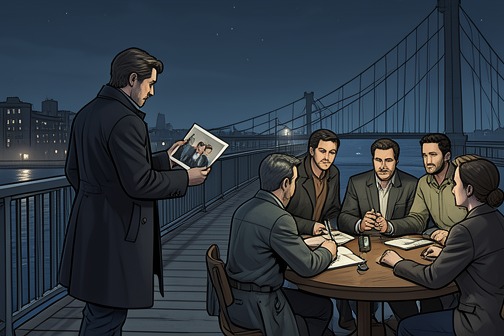
The [Black Bridge shooting](entity:event-recall-event-black-bridge-6d94153555ac) is a killing that exposes both [Tony Curran](entity:character-recall-character-tony-curran-df5bdde9d93a)’s reach in [Fairhaven](entity:location-recall-location-fairhaven-84c33d22c8d0) and the limits of the inquiry that followed. A young drug dealer died, a local taxi driver identified Tony as the person who fired the fatal shot, and Tony was questioned but escaped conviction. The witness disappeared soon afterward. Years later, the surviving police transcripts and a photograph of Tony with two associates give [Chris Hudson](entity:character-recall-character-chris-hudson-cd3fb8979c98) grounds to reconsider a case whose apparent ending never resolved what happened to everyone caught up in it.
## Background and setting
The shooting belongs to the period when Tony was, in Chris’s reading of the file, at the centre of Fairhaven’s criminal world. People asked about Tony, Chris understands, would have described him as running the town’s drugs trade and making substantial money from it. The account also suggests that his activity extended beyond drugs, although the evidence presented here does not specify the full scope of those other dealings. His position as a local builder sat alongside that reputation, a contrast that later mattered to the way he could walk away from suspicion.
The police records Chris opens include a history of Tony’s earlier dealings with [Kent Police](entity:organization-recall-organization-kent-police-951e67d7c944), most of them before Chris’s own time in Fairhaven. They include assault charges from Tony’s twenties, minor drug convictions, and offences involving dangerous driving, a dangerous dog, possession of an illegal weapon, a tax disc, and public urination. The list presents a long record of contact with the law, but the shooting stands apart from those lesser entries: it involved a dead man and a witness who would vanish.
## The shooting and the police inquiry
A series of interview transcripts records the questioning of Tony over the years. The last interview in the file followed the shooting at [Black Bridge](entity:location-recall-location-black-bridge-d8867ec42cb1), where a young drug dealer was killed. A witness, a local taxi driver, recognized Tony as the person who had fired the fatal shot. Fairhaven CID called Tony in for questioning. The file establishes that he was suspected and interviewed; it does not provide an account of the shooting itself or further detail about the victim.
The transcripts repeatedly record Tony giving no comment. That silence, preserved in the documentary record, did not produce a conviction. Tony, described in the file as a local builder, walked away scot-free. The contrast is stark: the police had a witness identifying him as the shooter, but the record Chris reads ends not with a demonstrated resolution but with Tony free and the shooting unanswered in court. The evidence does not explain why the interviews failed to lead to charges or a conviction, so the precise limits of the investigation remain unclear.
## The missing witness and uncertain toll
The taxi driver disappeared soon after identifying Tony. The account leaves open whether fear drove the witness away or whether something worse happened; it does not establish the witness’s fate. That uncertainty changes the apparent scale of the case. Chris asks himself whether the shooting involved one death or two: the young dealer killed at Black Bridge, and perhaps the witness who could connect Tony to the gunfire. The second death remains a possibility, not a confirmed fact.
The file therefore preserves two different kinds of absence. The young dealer’s death is established, while the taxi driver’s disappearance is recorded without an explanation. Tony’s freedom gives that gap particular force: the witness who might have sustained the accusation was no longer available, but the evidence does not prove that Tony or anyone acting for him caused the disappearance. Chris’s questions register the suspicion and the uncertainty together rather than turning one into a settled answer.
## The photograph and the case’s return
A photograph left beside Tony’s body brings the old shooting back into Chris’s present investigation. It shows three men: Tony, [Bobby Tanner](entity:character-recall-character-bobby-tanner-61e88acf3a90), and [Jason Ritchie](entity:character-recall-character-jason-ritchie-7df707091da6). Tony has his arm around [Bobby](entity:character-recall-character-bobby-7cd7d55e806b), a local dealer from the past who had been hired as muscle and whose whereabouts are then unknown. Jason, an ex-boxer, is the third man, and his whereabouts are known. The image places Tony among associates from the period of the shooting, though it does not itself establish what either man did at Black Bridge.
The smiles, banknotes, and beers in the photograph lead Chris to place it probably around 2000, the same period as the shooting. This is an estimate, not a stated date for the crime. By then, the file indicates, Tony’s earlier history had given way to a much quieter record: since 2000, it notes nothing beyond a speeding ticket in 2009, promptly paid. The apparent quiet does not answer the old case; instead, the photograph makes the past newly legible as a network of people and associations. Chris also considers selling the image to newspapers, but rejects that possibility as the lowest sort of conduct for an officer. The shooting thus returns not as a solved crime, but as an unresolved death, a missing witness, and a photograph whose significance lies in the questions it reopens.
Event 3
Ian Ventham removes Tony Curran from the development project
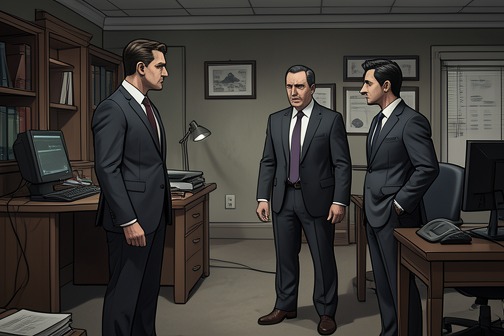
[Ian Ventham](entity:character-recall-character-ian-ventham-dd9e7fb2264a)’s decision to remove [Tony Curran](entity:character-recall-character-tony-curran-df5bdde9d93a) from [The Woodlands](entity:location-recall-location-the-woodlands-5436555a67da) is a business reversal that unsettles the partnership between them and places [Bogdan Jankowski](entity:character-recall-character-bogdan-jankowski-d42241699479) in line to replace Tony. Ian recognizes that the dismissal may provoke violence, yet proceeds; Tony, outwardly restrained, turns the slight over his exclusion into a private plan to strike back. The episode’s tension lies in the gap between Ian’s confidence that he has won and the threat neither man can safely dismiss.
## The decision and its immediate terms
Ian tells [Bogdan](entity:character-recall-character-bogdan-52d2900aa94a) that he is on his way to fire Tony and asks whether Bogdan is willing to step up. The question makes the practical consequence of the dismissal explicit: Ian has already identified a replacement, and the new role is to be Bogdan’s if he accepts. Bogdan does, while making clear that he sees a danger Ian would rather manage on his own: Tony may kill him in response.
Ian does not deny the risk. He tells Bogdan to leave that concern to him and says that the job will be his the following day. Their exchange is brief, but it sets the event’s stakes: Tony is not merely being reprimanded or temporarily sidelined. Ian is transferring his place and authority to someone else, while knowingly exposing himself to the possibility of retaliation. Bogdan’s warning accompanies his acceptance, so his promotion is presented from the outset as both an opportunity and a potentially dangerous succession.
## Ian’s confidence after the dismissal
By the time Ian reflects on events after a consultation about The Woodlands, he considers the development deal settled. He has dismissed the loud opposition at the meeting as something that will exhaust itself and assumes the cemetery issue is covered by his permits. Against that backdrop, Tony’s removal appears to Ian as another problem already contained. He notes that Tony was unhappy but did not kill him, and treats that outcome as an advantage.
That confidence has a narrow basis: Ian takes the absence of immediate violence as evidence that he has prevailed. The distinction between Tony’s anger and his actions matters. Tony has not attacked Ian at the moment of dismissal, but the evidence does not show that he has accepted the decision or abandoned the conflict. Ian’s conclusion that he has the advantage therefore closes the matter only from his own perspective. The episode allows the reader to see that his sense of security is premature.
## Tony’s response and the threat of retaliation
Tony revisits the row with Ian, focusing on the way Ian cut him out of The Woodlands during a conversation on the way to his car. Tony had wanted to hit him, but describes that impulse as belonging to his former self; the argument, he recalls, remained quiet. He takes comfort in the fact that no one could have noticed the exchange, imagining that this will keep the situation clean if Ian is later found dead. That thought reveals that Tony has already begun considering Ian’s death as a possible outcome, even as he takes pride in having kept the confrontation discreet.
Alone in his large kitchen, Tony tries to write down a plan, but finds no paper in the drawer and decides to work it out in his head. He tells himself that there is no need to act that night: he can let Ian believe he has won and wait before striking. The private planning reverses the apparent calm of the earlier encounter. What Ian regarded as a completed firing remains, for Tony, an unresolved affront and a potential campaign of retaliation.
## Dramatic irony and consequence
The episode places Ian’s and Tony’s interpretations side by side. Ian reads Tony’s failure to attack immediately as proof that the dismissal has gone in his favor; Tony’s private thoughts show that restraint is not reconciliation. Bogdan’s warning links those two perspectives before either can be resolved: Ian knows retaliation is possible, while Tony is already contemplating a future strike. The replacement arrangement thus carries more than a change of personnel; it sharpens the conflict around Ian’s authority and Tony’s lost position.
Tony’s plan does not reach its intended moment. As he sits in his kitchen, he hears a sound too late to avoid an incoming blow and collapses. The attacker is not identified in the evidence for this event, so the episode does not establish that Ian, Bogdan, or anyone else carried out the attack. Its placement nonetheless darkens Tony’s expectation that he will choose when to strike. The decision to remove him from The Woodlands begins as a calculated business move, but the episode frames it within a chain of anger, anticipation, and danger whose outcome is not under either former partner’s control.
Event 4
Thursday Murder Club begins investigating Tony Curran’s murder
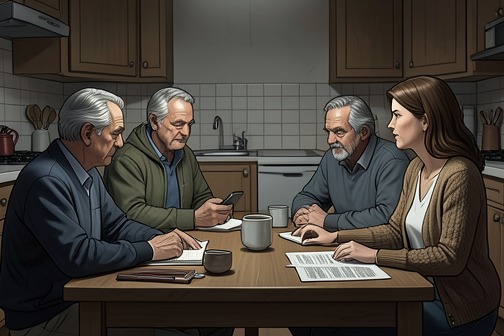
The [Thursday Murder Club begins investigating Tony Curran’s murder](entity:event-recall-event-thursday-murder-club-to-fee09ffe6b37) when [Elizabeth](entity:character-recall-character-elizabeth-83df578df81e) turns news of his death into a real case for the residents of [Coopers Chase](entity:location-recall-location-coopers-chase-574bd7ef72bf). She recruits [Ibrahim Arif](entity:character-recall-character-ibrahim-arif-a86ec0feb8bc) and [Ron Ritchie](entity:character-recall-character-ron-ritchie-2d882cb527dc), involves [Joyce](entity:character-recall-character-joyce-830d04161bf1) in an approach to [Fairhaven Police Station](entity:location-recall-location-fairhaven-police-sta-77f675ad6f9f), and seeks [Donna De Freitas](entity:character-recall-character-donna-de-freitas-b0c875579a5d)’s help from inside the police. The inquiry begins without official files or forensic access, making the club’s resourcefulness—and its willingness to cross procedural boundaries—part of the investigation from the start.
## The Case Reaches Coopers Chase
Elizabeth tells Ibrahim that she has a job for him and Ron, placing Ibrahim in charge. The news has travelled to her by a chain of informal contacts: Ron heard it from [Jason Ritchie](entity:character-recall-character-jason-ritchie-7df707091da6), who had heard it from a source not yet documented. [Tony Curran](entity:character-recall-character-tony-curran-df5bdde9d93a) has been found dead in his kitchen by his wife, with blunt force trauma to the head. The fragmentary route by which this information arrives contrasts with the certainty of the fact at its centre: there is a corpse, and somewhere there is a killer.
The assignment draws Ibrahim away from his familiar morning routine. He usually spends the early hours reviewing old case notes, and still sees occasional clients at Coopers Chase, where the battered chair and painting of a sailing boat have followed him for decades. His files include cases in which he could not help someone, including that of a bank manager who died by suicide. Elizabeth’s arrival changes the scale and immediacy of the work: this is not another account of a past case, but a present murder. Ibrahim understands that the club has a different priority and that he is needed.
Elizabeth’s request also makes clear that the investigation will not remain within ordinary professional boundaries. She asks Ibrahim to lie to a senior police officer. His experience and careful temperament make him a trusted recruit, but the request places trust alongside deception at the inquiry’s foundation. The club is not merely discussing crime as an intellectual exercise; it is choosing to interfere in an active murder investigation despite lacking formal authority.
## From Discussion to Investigation
The club’s transition from talk to action has a history. Months earlier, at lunch, Elizabeth had asked a companion to consider a hypothetical stabbing, opening a manila folder containing typed pages and the edges of old photographs. She kept her voice low because people were eating. The episode presents her interest in case details as practiced and deliberate: she arrives prepared, frames a question, and works through what the available evidence might mean.
An earlier unsolved case had also established the limits of amateur justice. [Penny Gray](entity:character-recall-character-penny-gray-1c396f74bd77) and Elizabeth had examined autopsy photographs of a young woman whose boyfriend had fled from [Penny](entity:character-recall-character-penny-20f5e0e3e7bd)’s police car while being taken for interview. He had not been seen again. The Thursday Murder Club understood that it could not simply bring him to justice; earlier cases had been solved to the women’s own satisfaction, but that was not the same as securing an official outcome. That distinction shadows the new inquiry. The club’s determination to investigate Tony Curran does not give it police powers, and the people involved know the difference.
[Elizabeth and Joyce](entity:relation-recall-relation-elizabeth-and-joyce-1daf8b1f68c7) make that gap explicit when they reach the steps of Fairhaven Police Station. Joyce has followed Elizabeth there without knowing what she plans to do; at the station, Elizabeth explains that they are going to investigate the murder. She also sets out what they lack: case files, witness statements, and forensic evidence. Her immediate objective is to change that situation, and she asks Joyce to back her up whatever happens. Joyce agrees and goes inside with her. The pair pass through a security door into the public reception area, where the ordinary desk-sergeant routine is a far cry from the dramatic police scenes Joyce has seen on television.
## Recruiting Donna De Freitas
Elizabeth’s approach to Donna De Freitas is another attempt to bridge the gap between the club’s determination and the police investigation. [Donna](entity:character-recall-character-donna-230485550224) points out that a highly qualified murder squad is already working on the case and questions whether Elizabeth understands how police work operates. Her scepticism is practical: the official team has no obvious vacancy for a constable who is usually given routine tasks, and Elizabeth’s invitation could easily seem unrealistic.
Elizabeth’s question nevertheless reaches the desire Donna has not been able to act on openly. When she is assured that the conversation will remain private, Donna admits that she would very much like to chase murderers. Elizabeth responds as though she has correctly read the situation. The exchange changes Donna’s position from an unimpressed listener to a willing participant, though it does not erase the divide between her formal duties and the unofficial investigation. For the club, her interest offers a potential connection to police knowledge; for Donna, the invitation recognises an ambition that her routine work has left unfulfilled.
## The Archive and the Investigation’s Reach
The inquiry’s significance extends beyond the immediate question of who killed Tony Curran. Penny Gray’s old case files preserve material that was not supposed to be kept: she made copies of her cases just in case they might help catch a killer years later. After [Karen Playfair](entity:character-recall-character-karen-playfair-232a882d12ac) recognizes [John](entity:character-recall-character-john-6bc68dc682c3), Elizabeth returns to one of those files to check a final detail. The later consultation shows how the club’s investigations can move between a current murder and the accumulated record of earlier crimes. The archive is not simply background; it gives Elizabeth a way to test what recognition might mean against documented evidence.
Across these steps, the investigation takes shape as a collaboration built from uneven forms of access. Elizabeth supplies initiative and direction; Ibrahim and Ron are drawn in through personal trust; Joyce supports Elizabeth at the station; and Donna offers a possible route into the official world. None of these arrangements grants the club the files, statements, or forensic material it needs. Instead, the opening of the case establishes its central tension: people who have experience, interest, and relevant connections must pursue answers from outside the authorized investigation. What begins with a rumour passed from one contact to another becomes a deliberate inquiry, with old case records already suggesting that the route to an answer may lead well beyond the circumstances of Tony Curran’s death.
Event 5
Ventham's betrayal of Curran over The Woodlands
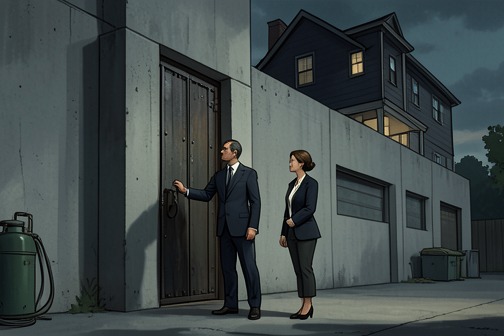
[Ian Ventham](entity:character-recall-character-ian-ventham-dd9e7fb2264a)’s decision to cut [Tony Curran](entity:character-recall-character-tony-curran-df5bdde9d93a) out of [The Woodlands](entity:location-recall-location-the-woodlands-5436555a67da) deal transformed a business partnership into a potential source of lethal motive. Revealed through [Elizabeth](entity:character-recall-character-elizabeth-83df578df81e)’s examination of a financial folder with [Donna](entity:character-recall-character-donna-230485550224), the betrayal was timed immediately before a consultation meeting, a mysterious argument between the two men, and Curran’s murder. The documents also showed that Curran’s death returned his [Coopers Chase](entity:location-recall-location-coopers-chase-574bd7ef72bf) shares to Ventham, making the deal’s altered terms central to the investigation without, by themselves, proving who killed him.
## The Deal and Its Original Terms
Tony Curran owned twenty-five per cent of Coopers Chase, while Ventham’s business was described as profitable and well run. The planned structure for The Woodlands had been expected to follow the same division: Ventham would hold seventy-five per cent and Curran twenty-five per cent. Curran was therefore not merely associated with the development; he had a defined stake in the company that was supposed to carry it forward.
That arrangement changed when Ventham used a new company for The Woodlands and left Curran out of it. The folder’s appendix 4c provided the documentary detail behind the discovery. It indicated that the development was originally due to preserve the partners’ existing 75–25 split, but that Ventham changed his mind and excluded Curran entirely. The shift was a change in ownership and expected benefit, not simply a disagreement over how the project would be run.
## Timing of the Exclusion
The timing made the altered terms especially significant. Ventham signed the papers cutting Curran out on the day before the consultation meeting. That was also the day before the men’s mysterious row, and the day before someone murdered Curran. The evidence establishes the sequence and the proximity of the events; it does not establish that the dispute over the deal caused the argument or that Ventham committed the murder.
Elizabeth and Donna reconstruct this chronology by working through the folder rather than witnessing the business decision itself. Elizabeth first directs Donna away from other possible leads, then draws her attention to the two points she considers decisive: Ventham’s betrayal and the reversion of Curran’s shares. Donna identifies the immediate investigative question—when Ventham changed his mind—and Elizabeth’s answer anchors the paperwork to the final day of Curran’s life. In this account, a signed document supplies a date that makes the otherwise mysterious row newly legible as a possible consequence of the business rupture.
## The Financial Stakes
Curran had reason to anticipate a large return from The Woodlands. The folder contained substantial projections, and Elizabeth estimated that exclusion from the arrangement cost him millions. The evidence does not specify the precise amount Curran personally expected to receive, but it makes clear that his anticipated payday was considerable. Ventham’s decision therefore threatened more than Curran’s place in a company: it removed him from the financial future on which he might have been counting.
The consequences of Curran’s death ran in the opposite direction for Ventham. Curran’s shares reverted to Ventham, and an expert’s calculation put the value of that gain at around twelve and a quarter million pounds. Elizabeth presents that figure as a simple point for Donna to convey to [Chris Hudson](entity:character-recall-character-chris-hudson-cd3fb8979c98). The estimate converts an obscure ownership clause into a concrete investigative lead: Curran’s death brought Ventham a major financial benefit at the same time that Ventham had removed Curran from the planned development.
## Significance for the Investigation
The betrayal gives the investigation a coherent possible motive built from documents, timing, and financial consequence. The original partnership supplies a baseline; the signed papers show the change; the date places it immediately before the row and murder; and the share-reversion clause identifies a benefit that followed Curran’s death. Each fact strengthens the relevance of the others, but the chain remains circumstantial. A profitable outcome for Ventham is not, on its own, proof of responsibility for the killing.
The episode also shows how the case advances through close reading of administrative records. Elizabeth does not begin with a confession or a direct account of the quarrel. She leads Donna from the ownership percentages to the new company, from the company structure to the signing date, and from the date to the financial consequence. What initially appears to be a technical alteration to a development agreement becomes a possible explanation for the rupture between the partners—and a reason for investigators to scrutinize Ventham’s role in Curran’s death.
Event 6
The Coopers Chase cemetery blockade
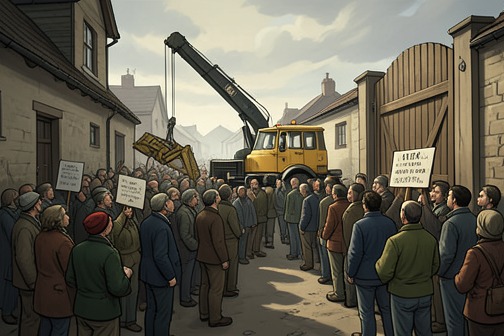
[The Coopers Chase cemetery blockade](entity:event-recall-event-the-coopers-chase-cemet-57ed7dc2c783) is the residents’ improvised resistance to [Ian Ventham](entity:character-recall-character-ian-ventham-dd9e7fb2264a)’s attempt to begin excavation at the [Garden of Eternal Rest](entity:location-recall-location-garden-of-eternal-re-7d067051ed48). A predawn delivery of diggers becomes a village-wide confrontation: the cemetery’s gate is obstructed, the residents make their opposition visible, and Ventham’s claim to legal authority meets a community unwilling to let the work proceed without a fight. The immediate result is a halt to the machinery and Ventham’s retreat from the scene, though the blockade does not settle the cemetery’s future.
## The predawn arrival and the alarm
The sequence begins at about six in the morning, when Ventham’s Range Rover turns off the road onto the track leading up to the Playfair farm. Edwin Ellidge, walking in the area, sees the vehicle but does not mistake it for the transport he is watching for. Around 6:20, the diggers pass him on a low-loader, nose to nose, as it slowly climbs the drive. Their destination is the Garden of Eternal Rest. At the entrance, [Bogdan](entity:character-recall-character-bogdan-52d2900aa94a) jumps down from the passenger seat and unbolts the heavy wooden gate so the load can continue along the narrow path.
The approach is meant to give the work an early start, but the village’s communications make secrecy impossible. By 6:21, word of two diggers coming up the drive has reached residents by phone; by 6:45 at the latest, the news has travelled across the village. The alarm moves through landlines rather than a messaging group: Ibrahim had tried to establish a WhatsApp group, but it had not caught on. Residents begin emerging and discussing what they can do. When Ventham returns down the hill at 7:30, he finds the village gathered outside. [Karen Playfair](entity:character-recall-character-karen-playfair-232a882d12ac) is with him, on her way to give a breakfast lecture at [Coopers Chase](entity:location-recall-location-coopers-chase-574bd7ef72bf).
## The gate becomes a barricade
[Ron Ritchie](entity:character-recall-character-ron-ritchie-2d882cb527dc) intercepts Bogdan at the gate, asks what is happening, and points out that the gate leads only to the cemetery. Seeing a crowd assemble, he uses the moment to address it. Among those present are members of his circle, including Ibrahim with his swimming things, [Joyce](entity:character-recall-character-joyce-830d04161bf1) carrying a flask, and [Elizabeth](entity:character-recall-character-elizabeth-83df578df81e) at the back beside [Stephen](entity:character-recall-character-stephen-657652c09f49), who has come out in a dressing gown. [John](entity:character-recall-character-john-6bc68dc682c3) is there too, still in his suit on his way to [Willows](entity:location-recall-location-willows-d88d740e5477). Ron notices him and feels guilty that he has not visited [Penny](entity:character-recall-character-penny-20f5e0e3e7bd) in a long time, but remains frightened by the thought of what that visit means. The gathering is both a protest and a glimpse of the ordinary ties and anxieties that the sudden arrival has drawn into the open.
Ron briefly climbs onto a bar of the gate to speak, nearly loses his balance, and decides to return to solid ground. The gesture does not diminish the force of his appeal. He presents the residents as people with varied experience and capacities, from soldiers, teachers, and doctors to people who have crossed deserts, built rockets, or locked up killers. Colin Clemence adds insurance underwriters to the list, drawing happy applause. Ron’s point is that Ventham has not arrived among a helpless crowd: by sending the diggers in at half past six without warning or consultation, he has picked a fight.
The resistance takes physical form at the cemetery entrance. By the next chapter, twenty chairs stand in front of the gate, mostly sun loungers, with one dining chair included because of Miriam’s back. Trees crowd either side, leaving the gate as the only way up to the Garden of Eternal Rest. The arrangement is makeshift but effective: the route is occupied by residents, some stretched out in the morning sun and some taking the chance to nap, and the diggers cannot get through for a while. Ventham watches from his car while Karen stands outside vaping an apple-and-cinnamon e-cigarette.
## The dispute over authority
Ventham answers Ron’s challenge by insisting that the dispute has already been decided. The residents, he says, made their objections and lost them; they had their consultation and their day in court. He argues that the land is his, that he has planned and is paying for the work, and that carrying it out will keep the service charge at its current reasonable level. His case is therefore not simply that the excavation is authorized: he frames it as an exercise of ownership and as a practical benefit to the residents. The protest contests the assumption that a legal victory and ownership end the community’s claim to the place.
Elizabeth is not at the barricade. After dropping Stephen at home, she takes a route through Blunts Wood and reaches the path to the Garden of Eternal Rest, where she sits on [Bernard Cottle](entity:character-recall-character-bernard-cottle-b66e42de137d)’s bench. The curve of the path hides the gathering below, though she can hear the disturbance. From this vantage, the public blockade is audible but out of sight. She waits there, and hears rustling in the trees before Bogdan emerges with a shovel over his shoulder. Her separate position at the cemetery’s approach places the blockade alongside another, quieter movement towards the same contested ground.
## The confrontation and immediate outcome
The standoff grows more volatile when Ventham confronts [Father Matthew Mackie](entity:character-recall-character-father-matthew-mack-87aff90c5a45). He advances on the priest, threatens to knock him out, and orders him off what he calls his property. Ventham shoves Mackie’s shoulder; Mackie reaches for balance and catches Ventham’s T-shirt, and the two men fall together. [Donna](entity:character-recall-character-donna-230485550224), helped by a horrified Karen, pulls Ventham off the priest. Joyce, Ron, [Bernard](entity:character-recall-character-bernard-2ea2639d5023), and other residents restrain Ventham, while another group forms a guard around Mackie, who sits dazed on the ground. The blockade has become a physical confrontation, and the residents’ bodies now do what their chairs did: prevent the dispute from remaining an abstract argument about access and ownership.
[Chris Hudson](entity:character-recall-character-chris-hudson-cd3fb8979c98) intervenes without making a public spectacle of the warning. He tells Ventham that Mackie stumbled after Ventham made contact with him, and that there may be witnesses if the matter goes to court. Chris makes clear that he could arrest Ventham for assaulting a priest, a charge that would not suit Ventham’s public image. He orders him to leave, and advises him to accept defeat for the day. Ventham protests that he did not touch Mackie, but eventually turns towards his car. As he passes the low-loader, he bangs twice on the cab door and signals the driver towards the exit.
The retreat is not a reconciliation or a final decision about the cemetery; it is the blockade’s immediate, limited success. Ventham still regards the residents’ action as a defeat he can reverse, and his thoughts turn to Bogdan and to what [Tony Curran](entity:character-recall-character-tony-curran-df5bdde9d93a) might do. At the Range Rover, he discovers that the car has been clamped. He becomes frightened and starts to cry, not wanting to go home. The abrupt shift from his threats and assertions of ownership to this private distress complicates the image of a man wholly in control, without undoing the coercive authority he has exercised at the gate.
The blockade’s force lies in that contrast. Ventham arrives with machinery, a vehicle, and the confidence of someone who believes the legal contest is finished; the residents answer with landline calls, chairs, and the collective occupation of a narrow path. Their action cannot erase the court ruling he invokes, but it interrupts the work and makes the burial ground’s value a visible matter of community rather than a line in a development plan. The cemetery remains contested when the scene ends.
Event 7
Ian Ventham's murder
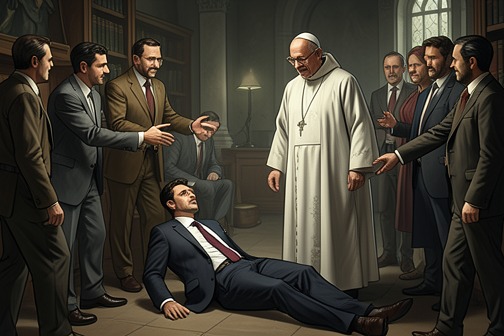
[Ian Ventham's murder](entity:event-recall-event-ian-ventham-s-murder-19db139c0c3f) turns a public confrontation over ownership and sacred ground into a death first witnessed as an abrupt collapse and later identified as deliberate poisoning. The sequence sharply revises the meaning of what the onlookers saw: Ventham's fall appeared to follow a heated dispute, but [Chris Hudson](entity:character-recall-character-chris-hudson-cd3fb8979c98) subsequently reveals to the investigation team that a massive fentanyl overdose caused his death. The available evidence confirms the murder and its method, while leaving the perpetrator unidentified.
## Causes and Background
The final sequence begins at a cemetery blockade, where [Father Matthew Mackie](entity:character-recall-character-father-matthew-mack-87aff90c5a45) stands in clerical dress and defends the ground against Ventham's claim of ownership. Ventham advances on him, threatens him, and shoves him. The encounter becomes a brief crowd struggle: Mackie reaches for balance, the two men fall together, and residents separate them. [Donna De Freitas](entity:character-recall-character-donna-de-freitas-b0c875579a5d) and [Karen Playfair](entity:character-recall-character-karen-playfair-232a882d12ac) help pull Ventham away; residents restrain him while others form a protective group around the dazed priest. The dispute is at once physical and symbolic, with Ventham asserting control over property and Mackie describing his action as peaceful protection of sacred ground.
Chris Hudson orders Ventham to go home rather than risk arrest. Ventham protests that he did not touch Mackie, then leaves the gathering. The immediate conflict thus appears to have been contained: the priest is helped to his feet, Ventham walks away, and no further confrontation is described. That apparent resolution supplies the murder's close context, but the evidence does not establish that the cemetery dispute caused the killing or identify anyone responsible for it.
## Collapse and Death
As Ventham heads toward his car, the narrative follows his attention away from the crowd and into confused, fragmented thoughts. He expects to speak with [Tony Curran](entity:character-recall-character-tony-curran-df5bdde9d93a) and wonders about Curran's lost phone. He also thinks of [Bogdan](entity:character-recall-character-bogdan-52d2900aa94a) in practical, dismissive terms, imagining that he should have him tile the swimming pool. These details place his attention on familiar plans even as his thoughts become disoriented; they do not explain the cause of his coming collapse.
At the Range Rover, Ventham discovers that the vehicle has been clamped. He worries that his father will be angry because he borrowed it, imagines having to take a bus, and becomes frightened at the prospect of going home. He searches his pockets for change, stumbles, and falls backwards, reaching for support but finding none. He dies before striking the ground. The scene's sequence initially connects death to a fall, but does not show the fall itself as the cause. The later briefing reverses that first impression: what seemed to be a sudden collapse is identified as the endpoint of poisoning.
## Murder Revealed
At a police briefing, Chris Hudson states plainly that Ventham was murdered. He reports that Ventham died from fentanyl poisoning: a massive overdose delivered into the muscle of his upper arm, almost certainly in the moments immediately before the collapse. This account changes the status of the preceding events. The altercation, the walk to the car, and the fall remain part of the chronology, but the newly disclosed cause makes the collapse evidence of a concealed lethal act rather than an unexplained accident.
Hudson explains that the information is preliminary and was obtained by calling in a favour. He points to the path lab's familiarity with fentanyl overdoses as the basis for recognizing the poisoning, while stressing that the finding has not been made official. His account specifies both the substance and the location of delivery, but the evidence does not say who administered it, where that happened, or how the poison was delivered. The timing is narrowly stated as shortly before Ventham collapsed; anything more exact would exceed what the briefing establishes.
## Investigation and Significance
The poisoning is initially known only to the people handling the investigation. Hudson asks the team to keep it from the press, friends, and family, marking the finding as sensitive information rather than a public conclusion. Donna De Freitas is present among the murder investigators, newly aware that she is again at the centre of a murder inquiry. Her reaction links the discovery to the case's expanding investigative stakes, without supplying evidence about the killer.
The scene's central reversal depends on the gap between appearance and explanation. Ventham has just been involved in a conspicuous physical dispute, then leaves, worries about a clamped car, and falls alone. Those visible circumstances invite an immediate reading of the death as a consequence of the fall or the preceding confrontation. Hudson's later disclosure replaces that reading with a specific medical cause and establishes murder, while preserving the crucial unanswered question of responsibility. The episode therefore moves from public disorder to private uncertainty and finally to controlled investigative knowledge: the death is no longer an accident, but the identity and actions of the murderer remain unresolved in this evidence.
Event 8
Discovery of the hidden skeleton in the Garden of Eternal Rest
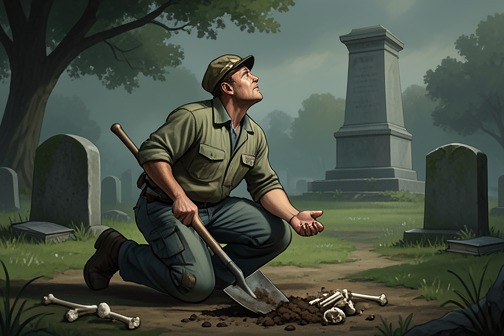
The [Discovery of the hidden skeleton in the Garden of Eternal Rest](entity:event-recall-event-discovery-of-the-hidden-e970d77e53dd) turns an expected cemetery excavation into evidence of a concealed burial: [Bogdan](entity:character-recall-character-bogdan-52d2900aa94a) finds two sets of remains where one grave should hold one body. The discovery first forces him to choose between preserving what he has found and keeping the work moving; later, [Elizabeth](entity:character-recall-character-elizabeth-83df578df81e) helps him confirm the arrangement and decides that the police need not be told yet.
## Excavation and discovery
Bogdan is digging while the cemetery faces the prospect of mechanized excavation. He knows a machine could expose a row of graves in minutes, particularly if its operators do not take care, so he works neatly with his shovel while he is alone. In the graveyard’s top corner, his shovel strikes something solid. It is not the coffin lid he expects: beneath stones and roots, he uncovers a white bone. The find contradicts his reason for digging there, since he had expected no coffins or bones at that spot.
Rather than immediately burying the evidence again, Bogdan concludes that uncovering a bone makes him its guardian. With no smaller tool, he kneels and clears earth by hand, trying not to disturb what he has found. As he shifts to reach further, he realizes the firmness beneath him is not compacted earth but the oak lid of a coffin. That makes the scene harder to interpret: the bone outside the coffin and the coffin beneath him seem to belong to different burials, yet the grave has not been opened in any ordinary way.
## Two burials in one grave
Bogdan works quickly, without pausing for ceremony. He exposes more bones and a skull, taking care not to move it, then uses the blade of his shovel to prise open the lower part of the coffin. Inside is another skeleton. The arrangement is starkly legible: one set of remains inside the coffin, another outside; one small, one large; one grey and yellow, the other cloud-white. The grave contains both the body where it belongs and a much newer body where it does not.
The contrast raises possibilities without resolving them. Bogdan wonders whether an old burial might have involved a cheap coffin or some other shortcut, and whether the remains could reflect past burial practices or a period of disease. But he recognizes that these explanations are only possibilities, not answers. He also anticipates that a formal examination would take time: investigators would use small tools and might need to inspect the surrounding graves as well. That process could delay the development and leave him waiting for work, while still failing to explain what happened.
## Bogdan’s decision
With no time to think at leisure, Bogdan hears a siren approaching. He takes it to be an ambulance at first, then reasons that it must be the police and expects the barricade to be cleared. He does not leave the grave exposed for their arrival. Instead, he hauls himself out and starts filling it in again, intending to ask [Ian Ventham](entity:character-recall-character-ian-ventham-dd9e7fb2264a) what to do. The discovery therefore begins with a concealment of its own: Bogdan does not destroy the remains, but temporarily covers the grave rather than reporting what he has found.
That choice reflects the practical pressures surrounding the excavation as much as uncertainty about the remains. A full investigation might delay the work and extend beyond this single grave; doing nothing, however, would leave a discovery that Bogdan feels responsible for. The tension is not resolved by the first find. It moves into a private decision about whom to trust and when to bring the police into the matter.
## Elizabeth examines the grave
Later, Elizabeth watches Bogdan dig again in faint torchlight and imagines that he may have uncovered money. When he calls her over, she sees the same discovery he saw on the morning Ian Ventham was murdered: bones and a coffin lid together in the grave. She had expected that a grave might contain a body, but not this particular arrangement. Her initial speculation about a hidden haul gives way to the evidence in front of her.
Elizabeth asks whether Bogdan opened the coffin. He confirms that he did so to check, and then exposes part of the lid again to show the older bones inside. She distinguishes the two burials: one body in its proper place, the other much newer and out of place. Bogdan admits that he could have told the police but was unsure how they would respond. Elizabeth accepts that he did the right thing by coming to her; although she allows that they may eventually need to speak to the police, she advises that they wait for now.
## Significance
The discovery changes the grave from an obstacle in a development project into a concealed history requiring explanation. Its paired remains make the central fact visible before its cause is known, while the repeated covering and reopening of the grave shape the event around delayed disclosure. Bogdan’s careful handling, followed by his decision to conceal the site temporarily, places stewardship and practical self-interest in uneasy proximity. Elizabeth’s examination does not solve the mystery, but it turns an uncertain private find into a shared investigation and establishes that the newer remains cannot be accounted for by the older burial alone.
Event 9
The secret burial of the unidentified man
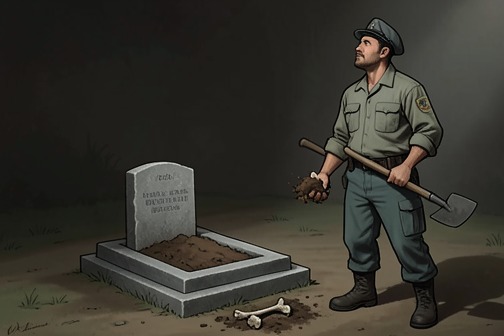
[The secret burial of the unidentified man](entity:event-recall-event-the-secret-burial-of-th-a434a4691c34) is pieced together from a grave that should have held Sister Margaret alone. When the Thursday Murder Club examines the additional bones, their age contradicts the headstone’s date, while their stripped condition offers no identifying clues. The remains point to a deliberate later burial, but leave open the central questions: who the man was, when he died, and whether he was killed. His concealed presence transforms the [Garden of Eternal Rest](entity:location-recall-location-garden-of-eternal-re-7d067051ed48) from a threatened cemetery into the site of an unresolved crime.
## The grave and its setting
The Garden of Eternal Rest lies above [Coopers Chase](entity:location-recall-location-coopers-chase-574bd7ef72bf), looking back toward the old convent and across the Kentish High Weald. For generations, the convent had been home to the [Sisters of the Holy Church](entity:organization-recall-organization-sisters-of-the-h-051773f27f94): a community whose life of devotion, work, and shared accommodation ended in burial beneath simple stones in the garden. The convent’s long association with its cemetery makes the later discovery especially consequential. A grave in this place is not merely a plot of land but part of the history of the women who lived and died there.
The setting is also undergoing change. The [Catholic Church](entity:organization-recall-organization-ba391efc867a) sold the land, and Coopers Chase was developed around the former convent, with modern residential buildings extending from it. Later, [Father Matthew Mackie](entity:character-recall-character-father-matthew-mack-87aff90c5a45) walks through the trees after learning that the cemetery is still due to be removed as part of the development plans. He had hoped [Tony Curran](entity:character-recall-character-tony-curran-df5bdde9d93a)’s death would end the need for further action, but [Ian Ventham](entity:character-recall-character-ian-ventham-dd9e7fb2264a)’s decision to continue the project leaves the cemetery’s future uncertain. This redevelopment dispute supplies a present-day pressure around the grave; the available evidence does not establish that it caused the earlier burial.
## The second set of remains
The discovery becomes a mystery when Austin examines a femur and judges the bones to have been underground for a considerable time. Asked whether they could have been buried with Sister Margaret, whose headstone bears the date 1874, he rejects that possibility. Depending on the soil, he estimates that the remains might have been buried for thirty, forty, or fifty years, but not for a hundred and fifty. The grave therefore appears to have been reopened and filled again at a later date, with another body placed inside.
Austin finds no jewellery or fragments of clothing. The remains have been stripped bare, so the grave yields no personal effects that could identify the dead man. He says that, if the case involved murder, whoever carried it out knew what they were doing. That observation raises the possibility of deliberate concealment without proving either how the man died or who buried him. Austin takes some of the bones away for further examination, which may help establish a clearer account of their age and identity.
At first, the discovery belongs to the club’s sense of adventure; the bones make the consequences harder to avoid. The remains are not an abstract clue but evidence that a person was buried there, and the group pauses to acknowledge that someone died. Austin’s initial assessment is that the body was probably a man, not a nun. Yet the club cannot explain why an additional body lies in the grave, and it does not know whether the man was murdered. The distinction matters: the concealed burial is established by the evidence, while the manner and circumstances of death remain questions.
## Investigation and unanswered questions
The club’s first task is to determine when the man was killed. Thirty years and fifty years would point to substantially different periods, so Austin’s tests could change the direction of the inquiry. Until then, the age estimate narrows the field only provisionally. The members also consider whether someone knew that the bones were hidden there and whether the secret might connect to Ian Ventham’s more recent murder. They raise those possibilities as questions, not conclusions; no evidence in the discovery establishes a link between the two cases.
The Thursday Murder Club decides, for the time being, not to involve the police. Its members regard the graveyard and the investigation as closely tied to their home, but they acknowledge that they will have to disclose what they have found once Austin returns with results. They also agree that the bones take priority over [Elizabeth](entity:character-recall-character-elizabeth-83df578df81e)’s efforts to locate [Bobby Tanner](entity:character-recall-character-bobby-tanner-61e88acf3a90) and [Gianni Gunduz](entity:character-recall-character-gianni-gunduz-8e1141010816). The discovery thus redirects the group’s attention and expands its inquiry: they are trying to solve two murders, and possibly a third if the unidentified man was murdered.
## Memory, place, and the search for a date
The investigation turns toward the convent’s past. [Gordon Playfair](entity:character-recall-character-gordon-playfair-33fde8f9ea1e) understands why the club wants to hear his memories of the 1970s and look through photographs from trips down the hill. In the second album, after wedding pictures and pages of sheep, the group finds six black-and-white photographs from a Christmas gathering at the convent. The fifth is a group photograph. The members look closely, then look again, and agree that they have found evidence; Elizabeth has a plan. The scene supplies a concrete route into the past, but the available account does not name the person in the photograph or explain what the image proves about the burial.
That search takes place against the institution’s remembered life. [Matthew Mackie](entity:character-recall-character-matthew-mackie-3c0c30ef4df9) recalls arriving from Ireland in 1967, when the convent was quiet, home to a hundred Sisters, and also a place of work with a busy hospital. The memory gives the cemetery a human and communal history beyond its stones. The unidentified man’s burial remains unexplained, but the inquiry now has both physical evidence in the grave and shared recollections and photographs to examine. The past has not stayed safely underground: its return makes the history of the convent, the threatened cemetery, and the man without a name part of the same investigation.
Event 10
The exposure of Matthew Mackie's false priesthood

[The exposure of Matthew Mackie's false priesthood](entity:event-recall-event-the-exposure-of-matthew-a9a478c65984) turns a familiar religious title into a question of identity, credibility, and possible criminal responsibility. At [Fairhaven Police Station](entity:location-recall-location-fairhaven-police-sta-77f675ad6f9f), [Donna De Freitas and Chris Hudson](entity:relation-recall-relation-donna-de-freitas-and-237023152bdf) confront a man who has appeared publicly as [Father Matthew Mackie](entity:character-recall-character-father-matthew-mack-87aff90c5a45). The inquiry establishes that he is Doctor Michael Matthew Noel Mackie, a retired general practitioner, not a priest employed by the [Catholic Church](entity:organization-recall-organization-ba391efc867a) or any other church. The discovery does not, by itself, explain his conduct or connect him conclusively to a killing, but it makes his assumed clerical identity impossible to treat as a harmless detail.
## The background check
The immediate breakthrough belongs to [Donna](entity:character-recall-character-donna-230485550224). She runs background checks on Father Matthew Mackie, expecting an ordinary search to reveal the history behind his name and position. Instead, nothing appears. The absence of a record is itself the anomaly: if Mackie has been acting as a priest, there should be some trace of that vocation. Donna spends several days piecing together why the searches return nothing, then takes her findings to Chris. Her work changes the inquiry from a general question about Mackie's conduct into a direct examination of who he is.
The interview carries a pointed parallel for Donna. Not long before, she had sat in the same room opposite someone pretending to be a nun; now she is facing a man pretending to be a priest. The repeated impersonation gives the room a pattern, but the cases are not interchangeable. Here, the claim to religious authority is entangled with an active murder investigation, and the question is not only whether Mackie has misrepresented himself but whether the disguise conceals something relevant to a death.
## The interview and the facts
The conversation takes place in Interview Suite B at Fairhaven Police Station. Chris proceeds carefully, asking whether Mackie has consistently introduced himself as Father and whether he has worn the full priestly vestments. Mackie confirms that he has worn them. Chris’s measured questions make the visible performance part of the evidence: the title and clothing were not incidental to how Mackie presented himself.
Chris then sets out what Donna’s checks have established. Mackie is not Father Matthew Mackie, does not work for the Catholic Church or another church, and is Doctor Michael Matthew Noel Mackie. Mackie admits that this is his name. Chris adds that he left private general practice fifteen years earlier, lives in a bungalow in [Bexhill](entity:location-recall-location-bexhill-f6223ae9ae38), and, according to local inquiries, does not even attend Mass. Together, these details replace the public identity of a serving priest with the documented life of a retired doctor.
Mackie does not offer a full explanation. He describes the situation as a possible misunderstanding, accepts some share of the blame, and says that he did not intend to mislead, while conceding that it could look that way without all the facts. Chris does not accept intention as a substitute for an answer. He returns to the verifiable contradiction: the church has no record of Mackie as a priest, and neither the church's records nor the inquiries have produced an old photograph or other evidence of his supposed clerical past.
## The murder investigation changes the stakes
The discrepancy becomes more serious because of the events surrounding the interview. Chris recalls that Mackie had been involved in a scuffle with another man who was impersonating a priest. Moments later, that man died from a lethal injection. Chris also points out that the apparent conman is a doctor. Those circumstances put Mackie's medical training beside the death and make his false clerical identity relevant to a murder inquiry. They do not establish that Mackie administered the injection, and Chris himself presents the connection as a question requiring an explanation rather than as a proved conclusion.
Chris asks Mackie to remove his dog collar. Mackie resists the implication that his present status settles every question about his past. He concedes that he is not currently a priest, but maintains that he was one for many years and regards the collar as a privilege he may choose to wear. The response exposes the remaining gap between his own account and the investigators' findings: he claims a former clerical identity, while the records and inquiries have produced no confirmation that he ever held it.
## Refusal and significance
Chris makes clear that this is a murder case, not merely a dispute over dress or title. He tells Mackie that Donna has examined every record and that the church has been helpful, then lists the audiences to whom Mackie has presented himself as a priest: the police, the council, [Ian Ventham](entity:character-recall-character-ian-ventham-dd9e7fb2264a), and the residents who protected the cemetery gate. Chris says that no trace supports the claim and asks Mackie to disclose whatever important fact he is withholding. The interrogation thus extends the exposure beyond the interview room: Mackie's assumed authority has been part of his dealings with people involved in the cemetery dispute as well as with the investigators.
Mackie considers Chris's demand, shakes his head, and declines to explain. He says he will speak only if arrested; otherwise, he wants to go home, adding that he bears no hard feelings because Chris is doing his job. The exchange ends without a confession or a resolution of the murder question. What has changed is the standing of Mackie's account: the priestly identity he has used is unsupported by institutional evidence, while his actual medical identity gives the police a concrete reason to press him about the lethal injection. The exposure is therefore both a revelation and a limit. It uncovers the false public role, but leaves the reason for maintaining it—and its precise relation to the death—unanswered.
Event 11
Bernard's death and final letter
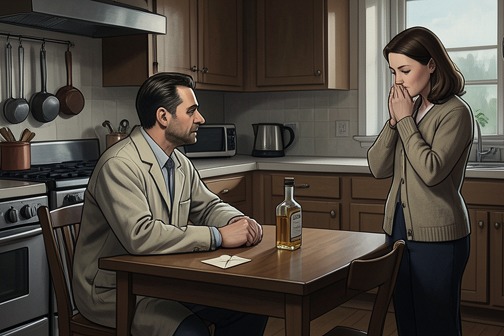
[Bernard Cottle](entity:character-recall-character-bernard-cottle-b66e42de137d)’s death and final letter bring a private crisis into the open: before dying, he tells [Joyce](entity:character-recall-character-joyce-830d04161bf1) that he intends to end his life and confesses what he has done with some of [Asima](entity:character-recall-character-asima-7973afe5b3d4)’s ashes. The letter is at once a farewell, an apology, and an attempt at repair. Its intimate details—the pills beside his bed, a bottle of saved whisky, Joyce’s flowers in a milk bottle—make his despair inseparable from the friendship and grief that have shaped his final days.
## Discovery and reading
Joyce approaches [Bernard](entity:character-recall-character-bernard-2ea2639d5023)’s flat and initially stalls outside, imagining ordinary explanations for his silence. Once inside the block with a spare key fob, she climbs the stairs and finds an envelope Sellotaped to his door. Bernard has addressed it to her by name, with a smiley face drawn inside the O. The small flourish preserves the familiar uncertainty of his manner even at the threshold of his death: Joyce knows the letter is serious, but its first mark is recognizably his.
When Joyce begins to read, the scene becomes a shared act of witnessing. Ron places a hand on hers and tells her to take her time; [Elizabeth](entity:character-recall-character-elizabeth-83df578df81e), Ron, and Ibrahim remain silent as she reads. Joyce’s wavering voice and the friends’ restraint frame the letter not as a private document encountered alone but as a message carried into the company of people who care for her and knew Bernard.
Bernard tells Joyce that he has bolted the door, a precaution he says he has never used since moving in. He expects to be lying on the bed and leaves it to the ambulance attendants to decide whether he will look peaceful. He also imagines Joyce might wish to say goodbye, but recognizes that she may not be permitted to do so because she is not family. Joyce later reports that she was not allowed to see him, and gently corrects his expectation: the attendants were women, not men. The detail gives the farewell a painful, matter-of-fact limit. Bernard can anticipate the separation, but he cannot control its terms.
## The planned farewell
Beside Bernard are the pills he intends to take and a Laphroaig he has been saving for a rainy day. His description of the lights going out around him turns the ordinary progression of evening into an image of approaching death. The scene is not made remote by grand declarations: the saved whisky, the bed, and the flowers Joyce bought him keep it domestic and particular.
The flowers are in a milk bottle because Bernard knows Joyce understands his dislike of vases. That makes them more than decoration. They register an established familiarity between the two friends, and their presence beside the pills puts companionship and planned solitude in the same frame. Before he dies, Bernard says, he must tell Joyce the whole story. The letter’s movement from farewell toward confession changes its purpose: it is not only an account of what he plans to do, but an attempt to disclose what he has been unable to put right.
## Confession and the failed attempt at repair
In the letter, Bernard recalls that the immediate pain passed and that he came to understand the enormity of what he had done, describing it as selfish and entitled. He considered digging up the tea caddy, taking it by bus to [Fairhaven](entity:location-recall-location-fairhaven-84c33d22c8d0), releasing some of Asima, and keeping some with him. He could not bring himself to tell Sufi what he had done, but imagined that returning some of her mother to the waves might at least bring her closer to the place Sufi believed people returned to. The plan would have been incomplete, but Bernard regarded it as the best remedy available to him.
That possibility disappears when Bernard walks up the hill and finds workmen laying a concrete foundation for a bench. They have dug the ground, though not far enough to find the tin, and filled the hole with cement. The foundation is laid in half an hour. Its permanence is accidental rather than malicious, but it closes off Bernard’s intended way of recovering the hidden tea caddy. The practical fact of the cement gives his remorse a physical form: what he buried cannot simply be retrieved, and his wish to correct the concealment has become harder to act upon.
Afterward, Bernard continues walking up the hill and speaking to Asima when no one is listening. He tells her his news, how much he loves her, and how sorry he is. His final admission to Joyce is that he has run out of whatever is needed to carry on. The letter thus links the concealed ashes to his despair without presenting confession as an easy absolution: telling the truth arrives only after the practical chance to undo his action has been blocked.
## Aftermath and significance
Joyce finishes reading and keeps her finger moving across the ink. She attempts a smile, but it gives way to tears and then shaking sobs. Ron leaves his chair, kneels before her, and holds her while she weeps for Bernard, Asima, [Gerry](entity:character-recall-character-gerry-2af545ef5299), and the women who had gone to Jersey Boys and shared canned G&Ts on the way home. Her grief gathers several losses and memories together rather than isolating Bernard’s death from the life around it. Ron’s embrace gives her immediate comfort where the letter could offer only explanation and farewell.
The scene’s emotional force comes from the distance between Bernard’s carefully imagined ending and the aftermath he cannot witness. He anticipates being judged by ambulance attendants and perhaps denied a goodbye; Joyce confirms that she was kept from seeing him, while his letter nevertheless reaches her and is heard by her friends. His confession does not undo the concealment or the failed attempt to recover the ashes. It does, however, make his remorse available to those left behind. The letter gives Bernard a final voice, and Joyce’s reading turns that voice into shared knowledge, held alongside grief rather than mistaken for a resolution.
Event 12
Bernard switches Asima's ashes
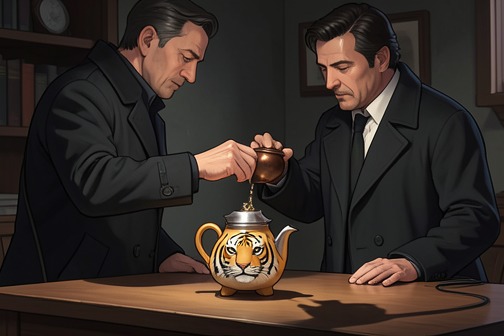
[Bernard](entity:character-recall-character-bernard-2ea2639d5023) switches [Asima](entity:character-recall-character-asima-7973afe5b3d4)’s ashes in the aftermath of her funeral, secretly keeping the remains he cannot bear to let go. Confessed in a letter read by [Joyce](entity:character-recall-character-joyce-830d04161bf1), the act is at once an intimate expression of bereavement and, as Bernard recognizes, a betrayal of his daughter: grief preserves what he loves by withholding it from someone else who loves Asima too.
## The wish and the journey
Bernard explains that Asima had long wished for her ashes to be scattered on the [Ganges](entity:location-recall-location-ganges-13554a03c098), a wish their daughter Sufi had grown up hearing. Two days after the funeral, Sufi and her husband, Majid, flew to [Varanasi](entity:location-recall-location-varanasi-e00828223a49) to carry it out. Bernard says that the funeral itself was too painful for him to think or write about. He also notes that he was not religious and that Asima had gradually left her faith behind. Her wish nevertheless held a force that his own beliefs could not dissolve: it was a promise carried into the family’s plans for her remains.
## The substitution
Bernard kept the urn at home for the first night after the funeral. Sufi and Majid stayed at a hotel rather than in his spare room, leaving him alone with the ashes. He describes taking them from the urn and placing them in the [Tiger-shaped tea caddy](entity:object-recall-object-tiger-shaped-tea-caddy-686c1307c7a7) he had kept for years. The object carried a history particular to the couple: Asima had first picked it out in an antique shop, and they had laughed over the affectionate tiger names they gave each other. Bernard later went back to buy it for her, only to discover that she had already bought it for him as a Christmas present. He kept it from then on.
After transferring the ashes into the caddy, Bernard filled the urn with sawdust and bonemeal, which he says made a convincing substitute, and sealed it again. Sufi therefore took the replacement contents to Varanasi and scattered them on the Ganges, believing she was carrying out her mother’s wish. Bernard’s preservation of Asima’s ashes depended on that deception: he held on to the remains while allowing the public ritual to proceed as if nothing had changed.
## The hidden burial
The following day, as soon after dark as he dared, Bernard took a spade from the allotment shed and walked up the hill. He cut the turf from beneath a bench, dug a hole, and buried the tin there. He knew even then that the arrangement could only be temporary, but he was not ready to let Asima go. The settled turf concealed the burial so completely that nobody noticed.
The bench became part of Bernard’s daily life with the secret. He returned to sit there, greeting people who passed and speaking to Asima when they did not. His routine gave the hidden ashes a place within his ordinary days, but it did not undo the concealment. Bernard understood that he had wronged Sufi and believed he could never make amends; he explains the act through the extremity of his pain while explicitly refusing to treat grief as an excuse.
## Confession and divided love
Bernard’s letter makes the switch legible as more than an attempt to keep a physical relic. He says he could not comprehend Asima being placed in hand luggage and then floating away from him so soon after he had said goodbye. His fear of that final separation led him to confuse holding on to his wife with having the right to decide what happened to her ashes.
As Joyce reads, [Ron Ritchie](entity:character-recall-character-ron-ritchie-2d882cb527dc) gives her water, and [Ibrahim Arif](entity:character-recall-character-ibrahim-arif-a86ec0feb8bc) responds to the confession by observing that people may love a child more than a partner, or a partner more than a child, without being able to admit either choice. The remark brings the letter’s moral conflict into focus without absolving Bernard: his attachment to Asima and his love for Sufi cannot be cleanly ranked, yet his decision deprived his daughter of the farewell she believed she had made. The disclosure therefore recasts the apparently completed scattering on the Ganges as an incomplete parting, and Bernard’s daily visits to the buried caddy as a private ritual sustained by a secret he knows has harmed someone else.
Event 13
The exhumation of the Garden of Eternal Rest
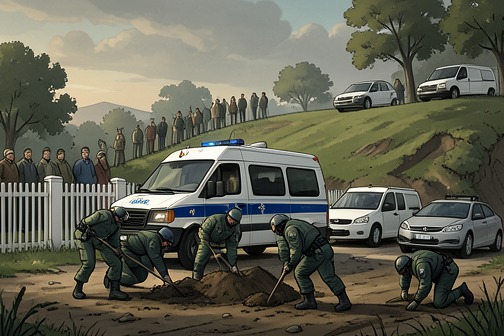
[The exhumation of the Garden of Eternal Rest](entity:event-recall-event-the-exhumation-of-the-g-68d510ca090e) brings a buried crime into the present and makes the cemetery’s history legible through physical evidence, remembered events, and old photographs. The police excavation is not an isolated discovery: it sets the Thursday Murder Club searching for witnesses to the site’s former life as a convent, until a photograph from [Gordon Playfair](entity:character-recall-character-gordon-playfair-33fde8f9ea1e)’s album provides evidence and a later confession recounts how a body was placed in a grave there.
## The excavation and its setting
A police cordon around the [Garden of Eternal Rest](entity:location-recall-location-garden-of-eternal-re-7d067051ed48) interrupts the club’s walk to the Playfair farm. At about ten in the morning, two police cars and a white van—widely assumed to be a forensics vehicle—have arrived at the cemetery. Officers in white protective suits walk up the hill carrying spades. From his flat in Larkin Court, Martin Sedge watches the site through binoculars and reports that there is only digging. The measured, incomplete report emphasizes how little the residents can know while the official search is under way.
The work matters because the cemetery occupies land with a concealed past. [Coopers Chase](entity:location-recall-location-coopers-chase-574bd7ef72bf) had once been a convent, and Gordon Playfair had lived with his young family in the same house on the hill during the 1970s. When the Thursday Murder Club tells him about the body, the present-day discovery gives a practical reason to ask what he remembers from those years. The excavation thus changes the old landscape from a setting people pass through into a place whose history may contain evidence.
## Reconstructing the past
The club’s inquiry turns from the cordon to Gordon’s recollections and personal photographs. They study his albums for images taken on trips down the hill, hoping that someone or something in them will be recognizable. The search takes patience: an album begins with wedding pictures, continues through photographs of a baby, and then devotes many pages to sheep. Only near its end does it reach six black-and-white photographs taken at a Christmas gathering at the convent.
The fifth photograph is a group picture. At first, the relevant detail is difficult to make out; the people in it have changed over the decades, and the observers acknowledge that even familiar faces might be hard to recognize after fifty years. They look again, and agree that the image provides evidence. [Elizabeth](entity:character-recall-character-elizabeth-83df578df81e) has a plan, but the account does not describe its precise steps at this point. The photograph’s importance lies in how it converts Gordon’s private album into a clue: a record of an ordinary gathering becomes a means of testing memories about the people who once used the convent.
## The concealed burial
A later account supplies the circumstances behind the hidden remains. The speaker describes driving through the gates at night with the headlights switched off, passing St Michael’s and the hospital before continuing up the lane to the Garden of Eternal Rest. He takes a spade to a grave belonging to one of the Sisters, at the top of the cemetery, where the ground is soft. After reaching the coffin, he returns to the car, brings the body to the grave, places it on top of the coffin, fills in the earth, and says a prayer.
The account presents the burial as a sequence of deliberate choices: a quiet journey to a familiar site, the selection of an existing grave, and the concealment of one body above another. The speaker recalls the work as difficult and says that no one ever came to his door afterward. In his dreams, however, someone knocks every night. His decision to tell the story is linked to the conviction that there should have been consequences. The excavation therefore exposes not only a physical arrangement beneath the earth, but also the long silence and moral unease surrounding it.
## Evidence, memory, and old cases
The novel places this investigation alongside Elizabeth’s interest in an older unsolved case. Months earlier, she approached [Penny Gray](entity:character-recall-character-penny-gray-1c396f74bd77) over lunch while [Penny](entity:character-recall-character-penny-20f5e0e3e7bd) was eating shepherd’s pie, opened a manila folder, and asked her to consider the circumstances of a girl’s stabbing. Later, the club examines autopsy photographs and learns that the boyfriend escaped from Penny’s squad car on the way to an interview and was never seen again. Penny had been struck during the incident. [Joyce](entity:character-recall-character-joyce-830d04161bf1) observes that the club could not simply bring the fugitive to justice; Penny and Elizabeth had previously solved cases to their own satisfaction without being able to secure an official outcome.
That distinction between private understanding and public proof recurs in the cemetery investigation. Elizabeth later explains that Penny kept copies of files from her old cases, although she was not supposed to retain them. After [Karen Playfair](entity:character-recall-character-karen-playfair-232a882d12ac) recognizes [John](entity:character-recall-character-john-6bc68dc682c3), Elizabeth checks one of those files for a final detail. The old records, Gordon’s album, the recognition of a face, and the excavation form different kinds of evidence, each with limits; together they allow the past to be examined rather than merely remembered.
## Significance
The exhumation joins the novel’s investigative present to a crime concealed in the grounds of a former convent. Its discovery does not arrive as a complete explanation: police activity first appears only as distant digging, and the club must work through Gordon’s memories before the photographs yield a usable clue. The later account of the burial supplies the concealed act in concrete terms, while the speaker’s recurring imagined knock gives the silence that followed a human consequence.
The event also places material evidence beside unofficial archives and personal testimony. A grave, a group photograph, and copied case files preserve different traces of events that formal processes did not resolve. By bringing those traces into contact, the investigation challenges the assumption that an old crime has vanished simply because it went unanswered. The cemetery becomes both the site of concealment and the place where that concealment can finally be questioned.
Event 14
Matthew Mackie's confession about Margaret Farrell
[Matthew Mackie](entity:character-recall-character-matthew-mackie-3c0c30ef4df9)’s confession turns a carefully staged test into a disclosure of the past he has carried for decades: his relationship with [Maggie](entity:character-recall-character-maggie-39724c72a859), her suicide while pregnant, and the secret arrangement that brought her to the [Garden of Eternal Rest](entity:location-recall-location-garden-of-eternal-re-7d067051ed48). The confession is both a revelation of concealed events and an account of how silence, institutional pressure, and the need to remain near the dead shaped the rest of his life.
## The confessional test
In the candlelit chapel, [Elizabeth](entity:character-recall-character-elizabeth-83df578df81e) and Matthew Mackie sit inches apart inside the confessional. Elizabeth offers what sounds like a deathbed confession of her own: she says that she killed a man long ago, presenting the killing as self-defence and saying that she wants a witness rather than forgiveness. Matthew invites her to continue, but when she finishes, he says that he does not believe her. Elizabeth presses the point by recalling the detail in her story and his reaction when she mentioned the Garden of Eternal Rest. The supposed confession is a provocation, not the truth she has come to hear.
Matthew’s resistance shifts when he admits that he would like to talk and invites Elizabeth to show her real purpose. His willingness to speak does not arrive as the reward for a successful interrogation so much as a choice to use the moment: he is at home in the church, and he wants a conversation. The confessional’s traditional demand for a confession is thus unsettled. Elizabeth has staged a false one to open the door, while Matthew decides that he is ready to bear witness to what actually happened.
## Matthew’s life at the convent
Matthew recounts that he came from Ireland in 1967, aged twenty-five, looking for adventure rather than a particular mission. He took a post at a convent with a busy hospital, where about a hundred Sisters lived and worked. He had rooms in the gatehouse, separate from the Sisters’ quarters, and served as a priest through sermons, confessions, and the ordinary work of sharing people’s happiness and sorrow. He remembers himself as young and inexperienced, and recalls that his position as a man seemed to matter more than wisdom.
That setting becomes the frame for his account of Maggie. His story, told later to the group in the [Jigsaw Room](entity:location-recall-location-jigsaw-room-b7b7e4a458ca), begins with a religious community that was peaceful on the surface but governed by rules and authority. The movement from the intimate confessional to the group’s meeting room also changes the circumstances of his testimony: Elizabeth initially draws him out alone, but later [Chris Hudson](entity:character-recall-character-chris-hudson-cd3fb8979c98) and [Donna De Freitas](entity:character-recall-character-donna-de-freitas-b0c875579a5d) take charge of the questioning, with Elizabeth stepping back. The Thursday Murder Club and the police are no longer listening to an abstract mystery; they are hearing the history behind it from the person who lived it.
## Maggie’s death and the bargain
Matthew reveals that Maggie was pregnant. She had confided in another young nun, whose identity he never learned. That nun told [Sister Mary](entity:character-recall-character-sister-mary-4ed65ce16de6), who summoned Maggie after prayers and sent her away: she was to spend one last night at the convent, then be collected and returned to Ireland. Matthew believes Maggie could slip out of the dormitory, but that night she did not come to him. Instead, she went to the chapel and hanged herself. Matthew says that she took the life of their unborn child as well.
The institution’s response did not make the loss public. Matthew says that he and Sister Mary were the only people who saw Maggie’s body hanging. A deal was made: he would leave without speaking to anyone, while Maggie would be allowed to rest in the Garden of Eternal Rest. The [Church authorities](entity:organization-recall-organization-0b37439dcca4) destroyed the old records and made new ones, and the account circulated about Maggie’s death concealed the priest, the baby, and the suicide. Matthew says that the burial place mattered because Maggie would not have wanted to go home, and [St Michael’s Chapel](entity:location-recall-location-st-michael-s-chapel-26b206771a14) was the only other place she knew.
Sister Mary also had a reason to agree. Matthew explains that his sudden departure, paired with Maggie being sent away for burial, might have prompted questions and exposed what had happened. The arrangement protected her as well as him. The car that had been due to collect Maggie instead took Matthew; they travelled through the day to Holyhead, and he returned to Ireland without telling anyone.
## Return and the need for a witness
Matthew stayed in Ireland and worked at a teaching hospital in Kildare. He remained away until he heard that Sister Mary had died. Then he left his job, packed a case, and returned to stay near Maggie. Sister Mary was buried in the convent graveyard, where Matthew says her headstone can be recognised by its cherubs. His return makes his attachment to the place more than a matter of memory: it is the nearest he can live to the woman he lost.
The delayed telling gives shape to the confession’s central burden. Matthew’s account joins Maggie’s hidden burial to a life organized around departure, silence, and eventual return. The bargain preserved a place for her in the cemetery, but it also sealed the circumstances of her death from the people who might have asked what happened. In telling the story, Matthew does not ask Elizabeth or the group to undo that past; he finally lets others bear witness to it. The Garden of Eternal Rest is consequently both a burial ground and the repository of a history that its official records were made to conceal.
Event 15
Margaret Farrell's suicide
Margaret Farrell’s suicide is the buried tragedy at the center of [Matthew Mackie](entity:character-recall-character-matthew-mackie-3c0c30ef4df9)’s account: after her pregnancy became known, she was ordered to leave, died in the chapel before she could be sent away, and was given a secret burial arrangement that bound Mackie to the loss for decades. Recounted in the [Jigsaw Room](entity:location-recall-location-jigsaw-room-b7b7e4a458ca), the event transforms a concealed death into a testimony about institutional silence, grief, and the bargain that determined where [Maggie](entity:character-recall-character-maggie-39724c72a859) would rest.
## The pregnancy and the order to leave
Mackie places the events in the period when he and Maggie were connected through the convent. She had confided her pregnancy to another young nun, whose identity he never learned. That confidence passed to [Sister Mary](entity:character-recall-character-sister-mary-4ed65ce16de6), who summoned Maggie to her room at about six, after prayers. Mackie was not told what Sister Mary said. He could infer the result, however: Maggie was to pack, spend one last night at the convent, and be collected in the morning for a return to Ireland.
The arrangement gave the coming departure an appearance of order, but it left Maggie with one night before an unwanted separation. Mackie says she knew how to slip out of the dormitory. On this occasion, rather than coming to him as she had on other nights, she went to the chapel. The change in destination marks the final break in the account: the planned journey home would not be hers to make.
## Her death in the chapel
Mackie says he entered the chapel after lighting a candle and saw enough in its shadowed interior to understand that Maggie had died by suicide. She had used a rope and a beam above the altar. His recollection dwells on the uncertainty of the timing: she may have acted while he was tying his laces or while he was putting out the candle. He could not establish exactly when she died, but he understood why she had not come to him.
Mackie found no note. He raised the alarm quietly, waking Sister Mary rather than making the death a public scene. The pregnancy made the loss twofold: Maggie died, and so did the child she was carrying. Later, when the account is told in the Jigsaw Room, [Elizabeth](entity:character-recall-character-elizabeth-83df578df81e) briefly supplies the fact of the pregnancy before Mackie resumes its consequences. His closing judgment is that nothing was ever fine again. The recollection therefore presents the suicide not as an isolated moment but as the event after which his life, and his sense of what could be repaired, changed.
## The bargain over burial and silence
Mackie explains that his departure was part of an agreement. He was to leave without telling anyone what had happened. The Church wanted him out of the way and sought to avoid trouble and scandal; Mackie says records were destroyed and new ones made. The account of Maggie’s death was not to become the story of a priest, a pregnancy, and a suicide. He does not claim to know what explanation was ultimately given to others.
In return, he asked that Maggie be buried in the [Garden of Eternal Rest](entity:location-recall-location-garden-of-eternal-re-7d067051ed48). He reasoned that she would not have wanted to go home, while St Michael’s was the only other place she knew. Sister Mary agreed. Mackie also recognized that the arrangement suited her: otherwise, questions might have arisen about his sudden departure and Maggie being sent away for burial. Their bargain thus served both a private attachment and a public concealment, while securing the burial place Mackie wanted for Maggie.
## Departure, return, and the delayed telling
The car meant to collect Maggie instead collected Mackie the next morning. He and the driver travelled through the day to Holyhead, and Mackie returned to Ireland. He says he stayed there, working at a teaching hospital in Kildare, until he heard that Sister Mary had died. Her grave was in the same graveyard, marked by cherubs on the headstone. On learning of her death, Mackie left his job, packed a case, and came back to stay as near to Maggie as he could.
That return gives the concealed event a long aftermath: the agreement removed Mackie from the scene, but it did not sever his attachment to Maggie or his wish to remain near her. His later account, told among the people gathered in the Jigsaw Room, makes the suppressed history speakable without undoing the years of silence. The suicide is consequently both a death and the origin of Mackie’s enduring proximity to the Garden of Eternal Rest.
Event 16
Karen Playfair identifies John
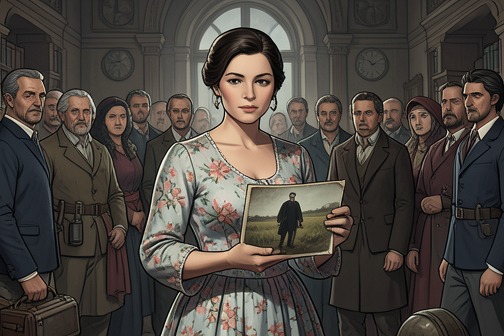
[Karen Playfair identifies John](entity:event-recall-event-karen-playfair-identifi-ac9179bde0f8) after recognizing him in an old photograph in the village newsletter *Cut to the Chase*. The recognition changes the status of a long-cold case: a face preserved in a record of village life becomes the lead that allows [Elizabeth](entity:character-recall-character-elizabeth-83df578df81e) to connect the past to the present and move from suspicion toward a solution.
## Background: the old case
The recognition matters because the club has already discussed an earlier stabbing that seemed unlikely to receive justice. Elizabeth had asked [Joyce](entity:character-recall-character-joyce-830d04161bf1) about knife wounds over lunch, opening a manila folder containing typed pages and what appeared to be old photographs. Her questions were framed as a hypothetical, but their specificity suggested an actual case: a girl had been stabbed, and the wound was not thought to have been fatal in itself.
The group later looked at autopsy photographs and considered the history behind them. The victim’s boyfriend had fled from [Penny](entity:character-recall-character-penny-20f5e0e3e7bd)’s squad car while being taken to a police interview and was never seen again. He had also assaulted Penny. The club understood that their informal attention could not simply deliver him to justice; Penny and Elizabeth had solved cases to their own satisfaction before, but that did not necessarily mean they could secure an official outcome. The old crime therefore carried both an evidentiary problem and a moral one: the suspect had disappeared, and the passage of years seemed to have protected him.
## The photograph and Karen’s certainty
The clue surfaces when Karen is with Jason and Ron. She has put down her copy of *Cut to the Chase*, then notices a photograph partway down one of its pages. She picks the newsletter up again and studies the image closely, taking care to confirm what she has seen. In it is a man associated with the village in the 1970s, pictured with Ron and a fox that [John](entity:character-recall-character-john-6bc68dc682c3) had helped save.
Karen connects the image to the description of the person the police were seeking: someone who had been in the village in the 1970s and was still there. Jason explains that this was what the police believed, though he had thought they were mistaken. Karen does not accept that dismissal. She points to the face in the photograph and repeats the identifying condition, then says she is sure despite the time that has passed.
Her certainty is a turning point because the photograph does more than establish that the man once lived in the village. It links an old, public record to the fugitive described in the case. Ron struggles to take in the implication, but cannot find a reason to reject it. He puts down his wine and takes up the newsletter, then decides that he needs to speak to Elizabeth.
## From recognition to investigation
Ron’s response carries the identification into the Thursday Murder Club’s investigation. Elizabeth considers the photograph and works through the implications step by step. At first the conclusion seems impossible; as she tests the pieces against one another, it begins to seem horribly true. Ibrahim returns with the final piece Elizabeth needs, and she concludes that the case is solved, although justice remains to be pursued.
The photograph’s role is part of a wider chain of evidence rather than a complete answer by itself. After Karen recognizes John, Elizabeth says that the recognition set her thinking and led her to check one final item in Penny’s stored case files. Penny had kept files from her old cases and made copies, despite not being supposed to retain them. Joyce understands the significance of that habit: the copies might help catch a killer many years later. The recognition thus redirects Elizabeth toward a surviving archive, connecting Karen’s memory to the investigative record.
The group then goes together to confront the man Karen has recognized. Elizabeth, Ron, Joyce, and Ibrahim arrive at his door. The old book open inside and John’s apparent lack of surprise give the meeting the quality of an encounter long delayed, but the decisive change has already happened: he is no longer an unidentified face in a newsletter. The recognition has made it possible for the investigators to address him as the person whose past they have been piecing together.
## Narrative significance
The scene turns on the difference between being seen and being recognized. The photograph had been available in the village newsletter, and John’s image had remained beside a story of ordinary local life; its meaning changes only when Karen connects that face to the police description. Her careful second look, followed by her insistence that she is sure, converts a commonplace record into evidence.
The event also brings the novel’s investigative strands together. The earlier discussion of the stabbing, Penny’s copied files, the fox photograph, and Elizabeth’s final reconstruction belong to different moments in the story, but Karen’s identification makes them converge. The years that had allowed the suspect to vanish from the case do not erase the evidence entirely: it survives in photographs, memories, and files kept for reasons that once seemed merely cautious. Karen’s recognition cannot by itself deliver justice, but it gives Elizabeth a name and a direction, and changes the old case from a story about an absent man into an investigation with someone to confront.
Event 17
The murder of Ian Ventham
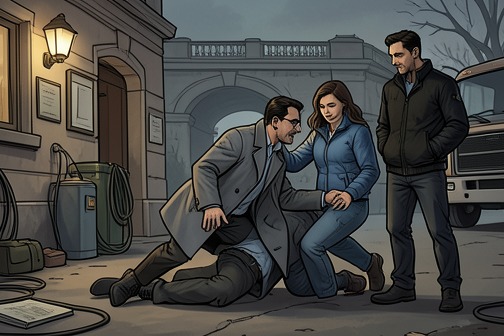
[The murder of Ian Ventham](entity:event-recall-event-the-murder-of-ian-venth-ea0051941b5c) turns a public confrontation over the cemetery into a concealed killing, then returns as a confession that changes the meaning of his collapse. At first, the scene appears to end in defeat for Ventham and disorder among the protesters. Only afterward does the investigation establish that he was poisoned, and [John](entity:character-recall-character-john-6bc68dc682c3) explains that he administered the drug during the chaos to protect a secret burial from discovery.
## Causes and Background
The killing takes place amid the attempt to proceed with the cemetery excavation. [Father Matthew Mackie](entity:character-recall-character-father-matthew-mack-87aff90c5a45) insists that he is protecting sacred ground peacefully and lawfully; [Donna](entity:character-recall-character-donna-230485550224) helps him to his feet after the confrontation. Chris pulls Ventham out of the surrounding scrum and tells him to go home rather than risk arrest. Ventham protests that he did not touch Father Matthew Mackie, but the immediate dispute does not end there.
As he walks away, Ventham signals to the driver of a low-loader, apparently directing it toward the exit. His thoughts shift among people and practical concerns: he wonders where [Bogdan](entity:character-recall-character-bogdan-52d2900aa94a) is, thinks of having him tile his swimming pool, and considers speaking to [Tony Curran](entity:character-recall-character-tony-curran-df5bdde9d93a). The sequence also gives his departure a disoriented quality. On reaching his clamped Range Rover, Ventham worries that his father will be furious because he borrowed the vehicle; he imagines taking the bus and does not want to go home. These details establish the confusion surrounding his final minutes without, by themselves, explaining what caused his death.
John later supplies the concealed motive. He says he had secretly buried a body and could neither dig it up himself nor risk the grave being disturbed and the body found. When the confrontation over the excavation erupted into chaos, he acted to prevent that discovery. The murder is therefore connected not simply to the immediate clash with Ventham but to John's fear that the cemetery work would expose what he had hidden.
## The Collapse and Its Discovery
The killing is not initially recognized as a murder. After reaching his car, Ventham searches his pockets for change, stumbles, and falls backward. He reaches out for support but finds nothing to hold. He is dead before he hits the ground. The abruptness of the collapse makes the later medical finding consequential: what appeared to be a sudden fall followed a deliberate act committed during the earlier confusion.
At a briefing, Chris tells the murder squad that Ventham was murdered. He reports that the cause of death was fentanyl poisoning: a massive overdose delivered into the muscle of Ventham's upper arm, almost certainly shortly before he collapsed. The information comes from a path-lab contact rather than an official report, and Chris stresses that the team is the only group that has it for now. His instruction to keep it from the press, friends, and family makes the finding a tightly held investigative lead, not public knowledge.
The timing narrows the field. Chris reasons that whoever administered the fentanyl must have been present that morning, so investigators already know the killer's identity in the broad sense that the person is among those who were there. The team must compile a full list of everyone at the scene. Chris also raises the possibility that Ventham may have killed Tony Curran and that Ventham's death could be retaliation, leaving open a connection between the two cases rather than treating them as unrelated murders.
## Investigation and Suspicion
Donna considers the people who had been near Ventham. Father Matthew Mackie draws her attention because the team knows relatively little about him; she also thinks of the Thursday Murder Club, whose members had all been present and had at one point surrounded Ventham. She can imagine each of them as a hypothetical suspect, but does not actually believe they are responsible. Her uncertainty captures the investigation's central problem: the forensic evidence places the killer among those present, while the crowded confrontation gives no immediate answer about who acted.
Chris broadens the work beyond the people at the scene. Ventham was unpopular, his business dealings were complicated and wide-ranging, and his phone records disclose numerous affairs. Those details give the squad several lines of inquiry, but they do not displace the crucial timing of the poisoning. The investigation must weigh Ventham's many conflicts against the more specific opportunity created by the morning's chaos.
## John's Confession
The explanation arrives when John tells [Elizabeth](entity:character-recall-character-elizabeth-83df578df81e) what happened. He admits that he could not dig the body back up because he was too old and feeble, and that he feared the grave would be excavated and the body discovered. In the panic of the confrontation, while people were holding Ventham back, John slipped a syringe into Ventham's arm. He acknowledges the act as unforgivable and says that from then on he had been waiting to face its consequences.
Elizabeth asks how John came to have a syringe filled with fentanyl. He explains that he had kept it for a long time in case he needed it there, if anyone ever wanted to move [Penny](entity:character-recall-character-penny-20f5e0e3e7bd). This disclosure connects the means of the murder to an earlier contingency in John's life, while his account identifies the immediate decision as an act made during the confrontation. The evidence does not make the killing an accident: John describes deliberately administering the drug, although he presents the moment as panic prompted by the danger to the concealed body.
John tells Elizabeth that he is glad she, rather than the police, solved the case, and that he had expected her to do so. Elizabeth is glad he has told his story, but makes clear that the police must be informed. John accepts this. His confession brings the hidden cause of Ventham's death into the open, but it does not undo the killing or exempt him from its consequences.
## Significance
The event is structured around a reversal in what the collapse means. The first account offers a fall amid confusion; the briefing supplies the forensic fact of fentanyl poisoning; John's confession identifies the person and motive. Each stage revises the previous one without changing the visible ending: Ventham still falls and dies before reaching the ground, but the apparent accident becomes a murder committed in a crowded public confrontation.
The cemetery dispute also binds private concealment to public action. John says he killed Ventham because he feared the excavation would expose a body he had hidden, and his explanation reveals how the attempt to disturb the grave turned a buried secret into an immediate threat. His admission to Elizabeth shifts the scene from investigation to witness and accountability: she receives the truth, recognizes the obligation to report it, and John does not resist that outcome. The murder's eventual explanation thus resolves the central question of who killed Ventham while leaving its moral cost plainly acknowledged by the killer himself.
Event 18
Penny's murder of Peter Mercer
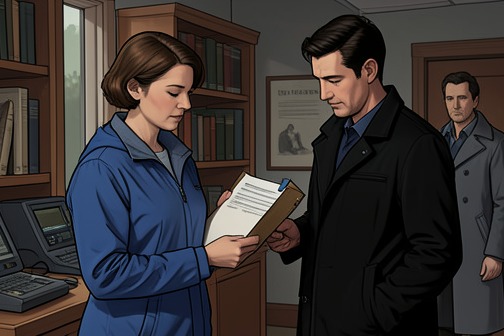
[Penny Gray](entity:character-recall-character-penny-gray-1c396f74bd77)’s killing of [Peter Mercer](entity:character-recall-character-peter-mercer-82b426e4ef64) closes a case that had remained officially solved and morally unresolved for nearly fifty years. Mercer had been treated as the boyfriend who fled after [Annie Madeley](entity:character-recall-character-annie-madeley-864eca0c266f)’s death; the later investigation exposes how [Penny](entity:character-recall-character-penny-20f5e0e3e7bd), then involved in the original police inquiry, eventually found him and killed him. The truth surfaces not through a conventional confession from Penny, but through the patient reading of old files, a clue in Mercer’s military history, and [John](entity:character-recall-character-john-6bc68dc682c3)’s account of what Penny told him when she could still communicate.
## The original case and its false resolution
In 1973, Annie Madeley was stabbed during what the police concluded was a burglary in Rye. Broken glass on the floor seemed to show where the intruder had entered, but nothing had been stolen. The official account held that a burglar had been surprised by Annie, panicked, used a kitchen knife, and fled. The case was closed on that explanation, despite the absence of a convincing theft.
Penny was among the officers who attended the case. Mercer, Annie’s boyfriend, had been present when she died and was initially treated as a suspect: he was being taken to a police interview in Penny’s squad car when he bolted and disappeared. He had also assaulted Penny. The escape meant that he was never brought to justice for Annie’s murder, and the passing years hardened the appearance of an unsolved crime concealed beneath an official conclusion.
[Ron Ritchie](entity:character-recall-character-ron-ritchie-2d882cb527dc) had doubted the burglary story. A midday break-in on a busy estate, when people were at home, made little sense to him; in his view, the supposed intruder’s timing did not fit the circumstances. The Thursday Murder Club could not simply reopen the case or compel a prosecution, and Penny and [Elizabeth](entity:character-recall-character-elizabeth-83df578df81e) had previously been able to solve cases only to their own satisfaction. Yet the old account had never fully convinced those who knew its details.
## Reconstructing what happened
The renewed inquiry began with a physical question. At lunch, a few months before the confrontation with John, Elizabeth brought [Joyce](entity:character-recall-character-joyce-830d04161bf1) a manila folder and asked her to consider a hypothetical knife wound. Elizabeth kept the conversation quiet out of consideration for people eating nearby. The exchange reflected her effort to test the medical account of Annie’s wound against the explanation on file, rather than accept the case’s official narrative as conclusive.
Penny had kept copies of files from her old cases, although she was not supposed to retain them. Elizabeth explains that the copies could help catch a killer many years later. After [Karen Playfair](entity:character-recall-character-karen-playfair-232a882d12ac) recognized John, Elizabeth returned to the archive and checked the Rye file. She found the record of Annie’s death and connected its account to the question she had first put to Joyce. The old papers, preserved outside the proper system, made it possible for the club to examine a case that had otherwise been left behind.
Elizabeth then asked [Ibrahim Arif](entity:character-recall-character-ibrahim-arif-a86ec0feb8bc) to investigate why Mercer had been invalided from the army. The answer was a gunshot wound to his lower leg. When Elizabeth put the question to John, he independently identified that injury as the reason Mercer had left the army, and Elizabeth confirmed it. The clue did not itself explain how Mercer died, but it linked the fugitive’s past to the inquiry and showed that the club had found a detail Penny and John recognized.
## Penny’s later act and John’s confirmation
Elizabeth tells John that Mercer murdered Annie, vanished, and was believed to have escaped the consequences. She then identifies the reversal: years later, Penny paid him a visit, and he did not escape justice. Elizabeth presents the killing as Penny’s answer to a crime that had gone unpunished, and asks whether she had grown tired of such cases and of not being listened to. The scene makes clear what Penny did without supplying an unsupported account of the encounter itself.
John confirms the disclosure that makes the reconstruction personal. He recalls that Penny was already in the hospital and that, on one of the last occasions he remembers her sitting up, she recognized him and asked what they were going to do. He had not understood her question at first. Penny then told him what she had done, matter-of-factly, as though she were asking him to retrieve something from storage. John says he could not let other people find out and had tried to protect her secret. His recollection establishes both that Penny told him and that he knowingly concealed her responsibility.
## Delayed justice and the limits of the record
The event is revealed through evidence gathered after the killing, not staged as a direct account of its circumstances. The first crime is reconstructed from an old case file and the doubts it left behind; the later killing emerges through Elizabeth’s deductions and John’s belated confirmation. Mercer’s army discharge supplies a precise, consequential clue, while Penny’s preserved copies and her conversation with John bridge the decades between the two crimes.
The case therefore unsettles the distinction between an official ending and a just one. Annie’s file had been closed, Mercer had vanished, and the people who suspected the account could not make the legal system deliver an answer. Penny ultimately acted outside that system, but the novel does not turn that act into a procedural resolution: the evidence presented here reveals her deed and its concealment, while leaving the details of Mercer’s death unstated. At Penny’s bedside, Elizabeth’s investigation makes the hidden past speak at last, and John’s tears mark the cost of having carried its secret.
Event 19
The murder of Tony Curran
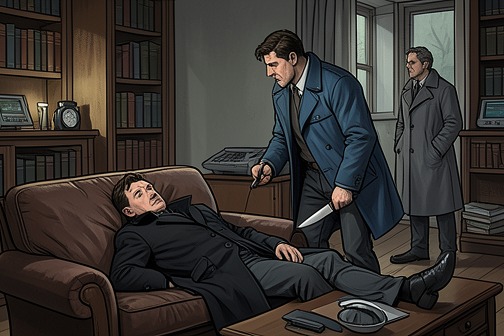
[The murder of Tony Curran](entity:event-recall-event-the-murder-of-tony-curr-ed10714085dd) is both a sudden attack and a crime delayed: [Bogdan Jankowski](entity:character-recall-character-bogdan-jankowski-d42241699479) kills him at home, then reveals that he had prepared the conditions for the killing months earlier and waited for the right moment. The early investigation gives [Ian Ventham](entity:character-recall-character-ian-ventham-dd9e7fb2264a) a compelling apparent motive, but [Bogdan](entity:character-recall-character-bogdan-52d2900aa94a)’s eventual confession reshapes the case around an older act of violence and a friendship whose loss is never fully explained.
## Causes and competing motives
Tony had reason to expect a confrontation with Ventham. [The Woodlands](entity:location-recall-location-the-woodlands-5436555a67da) development had been due to follow the same ownership split as the rest of [Coopers Chase](entity:location-recall-location-coopers-chase-574bd7ef72bf): Ventham with seventy-five per cent and Tony with twenty-five. Ventham changed the arrangement and excluded Tony altogether. He signed the papers the day before a consultation meeting and before the pair’s reported row; Tony was murdered the following day. The lost share represented millions, and Tony learned of the decision from Ventham on the day he died.
The business dispute made Ventham an early suspect, not merely a convenient rival. [Ibrahim Arif](entity:character-recall-character-ibrahim-arif-a86ec0feb8bc) calculated that Ventham could have reached [Tony Curran's house](entity:location-recall-location-tony-curran-s-house-9eb3173a4c6c) after leaving Coopers Chase at three o’clock, arriving at 3:29 and having about two minutes to enter and attack him. [Elizabeth](entity:character-recall-character-elizabeth-83df578df81e) regarded speed as an important feature of a killing, and [Ron Ritchie](entity:character-recall-character-ron-ritchie-2d882cb527dc) entertained the possibility that Ventham had acted quickly. The calculation established that the timing was possible, not that Ventham had done it.
The later account from Bogdan supplies a different history. He tells [Stephen](entity:character-recall-character-stephen-657652c09f49) that, when he first arrived in England, his best friend drove a taxi and witnessed Tony shoot a young boy from [London](entity:location-recall-location-london-420923d4a60a) in connection with drugs. Bogdan says he never learned the details of what had prompted the shooting. Stephen asks whether Tony killed Bogdan’s friend, but Bogdan does not give a definite answer. Instead, he describes the taxi company, run by [Gianni Gunduz](entity:character-recall-character-gianni-gunduz-8e1141010816), known as Turkish Gianni despite being Cypriot, with Tony as the boss. Gianni later disappeared; searches in [Cyprus](entity:location-recall-location-cyprus-f0261af0f810) found no evidence linking him to a killing and no drug money in his house, and the authorities eventually moved on. Bogdan’s story places his friend’s experience beside his own eventual revenge, while leaving the precise fate of that friend unstated.
## The attack and the evidence left behind
On the day he is killed, Tony is still thinking about how to respond to Ventham. He decides there is no need to act that night and allows his plans to continue in his head. Before he can carry them out, he hears a sound too late to avoid the blow. The weapon is a large, old-fashioned spanner. It strikes his left temple, and he collapses on the marble floor of his kitchen.
The scene includes a detail that is conspicuous without explaining itself: the killer places a photograph on the worktop beside the walnut kitchen island. The photograph’s contents are not identified in this account, so it cannot by itself establish the killer’s message or motive. Its placement does, however, become part of the crime’s material record. The attack is over quickly; outside, the garden birds resume their song, while Tony’s own plan against Ventham remains unfinished.
News of the death reaches the Thursday Murder Club through a chain of second-hand reporting. Elizabeth tells Ibrahim that she has heard from Ron, who heard from [Jason Ritchie](entity:character-recall-character-jason-ritchie-7df707091da6), whose source has not yet been documented. The initial account is that Tony was found dead in his kitchen after blunt force trauma to the head, with his wife discovering him. The uncertainty of that chain contrasts with the apparent simplicity of the scene: a dead man at home, a weapon, and several people with plausible reasons to want him gone.
## The investigation and its false leads
The police investigation treats Tony’s death as one strand of a case that soon includes Ian Ventham’s murder. At a briefing, [Chris Hudson](entity:character-recall-character-chris-hudson-cd3fb8979c98) announces that Ventham was murdered; subsequent information about fentanyl poisoning concerns Ventham, not Tony. Chris reasons that whoever administered the fentanyl must have been present that morning and asks his team to identify everyone who was there. He also raises the possibility that Ventham killed Tony and that Ventham’s own death was retaliation. The two murders therefore shape one another as investigative possibilities, even before their separate circumstances are clear.
The inquiry into Tony’s death also brings Jason under scrutiny. Chris and [Donna De Freitas](entity:character-recall-character-donna-de-freitas-b0c875579a5d) ask what Jason was doing at Tony’s house on the day of the murder. Traffic cameras have not recorded Ventham visiting Tony that afternoon, undermining the apparently straightforward timing case against him. The same camera review places Jason’s car about four hundred yards east of the house at 3:26 and on the other side of the house at 3:38. That interval leaves an unexplained stop, but the footage alone does not establish what Jason did or who killed Tony.
Bogdan, too, is questioned about Ventham. Elizabeth asks whether Ventham wanted Tony murdered, whether he sought Bogdan’s help, and whether Bogdan helped. Bogdan denies all three propositions. Elizabeth observes that the outcome has nevertheless worked to his advantage because he has a lucrative new job. The exchange preserves the distinction between a possible benefit and proof of participation: at this point, Bogdan’s denial leaves the central question open.
## Bogdan’s preparation and confession
Months before the killing, Bogdan had installed Tony’s surveillance system, including cameras and an alarm. He later tells Stephen that he deliberately fitted the system incorrectly so that it recorded nothing. He also had keys made. These preparations gave him a way to enter the house without being seen by the cameras, and Bogdan says he concluded that the time had come to act. His confession transforms the failed security system from background equipment into a practical part of the murder plan.
Stephen raises the suspicion directly during a game of chess, telling Bogdan that, from what he has heard, he thinks Bogdan killed Tony. Bogdan confirms that he did, adding that the secret is known to only one other person. The admission comes not through a police interview but in a private conversation between the two men. The chessboard gives the disclosure an understated setting: as pieces move and Stephen recognizes Bogdan’s strategy, Bogdan explains the strategy he had used outside the game, where patience and concealment had life-and-death consequences.
Bogdan says he had been waiting and planning because he did not want to be caught. His account joins the old grievance to the deliberate preparation of the house, but does not fill every gap: he does not specify what happened to his friend, and the identity of the other person who knows the secret is not given here. The confession nevertheless resolves the core mystery. The apparent conflict between Ventham and Tony was real and financially consequential, but it was not the explanation for Bogdan’s attack.
## Consequences and narrative significance
Tony’s death interrupts his intended response to Ventham and leaves the murder investigation to reconstruct events from timings, business records, camera footage, and testimony. Ventham’s exclusion of Tony from The Woodlands deal explains why investigators considered him; the camera evidence weakens that lead, while Bogdan’s admission finally identifies the killer. The case moves from a visible commercial dispute to a concealed personal history, disclosed only after Bogdan has lived with the secret and prepared the means of entry.
The narrative presents the murder in two orders. First comes the attack itself, where Tony’s anticipation of a future strike against Ventham is cut short. Much later, Bogdan explains the old shooting, his friend’s place in the story, the disabled surveillance system, and the copied keys. Readers thus encounter the criminal act before they receive its fuller history, and the investigation’s plausible but incomplete theories reproduce that delay. The eventual confession does not make the past entirely knowable; it establishes who killed Tony and how Bogdan prepared, while preserving uncertainty about the friend’s fate and the photograph left at the scene.
Event 20
Kazimir's murder and Bogdan's killing of Gianni
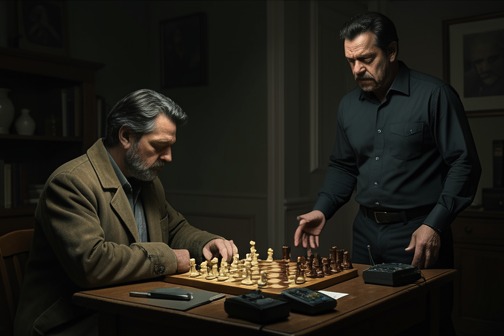
[Kazimir](entity:character-recall-character-kazimir-51bac0920a03)’s murder and [Bogdan](entity:character-recall-character-bogdan-52d2900aa94a)’s killing of [Gianni Gunduz](entity:character-recall-character-gianni-gunduz-8e1141010816) are linked acts of violence recounted years later as a personal history of betrayal and retaliation. In a chess game with [Stephen](entity:character-recall-character-stephen-657652c09f49), Bogdan explains that Gianni killed Kazimir at [Tony Curran](entity:character-recall-character-tony-curran-df5bdde9d93a)’s direction, then describes how he drew Gianni to [Newhaven](entity:location-recall-location-newhaven-13f548bcab8e) and killed him. The account also reveals the practical arrangements that made Gianni’s disappearance appear to point elsewhere: his belongings were removed, his money divided, and the police given an anonymous lead.
## Causes and Background
Bogdan begins by identifying the victim as a close friend from his first period in England. Kazimir drove a taxi and, according to Bogdan, had seen Tony Curran shoot a young boy from [London](entity:location-recall-location-london-420923d4a60a) in an incident connected with drugs. The evidence does not establish why Tony shot the boy, and Bogdan says he never learned the reason. That earlier shooting matters to the account because it places Kazimir in possession of knowledge that could expose Tony’s criminal activity.
The taxi company was run by Gianni, a Cypriot known as Turkish Gianni. He and Tony were business partners, but Tony held the senior position. Bogdan distinguishes between the man who carried out the killing and the man who ordered it: Gianni killed Kazimir, while Tony instructed him to do so. To Bogdan, that division did not lessen Tony’s responsibility. His account presents the murder as a consequence of the hierarchy between the two men and of Kazimir’s proximity to what Tony wanted kept hidden.
## Kazimir’s Murder
Gianni asked Kazimir to drive him into the woods, claiming that he needed help burying something. The two men dug a hole. Bogdan recalls Kazimir as hardworking and kind, qualities that make the betrayal in the scene especially stark: the work Kazimir performs to help Gianni becomes preparation for his own burial. Gianni shot him and buried him in the hole they had dug.
At first, Bogdan believed Kazimir might have fled or returned home and gone into hiding. The uncertainty ended when Gianni spoke to his associates about the killing, including the detail that Kazimir had done the digging. Bogdan learned what had happened through those conversations. In retrospect, Gianni’s willingness to boast supplied the information that allowed Bogdan to act, even as it exposed the carelessness that would later leave Gianni vulnerable.
## Bogdan’s Retaliation at Newhaven
Bogdan arranged a private meeting with Gianni at Newhaven at about two in the morning. He told Gianni that a friend who worked at the port might have money-making work for him and asked him to keep the meeting secret from Tony and the others. The promised opportunity was a deception designed to bring Gianni within Bogdan’s reach. A security guard was present, but he was a cousin of [Steve Georgiou](entity:character-recall-character-steve-georgiou-683d25164981), who genuinely worked at the port; Bogdan describes the use of a real connection as making the lie easier to sustain.
Steve accompanied them. He had known Kazimir and liked him, giving the retaliation a shared personal connection rather than making it Bogdan’s alone. The three went down the harbour steps and boarded a small boat. Bogdan allowed Gianni to believe they were discussing the use of the boat for smuggling people and that the port security guard would look the other way. Once they were away from the shore, Bogdan told Gianni that the meeting was about Kazimir and shot him. The supposed business arrangement thus reversed into a confrontation over the murder that had been concealed as an ordinary disappearance.
## Concealment and Consequences
Bogdan and Steve took Gianni’s keys and cards, weighted him with bricks, and threw him overboard. They returned to Newhaven and asked Steve’s cousin not to speak about what had happened. They then went to Gianni’s home, entered with the keys, and removed his passport, clothes, cash, and other valuables. The money included drugs proceeds and funds belonging in part to Tony; Bogdan estimates the total at about one hundred thousand pounds.
The proceeds were divided according to Bogdan’s account. He sent half the money to Kazimir’s family. He gave the remainder to Steve, who wanted to open a gym and whom Bogdan considered trustworthy. Bogdan then drove Steve to Gatwick. Steve travelled to [Cyprus](entity:location-recall-location-cyprus-f0261af0f810) using Gianni’s passport, then returned to England on his own passport. These steps helped create the appearance that Gianni had left the country, while also directing a substantial part of the stolen money toward Kazimir’s family and Steve’s proposed business.
Bogdan later called the police anonymously and told them that Gianni had killed Kazimir. The police raided Gianni’s home and found that his passport and clothes were missing, details consistent with the apparent flight Bogdan and Steve had staged. The account does not describe a formal resolution of either killing; instead, it closes on the contrast between an official investigation redirected toward Kazimir’s murder and Bogdan’s concealed role in Gianni’s death. Because the events emerge through Bogdan’s retrospective explanation to Stephen over chess, the scene turns a private game into a measured disclosure of the loyalties, revenge, and deception behind the two deaths.
Event 21
John and Penny's deaths
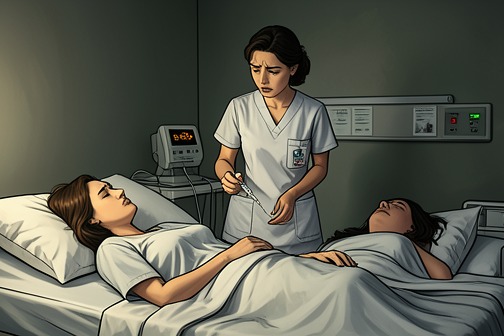
[John and Penny](entity:relation-recall-relation-john-and-penny-3228f3e41287)’s deaths are presented as a paired act of concealment and protection, with [Elizabeth](entity:character-recall-character-elizabeth-83df578df81e) caught between loyalty to her friends and the justice she believes their choices require. [John](entity:character-recall-character-john-6bc68dc682c3) leaves to die rather than let [Penny](entity:character-recall-character-penny-20f5e0e3e7bd) answer for her past, and the syringe Elizabeth saw in his hand signals that Penny, too, is near death. The acts themselves remain offstage; the story makes their meaning emerge through a private farewell and Elizabeth’s uncertain vigil at Penny’s bedside.
## The Farewell and John’s Departure
The scene begins in quiet recollection. John remembers picnics with Penny on a hill, and wonders why they stopped. Their silence is broken only by the electronic beeps beside her bed, a small, regular sound that Elizabeth’s account later makes seem like the last signal of Penny’s presence. The memory of shared outings briefly places their long marriage against the immediate fact of Penny’s unresponsive condition.
Elizabeth proposes that the others take John home for the night. She tells him to sleep in his own bed and, if he has letters to write, to write them; she will come with the police in the morning. Her plan is both practical and deliberate: John is to leave [Willows](entity:location-recall-location-willows-d88d740e5477) now, while she will return with the authorities once he is gone. She also makes room for him to say goodbye to Penny in private, rather than turning their final moments into a scene witnessed by the group.
The four friends step outside. Through the clear border of the frosted glass in Penny’s door, Elizabeth watches John hold his wife. She looks away. The window permits her to see enough to understand the intimacy of the moment but not to intrude upon it; her withdrawal marks the difference between witnessing a farewell and claiming it. When John puts on his coat, Elizabeth asks the others to see him safely home while she stays with Penny, then tells him it is time to go.
## Protection, Justice, and the Unseen Death
Later, beside Penny in the low light of her bedside lamp, Elizabeth explains the consequences she expects. She believes John will die after returning home and taking a nightcap, and expects to take the police there in the morning, where they will find his body. She frames his choice as an attempt to protect Penny: he knows enough to make his death peaceful, and he has walked into the night because he wants to shield the woman he loves. The anticipated death is therefore not presented as an accident or a sudden discovery, but as a decision whose aftermath Elizabeth already expects to manage.
Elizabeth also confronts Penny with the choice that, in her view, has led to this ending. She understands why Penny acted and recognizes that Penny delivered her own form of justice, although Elizabeth does not agree with it. Her judgment does not erase her empathy: she admits that she was not present in the situation Penny faced. Instead, she asks whether Penny has escaped the consequences of what she did. If Penny can hear her, Elizabeth suggests, John’s death and the knowledge that he died to protect her may itself be punishment; if Penny cannot hear, she may have escaped that reckoning. Elizabeth cannot know which possibility is true.
## The Syringe and Penny’s Imminent Death
The central revelation comes when Elizabeth states that she saw the syringe while John was holding Penny. From that observation, she concludes that Penny is going to die too, and says goodbye. The text does not describe the syringe’s contents, the precise act, or a medical outcome; its significance is conveyed through Elizabeth’s recognition and the finality of her words. John’s embrace, first seen from outside the room, is thus recast as more than a marital farewell: it is also the moment in which he acts to bring Penny’s life to an end.
The paired deaths remain morally distinct even as they converge. John’s expected death is his own choice, made to protect Penny from exposure; Penny’s impending death follows the act Elizabeth believes John performed while holding her. Elizabeth does not call Penny innocent, nor does she approve of the justice Penny took into her own hands. Yet she does not reduce her friend to that act. Her tenderness—stroking Penny’s hair, taking her hand, kissing her cheek—persists alongside her judgment, making the bedside conversation an intimate reckoning rather than a simple absolution.
## Witness, Secrecy, and the Ending
Elizabeth’s vigil is shaped by what she can see and what she cannot establish. She saw John holding Penny through the frosted window, saw the syringe, and believes she knows what he did; she cannot know whether Penny hears her. That uncertainty gives her closing words two possible audiences: a friend who may understand the cost of John’s sacrifice, or a friend already beyond hearing. Elizabeth’s farewell accommodates both possibilities without pretending to resolve them.
Before leaving, Elizabeth discloses her own secret: [Stephen](entity:character-recall-character-stephen-657652c09f49) is gravely unwell, and she feels she is losing him bit by bit. The admission does not make her experience equivalent to John and Penny’s crisis, but it places her beside them as someone already living with an approaching loss. She leaves Willows alone and walks into a dark, cloudless night, described in terms that make morning feel uncertain. John’s body and Penny’s death are anticipated rather than shown; Elizabeth’s departure closes the scene on the surviving friend, carrying what she has witnessed into the darkness.
Event 22
Joanna's acquisition of Coopers Chase
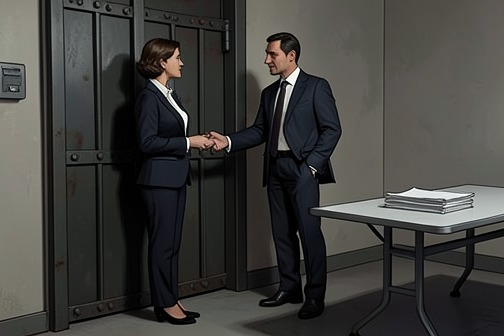
[Joanna's acquisition of Coopers Chase](entity:event-recall-event-joanna-s-acquisition-of-aa8febd24149) transforms a piece of financial scrutiny into a change of ownership with personal and lasting consequences. What began when [Joanna](entity:character-recall-character-joanna-3d81f486abc1) and Cornelius examined [Ian Ventham](entity:character-recall-character-ian-ventham-dd9e7fb2264a)’s accounts for the Thursday Murder Club did not end with their report: they saw promise in both the accounts and [Hillcrest](entity:location-recall-location-hillcrest-4d9b26d57138), and Joanna persuaded the other board members to buy the company. The purchase gives her control of the whole development, but its importance lies as much in what she chooses to protect as in what she acquires.
## From an inquiry to an opportunity
The accounts reached Joanna because [Elizabeth](entity:character-recall-character-elizabeth-83df578df81e) had wondered whether Ian Ventham had murdered [Tony Curran](entity:character-recall-character-tony-curran-df5bdde9d93a). Joanna and Cornelius examined them and reported back, apparently closing that line of inquiry. For Joanna, however, the documents and the information about Hillcrest opened another possibility. Her continued interest was not simply an extension of the murder question: she recognized an opportunity in the company and its development plans, and took it to the board.
Joanna presented the proposal to the other board members. [Joyce](entity:character-recall-character-joyce-830d04161bf1) pictures the meeting around an aeroplane-wing table, a detail that gives the decision a concrete setting without making the narrator a witness to the presentation. The board agreed to buy the company. Joanna had expected to purchase it from Ian Ventham, but the eventual seller was [Gemma Ventham](entity:character-recall-character-gemma-ventham-717ea29b3e0d). That change in who completed the sale is one of the deal’s reversals: Joanna’s plan succeeded, though not by the route she had anticipated.
## The purchase and its reach
The acquisition encompasses the company, the land, and the whole development. Joyce describes this as Joanna owning the place, while also noting that, strictly speaking, it is Joanna’s company that owns it. The distinction is acknowledged and immediately treated as almost immaterial: in practical terms, the purchase puts the development under Joanna’s control. The account thus presents corporate ownership not as an abstract transaction but as a new capacity to decide what happens to the site and its surroundings.
Hillcrest demonstrates the development’s immediate reach. It is already operating, with cranes and diggers on the hill. [Gordon Playfair](entity:character-recall-character-gordon-playfair-33fde8f9ea1e) has received £4.2 million for his land and left the house where he had lived for seventy years. He packed his belongings into a Land Rover and trailer, drove roughly 400 yards down the hill, and unpacked at a two-bedroom home in Larkin Court. [Bramley Holdings](entity:organization-recall-organization-bramley-holdings-97cb93a34169) provided him with the flat as part of the deal. The account holds two scales together: a multimillion-pound land transaction and the intimate work of leaving a long-inhabited house and establishing a new home nearby.
## Joanna’s reason for buying
Joanna explains the purchase to her mother as an act of thanks. She recalls having believed that her mother’s move to [Coopers Chase](entity:location-recall-location-coopers-chase-574bd7ef72bf) would end in isolation, with her sitting among people merely waiting out their days. Instead, she says, the move marked a beginning: her mother’s eyes and laughter had returned, and she credits Coopers Chase and the people around her, including Elizabeth, Ron, Ibrahim, and [Bernard](entity:character-recall-character-bernard-2ea2639d5023), with that change. The acquisition therefore answers a personal history that mother and daughter had not previously discussed openly. Joanna’s account makes the purchase a material expression of gratitude for her mother’s renewed happiness.
That motive does not exclude financial ambition. Joanna anticipates her mother’s concern about the business logic of the purchase and promises that she will also make millions from it. Joyce says she was not, in fact, panicking, though that was what she would have asked next. The exchange refuses a simple opposition between affection and profit: Joanna presents the deal as both a thank-you and a profitable business decision, and her mother recognizes the commercial question without diminishing the personal meaning.
## Consequences for the land and its memory
The acquisition changes the prospects for the [Garden of Eternal Rest](entity:location-recall-location-garden-of-eternal-re-7d067051ed48). Joanna says it will remain where it is, while [The Woodlands](entity:location-recall-location-the-woodlands-5436555a67da) has been quietly shelved because Hillcrest is expected to make enough money. The cemetery’s preservation is not described as dependent solely on the company remaining in Joanna’s hands. Even if Coopers Chase is sold again in the future, covenants will protect the graveyard. Joanna acknowledges that selling the development again is part of the company’s business, while insisting that the burial ground is not thereby made available for removal.
The outcome gives the purchase a consequence beyond its commercial success: development continues at Hillcrest, but the cemetery is secured from the threatened plan. This protection follows from Joanna’s control of the company and from the covenants established around the site, rather than from an assurance that ownership will never change. The deal thus joins family gratitude, commercial calculation, and the preservation of a place containing the community’s dead. Its decisive result is not that development stops everywhere, but that the Garden of Eternal Rest is made to remain, even as the business around it moves forward.
Event 23
The reunion of Bernard and Asima's ashes
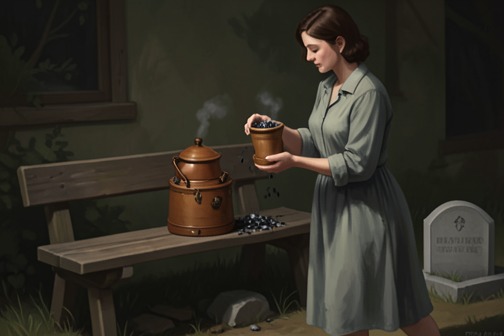
The reunion of [Bernard and Asima](entity:relation-recall-relation-bernard-and-asima-52c298530ff9)’s ashes is a quiet act of devotion carried out by [Joyce](entity:character-recall-character-joyce-830d04161bf1) after [Bernard](entity:character-recall-character-bernard-2ea2639d5023)’s death. Following Bernard’s deliberately deciphered instructions, she divides his ashes and [Asima](entity:character-recall-character-asima-7973afe5b3d4)’s between a [Tiger-shaped tea caddy](entity:object-recall-object-tiger-shaped-tea-caddy-686c1307c7a7) and a wooden urn: one half of each in both vessels. The tea caddy is buried again beneath Bernard and Asima’s bench, while the mixed ashes in the urn are taken to [Fairhaven](entity:location-recall-location-fairhaven-84c33d22c8d0) to be scattered. The arrangement lets the couple remain together in two places, and turns a request for scattering into a private act of reunion.
## Bernard’s request and Joyce’s understanding
In his final letter, Bernard asked for his ashes to be scattered off the pier at Fairhaven. The postscript described Asima as already free in holy waters and imagined his own ashes drifting until he found her again. Joyce recognizes the sentiment as a message meant for her, rather than taking its poetic language as a literal plan to keep their remains apart. She understands Bernard’s intention to be that his ashes should join Asima’s. The reunion therefore begins not with a public announcement but with Joyce reading the personal meaning behind a request that, on its face, concerned where Bernard would be scattered.
After the funeral, Sufi and Majid stayed at an airport hotel, following their usual way of doing things. Joyce offered to keep Bernard’s ashes safe until they went down to Fairhaven. That practical arrangement gave her the opportunity to carry out Bernard’s wishes as she understood them, without telling his children what she had done. The decision is affectionate, but it also involves secrecy: Sufi and Majid believe they are taking Bernard’s ashes to the pier, not a mixture of their father’s and Asima’s.
## The caddy beneath the bench
The Tiger-shaped tea caddy had belonged to the history of Bernard and Asima’s affection before it became a container for their ashes. Both had wanted to buy it for the other for Christmas. Joyce had kept Asima’s ashes inside it; Bernard’s, by contrast, were in a plain wooden urn. The vessels thus already carried different associations: the caddy was bound to a shared exchange between the couple, while the urn was the form in which Bernard’s ashes had been entrusted to Joyce.
The caddy had been hidden beneath Bernard and Asima’s bench. To retrieve it, [Bogdan](entity:character-recall-character-bogdan-52d2900aa94a) used a pneumatic drill on the concrete and dug down until he found it, then gave it to Joyce. His careful recovery makes the return of the caddy part of the reunion: it is not simply an available container, but an object reclaimed from the place where the couple’s keepsake had been concealed. The bench and the buried caddy connect the physical setting of their shared memory to the later handling of their remains.
## Dividing the ashes
Joyce uses proper scales, explicitly preferring them to electronic ones, and carefully tips the ashes from their separate containers. She is fond of Bernard, but does not want his ashes scattered across her worktop; the practical care in her handling is both matter-of-fact and respectful. With two intermediary Tupperware containers, she completes the transfer within minutes. The process is deliberate: each person’s ashes are divided so that both the caddy and the urn contain half Bernard and half Asima.
The next day, Joyce and the others bury the caddy again under the bench, where it had belonged. They ask [Matthew Mackie](entity:character-recall-character-matthew-mackie-3c0c30ef4df9) to bless the site. He is touched by the request and performs the blessing. The act gives the hidden keepsake a settled resting place, while involving a former priest whose own history with [Maggie](entity:character-recall-character-maggie-39724c72a859) has recently come back into view. The burial is private, but not solitary: Joyce’s plan is joined by the presence and participation of others who help place the caddy back beneath the bench.
## Scattering and the private cost
The urn holds the other half of each person’s ashes. The following day, Sufi and Majid take it to Fairhaven so that Asima can be scattered, unaware that Bernard is with her in the urn. Joyce and the others do not accompany them, because they do not want to interfere. This preserves the family’s outward farewell at the pier while allowing Bernard’s final request, as Joyce interprets it, to be fulfilled in secret. The reunion has two forms: the caddy remains buried at the bench, and the mixed ashes travel to the water where Asima is to be scattered.
Afterward, Joyce is left with the two Tupperware containers used in the transfer and cannot decide whether keeping them or throwing them away would be more disrespectful. Her uncertainty brings the physical, domestic residue of the act into view: a private ritual of love has left behind ordinary containers that no longer seem ordinary to her. She expects [Elizabeth](entity:character-recall-character-elizabeth-83df578df81e) to know what to do. The question does not undo the care of the reunion; it shows that the practical choices surrounding death continue after the ceremonial work is finished.