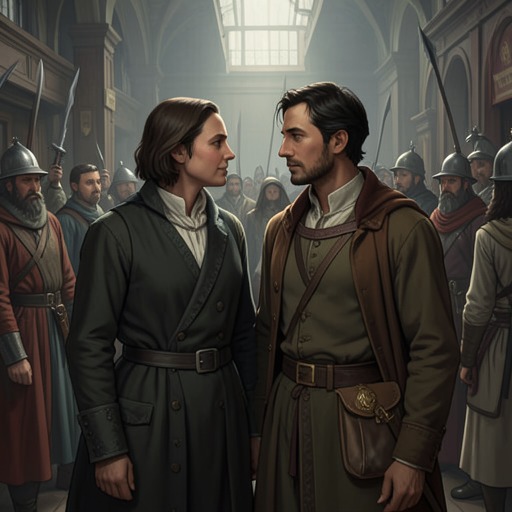
James proposes to Beatrix
TideKing James proposes to Lady Beatrix Greigh after ascending the Mhuirlan throne, making a private bond of friendship and longstanding love central to his choice of queen. His declaration comes at a gathering of friends: he asks them to witness his decision, then addresses Beatrix directly, joining personal devotion to the burdens and future of kingship.
From prince to king
King James’s proposal follows a sudden change in his position. After King Leonardo dies, the succession rules make James king; Galahad Stormcrane explains that James is twenty-five, four years past the age at which he should have been eligible to ascend. The news changes the balance between private feeling and public duty. Galahad tells Meira and Little Emblyn that the new king must put his kingdom before his own heart.
The transition is made public in a town-square proclamation. A herald announces that the coronation will take place three days later and invites the people of Metern to the royal festivities. The proposal comes against this newly formalized kingship: James is no longer simply choosing a partner for himself, but naming the person he hopes will stand beside him as queen.
The proposal
At an evening gathering, King James asks his friends to bear witness and speaks of friendship as a source of strength, purpose, and honesty. He singles out Lady Beatrix Greigh of Arsa Coill as the dearest of his friends. The speech first establishes the history of their attachment, then turns toward the future he wants to share with her.
He recalls that Beatrix stood by him through the stillbirth of his brother, his time at the academy, a broken leg, and the loss of his father. He also remembers being there for her when she lost her sister, Valentine. These paired memories make the proposal reciprocal: their closeness is shown not as a sudden courtship but as a bond tested by each person’s grief and sustained by care for the other.
King James then connects that shared past to his new responsibilities. He can imagine no one else beside him to share the joys and burdens of ruling Mhuirlan, and admits that he cannot bear the thought of being without her. He asks Lady Beatrix to become his queen. Beatrix gasps, nods, and weeps as she listens. The scene records the proposal and her emotional response; the later wedding establishes that they marry.
The choice’s wider stakes
The proposal also lands amid danger surrounding Meira. She rescued Prince James after his ship was wrecked at Serpent’s Pass, and later remembered being taken in a woman’s arms and hearing her sing as she lay on the shore of Hanter-hwor. Meira’s bargain with Myrkur, the Sea Witch, left her unable to speak and placed her life at risk if James married someone else. Galahad Stormcrane discovers that the spell requires James to marry Meira for her to live as a human and regain her voice. James’s choice of Beatrix therefore carries consequences beyond the couple: it intersects with the threat hanging over Meira.
That pressure does not erase the independent history behind the proposal. Later, when Sir Lancelot asks whether the wedding’s suddenness surprised them, Beatrix’s parents say that James and Beatrix had been in love since they were both fifteen. They distinguish the long-standing relationship from the rushed preparations: there had been little time to make wedding clothes. The wedding confirms the outcome of the proposal, while the parents’ account clarifies that it formalizes an old attachment rather than beginning one.
Personal devotion and royal responsibility
The proposal reverses the tension Galahad had described when James became king. At first, the new office appears to require James to place the kingdom ahead of his heart. In the proposal, however, he presents Beatrix as the person with whom he wants to share the work of ruling, bringing private affection and public responsibility into the same future. The event is both a declaration of love and a request that she occupy the queen’s place beside him.
Its emotional force comes from the detail of what the pair have already endured together: family deaths, injury, separation from ordinary life at the academy, and reciprocal consolation. Rather than treating the crown as a reason to abandon intimacy, King James makes companionship part of his account of how he can rule. The proposal thus marks a personal commitment with dynastic and political consequences, while the subsequent wedding turns that spoken intention into a royal marriage.