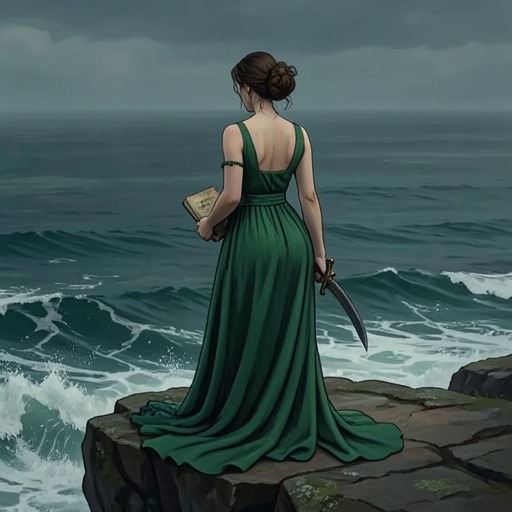
Meira’s bargain with Myrkur
TideMeira’s bargain with Myrkur transforms her from a mermaid into a human, but its hidden terms make her life depend on Prince James marrying her. The bargain joins a private longing to the safety of a realm: Meira seeks a human life with the prince, while her transformation prevents her from guarding the seal bound to her. Galahad’s questioning exposes the bargain’s mortal condition, though Myrkur disputes his description of it as a curse.
Background: A Guardian’s Duty
Galahad approaches Meira’s transformation with knowledge of Edel’s Seven Seals, which the masters at the Fortress of Maith watch over. The seals were established by the first Curse-Breakers to protect Edel from Curse-Makers from other shores. Each has a guardian whose life is bound to the seal, and whose duty is to guard it and keep it strong. The eastern seal lies in the sea near Prince James’s palace; the prince recognizes the great circle of dark stone beneath the water, but has not known that it has a guardian.
This obligation changes the meaning of Meira’s new human form. Galahad concludes that a spell has bound her to land so she cannot protect the seal. Her transformation is therefore not simply a change in identity or an escape from life beneath the sea: it removes a guardian from a duty on which the protection of the realm depends. The bargain’s personal and political stakes are linked from the start, even though Meira’s wish is directed toward the prince rather than toward the seal.
Meira’s Wish and the Terms Galahad Uncovers
Meira confirms through her gestures that she asked for the spell herself. Galahad first considers whether the transformation was meant to give her access to the seal, but she shakes her head. He then identifies her reason: she has fallen in love with Prince James and wants to become human so she can be with him. The scene presents that desire alongside the danger to Edel and the surrounding seas, not as a separate matter from it.
Meira had been able to speak before accepting the spell, but she cannot speak during Galahad’s questioning. When he asks who took her voice, she gives no verbal answer; she turns toward her soup and closes her hands into fists on the table. Galahad consults an old book of runes, maps, and monastic writing, then presses her about what Myrkur promised. His questions lead him to infer that the bargain requires Meira to marry the prince: if she does, she will speak again and live the rest of her life as a human. Meira confirms his interpretation by nodding.
The other side of the condition is fatal. When Galahad asks what will happen if Prince James marries someone else, Meira does not answer, but her trembling lip makes her distress visible. Galahad concludes that she will die if the prince does not marry her. The bargain thus makes marriage more than the desired fulfilment of Meira’s love: in the terms Galahad uncovers, it is the condition on which her voice and continued life depend. The evidence presents the terms through his questioning and Meira’s responses, rather than through a written agreement or a direct account from Myrkur.
Disputed Responsibility and Immediate Consequences
Galahad understands the bargain as a trap. He asks whether Meira knew what Myrkur was and whether she trusted the Sea Witch to keep her promises. He suspects that the price was her life and that the marriage condition was meant to preserve her hope of surviving. He also argues that the spell deprived Meira of any real chance to fulfil her side of the bargain, leaving her to die through a choice she had made and allowing Myrkur to take her place as guardian. These are Galahad’s conclusions about Myrkur’s design; Meira’s gestures confirm the marriage condition, but do not independently establish every part of his accusation.
Myrkur later rejects Galahad’s account of the transaction as a curse. She says that Meira willingly came to her for a spell and that she gave her one. Galahad counters that a spell which robs Meira of her chance to meet its terms can function as a lethal trap even if Myrkur refuses the word curse. The disagreement leaves a crucial distinction in view: Myrkur emphasizes Meira’s consent to request a transformation, while Galahad emphasizes the consequences and the way the terms make her death serve the Sea Witch’s interests.
On discovering the condition, Galahad takes responsibility for finding a solution and tells Meira she must remain in the house until he has solved the problem. He also explains to Little Emblyn that Meira was formerly a mermaid, was transformed by the Sea Witch, and has been human for only a few days. His response marks the bargain as an urgent danger rather than a private secret that can be left to run its course.
Royal Succession and the Cost of Magical Bonds
The bargain’s dependence on Prince James makes it vulnerable to events beyond Meira’s control. When King Leonardo dies, Galahad explains the Mhuirlan succession law: if a king’s first son is too young to inherit, the king’s younger brother takes the throne, and the prince becomes king when that uncle dies. Prince James is twenty-five, four years past the proper age, when King Leonardo’s death brings him to the throne. Galahad stresses that the new king’s duties must come before his heart. The succession does not itself cancel Meira’s bargain, but it places her hoped-for marriage under the pressure of royal responsibility.
The later discussion of a Curse-Breaker’s marriage ceremony shows that magical marriage carries its own binding terms: the wife lives as long as her Curse-Breaker husband, and dies instantly if he dies. This is a distinct contract, not a stated clause of Meira’s bargain with Myrkur. Its relevance lies in the story’s broader treatment of vows and spells as arrangements with concrete consequences for life and death. Meira’s bargain is especially perilous because her consent to seek human form does not make its hidden costs harmless, and because the condition that might save her also depends on a prince whose position and obligations can change.