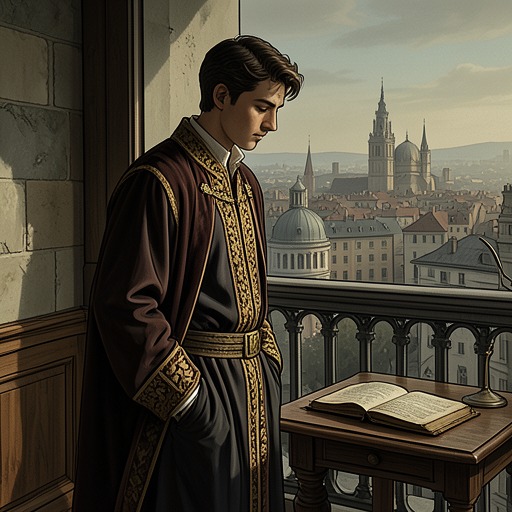
Meira rescues James from the shipwreck
TideMeira rescues James from the shipwreck is the life-saving act at the heart of a delayed revelation: Prince James survives a wreck that destroys his ship and crew, but only later does Meira confirm that she was the woman who carried him to safety. The account binds an unseen rescue to its consequences, first preserving the rescuer as a voice and a pair of arms in James’s memory, then giving her a name through Meira’s silent acknowledgment.
The Wreck at Serpent’s Pass
A fortnight before James recounts the incident to Galahad Stormcrane, he is traveling home from Hanter-broder when a storm catches his ship. The danger is heightened by the route: Serpent’s Pass, a ring of protruding stones between Hanter-broder and Hanter-hwor, is difficult to navigate even in calm water. That night, darkness, rising seas, and rain make the stones impossible to see. The ship is driven straight into them and smashed to pieces; James says that the entire crew is lost.
The account makes the rescue inseparable from the wreck’s scale. James does not describe an ordinary accident from which a whole crew escapes together: he is the sole survivor identified in the exchange, while the ship and everyone aboard it are gone. The physical circumstances also explain why survival initially seems inexplicable. Asked how he lived, James cannot supply a practical account of getting clear of the wreck or reaching land. He says he does not know; the next thing he remembers is waking on Hanter-hwor’s beach the following morning, unharmed.
A Rescue Remembered as Sensation
James’s memory does not recover the rescue as a complete sequence of actions. What remains is tactile and auditory: arms taking hold of him, followed by a voice singing. He recalls that hearing the voice made him forget his fear. The memory therefore identifies the rescue’s effect more clearly than its mechanics. It preserves contact and sound, but not the rescuer’s face, name, or method of bringing him ashore.
That fragment is the event’s most distinctive link between danger and safety. The storm leaves James without knowledge of how he survived, yet the memory of being held and hearing a song supplies a human presence within the disaster. His fear gives way, for that moment, to the voice’s calming effect. The text does not show the wreck or the rescue directly; it lets James’s hesitant recollection carry the event into his conversation with Galahad Stormcrane. The rescue reaches the reader through what the survivor can remember after the fact, rather than through a narrated account of the action itself.
Meira’s Confirmation
When Galahad Stormcrane asks whether the rescuer was a man, James answers that she was a woman. The detail narrows the mystery but does not identify her. The answer also makes the remembered singing voice and the arms that held him an incomplete clue: James can recall the rescuer’s gender, but the exchange gives him no recognition of her identity.
The later confirmation takes place in a different conversation. Galahad Stormcrane asks Meira directly whether she saved Prince James from his shipwreck. Meira looks around helplessly, lifts her hands, and presses them to her heart with an imploring gaze. After glancing at Little Emblyn, she turns back to Galahad Stormcrane and nods. Her response is brief and nonverbal, but it settles the question that James’s account had left open. Meira does not give a spoken explanation of the rescue in this exchange; the nod itself confirms that the woman James remembers was her.
Consequences and Narrative Significance
The rescue changes the meaning of James’s survival from an unexplained outcome into a connection between him and Meira. At first, his story establishes the wreck, the deaths of the crew, and the unexplained fact that he reaches shore alive. His fragmentary recollection then introduces an unknown woman through touch and song. Meira’s later acknowledgment converts that sensory trace into a specific relationship between the two characters: she is not merely someone James may have imagined or remembered indistinctly, but the person who saved him.
The event’s presentation emphasizes the difference between what James can report and what Meira can confirm. James supplies the circumstances of the disaster and the sensations that survived it; Meira supplies the missing identification with a nod. Galahad Stormcrane’s question makes that recognition explicit, while his tightened jaw, closed hands, and turn away register the weight of the answer without explaining it. The rescue thus functions both as a survival event and as a delayed disclosure. Its decisive fact emerges not from a full account of how Meira brought James ashore, but from the moment she acknowledges that she did.