Michael’s cardigan
TrespassesMichael’s cardigan is one of the objects through which Cushla Lavery’s grief for Michael Agnew takes material form. After his death, its familiar knitted pattern remains close to her even as the person associated with it is gone; later, its pocket carries photographs that bring his image back into view. The cardigan links mourning’s daily physical presence with the fragile records through which Cushla remembers him.
A Garment Made Newly Visible
Cushla lifts a piece of ash from the cardigan and recognizes its stitches in detail: blackberry, honeycomb, and diamond patterns, as well as a turning row where the cable crosses itself. The specificity of the knitting contrasts with the absence it marks. Michael’s smell has faded, but the pattern can still leave an imprint on Cushla’s skin when she wakes. An ordinary garment, once associated with its wearer, has become something she attends to as an object in its own right.
Part of a Private Memorial
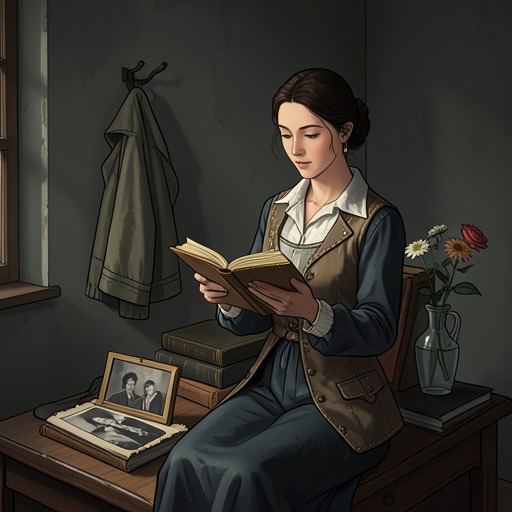
The cardigan sits within a collection of things Cushla keeps beside her: Davy McGeown’s missal and medals, The Black Prince, a key, a bar of soap, and a novena that Davy had read jokingly. The objects differ in their associations, but together they make a domestic arrangement around loss. Cushla recognizes her mother’s grief in her own heaviness and difficulty with basic tasks; the cardigan belongs to that changed room and to a mourning expressed through what is kept nearby.
Carrying the Photographs
Cushla later takes a wallet of photographs from her basket and tucks it into the cardigan’s pocket before leaving the house. The gesture gives the garment a practical role as well as an emotional one: it carries images she has been unable to put away. Weeks later, she takes the paper wallet from her pocket and looks through the photographs, including pictures made during an earlier gathering. The sequence joins the cardigan to her effort to preserve people and moments that separation has made inaccessible.
Michael in the Image
The last photograph Cushla examines shows Michael Agnew standing at the bar counter. His posture still registers the quarrel between them, while Cushla’s hands appear in the frame as she slips a beer mat beneath his whiskey; their outstretched fingers nearly touch. Looking toward the doorway, Cushla briefly sees Michael there, turning away, before the vision passes. The cardigan does not restore him, but its presence alongside the photographs makes a distinction central to her mourning: the object and image remain, while Michael is absent.