Dúil
TrespassesDúil appears as a book on Michael’s table, but its significance exceeds its place among his papers. Inscribed with Siobhán de Buitléar’s name and later set aside by Cushla, it makes language materially present in a relationship shaped by secrecy and unequal knowledge. The volume also sits beside Michael’s effort to understand the Irish word dúil: a word he tries to approach through a cluster of English meanings and the Portuguese Saudade.
The book among Michael’s papers
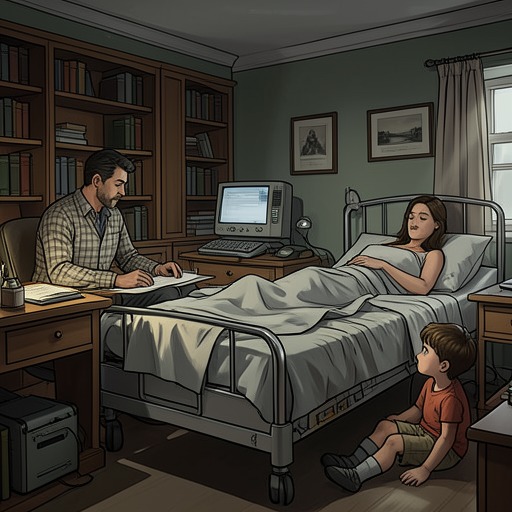
At eight in the morning, Cushla and Michael are in the narrow galley kitchen off the sitting room. As Michael makes tea, she sits at a dining table crowded with grim-looking legal texts and box files marked in handwriting. Among them are two books: Dúil by Liam O’Flaherty and de Bhaldraithe’s Irish dictionary. The contrast in this arrangement matters. Legal paperwork belongs to Michael’s work, while the dictionary and Dúil place Irish language and literature in the same crowded domestic space.
Cushla picks up Dúil and finds a name inside its cover, written in cló gaelach, the old Celtic script. Beneath Siobhán de Buitléar, the printed name Joanna Butler appears. The inscription gives the book a prior history in Michael’s household without explaining the relationship between its owner and the volume, or why it is among his things. Its presence is therefore concrete but not fully accounted for: the writing identifies someone, while leaving the significance of that identification open.
Michael does not answer Cushla’s question about Siobhán directly. As he sets down a tray of art deco china, he glances at Cushla’s hands and hands her a foolscap notebook instead, saying that he has been swotting up and must stop every few words to look things up. The notebook shifts attention from the named owner of the book to Michael’s own encounter with Irish. Dúil is not only evidence of another person’s place in the flat; it sits beside his attempt to learn what its title means.
The word and its translations
Cushla turns the book face down on her lap and reads Michael’s notes. He has written dúil, then listed desire, liking, fondness, craving, and the questions of yearning or want. He wonders whether the word is like Saudade. Rather than offering a single settled equivalent, his list records a search among meanings that overlap without becoming identical. The notebook makes the act of translation visible as hesitation and comparison.
When Cushla asks what Saudade means, Michael gives its pronunciation and describes it as a Portuguese word like dúil, in his estimation. This exchange links the Irish word not to a definitive dictionary answer but to an attempt at explanation across languages. The Irish dictionary on the table suggests a practical resource for his study; the handwritten list shows that looking words up has not removed the difficulty of conveying their shades of meaning. The novel thus places the book, dictionary, and notebook in a small material sequence: a title encountered, a word copied, and possible meanings tested.
A volume Cushla puts away
Later, in Michael’s flat, the room is otherwise tidy: papers spill from a leather briefcase, the hearth is swept, and a decanter and tumblers sit on a tray. Beside Cushla on the maroon Chesterfield are the objects associated with Michael’s evenings—pipe, tobacco, matches, newspaper, glasses, and pen. Siobhán de Buitléar’s copy of Dúil is among them. Cushla puts it at the bottom of the pile so she will not have to look at it.
That small movement changes the book from something she can examine into something she wants out of sight. Earlier, the inscription prompted a direct question; here, she does not reopen the matter but physically lowers the volume beneath the other objects. The text does not explain all that she feels about its presence, and the gesture should not be mistaken for an answer to the question of Siobhán’s place in Michael’s life. It does show that the book has become difficult for Cushla to face. Its association with a named woman, already written inside its cover, travels with it from the breakfast table to Michael’s private living space.
Irish as study and shared speech
At a gathering with Victor and others, Cushla brings books from her basket and becomes conscious that the people present now know she is more to Michael than an Irish teacher. The scene makes her professional identity and private relationship newly visible to the group. Michael smokes in silence while the others struggle through Irish sentences, their syntax and accents marked as uncertain. Cushla identifies a difference between them and herself: they have the confidence to be foolish and wrong.
When she asks Michael a question in Irish, he looks surprised, as though he has forgotten where he is, and reaches for her dictionary. She takes it back, offering to translate if he gets stuck. Victor then says he would like to learn many Irish words, and Cushla invites him to ask. Dúil is not named as one of the books in this exchange, and the scene does not establish that anyone reads it there. Its place in the larger pattern is more restrained: alongside the dictionary and Michael’s notes, it belongs to a narrative in which Irish is at once a subject of private study, a language Cushla can inhabit with confidence, and a means of connection that can expose differences between people. The volume’s inscription and Cushla’s reluctance to look at it give that language a personal history as well as a public one.