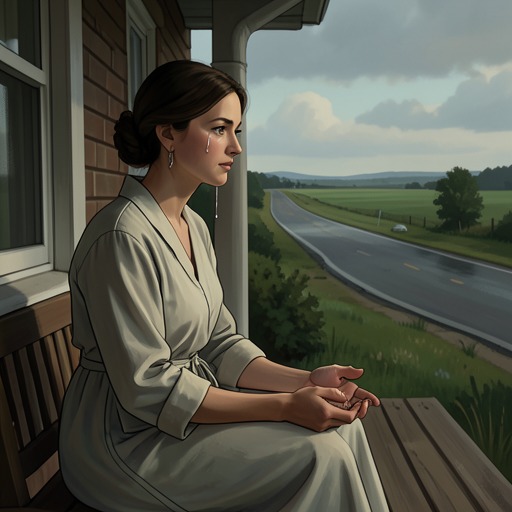
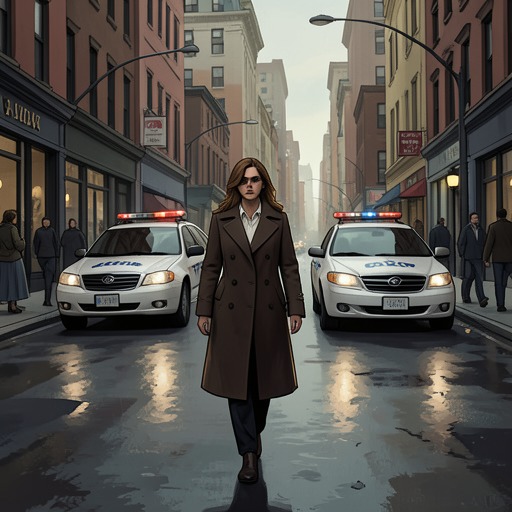
RUC surveillance photographs of Cushla and Michael
TrespassesThe RUC surveillance photographs of Cushla and Michael make their concealed relationship visible to the authorities and, eventually, to Cushla herself. The images record meetings at different locations, convert fragments of private life into evidence, and bring the pressure of state surveillance directly into an interrogation. Their significance lies not only in what they show, but in the change of power that occurs when Cushla is made to look at them.
Identification and Context
The photographs appear in a folder during the RUC’s questioning of Cushla about Michael Agnew. An interviewer takes them out one by one, turning one over and pushing it towards her, then laying others on the table. Their arrangement gives the questioning a deliberate progression: each picture supplies another setting or detail, while the folder allows the interviewer to control when Cushla sees it. The photographs are not presented as neutral keepsakes. They are part of an investigation, and their existence tells Cushla that encounters she might have regarded as private were observed and recorded.
The novel sets this private photographic record against the public images that repeatedly enter daily life through television news. One broadcast montage moves from a riot and a child beside a military vehicle to a march on Stormont and a car exploding on an empty street, ending with Mary Peters holding her Olympic medal. Later, footage of the strike and the Dublin bombings connects political events to the Lavery bar’s customers and Cushla’s memories. Those images are broadcast to a public; the surveillance photographs, by contrast, select Cushla and Michael as their subjects. The contrast places intimate observation inside a world already saturated with political images, without making the private photographs interchangeable with news footage.
The Photographs and Their Settings
One photograph shows Cushla and Michael on the footpath at the perimeter of the barracks, illuminated by a streetlamp. Michael swings a bottle of brandy by its neck, his face marked by laughter. The location and the visible bottle give this image a specific occasion rather than an abstract record of their association. The interviewer identifies the destination as the home of James and Penelope Scott. Cushla confirms that she was there, while the photograph fixes her presence in a way her answer alone would not.
A second image shows Cushla speaking, her mouth slightly open and a furrow between her eyebrows, with Michael turned towards her. The picture records not simply that they were together but the direction of his attention. Faced with it, Cushla registers the expression on his face as evidence that he had loved her. The photograph cannot explain the history of their relationship, but its captured look makes that relationship newly legible to her within the interview. What had been lived as an intimate exchange is now fixed in a frame and examined under another person’s control.
The most revealing image shows the pair beside a dining table, their faces close and Cushla’s bare knee against Michael’s body. Cushla recognizes that it was taken on the day a car reversed onto the gravel. She judges from the light and angle that the photographer was across the street, beneath one of the trees. This detail makes the surveillance location part of the photograph’s meaning: the image preserves an intimate moment while also indicating that an unseen observer had a view into the scene. The camera’s distance contrasts with the closeness it records.
Evidence and Interrogation
The interviewer uses the photographs to test Cushla’s account of where she met Michael. When asked whether she visited his flat, she does not provide a straightforward confirmation; the displayed image instead makes the question feel backed by knowledge she has not volunteered. The photograph beside the dining table sharpens that pressure. Cushla recognizes what it shows, reacts with dismay, and is confronted with a record made from outside the couple’s immediate awareness. The sequence turns looking into part of the interrogation: the interviewer watches her as she looks at the pictures.
The questioning moves from the images to the night of May 25. The interviewer tells Cushla that her car was seen outside Michael’s family home. She explains that she was upset she could not see him and drove out to check whether he had gone home. He then states that Michael was shot dead in that home. The photographs belong to the same investigative encounter, but this exchange also distinguishes what they show from what the authorities know about her movements: the record extends beyond the depicted meetings to her presence outside the house on the night of his death.
After the interview, Cushla tells Gina that the RUC had photographs of her in Michael’s car and flat, and that she had been interviewed by Disco Peeler, a policeman who also spun records at a school disco. She recalls that he threatened to detain her if she would not remove her clothes. The photographs thus remain part of a broader coercive encounter, not an isolated act of documentation. Gina responds with regret that she had not accompanied Cushla. Cushla’s concern then turns to Davy, leaving the immediate personal consequences of the interview unresolved rather than allowing the photographs to close the story.
Narrative Function and Afterlife
The photographs change the status of Cushla and Michael’s relationship within the narrative. Their existence confirms that the authorities had observed the couple, while their successive display makes the evidence accumulate in front of Cushla. Each image narrows the distance between her private memory and an external record: first a meeting at the barracks perimeter, then a look between them, then a moment of physical closeness. The sequence reveals the surveillance gradually, through the interview’s controlled presentation, instead of explaining it in advance.
Their force also depends on what a photograph cannot contain. The image of Michael looking towards Cushla gives her a way to recognize his love, but it cannot restore him or reproduce the relationship beyond the frozen moment. Later, Cushla encounters a different kind of image when she sees Michael in her memory at the bar counter: his hand nearly touching her wrist as she slips a beer mat beneath his whiskey, and then his departing figure. That remembered scene is not one of the RUC photographs, but its contrast clarifies the photographs’ limits. The camera preserves visible evidence; Cushla’s recollection carries the gestures and loss that the evidence cannot settle. The surveillance images endure in the novel as records of both exposure and absence: they establish how closely Cushla and Michael were watched, while leaving the meaning of their shared life to the people who remember it.