Sculpture of a murdered man
TrespassesThe Sculpture of a murdered man is a pale, shrouded figure whose formal calm is unsettled by the disordered arrangement of its limbs. Presented to a group as a work about a murdered friend and as an image of Everyman, it acquires a different meaning when Cushla Lavery stays to examine it: she reads its physical particularity as evidence of an intimate likeness. The scene makes the sculpture both a public account of violent death and an object through which private recognition emerges.
Materials and composition
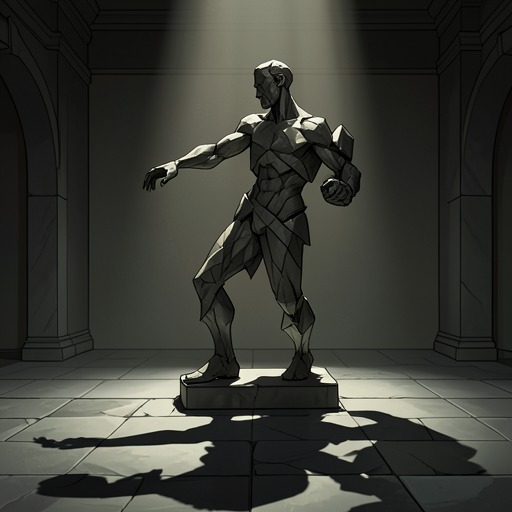
The figure is made from resin, fabric, and glass fibre, and stands on a plinth. Its chalky whiteness and indistinct features lend it the appearance of a shrouded, almost sarcophagus-like figure. The form is male, though oddly sexless: breadth through the torso and bulk at the chest give the body a recognizably masculine shape without making its face distinctive.
The upper half appears peaceful. The head rests near the bend of an arm, as if the figure were sleeping. But the calm does not extend to the whole body. Its limbs splay awkwardly, and the guide notes that they have not been arranged. This contrast is central to the sculpture’s effect: a familiar, almost classical image of death is held together with a posture that refuses the order or composure such an image might promise.
The guide explains that the work dates from the seventies and that its artist was moved to make it after a friend was murdered. She presents the figure as Everyman, an image broad enough to stand for a person beyond any single identity. Yet even in that public explanation, the untidy bearing keeps the figure human. The sculpture’s generality and its irregularity coexist rather than resolving into a single, settled meaning.
The guide’s account and Cushla’s response
The sculpture is encountered as one exhibit among others. After the guide has spoken, the group moves on toward a structure resembling a Tardis, made from six doors taken from Armagh Prison. Cushla does not follow immediately. She hangs back, steps closer to the figure, and looks at it for herself. The difference between hearing an interpretation and inspecting the object becomes consequential: the guide’s description has supplied a public frame, but Cushla’s attention discovers a likeness that frame cannot contain.
Cushla rejects the claim that the figure represents Everyman. To her, its details are intimate and accurate, almost as though the material had been moulded over the person’s body. She recognizes a neat ball of fat at the middle, a slight elevation of the right shoulder, and a doughiness in the jaw. These are not the distinguishing features of an abstract emblem. They make the figure particular, legible to someone who knows the person represented, while leaving the face itself indistinct.
Her reading does not depend on an identifying portrait. Rather, a cluster of small bodily details carries recognition where the face does not. The sculpture can therefore remain formally anonymous to the assembled visitors and still be precise for Cushla. That difference does not simply make the guide wrong: it reveals the limit of her account. A figure offered as a universal image can also preserve traces that matter intensely to one viewer.
Looking at the figure
Cushla’s inspection slows the scene. Instead of moving with the group, she stays with the sculpture and attends to its form piece by piece. The details she notices are modest, but together they alter how the whole work is perceived. The broad chest and peaceful upper body no longer stand only for a representative male figure; the slight shoulder and shape of the jaw pull the image toward an individual person.
The contrast between sleeping appearance and awkward posture also changes under her gaze. Cushla is afraid that she will see fear or pain in the face, but it looks as it did when he was sleeping. The work thus holds two modes of seeing at once: its disordered limbs suggest the violence and confusion associated with the murder, while the face preserves the appearance of sleep. The sculpture does not show Cushla an expression that explains or resolves what happened. Its power in this moment rests instead on the familiar form she recognizes and the stillness she confronts.
The encounter makes looking an active form of interpretation. The guide speaks to the group; Cushla tests that account against the object’s material details. Her recognition is neither announced as a formal correction to the guide nor made public to the visitors. It remains a private response, conveyed through the fact that she stays behind and through the specificity of what she sees.
Interruption and significance
Someone touches Cushla’s arm: the man with small glasses who had stood near her in the crowd. He addresses her as Miss Lavery and asks whether she remembers him. The interruption connects the act of looking to a separate question of recognition. Cushla has just identified, in the sculpture, details that distinguish a particular person from an Everyman; now another person identifies her and asks to be remembered.
The scene does not give the man’s name or Cushla’s answer in this exchange. It ends the encounter with the sculpture at the moment another relationship enters the frame, rather than supplying a complete explanation of the figure or its history. The object’s significance consequently lies both in what it shows and in the different kinds of recognition it prompts: the guide’s general interpretation, Cushla’s private identification, and the stranger’s direct address.
By setting an almost classical representation against an unarranged posture, the sculpture makes death legible without reducing the murdered person to a symbol. Its public presentation reaches for universality, but its intimate details resist anonymity. For Cushla, the difference is decisive: she sees not simply a figure that can stand for anyone, but someone whose particular body she knows.