Battle of the Bands begins at the Trumbull prom
UnforgivenThe Battle of the Bands begins at the Trumbull prom as a public contest and a test of what Revenge has built together. For Lilith, performing means stepping into a dream she once considered financially and geographically impossible; for Cam, the performance unfolds under the scrutiny of Lucifer and his demons. The competition’s elaborate stage, its nervous backstage rituals, and the band’s improvised harmonies make the event both a school spectacle and a measure of the relationships formed through music.
Background and Stakes
Lilith’s path to the contest begins with an instrument that bears the marks of her circumstances. At Rattlesnake Creek, she plays a dark orange Martin 000-45 guitar with a crack slanting down its body, salvaged from someone’s rubbish because her family could not afford a better one. She thinks the flaw enriches its sound. Playing there gives her the company of music, even when she lacks friends who share her taste, and she imagines seeing The Four Horsemen live while doubting she could afford a ticket or that the band would ever come to Crossroads.
That private relationship with music becomes public when Lilith sings her song “Exile” into a microphone. Cam encourages her to show what she can do by playing, and she responds by introducing the song and beginning to sing. The moment establishes the songwriting and performance that later become central to Revenge’s contest entry. Lilith’s confidence remains fragile, however: when Lucifer suggests she has a real chance to win, she answers that Chloe wins everything. The contest therefore carries more than the promise of a prize. It asks Lilith to believe that her original work can command attention in a world where she expects someone else to prevail.
Six days before the prom, Jean Rah identifies the event as both the band’s debut performance and a reason to find a look for the occasion. His practical planning ties the competition to the band’s public arrival. At the same time, Cam’s changing appearance—age spots near his hairline and a receding hairline—has alerted him that Lucifer is manipulating his mortal appearance, making his effort to win Lilith’s love harder. The school contest proceeds within that larger pressure, even as its immediate demands are rehearsal, costumes, and a performance.
The Prom and Its Stage
Cam and Lilith arrive at the edge of Trumbull Prep in a limousine. The prom’s principal spectacle is a replica of the Colosseum, constructed on the football field by Lucifer. Its three tiers of arches imitate the Roman model, but the material is not stone: the structure is made from packed ash from Lilith’s Hell. Cam recognizes the makeshift quality of the building and reads it as an emblem of how temporary the evening, the school, and Crossroads itself are. Lilith sees no such warning in it; to her, the venue is simply another ugly building in an ugly town.
Inside, balloons frame the entrance, and students gather at candlelit cocktail tables or dance beneath the open sky. A tall stage stands at the back, with red velvet curtains screening the waiting bands. The judges’ table carries a banner welcoming The Four Horsemen, the famous band Lilith had once only dreamed of seeing. Their presence turns her old musical longing into part of the prom’s immediate spectacle, while the Battle of the Bands gives a local group the chance to perform on the same stage.
Tarkenton, dressed in a navy tuxedo with a red rose, makes the final call for contestants to report backstage. Lilith takes Cam’s hand and pulls him through the crowd, and they find the labeled dressing rooms: Love and Idleness, Death of the Author, the Perceived Slights, The Four Horsemen, and, last, Revenge. The sequence makes the competition’s lineup tangible before any band plays. In Revenge’s room, Luis rehearses backup harmonies for “Somebody’s Other Blues” while eating peanut M&M’s; Jean Rah, in a cranberry satin dress, pauses from kissing his girlfriend Kimi to greet Cam and Lilith.
Backstage Nerves and Solidarity
As the performance approaches, Luis admits that he is breathing shallowly and asks whether the others get stage fright. Lilith does. Her knees tremble, and she worries that nerves will make her fail just as she has reached a place she could not have imagined standing in only two weeks earlier. Her anxiety gives the contest a clear personal stake: success is no longer an abstract possibility, but something she wants badly enough to fear losing.
Cam answers by widening the measure of the band beyond a three-minute performance. He recalls Lilith writing the songs, the members learning to play them together, their practices, their trip to the Salvation Army, and Lilith’s songwriting-contest win. He also names the less orderly work of becoming a band: Lilith threw him out repeatedly and later let him return, and the members now genuinely like one another. His argument turns the contest into the culmination of accumulated effort and repaired relationships, rather than a verdict on whether one night can make them worthwhile. He acknowledges that the band might not succeed, but insists that the time they have spent playing together still matters.
Lilith tells Cam that his reassurance has helped and that she is ready. He lifts his guitar, and Revenge gathers in the wings with instruments in hand. The performers wait in small groups without curtains separating the acts; the crowd beyond the stage is restless and energized. Arriane and Roland arrange folding chairs for Lilith’s mother and brother, and Arriane hangs a disco ball above the stage. Their preparations connect the family’s presence to the band’s performance and recall the help Cam’s friends have given him as he tries to reach this moment with Lilith.
The Contest Opens
The prom’s brightness has a darker audience. Roland looks toward the unusually bright points in the smoky sky, and Cam realizes they are the eyes of Lucifer’s demons gathered overhead. They have come to watch what becomes of him, so the school audience is not the only one measuring the night. The ash-built Colosseum and the demonic observers place the contest inside the supernatural conflict surrounding Cam and Lilith without changing its visible form as a school dance and competition.
When the house lights go out, Lucifer takes the spotlight in a blue pin-striped suit and addresses the crowd from a gold-plated microphone. He announces that the Battle of the Bands will begin before the prom king and queen are crowned. His introduction divides the performers between fan favorites and relative unknowns, then darkens into a pointed suggestion that some bands never had a chance. He winks at Cam as he introduces the first act, Love and Idleness. The contest’s emcee thus makes the competition feel less neutral: Lucifer’s words turn the order of performance into a public taunt aimed at Cam.
Two sophomore girls bring stools onto the stage and play ukuleles. Cam recognizes their opening chords as “Silver Dagger,” an old folk song he first heard a couple of hundred years earlier aboard a boat in a storm-dark sea. His recognition briefly folds his long past into the present-day school contest. Jean praises the performer, while Luis asks which one he means; the scene keeps the waiting band’s attention on the stage even as the song awakens Cam’s memory.
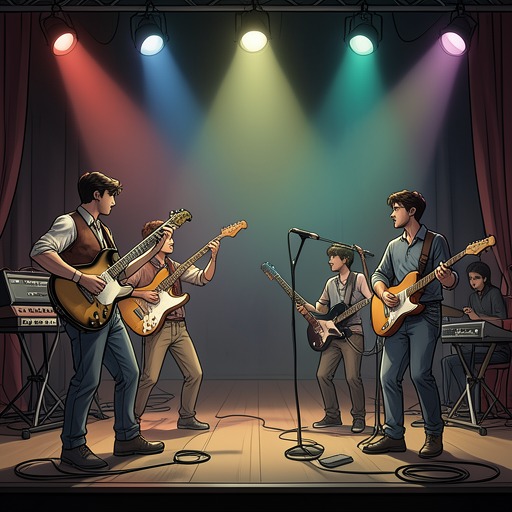
When Revenge’s turn arrives, Lilith cups the cold microphone and faces a blinding spotlight that makes the audience disappear from her view. She notices the disco ball and thinks that without Cam she would be alone in her bedroom writing songs instead of standing at prom with her band. Ignoring her trembling knees and pounding heart, she counts the band in. The drums enter suddenly; her guitar begins with a slow, sad riff before opening into the song, and Cam’s guitar joins hers. She is no longer afraid: playing before the packed dance floor, she feels that she is living her dream.
Lilith sees her mother and brother standing apart from the crowd but dancing freely. The audience’s cheers nearly drown her out as she turns from the microphone to play, then returns for the bridge and last verse. Cam finds harmonies with her that the band has never practiced. At the final couplet, Lilith raises her arm and stops; Jean Rah, Luis, and Cam stop with her, and the audience answers with louder screams. The available scene ends on that suspended response, with the performance’s reception still unfolding.