Lilith forms the band Revenge
UnforgivenLilith forms Revenge when an invitation to jam becomes a decision to create a band, name it, and enter the school’s Battle of the Bands. The moment turns her private attachment to music into a shared undertaking: Jean Rah proposes the group, Luis takes up the drums, and Lilith supplies its name and her guitar-playing and singing. Revenge begins not as an established act but as a small, improvised community that gives Lilith a way to step into public performance on her own terms.
From solitary music to a shared sound
Before Revenge exists, music is one of the few places where Lilith feels accompanied. At Rattlesnake Creek, she rests her guitar case in the crook of a tree and plays alone, finding in the sound a kind of company she does not have elsewhere. Her instrument is a dark orange Martin 000-45 with a crack down its body, discarded by someone on her street. Lilith cannot afford to be selective, but she also believes the flaw makes the guitar sound richer. That battered instrument becomes a concrete link between her solitary practice and the band she will help build.
The wish behind that private playing is not simply to own a guitar or to be heard. Lilith wonders what it would be like to meet someone who shared her musical taste. She loves The Four Horsemen, though a cheerleader once dismissed the band as sounding like whipped dogs, and she dreams of seeing them play live. The scale and cost of such a concert make that dream feel distant: The Four Horsemen are too big to play Crossroads, and Lilith’s family struggles to afford food. Revenge offers a nearer possibility—not access to a famous band, but the chance to make music with people in her own school.
The invitation and the first lineup
The formation follows Lilith’s open-mic performance of her song Exile. When Jean Rah asks whether she wants to jam, Lilith leaves the cafeteria with him; his question also carries the possibility that she may be trying to make Cam jealous. In the band room, Jean first acknowledges that he heard her at the open mic and liked the song. Lilith answers darkly that it was a crowd-pleaser, but Jean makes his support unmistakable: he had been clapping for her. His encouragement connects the new group to what Lilith has already done as a songwriter and performer, rather than asking her to set that work aside.
Jean proposes that the three of them start a band and notes that there is still time to sign up for prom. Lilith initially says she is not going. She is confused about other things, but her refusal sounds certain. Jean counters not by pressing her about a date, but by insisting that she is good enough to perform. Luis is present in the band room, where he has been struggling to set a large copper timpani on its base. He says he can drum and intends to attend prom even if no senior girl asks him. His practical willingness to play helps turn Jean’s proposal from an idea into a workable arrangement.
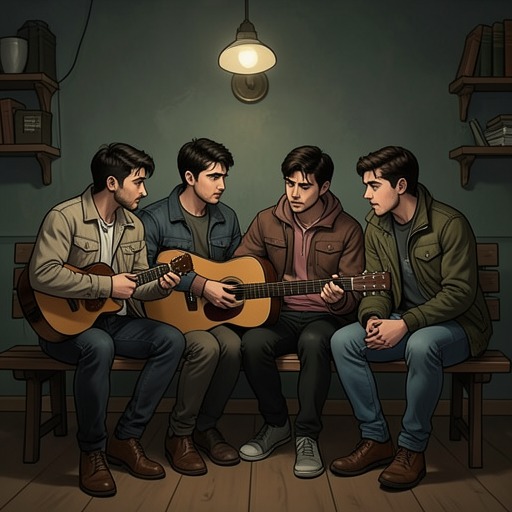
Jean sketches out the initial roles: Luis on drums, Lilith singing and playing guitar, and Jean adding synthesizer. He takes a black Moog from the instrument closet. The combination is tested rather than merely imagined: Lilith plays a C on the keyboard with her left hand, while her guitar answers with a punchy C; her fingers then run an ascending riff on the MIDI keys as the guitar responds. Jean’s suggestion that this will keep the audience on its toes points toward the group’s shared experimentation. For Lilith, who has dreamed of being in a band, the sound makes the proposal feel possible. After hesitating, she agrees.
Naming the band and entering the competition
The name comes just after the first musical exchange. Luis observes that they are not really a band without one, and Lilith answers with a single word: Revenge. The name gives the hastily assembled group an identity at the same moment that Lilith commits to it. Her smile registers a change in scale: for the first time, she feels part of something bigger than herself. Luis celebrates with a hard strike on a snare drum, its sound still reverberating when Principal Tarkenton appears and orders Lilith to his office.
The name immediately raises a question of how the group will be understood. When Lilith later explains that she wants to play in the Battle of the Bands, Principal Tarkenton checks the enrollment sheet on his desk and points out that she is not listed. She takes the sheet and writes Revenge onto it. The act is small but decisive: until the name is on the competition form, the band is an arrangement among students; once written down, it has been formally entered. Principal Tarkenton scoffs that Revenge sounds anti-authority. Lilith rejects that interpretation and asks for one more chance, making clear that the name’s suggestive edge does not, in her account, define the band’s purpose.
The movement from refusing prom to signing up for its competition marks a shift in Lilith’s relationship to the event. Jean’s invitation initially meets a firm no, but his confidence in her music and the prospect of playing with a group change what prom can mean to her. Her decision is not presented as a change of romantic plans: Lilith insists that she wants to play, not that the invitation is about a boy. The competition gives the band a concrete goal and turns the new name into a public commitment.
What the formation makes possible
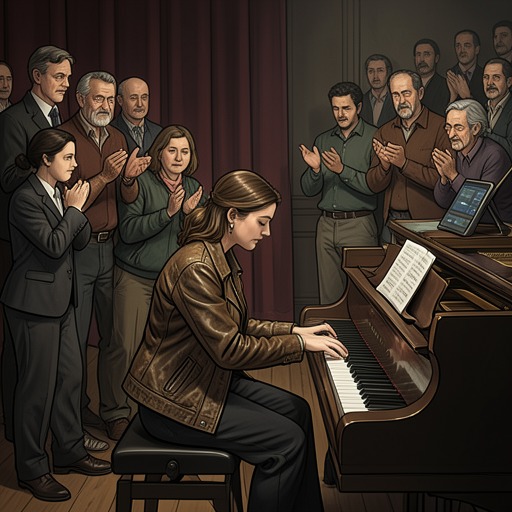
Revenge later appears on the prom stage with Lilith, Jean Rah, Luis, and Cam playing together. Before the performance, Lilith registers the counterfactual that makes the moment matter to her: without Cam, she would have been alone that night, writing songs in her bedroom, rather than at prom with her band and a packed dance floor. She grips the microphone, counts the band in, and plays with them. During the final verse, Cam joins her in harmonies they have never practiced. These later details show the band’s development beyond its original three-person arrangement, while preserving the importance of Lilith’s own music and initiative.
At its beginning, Revenge answers several forms of isolation at once. The cracked guitar that Lilith once played alone becomes part of a sound assembled with Jean’s synthesizer and Luis’s drums; Jean’s private approval of her open-mic song becomes a proposal to collaborate; and a name spoken in the band room becomes an entry on the competition sheet. The band does not erase the difficulty of Lilith’s circumstances or make her earlier dream of seeing The Four Horsemen come true. It gives her a distinct, attainable form of musical belonging: a group she helps create, a performance to prepare for, and a place from which her songs can reach other people.