Lilith performs “Exile” at the open mic
UnforgivenLilith’s open-mic performance of Exile is a turning point in which private music becomes public exposure: Cam helps her face a hostile cafeteria audience, and the song briefly makes audible a love she had seemed to lose. Its artistic success does not win the crowd. Laughter and a thrown bottle cut short the moment, making the performance both an expression of Lilith’s inner life and a fresh injury inflicted in public.
Background and the open-mic setting
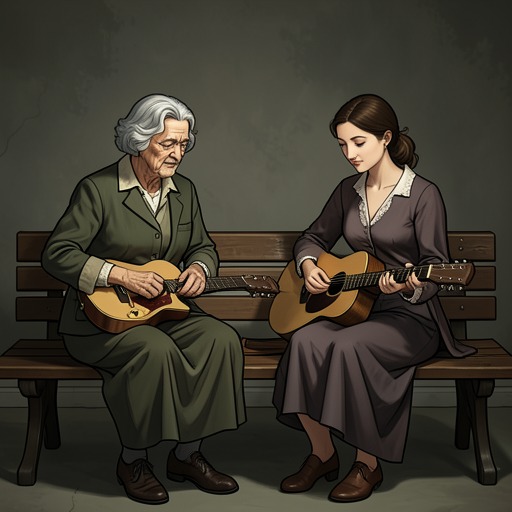
Before the school performance, music offered Lilith a refuge from the isolation and poverty of her life in Crossroads. At Rattlesnake Creek, she could rest with her guitar and play without needing anyone else to share her taste. She had salvaged the instrument from someone’s discarded belongings because her family could barely afford food: a dark orange Martin 000-45, marked by a crack slanting down its body. Rather than hiding the damage, Lilith believed it gave the guitar a richer sound. Playing could make her feel surrounded by friends she did not have in person, while her hope of seeing The Four Horsemen live seemed financially impossible.
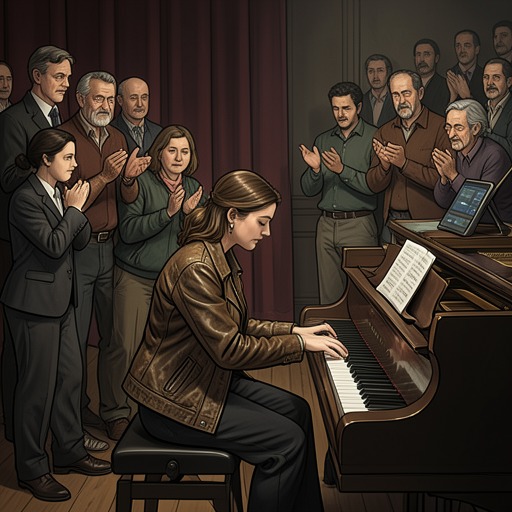
At school, the open mic put that private relationship with music before classmates who had already shown their contempt. After a spoken-word performance and several poets, Mr. Davidson introduced Lilith. Boos met her as she took the stage with her black journal under her arm. The spotlight made her look paler; when she tried to speak, the microphone shrieked with feedback. Students covered their ears, and one called her a loser. The failed microphone intensified the pressure of an audience that was not simply waiting to hear her but already heckling her.
Cam helps her perform
Cam rushed to the stage and adjusted the microphone so Lilith could speak in her natural, low voice without hunching over it. The practical gesture could not remove the audience’s hostility. As he started to leave, Lilith mouthed that she could not do it. She said she would take the zero rather than read in front of people who hated her, then backed away from the microphone with her journal clutched in her hands. Cam stopped himself from embracing her and urged her to continue.
The decision to sing came through the guitar rather than the journal. After Lilith indicated that she did not want to proceed, Cam jumped off the stage, opened the silver clasps of her guitar case, and lifted out the cracked instrument. He saw students snickering and someone photograph Lilith as she stood frozen by stage fright. He ignored them, placed the guitar in her hands, and carefully eased the strap over her shoulder without catching her long red hair. He took her journal from her, warm from her hands. Lilith called the situation a disaster, but Cam redirected her attention from winning the crowd to expressing what she felt. His encouragement was not a promise that the audience would change; it was an appeal for her to claim the song as her own.
The performance and its reversal
Lilith closed her eyes and leaned toward the microphone. A student booed, and she opened her eyes, going white. Cam did not answer the heckling for her; he told her to play the guitar and show the audience for herself. Lilith did not reply, but her expression changed. She leaned in again, introduced the song as Exile, and began to sing in a voice that was soft and clear.
The song poured out of her with an ease that contrasted with her struggle to speak. As she sang with her eyes closed, the anger that had seemed to twist her was less visible, and Cam glimpsed the girl he had fallen in love with. Her performance also revealed something specific to him: the song was a version of one he had hummed while leaving Troy, and Lilith still knew it. He took that recognition as evidence that some remnant of their love story remained alive in her. The scene therefore lets the same song carry two kinds of meaning: Lilith’s present attempt to give voice to herself and Cam’s recognition of a shared past.
When Lilith finished, the audience did not applaud. After a silence in which she waited hopefully, laughter replaced the response she had wanted. Someone insulted her song and threw an empty soda bottle onto the stage; it struck her knees, and the hope in her eyes died. Mr. Davidson returned to the stage and told her she had done a nice job, but his approval could not undo the crowd’s rejection. The performance had reached its emotional opening for Cam, while remaining a public defeat for Lilith.
Aftermath and significance
Lilith hurried off the stage and out of the cafeteria. Cam ran after her but could not catch her; outside, it was too dark to see where she had gone, and she knew the place better than he did. The abrupt exit leaves no immediate reconciliation or comforting conversation. Instead, the failed performance ends in separation: Lilith disappears into the dark while Cam remains outside, unable to follow.
The event establishes the cost of making Lilith’s music public in a school environment that mocks her, but it also marks a contrast with her later appearance at prom. There, facing a packed dance floor with her guitar across her chest, she ignores her shaking knees, counts the band in, and plays without fear; near the end of that performance, Cam joins her in harmonies they had never practiced. That later confidence does not erase the open mic’s humiliation. It makes the earlier scene legible as an instance of the vulnerability from which her later stage presence differs: at the open mic, Cam must physically place the guitar in her hands, while at prom Lilith takes the stage and begins the music herself.