Rattlesnake Creek promposal and first kiss
UnforgivenRattlesnake Creek promposal and first kiss marks the turn from cautious reconciliation to openly chosen romance between Lilith and Cam. In the grove that has long been Lilith’s refuge, Cam stages a private version of prom rather than asking her to attend the school dance with him. The gesture respects her wish to make music at the Battle of the Bands, but also gives her room to decide whether she wants him beside her. She accepts his request for time together, invites him to the Battle as her date, and shares her first kiss with him.
The creek as a meeting place
Rattlesnake Creek already belongs to Lilith in a way that more celebrated places do not. She has made a customary resting place for her guitar case in the crook of a tree, and the grove’s withered trees and small creek feel beautiful to her precisely because she knows few others would see them that way. Playing her dark orange Martin 000-45, its body slanted by a crack, gives her a sense of companionship she lacks elsewhere. The setting therefore makes Cam’s choice of her favorite spot more than decorative: he brings his courtship into the private landscape where her music and imagination have room to exist.
The scene follows an earlier musical connection. When Lilith sang her song Exile, Cam encouraged her to show people what she could do by playing her guitar. Later, when Lilith assumes that Chloe will win everything, Cam tells her that she has a genuine chance in the songwriting contest. These moments establish a pattern for his approach here: he recognizes Lilith’s music as something she can claim for herself, rather than treating it as an obstacle to romance.
By the time he leads her into the clearing, Lilith has become familiar with details of Cam she once could not have known: the way he licks his lips when thinking, listens closely, and holds her hand. That accumulated intimacy helps explain why the nighttime return to her tree feels exciting rather than simply strange. The tree is lit with soft red and yellow strands, transforming a place she knows into a deliberate invitation without erasing its familiarity.
A private prom, not a demand
Cam’s friends Arriane and Roland are waiting in the grove. The gathering begins with a toast: Roland produces champagne and flutes, and Cam raises his glass to second chances. Cam then explains that his favor is not immediate readmission to Lilith’s band. He asks her instead to set aside what she has heard about him and spend an hour with him beneath the stars. Lilith agrees to take his hand and follow him to a set table.
The preparations make this an improvised celebration rather than a conventional school dance. The table holds crystal glasses, mismatched golden cutlery, swan-folded white napkins, and two Russian samovars. Arriane serves a steaming red casserole topped with eggs and parsley, while Roland plays a 1930s Martin guitar in a soft, syncopated blues rhythm. His friends have helped Cam build an occasion around Lilith, but they remain at the edges of it: they serve, play, and make themselves unobtrusive while he and Lilith share the meal.
Lilith notices the care that has gone into the scene and wonders whether it is an elaborate promposal. Cam quickly clarifies that he is not asking her to prom. He knows she wants to play at the Battle of the Bands and does not want to make that choice for her. He describes the ordinary pleasures he would have wanted to share with her—a corsage, a photograph with her mother, punch and doughnuts—but says he can respect her wishes. Instead, he has brought a version of prom to the grove. Its difference is the point: the gesture offers romance without requiring Lilith to give up the musical event she has chosen.
Reassurance and a second chance
Cam also addresses what Chloe may have overheard. He tells Lilith that his conversation with Lucifer concerned how much he likes her, and that Lucifer doubted he had a chance; Cam presents the exchange as an expression of his competitive side. His explanation is part of his appeal for an opportunity, not a separate proof that every rumor has been settled. He says that what he wants most is a chance with Lilith, while asking her to judge what she experiences with him rather than rely on others’ accounts.
Lilith’s response is immediate but not framed as a completed resolution. She studies Cam and finds herself leaning closer, wanting to kiss him; in that moment, the rumors lose their force beside what she knows she feels. When he asks whether she wants to dance, she accepts. The decisive change is hers: Cam has created the occasion, but Lilith moves toward him and later makes the next invitation herself.
Dance, kiss, and the invitation
As they dance, Cam leads carefully, neither moving too fast nor stepping on Lilith’s toes. Their turns and dips feel instinctive to her, and she describes the fit between them as if two puzzle pieces were snapping together. The dance gives physical form to the new ease in their relationship. When Lilith wonders how they arrived at this point, Cam jokes that they took the bike; she answers that she means the two of them. He repeats the idea of an “us,” and Lilith recognizes that she wants more than to perform at prom and leave. She wants to experience the event with her friends and, especially, with Cam.
Lilith asks Cam to be her date to the Battle of the Bands. His happiness is unmistakable: he twirls her in a wide circle, while Arriane and Roland react from nearby. Lilith attaches a condition to her invitation. He must rejoin the band and play their song. Cam agrees, promising to make music with her for as long as she will have him. Her offer thus joins the romantic and musical strands of the scene: accepting Cam as her date also means restoring him, provisionally, to a shared creative undertaking.
Cam then asks Lilith to close her eyes and shows her what dancing can feel like. Their steps grow more intricate; he lifts her by the waist, and she feels as though they are rising above the creek, trees, and hillside. The sensation leads into their first kiss. Cam kisses her deeply, and Lilith kisses him back; she recognizes that she has never kissed anyone this way before. Afterward, she asks whether they were dancing or flying. Cam answers that, when it is done right, there is no difference. The line binds the scene’s physical motion to its emotional change: what began as an invitation to spend an hour together has become a mutual experience Lilith chooses and names for herself.
From the grove to the stage
The private prom changes Lilith’s plan for the public one. Before this night, she intended to play her song at the Battle of the Bands and leave; now she wants the whole evening, with her friends and Cam. The arrangement is reciprocal rather than simply a rescue or a grand gesture: Cam makes space for her choice, and Lilith answers by asking him to return to the band on her terms.
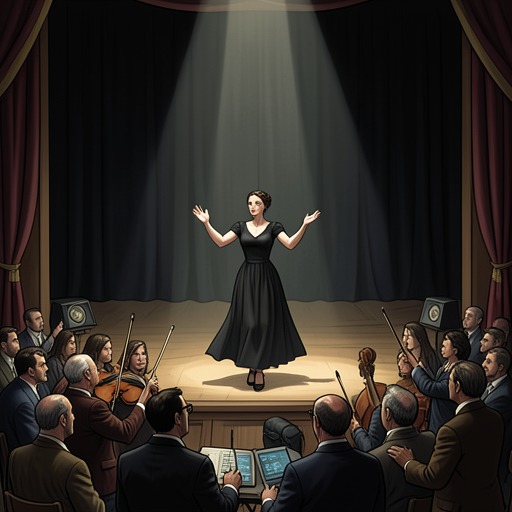
At the later performance, Lilith stands beneath the spotlight with her guitar and counts the band in. Cam’s guitar finds hers during the song, and after the bridge he joins her in harmonies they have never practiced. That musical coordination carries the promise made beside the creek into public performance. The first kiss is not the only evidence of their renewed closeness; their unpracticed harmony shows how the private invitation has reopened a shared musical relationship as well.