Exile
Unforgiven“Exile” is Lilith’s song, first heard by Cam as she sings into a microphone and later carried by him into other encounters. Its lyrics turn on love, an afflicted mind, and the unanswered prospect of drowning from thirst; its narrative importance lies as much in who performs it and who listens as in the words themselves. In successive scenes, the song becomes a fragile sign of remembered connection, a lullaby, and a melody Cam uses when he has no other song to offer.
Lyrics and Form
The lyrics give the song a voice caught between motion and suffering. It begins, “Where love spurs me I must turn,” then doubles back on its own language: “My rhymes, my rhymes,” followed by “Which follow my afflicted mind” and “My mind, my mind.” The repeated phrases make the mind both the source of the song and the thing it circles around. Rather than telling a settled story, the speaker asks what comes first and last, and ends with the question, “Shall I drown from this thirst?” The image joins thirst to the possibility of drowning, holding need and danger together without resolving either.
That unresolved quality is part of what gives the song room to recur in different circumstances. At the microphone, Lilith sings the words with a soft, clear voice. In a later scene, Cam sings the same song slowly and with great emotion, and in another he reaches for its opening lines when pressed to sing without preparation. The song is recognizable across these changes of performer and instrument, but each occurrence places it in a different relationship: Lilith’s own act of expression, Cam’s tender address to a group of children, and Cam’s attempt to meet an immediate demand.
Lilith’s Performance
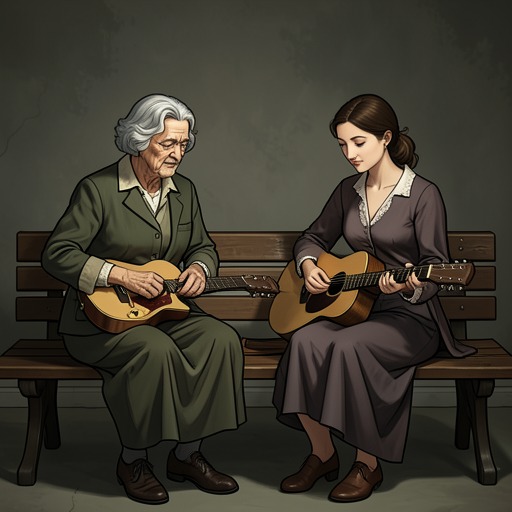
Before Lilith sings, Cam tells her to play her guitar and show the audience herself. She does not answer, but her changed expression tells him that his words have reached her. She leans toward the microphone and introduces the song as “Exile.” When she begins, the performance reveals a side of her that Cam associates with the girl he once loved: with her eyes closed, she seems less twisted by anger. The song does not erase that anger; instead, for the duration of the performance, it gives her another way to appear and be heard.
Cam’s response is immediate and personal. He trembles with emotion because he recognizes the song as a version of one he had been humming while leaving Troy. He believes Lilith still knows it, and takes that recognition as evidence that some remnant of their love story remains alive in her. That conclusion belongs to Cam’s interpretation of the moment; the scene gives no direct confirmation from Lilith. The song therefore links their shared past while leaving the meaning of that link uncertain.
The audience’s response sharply breaks the scene’s hopeful pause. Lilith lifts her fingers from the guitar strings and waits for applause, hope visible in her eyes, but the audience laughs instead. The contrast matters: the performance has reached Cam deeply, yet the surrounding listeners answer it with ridicule rather than recognition. “Exile” is not presented as automatically winning its audience; its emotional force is intimate and unevenly received. Lilith has made herself audible, but the response she gets does not affirm her.
Cam Carries the Song
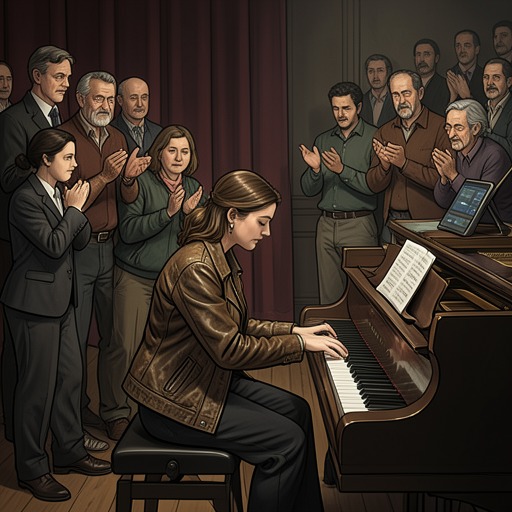
Later, when Cam is asked for a lullaby, he introduces his choice by naming Lilith as a talented musician. He then sings “Exile” for the children. He sings it twice, slowly and with great emotion, bringing a depth to the song that Lilith had not imagined. The setting and response differ from Lilith’s performance at the microphone: the children nod toward sleep, and their father applauds softly. Jean Rah whispers in surprise, while Lilith, shaking and near tears, is so moved that she cannot say more.
This scene gives the song a new function without detaching it from its source. Cam presents the lullaby as something he learned from Lilith, and his performance makes her songwriting audible to others through his voice. Yet the emotional effect returns to her: hearing him sing it moves her intensely. The scene does not explain exactly what she understands or feels, but her physical reaction marks the song as more than a piece of music shared in passing. Its repeated performance allows a feeling to pass between them where speech does not supply a full explanation.
A Song Reclaimed and Reused
In another encounter, Cam is told to sing after the man he has met kicks his lyre to the ground. Unprepared to improvise, Cam finds Lilith’s song rising to his lips: it is the first song he ever heard her sing. He thinks that she stole his heart and that he will now steal her song. The wording makes his performance an act of taking, but also acknowledges the song’s prior connection to Lilith. He does not produce a new composition; he relies on what he remembers hearing from her.
Cam plays the melody on his lyre as he sings the lyrics, and the man is impressed, judging the music and words to complement each other perfectly. He gives Cam a flagon and offers to teach him, asking him to stay. In this encounter, the song helps Cam answer a demand he could not meet through improvisation. The song’s usefulness does not make its significance merely practical: its words still come from Lilith, and Cam’s thought explicitly frames singing them as taking something of hers into his own performance.
Across these scenes, “Exile” moves between voice, guitar, and lyre, and between a public performance, a lullaby, and an improvised answer under pressure. Its changing reception is equally significant: laughter, quiet applause, sleeping children, and an impressed listener all surround the same song. The text does not settle its meaning into a single message. Instead, it makes the song a recurring point of contact whose emotional charge depends on the history between Lilith and Cam, and on the moment in which one of them gives it voice.