Vows
UnforgivenVows is the song through which Lilith’s lost history with Cam breaks into her present. When the Four Horsemen perform it for her at prom, she recognizes its musical direction before she can explain why; then she sings along and sees herself writing it for Cam in another life. The performance transforms a song she does not remember into evidence of a past engagement, making music both an act of connection in the present and a passage into memory.
A song presented to Lilith
At prom, Ike catches Lilith’s eye and introduces Vows as a song for her. The dedication is startling rather than reassuring: Lilith has never written a song by that name, and she briefly considers whether Ike has mistaken the title. The band begins before she can settle on an explanation. This gap between what Lilith consciously knows and what the music seems to know gives the performance its defining tension. Vows arrives as a gift from the Four Horsemen, but it also appears to belong to a history Lilith cannot yet access.
The song’s words center on giving oneself to another person. Its successive images include arms, eyes, scars, a heart, and the sky. That movement from bodily vulnerability toward an expansive offering gives the title a personal weight before Lilith understands its source. The performance does not initially explain who wrote the song or why Ike has chosen it for her; instead, it lets the lyrics and music make the recognition happen in stages.
A duet before recognition
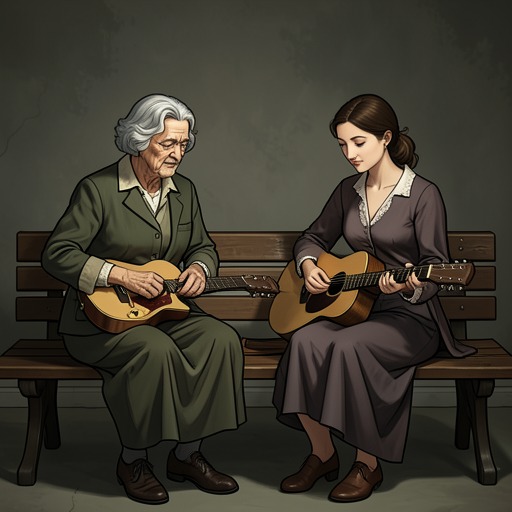
Although Lilith has never heard Vows, she begins to anticipate its chords a fraction of a second before the band plays them. The familiarity is not presented as the result of practice or a remembered recording: she experiences the song as though its direction is already available to her. Before she has decided to join in, its words come to her, and she sings. What began as the Four Horsemen performing for an audience becomes an unplanned duet, with Lilith participating in a song she believes she cannot know.
The scene extends a musical pattern established in Lilith’s life. At Rattlesnake Creek, she played a dark orange Martin 000-45 with a crack down its body, an instrument someone had discarded because she could not afford to be selective. Playing there made her feel accompanied by friends she did not have, while her wish to see the Four Horsemen perform live seemed unreachable. Later, she sang her own song Exile into a microphone. At prom, the Four Horsemen are no longer only the band she longed to hear: their performance draws her into making music with them, and the song’s familiarity carries her beyond the present stage.
The vision of a former life
The question of why the duet feels familiar prompts a vision. Lilith sees herself with Cam beside a body of water, not at the small creek she knows but at a great, clear river in the distant past. In that scene she has just written Vows for him and can see that he likes it; he kisses her, and their relationship has none of the resentment or fear that marks their present difficulties. The vision identifies the song with a former intimacy rather than with an event in Lilith’s current life.
The memory also reveals the relationship’s former shape: Cam and Lilith had been engaged. As the vision unfolds, the song is connected to their preparations for a wedding, and Lilith understands that they had shared a life together long ago. Vows therefore works as more than a title or a romantic dedication. Its sound gives Lilith access to a relationship she has not consciously remembered, while its wedding resonance gathers the vision’s tenderness around a promise that existed in another time.
Music as recognition
The performance changes the meaning of Lilith’s apparent ignorance. She does not identify the song through an explanation from Ike or a deliberate recollection; her hands and voice respond first, and the vision follows. The sequence makes musical participation the form through which memory returns. The song is at once unfamiliar to her present understanding and intimate in a way that her response cannot conceal.
That contradiction gives Vows its importance in Lilith and Cam’s story. At the concert, Lilith’s singing joins her to Cam in the present, while the vision shows that their connection reaches back to an earlier engagement. The song does not, by itself, resolve the distance between them, but it changes what Lilith can know about their shared past. What the audience hears as a performance becomes, for Lilith, a recovered piece of a life: a song written for Cam, remembered first through its music and only then through its story.