Somebody’s Other Blues
UnforgivenSomebody’s Other Blues is Lilith’s account of heartbreak rendered as the estrangement of watching a life from outside it. First encountered in her private journal, the song becomes the basis of Cam’s unauthorized contest submission, an injury to Lilith’s trust, and the work that wins praise from Ike Ligon. Its passage from private writing to public recognition makes the song a hinge between Lilith’s isolation and her growing belief in her own music.
Composition and lyrical perspective
Cam encounters the song among the work in Lilith’s black journal, which he has kept after she leaves the band room. He intends to return it, searches for her at Rattlesnake Creek, and cannot bring it to her home because he does not know where she lives. The delay becomes a choice: by sundown, temptation has overcome his intention, and he spends the night on the roof of the Trumbull gym reading and rereading her songs by the light of his phone.
The journal gives Cam access to an intimate voice Lilith does not offer him in conversation. He recognizes that reading it is a violation, yet experiences the songs as a view into her vulnerable inner life. Somebody’s Other Blues is his personal favorite, and the collection as a whole devastates him because its suffering, humiliation, and betrayal reflect pain whose origins he knows. The song therefore reaches him not as detached writing but as an account of what he understands himself to have caused.
The lyrics present a speaker uncertain whether the life being lived belongs to them. The opening image, “I dreamed life was a dream,” leads into “Someone was having in my eyes,” before the speaker describes being “outside looking in” and seeing only lies. The phrasing makes estrangement both the song’s subject and its point of view: the speaker is present enough to see, but feels displaced from the experience being seen. Its refrain, “It’s not my life, it’s not my life,” sharpens that division, while “I’m not the one not having fun” turns exclusion into a bitterly unstable claim. The lyrics do not resolve the speaker’s disconnection; their repeated denials make it audible.
From private journal to contest entry
Cam decides to send the song to Ike Ligon, Lilith’s favorite singer, through the prom Battle of the Bands competition. He knows that Luc will vet the other submissions and believes Ligon will not judge the material, so he hopes Lilith’s music can reach its intended listener without the devil’s influence. The plan arises from the journal’s contents, but it also crosses a clear boundary: Lilith has not agreed to share the song or enter the contest.
The black journal remains on Cam’s lap as he writes the lyrics from memory. That detail shows how thoroughly he has absorbed them during his night of reading; he no longer needs to open the notebook. Alongside the lyrics, he drafts an email to Ligon and a biography in Lilith’s voice. Rather than write an impersonal musician’s résumé, he describes the creek behind her school as an escape from a suffocating world, says she wrote the song after her heart was broken, and presents music as a source of help. The biography interprets the song through Lilith’s circumstances, but it is Cam’s account of her experience, sent without her permission. His care for her work and his presumption about her right to control it remain inseparable.
Lilith discovers the submission when a printout of Cam’s email and the lyrics is thrust before him. She identifies the acts plainly: he went through her journal, took her lyrics, and entered them in the contest. Cam acknowledges that what he did was wrong, then argues that the song is brilliant and that she had said she would not enter. He insists that he sent it as her, not as himself, and describes the contest as an opportunity he could not let her pass up. His intended support does not undo the breach: the song that expresses her heartbreak has been made public through a decision she did not make.
Recognition and changed significance
The consequences emerge first through an email on Cam’s phone. While Cam and Bruce play air hockey, Lilith notices a message whose subject identifies Somebody’s Other Blues as a song by Lilith Foscor. She later opens it and sees that Ligon has written directly to Lilith. He praises her songwriting talent, says that she has won, and looks forward to meeting her. Lilith lets the screen go dark. Her response registers the discovery as more than a favorable judgment: the singer whose attention Cam sought has recognized the song on its own merits.
When Lilith tells Cam that Ligon likes the song, he answers that there was never any question he would. She then says that she won. The exchange places her achievement beside the guilt that still surrounds Cam’s submission: she can welcome the recognition without retroactively making his decision hers. Before Cam’s arrival, music had been an escape, passion a daydream, and love an impossibility. Now, Lilith feels these things connected, as if they might help her become a different person. The song’s public success thus accompanies a change in how she imagines her own future, not merely an external prize.
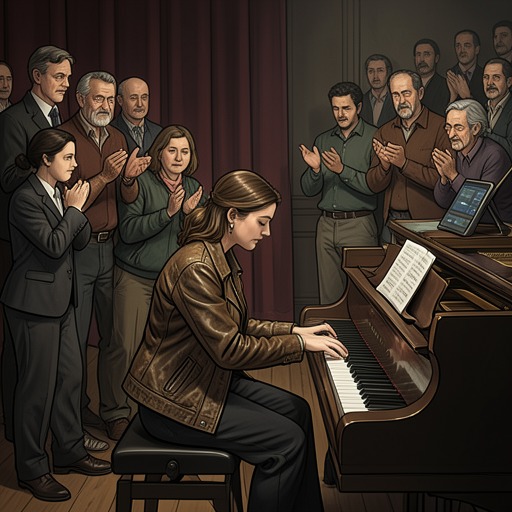
At the celebration, Cam raises root beer to Lilith and the song; Bruce joins him, and Lilith is surrounded by her brother and friends. She remembers writing the lyrics in a grim, lonely state, as a purge and the only therapy she could afford. She had never imagined that words born from that misery could lead to such a happy moment. She credits Cam’s belief in her, while also recognizing the importance of believing in herself. The song’s path does not erase the loneliness from which it came; it gives that private expression a listener and lets Lilith experience its value beyond the pain that produced it.
Place in Lilith’s musical and emotional arc
Somebody’s Other Blues becomes one marker in the history of Revenge, not a substitute for the work that forms the band. Before its prom performance, Lilith worries that she may fail onstage and that the whole undertaking may have been a mistake. Cam answers by recalling the steps that brought them there: her songwriting, the band learning to play the songs together, their practices, their trip to the Salvation Army, and her victory in the lyrics contest. He also points to the changes in the group’s relationships, including the times Lilith threw him out and later let him return. His account places the winning song within a larger process of making music together.
That perspective gives the contest result a meaning beyond approval from a famous musician. Ligon’s response confirms that Lilith’s writing can reach an audience; the later rehearsal scene emphasizes that the band’s value also lies in the shared effort behind its performance. The song begins as a record of feeling shut out, yet its recognition contributes to Lilith’s growing confidence and to the connections she is forming through music. Its significance rests in that contrast: a work written as private release becomes evidence, for Lilith, that her voice can carry beyond the loneliness in which it began.