Flying Upside Down
UnforgivenFlying Upside Down is a song Lilith writes and develops with Revenge, moving from private composition to rehearsal-room collaboration and, ultimately, a performance before a prom audience. Its progress carries two opposing meanings: the song gives Lilith a way to trust her own voice and join with other musicians, while Cam’s unauthorized handling of its lyrics makes that same work a source of public humiliation and conflict.
Creation and musical beginnings
Lilith’s songwriting grows out of a solitary musical life. At Rattlesnake Creek, she plays a dark orange Martin guitar with a crack slanting down its body, an instrument someone had discarded and she could afford to keep. The flaw does not make it worthless to her; she thinks it enriches the sound. Playing there makes her feel accompanied by friends she does not have, and she longs for someone who shares her taste in music. Her dream of seeing The Four Horsemen live seems financially impossible for a family that barely has enough money for food. In this setting, writing songs is both a practice and a form of imagined connection.
Her earlier public singing offers a point of contrast. When Cam encourages her to sing at an open mic, Lilith performs Exile, a different song, rather than Flying Upside Down. The distinction matters: the later song enters the story not simply as another solo performance, but as a piece whose sound and circulation become bound up with the newly formed band and with disputes over who controls Lilith’s work.
Rehearsal and the discovery of a band sound
Revenge meets in the band room before school, and Lilith arrives carrying photocopies of Flying Upside Down. The song has already existed in her imagination as lyrics and melodies worked out alone in her room; singing it in front of other people feels exposing. Her voice trembles, and she considers stopping and leaving. The rehearsal makes that private uncertainty audible rather than resolving it in advance.
Luis’s drumming and Jean Rah’s playing change the conditions of the song. Lilith opens her eyes to find Luis nodding encouragement, his sticks moving between snare and cymbals, while Jean fills the musical space with guitar notes that seem to tell a story. Their support reaches her through the playing itself: she feels a surge of energy, sings louder and more freely than she has before, and hears a band that had not existed two days earlier finding a sound that is both rich and nimble. Luis ends the song with a crashing drum flourish. The three musicians finish smiling and slightly dazed, having moved from separate contributions into a shared sound.
The scene’s small material details underscore that change without accounting for all of it. Luis offers Lilith Doritos before the rehearsal, and she feels less hungry and edgy after eating. She arrives wearing a white dress with green polka dots borrowed from her mother, a purple belt, and combat boots; her mother has lent her pink lipstick. Lilith takes care not to get lipstick on the microphone. These details place her in a moment of unusual openness, but she recognizes that the band’s ease and friendship, as well as her own changing circumstances, matter more than the snack. The song becomes a setting in which companionship is made by listening, playing, and responding together.
Encouragement and unauthorized circulation
Cam recognizes the promise of the song when he reads a photocopied page. He tells Lilith he believes in her, and his praise feels different to her from his earlier expressions of attraction: she reads it as genuine faith in her ability. When she is ready to explain revisions she has already considered, he tells her he loves the song and that she should not change a word. His encouragement helps establish that he takes her songwriting seriously, but it does not give him authority over the work.
That distinction becomes a breach. Lilith confronts Cam with damaged copies of Flying Upside Down, including pages folded, trampled, or marked with gum. She says that he first submitted her lyrics to the competition without permission and persuaded her that he had acted for her own good; then he made a thousand copies and papered the school with them. Cam’s act turns a song she had shared with bandmates into material displayed around the school without her consent. The lyrics’ circulation may serve the competition’s promise of exposure for Revenge, but Lilith experiences the method as a violation of authorship and trust. The same photocopied pages that had brought her work into rehearsal now stand as evidence that someone else has taken control of how it is presented.
Revision through collaboration
The band’s work on the song continues after the confrontation. Luis approaches Lilith in the lunch line with a new beat he has been developing for Flying Upside Down. Lilith responds by suggesting that they raise the tempo. Their exchange is practical and mutual: he brings a rhythmic idea, she answers with a change to the song’s pace. Luis then sits with Jean and makes room for Lilith to join them, easing a musical collaboration into ordinary shared time.
This process complicates any picture of the song as either wholly solitary or simply taken over by others. Lilith brings the lyrics and melodies; her bandmates help discover what those materials can become in performance. Their contributions do not erase her authorship. Rather, rehearsal and revision make the song a relationship among its players, while the earlier unauthorized copying shows how collaboration differs from appropriation: shared musical decisions depend on participation, not unilateral control.
Prom performance and significance
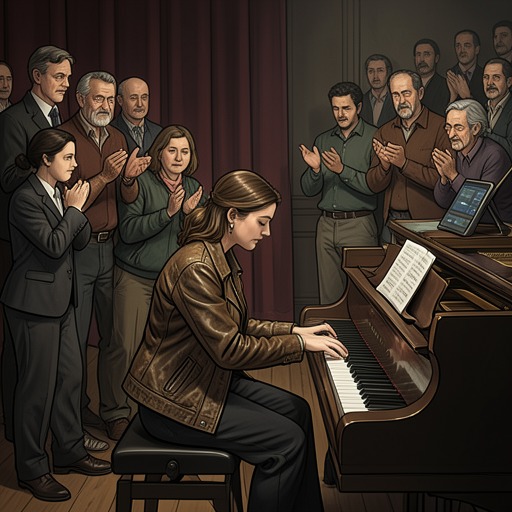
At prom, Lilith takes the microphone beneath a spotlight, holding her guitar across her chest as her knees quake and her heart pounds. She counts the band in, and the drums begin before her guitar moves from a slow, sad riff into a more forceful passage. Cam’s guitar meets hers, and the musicians play with an intensity that makes the moment feel momentous to Lilith. She is no longer afraid of the audience; she closes her eyes and sings. Her mother and Bruce are among the people watching, standing apart from the crowd but dancing freely.
The performance develops into a visible exchange among singer, band, and audience. Lilith turns away from the microphone to play, the crowd’s cheers rising around her. After the bridge she returns to the mic, and Cam joins her in harmonies the two of them have never rehearsed. Before the final couplet, Lilith raises her arm and stops; Jean Rah, Luis, and Cam stop with her, while the audience responds with louder screams. The song’s public arrival is therefore not just the completion of a composition. Its final pause makes the musicians’ coordination and the audience’s attention part of the event.
Flying Upside Down traces a movement from a song imagined alone to one shaped in rehearsal and carried onto a crowded dance floor. That movement does not settle the tension between connection and control: the band’s sound depends on shared contribution, while Cam’s copying of the lyrics demonstrates the harm of bypassing Lilith’s consent. The song’s arc holds both facts together. It is a work Lilith brings into relation with other people, and a work whose meaning depends on her continuing claim to her own voice.