Lilith forms the band Revenge and enters the competition
UnforgivenLilith forms the band Revenge and enters the Battle of the Bands at prom, turning music from a private refuge into a public, collective act. Her route to the band is not simply Cam’s proposal: she rejects his first plan, later accepts Jean Rah’s invitation to make music with Luis, and chooses the name that had long expressed her wish to answer the cruelties of school on her own terms.
A private musical refuge
Before Revenge exists, Lilith plays alone at Rattlesnake Creek. She rests her guitar case in the familiar crook of a tree, among withered trees she considers more beautiful than the celebrated places shown in her textbooks. Her instrument is a dark orange Martin 000-45 with a crack slanting down its body, discarded by someone on her street. Lilith cannot afford to be particular, and she thinks the flaw gives the guitar a richer sound.
Playing makes her feel as if an invisible hand is smoothing her rough edges; the chords seem to surround her with the friends she does not have. She longs to meet someone who shares her musical taste rather than dismissing the Four Horsemen, her favorite band. Seeing them live feels out of reach: they are too big to play Crossroads, and her family can barely afford food, let alone a concert ticket. This solitude gives Revenge’s later formation a personal stake. The band is not just a school activity; it answers a desire for musical kinship that Lilith has so far been able to imagine but not afford.
A name claimed, not bestowed
Cam first tries to turn Lilith’s and Jean’s anger toward school and the town into a band. He hands Lilith a guitar and tells Jean that he and Lilith are starting one; he then proposes The Devil’s Business and points to prom, fifteen days away, and the Battle of the Bands as their goal. Lilith objects both to the assumed agreement and to the name. Any band she starts, she insists, will be called Revenge.
The name has a history of its own. Lilith has kept it secret for ages, imagining that she might become famous with legitimate musicians, leave Crossroads behind, and be encountered by people from home only through sold-out shows streamed online. She had not meant to reveal the name aloud. Her response therefore does more than reject Cam’s suggestion: it exposes a private ambition, while establishing that she—not Cam—has already imagined what her band should mean.
At an open mic, Cam urges her to play her guitar and show the audience for herself. Lilith answers by introducing “Exile” and singing. The moment connects the band she has yet to assemble with an existing act of public self-expression: before she has a group, she has already put her own song and voice before listeners.
Choosing Jean and Luis
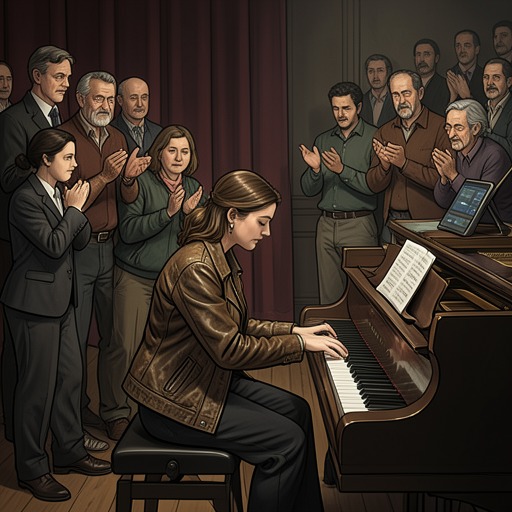
Later, Jean follows Lilith toward the band room and asks whether she genuinely wants to jam or is trying to make Cam jealous. In the room, a scrawny freshman named Luis is struggling to set a huge copper timpani on its base. Jean offers him a hand, then tells Lilith that he had been at the open mic and liked her song. His praise matters in the same terms as her earlier isolation: Jean had clapped for her when she had expected the school to dismiss her.
Jean proposes that the three of them start a band and sign up for prom. Lilith says she is not going, though she is certain she wants nothing to do with prom at that point. Luis, meanwhile, says he will be there to play and is confident he can drum. Jean builds the proposal around what each can do: Luis on drums, Lilith singing and playing guitar, and Jean on a black Moog synthesizer. The arrangement gives Lilith a reason to hesitate—she has dreamed of belonging to a band—but Jean’s practical enthusiasm helps turn that dream into a decision. She agrees, and Luis’s delighted response makes the plan feel shared rather than imposed.
When Luis asks what to call the group, Lilith gives the name Revenge. Her smile marks the change: for the first time, she feels part of something larger than herself. In the band room, Jean’s keyboard and Lilith’s guitar answer each other, with Jean adding a quick ascending riff to keep the audience uncertain about what sound will come next. The name is no longer only a secret fantasy of future fame. It belongs to a group making music together now.
Entering the competition
Principal Tarkenton interrupts the band-room moment and summons Lilith to his office. There, Lilith says she wants to play in the Battle of the Bands. Tarkenton checks the competition’s enrollment sheet and points out that her name is not on it. She takes the sheet and writes down the name of her new band. That small act makes the group official enough to enter: Lilith looks at the written name and swallows, registering that the private idea has become a real commitment. When Tarkenton calls Revenge antiauthority, she denies that this is what the band is about and asks him to give her one more chance.
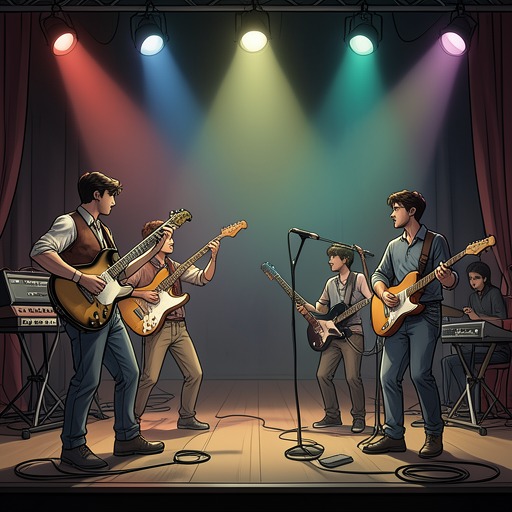
The competition gives the band a deadline and a public setting, but its importance lies in more than the prospect of winning. At the prom performance, Lilith stands before a packed dance floor with her bandmates, wearing a gown and carrying the guitar that has accompanied her from private playing into public performance. She counts the band in, ignores her trembling knees and pounding heart, and begins with a slow, sad riff that grows into the song. Cam’s guitar joins hers. The scene presents the music as something made between players: her instrument does not merely accompany her voice, but finds another part to answer it.
The band onstage
As Lilith turns toward the audience during the second verse, she sees her brother and mother standing apart from the crowd but dancing freely. The audience’s cheers nearly drown her out. She turns from the microphone to play, while the band and its music command her attention; the scene marks a sharp contrast with the solitary player at Rattlesnake Creek, who had felt surrounded by friends she did not have.
After the bridge, Lilith reaches for the microphone again. Cam joins her on the last verse, finding harmonies they have never practiced. Before the final couplet, Lilith raises an arm and stops playing; Jean, Luis, and Cam stop with her, and the audience screams louder. The performance thus ends not with a reported contest result but with a coordinated pause that makes the band’s connection to its listeners audible. Revenge has carried Lilith from a cracked, cast-off guitar and an unreachable dream of belonging into a performance shared by musicians, family, and a cheering crowd.