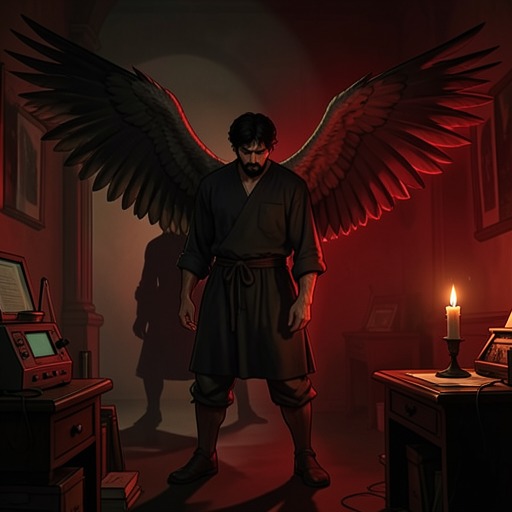
Lucifer forces Cam to reveal his demonic form
UnforgivenLucifer forces Cam to reveal his demonic form at the stage before Lilith and a trapped audience, transforming a hidden fear into a public confrontation. Lucifer’s monstrous appearance and his power to alter Cam’s body make the exposure an act of coercion; Cam’s response, however, is to stop hiding from Lilith and acknowledge the distrust behind his earlier concealment.
The confrontation at the stage
The reveal follows Cam’s confession that he came because he loved Lilith, believed she was dead, and had learned only recently that she was in Hell. He tells her that he made a deal with Lucifer and spent the ensuing fifteen days falling in love with her again, hoping she might return his feelings. Lilith recognizes the wager behind his actions and calls him selfish, judging that he has not changed. Her accusation makes the hidden bargain part of the immediate conflict: Cam has presented his return as an act of love, but Lilith now sees the wager and the lack of trust within it.
Lucifer answers Lilith’s judgment by appearing in his true form. The youthful mortal guise disappears; his chest heaves, his eyes are red, and his body swells until it dwarfs the stage and eclipses the moon. The audience screams and tries to escape, only to find every exit locked and bolted. Some students attempt to scale the walls while others huddle together and cry. The blocked exits establish the scene’s imbalance of power: the crowd can witness what happens, but cannot leave or intervene.
Lucifer’s transformation is made physically explicit. His fingers sharpen into claws as large as butcher’s knives; black, reptilian scales cover his body, and his features become jagged and merciless. He releases tarnished green-gold wings. The other student performers have fled the stage into the audience, leaving Cam, Lilith, Lucifer, and the watching bandmates Jean Rah and Luis onstage. Jean Rah and Luis stand together at the stage’s edge, pale and horrified. Their presence makes the revelation not merely an intimate exchange between Cam and Lilith but a spectacle witnessed by people connected to Cam and the performance.
Cam’s forced transformation
The threat expands beyond the stage when Lucifer’s demons fly closer through the glassy firmament, gathering above Lilith. Lucifer accuses Cam of continuing to lie by withholding his true nature, then points at him. Cam experiences an irresistible urge, and the force of Lucifer’s command makes his shoulders feel engulfed in flames as his wings are forced open. Their unfurling sounds like tearing vinyl.
Cam has known his wings as glorious, so their altered appearance shocks him. They are leathery, limp, charred, and like the wings of the lowest demons in Hell. His bones twist painfully; his skin tightens and pulls. When he looks at his hands, they have become scaly claws. He touches his face and chest and understands that the transformation is complete. Lilith will now see the monstrous appearance he had feared she might reject.
The change is therefore both a bodily violation and the exposure of a concealed truth. Lucifer controls the moment and forces Cam into it; Cam does not choose the pain or the hideous form. Yet the reveal produces a change in his response to concealment. Rather than treating the transformation only as something to hide, Cam is suddenly glad that Lilith can see him without disguise. He resolves not to hide anything from her again.
Confession and recognition
Cam explains that he had feared Lilith would not love him if she knew who he really was. His confession identifies the fear that shaped his earlier secrecy, but it does not excuse its consequence. Lilith looks at his aged demon’s face, decrepit body, and repulsive wings and answers that he never gave her the chance to love the real him. She says he did not trust that she might accept him.
Her response separates appearance from the injury at the heart of the scene. The revelation does not show that Cam’s fear was justified; instead, it makes visible the choice he made on Lilith’s behalf by withholding the truth. Lilith says she loved him and wanted to marry him, and that this meant accepting every part of him, both the good and the bad, the known and the unknown. What Cam had treated as a reason to conceal himself becomes, in Lilith’s account, a denial of her ability to choose him knowingly.
Significance of the reveal
The scene turns a supernatural display into a test of trust. Lucifer makes the truth public through force, using Cam’s transformed wings and body to support his accusation; Cam then begins to answer the deeper grievance by admitting his fear without asking Lilith to deny what he did. The contrast between coercive exposure and voluntary confession matters: Lucifer can reveal Cam’s appearance, but Cam must himself acknowledge that he withheld the chance for Lilith to accept him.
For Lilith and Cam, the moment reframes love as more than desire or a renewed courtship. Her declaration that she wanted every part of him gives the bodily transformation an immediate relational meaning, while her reproach keeps the revelation from functioning as an automatic reconciliation. The stage, the locked exits, the demons above Lilith, and Jean Rah and Luis watching from its edge make private vulnerability impossible to separate from public danger. Cam’s resolve to hide nothing marks a change in his own stance; Lilith’s words make clear that rebuilding trust requires more than showing what he had concealed.