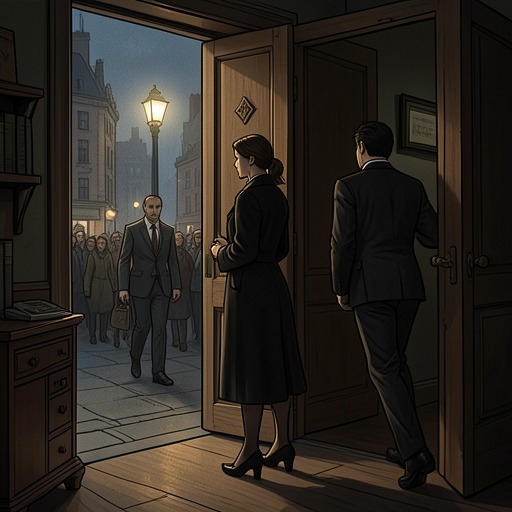
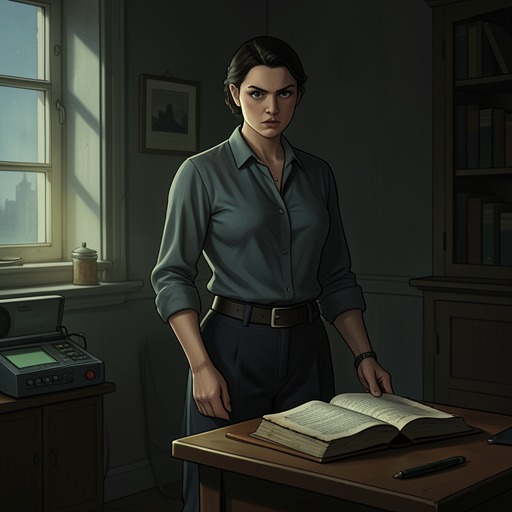
Lilith recalls her past lives and realizes she is in Hell
UnforgivenLilith’s recovery of her past-life memories transforms a song performance in Crossroads into a recognition of the life and suffering concealed beneath her present one. Visions of a wedding with Cam expand into memories of repeated, brutal existences; the rumors about a girl’s suicide become her own history, and Lilith realizes that her life in Crossroads is not an ordinary life but a Hell connected to Cam.
The song opens a past
The recognition begins not with a deliberate search for answers but with music. Lilith feels that she and Cam have sung the song together before, although she knows they could not have done so in this life. Closing her eyes, she sees them seated before a vast, clear river, in contrast to the dwindling water at Rattlesnake Creek. The vision gives the song a history older than the performance: she had written it for Cam, wanted him to like it, and remembers his affection in his eyes and in a kiss.
In that memory, there is no strain, resentment, or fear between them. Lilith understands that she loved Cam deeply in another time and that they had been practicing for a wedding. The thought culminates in her recognition of the wedding as theirs. This remembered intimacy sharply contrasts with the painful distance and distrust surrounding the couple in the present, making the vision both an answer to the song’s uncanny familiarity and the first sign that the present is repeating an older relationship.
The memory then shifts into a scene with a different appearance and setting. After a burst of light, Lilith finds that her gown is whiter and no longer bears Arriane’s alterations. She is facing Cam as she had been onstage, but now appears in a dark cave at sunset, beneath a sky streaked with red and orange. Her heart hurts, and she speaks in a language new to her but intelligible to her all the same. In the memory, she recalls dreaming that she taught nightingales a love song so they could find Cam and sing him home; now she identifies herself as the nightingale who has traveled to him and asks him to return. The longing is continuous across the transformed setting: the woman who once waited for Cam is speaking through Lilith’s present body.
A sequence of other Hells
The visions do not stop at the remembered romance. After Lilith fails to prevent a woman from cutting a wire, she shuts her eyes and opens them on a horse racing along a frozen road through hilly countryside. She clings to the reins, feverish and dying, and recognizes herself as a starving, ragged gypsy expected to sing love songs for crumbs. The abrupt change in place, body, and circumstance makes the memories feel less like a single past and more like entries in a series of torments.
Each further blink brings another existence into view. Lilith remembers Opera Lilith sleeping in an alley behind a theater, Orchestra Lilith suffering under a cruel conductor, and Troubadour Lilith starving in a medieval city. Across these lives, she is repeatedly a struggling musician, exposed to poverty, loneliness, and abuse. The recurring role of musician links these former selves to the songwriter onstage, while the repetition makes music an occupation that persists through radically different circumstances rather than a refuge from them.
The memories also expose a deeper commonality than hardship. Lilith recalls that, in each existence, rage darkened her heart; she loathed the world she inhabited and wanted revenge. Her former selves are not simply a collection of separate misfortunes. Their shared anger joins them to the resentful, embattled person she has been in the present, even before she understands why her suffering repeats. The remembered plea for Cam to come back is answered by the painful recognition that he has not come back to her in the way she hoped.
The present is exposed as Hell
Lilith returns to the stage in Crossroads, but the performance has become an uncanny suspension of ordinary time. The audience is motionless and terrified; the Four Horsemen are gone, and Lucifer stands in the middle of the stage. Cam rushes toward Lilith, but Lucifer holds him back and beckons her forward. The staged musical moment has become a confrontation in which Lilith must face what her visions mean, while the still audience watches without moving.
When Lilith connects the memories to the rumor circulating at Trumbull about the girl Cam had driven to suicide, she recognizes that the dead girl was herself. The revelation changes the rumor from an account of someone else’s past into a fact of her own history. She tells Cam that she took her life because she loved him; as her memories return, the suicide is no longer an unexplained story attached to his reputation but part of the relationship they shared before this life.
Cam’s reference to other Hells prompts a further inference: the life Lilith has understood as her present life was not a life at all. She realizes that the horrors she endured were inflicted because of Cam, who had tricked her into falling in love with him long ago. Her anger is therefore sharpened by recognition. What had seemed to be a series of private misfortunes now appears, to Lilith, as a pattern organized around her love for Cam and his part in it.
Accusation and reversal
The decisive change is not only that Lilith remembers; it is that remembering reverses the meaning of her reunion with Cam. The earlier vision promises a return to a love without fear or resentment, and her song carries the hope that he might come back. The memories of suicide, repeated suffering, and the other Hells replace that hope with knowledge of the cost attached to loving him. Lilith steps away from Cam, out of the spotlight and into darkness, and accuses him of making her endure Hell.
The scene leaves that accusation unresolved. Lilith has recognized her own identity in the suicide rumor and understood the Crossroads life as part of a larger torment, but the stage offers no reconciliation or explanation that erases the remembered harm. Instead, the performance ends as a confrontation watched by the frozen audience. Cam remains before Lilith beneath the disco ball, with a thousand teenagers and a million demons seemingly looking on. The public spectacle of the song has become the setting for a private history’s exposure, and Lilith’s recovered memories turn the story toward the consequences of what she now knows.