Sword & Cross Reform School
UnforgivenSword & Cross Reform School is both the institutional setting of Lucinda’s final cursed life and the gathering place where the angels’ six-millennia-long contest over her repeatedly played out. Its decisive change came when Daniel kissed Lucinda and she lived: the familiar cycle broke, leaving the campus behind as a site of memory for Cam and of a freedom the angels had never been able to secure for her by force.
Setting and Return
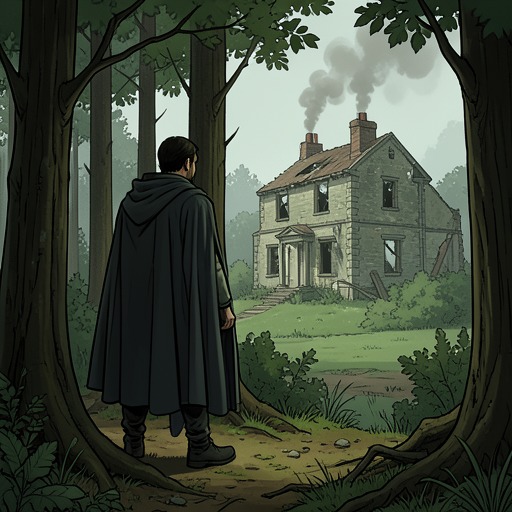
During winter break, the campus is empty. Cam arrives shortly after midnight, having flown in from Troy under the influence of a force he cannot identify. He lands on the eaves of an old church beneath a cold, starry sky. Around him, Spanish moss hangs from antebellum trees, while cinder-block buildings, a weedy field, and splintery bleachers give the school a worn, exposed aspect. The wind comes in from the sea. The setting is quiet, but Cam’s return is charged by the long history that has accumulated there: Sword & Cross is where the fallen angels encountered Lucinda in her last cursed life, and where Cam now finds himself after that curse has ended.
The campus is not simply a backdrop to Cam’s memories. Its familiar grounds recall the pattern that once governed the angels’ movements, while their present emptiness makes the pattern’s absence tangible. The force that had repeatedly drawn the fallen angels to Lucinda is gone; the school remains, but the urgent purpose that filled it has disappeared. Cam’s arrival therefore brings the past into a place no longer occupied by its old drama.
The Recurring Contest
For six millennia, Sword & Cross was associated with the angels’ repeated interventions whenever Lucinda turned seventeen. The same basic performance returned in changing variations. Cam, Roland, and Molly, as demons, tried to influence Lucinda’s alliances toward Lucifer. Arriane and Gabbe, and sometimes Annabelle, worked to lead her back toward Heaven. Neither side succeeded in winning her over. Their rival efforts could change from one cycle to the next, but the result remained stubbornly consistent: Lucinda’s attachments did not yield to either faction’s claims.
The larger repetition had an intimate center. Lucinda always met Daniel, and their love mattered more than the angels’ competing designs. Again and again, they fell for each other, and again and again Lucinda died in a blaze of fire. Her three hundred and twenty-fourth incarnation brought that cycle to Sword & Cross once more. In this final version, however, the campus became the place where the established outcome failed to repeat. The school’s history of recurrent meetings and deaths gave the change its force: what had seemed fixed across innumerable lives became open to choice.
The Turning Point
One night at Sword & Cross, Daniel kissed Lucinda, and she survived. The angels understood that this time she would be allowed to choose. The kiss marked a reversal in the school’s familiar story: Lucinda’s encounter with Daniel no longer ended in her death, and the opposing factions’ long efforts to claim her were no longer the terms that determined her future.
A few weeks later, the angels flew to Troy, the site of their original Fall. There, Lucinda and Daniel again refused to side with Heaven or Hell, choosing one another instead. They gave up immortality for a single mortal lifetime together. Sword & Cross thus stands at the threshold of that decision: it is where the curse’s repeated pattern finally breaks, even though the lovers make their final choice elsewhere. Their departure leaves the school tied to both the end of the old cycle and the beginning of a life beyond the angels’ contest.
Aftermath and Memory
After Lucinda and Daniel are gone, Cam returns to Sword & Cross and finds the campus’s worn surroundings unexpectedly nostalgic. He remembers the early days there as thrilling, in part because Lucinda’s spark had kept the angels guessing when they thought they knew what to expect. The memory reframes the school: its attraction for Cam lies not in its physical condition but in the uncertainty and intensity that once animated it.
That contrast becomes especially clear when Cam recognizes that he had once resented the force that pulled the fallen angels to the cursed lovers every seventeen years. He had abandoned battlefields, coronations, the arms of lovers, and even a movie set to answer it. Now that the pull is gone, he misses it. At Sword & Cross, the end of the cycle is therefore not only a release from compulsion; it also leaves Cam confronting an eternity without the recurring summons that had structured his choices. The empty campus preserves the memory of a purpose that was both burdensome and, in retrospect, thrilling.