Aevum food court
UnforgivenThe Aevum food court is a deserted mall atrium where Lucifer explains the structure of Lilith’s recurring Hells to Cam and proposes a wager over whether Cam can win her love again. Introduced as a state between time and eternity, the place becomes more than an uncanny interval: its failing shops, endless tables, and snow globes turn Lucifer’s account of Lilith’s suffering into a physical landscape. The food court joins revelation to negotiation, making the Hells visible just before Lucifer sets Cam a fifteen-day challenge.
Setting and Condition
Cam arrives after the ground disappears beneath him. The forest and Rattlesnake Creek are gone; he lands on linoleum in the center of the food court, folds his wings, and sits at an orange laminate table. The sudden change of setting carries him from an outdoor encounter into an enclosed, abandoned commercial space, where Lucifer can address him face to face.
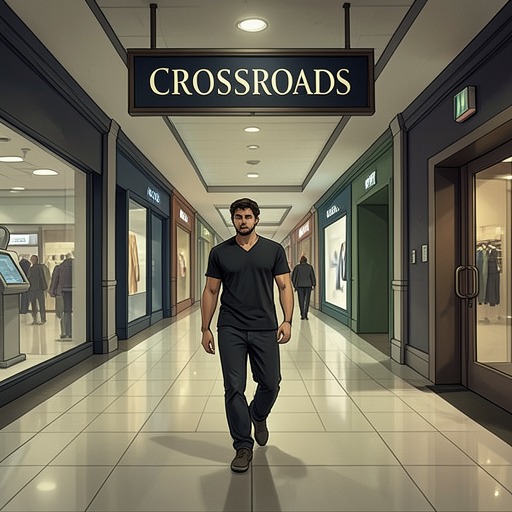
The atrium is vast, with a hundred identical tables and no clear beginning or end. A long skylight is obscured by gray grime, while trash—empty plates, greasy napkins, crushed cups, and chewed plastic straws—covers the floor. The stale odor and neglected surfaces give the place the appearance of a mall long emptied of ordinary customers. Its scale and sameness make it difficult to orient oneself: the tables repeat, and the atrium seems to extend into indistinction.
The food vendors establish a contrast between general decay and one functioning counter. Chinese food, pizza, and wings are among the offerings, but the burger restaurant is shuttered, the sandwich shop lights are burned out, and the yogurt shop’s glass case is smashed. Only the vendor beneath the black-and-gold Aevum awning has its lights on. This surviving business gives Lucifer a stage and a recognizable commercial role within the otherwise abandoned setting.
Lucifer’s Counter and Limbo
Behind the counter, Lucifer appears as a youthful figure with wavy auburn hair, a white T-shirt, jeans, and a flat chef’s hat. Cam recognizes him not from this changeable appearance but from the searing heat that radiates from him, even across the twenty feet separating them. The familiar food-court setting therefore offers no ordinary encounter: its apparent vendor is the devil, and the warmth around him marks the supernatural presence beneath his borrowed guise.
Lucifer calls the place Aevum, sometimes referred to as Limbo, and describes it as a state between time and eternity. He is cooking something Cam cannot see, flips it onto a cafeteria tray, and moves behind a beige register, lifting the plastic divider between the kitchen and the food court. His offer of a special for first-time customers gives the exchange a deliberately mundane, transactional surface. Cam says he is not hungry, but the encounter is not really about a meal. The counter frames Lucifer as host and proprietor while he prepares to discuss business with Cam.
The Snow-Globe Display
The food court’s tables change as Lucifer reveals what Lilith has endured. After a snow globe shatters and cuts Cam’s palm, he watches the wounds heal, wipes his hands, and sees a globe centered on a brown plastic tray at each table. The number of tables has grown into a sea stretching into the dim distance. The multiplication transforms the atrium’s original repetition: what first looked like vacant, identical furniture now holds a distinct object at every station.
Each globe contains a small instrument and plays a different version of the same bittersweet song when wound. Cam encounters a violin and a cello, then sitars, harps, violas, lap steel guitars, balalaikas, and mandolins. Their variety does not break the musical pattern; each tune is an ode to Lilith’s broken heart. As Cam moves from table to table, the globes make the Hells legible as a series of variations rather than a single punishment. Their music gives the suffering a repeated, changing form, while the tiny instruments keep each version contained inside its own display.
Cam recognizes that the globes represent the different Hells in which Lucifer has trapped Lilith. Lucifer explains that whenever she dies in one, she returns to Aevum and is reminded of Cam’s betrayal; he then sends her into another Hell crafted specifically for her. The food court is thus part of the cycle, not a release from it: Lilith’s return there renews the memory that links one bespoke torment to the next. Lucifer identifies her anger and hatred as what keeps her going, making the place a station where suffering is recalled before it begins again.
The Wager and Narrative Function
The globe display leads directly to Lucifer’s proposal. Lilith’s current Hell is due to expire in fifteen days, and Lucifer offers Cam a wager: if Cam can remove her hatred and make her truly fall in love with him again within that period, Lucifer will stop creating Hells for her. The food court is where Cam learns both the recurring mechanism of her punishment and the precise deadline attached to his attempt to change its outcome.
That bargain sharpens the setting’s commercial imagery. Lucifer first presents himself as a vendor offering a special, then turns the meeting into a calculated contest with a stated term and condition. The globes reveal the cost behind the language of business: each is a crafted variation on Lilith’s pain, and the wager makes Cam’s attempt to regain her love answer to the devil’s control over that cycle. Aevum’s position between time and eternity also gives the scene a threshold quality. Cam has left the forest, but he has not entered a place of safety; he has entered the space where the rules of Lilith’s imprisonment are displayed and where his next course of action is set.