Michiel—Iefke
UpMichiel—Iefke is a relationship strained by competing ideas of responsibility, vulnerability, and harm within PAAZ. Its decisive rupture follows Amelie’s relapse: Iefke sees Michiel’s conversation with her about drugs as a preventable danger that has helped cost Amelie her place in the ward and her child, while Michiel regards Amelie’s return to drug use as her own choice. Iefke’s anger becomes personal when she invokes Michiel’s adoption against him. He does not answer with violence; he turns away and leaves the garden, but the conflict persists in the tense silence between them.
The dispute over Amelie
The confrontation begins in confusion. Iefke is furious, and Emma initially thinks her anger concerns a dog. Iefke corrects her: Amelie is gone. Once the subject is clear, she explains that Michiel spent two hours talking with Amelie about drugs in the garden. Amelie had been clean for two years, Iefke says, and had come to PAAZ on the understanding that she would stay off drugs. Iefke sees the ward as a place meant to protect recovery; to her, the fact that the conversation and relapse happened there makes the staff’s failure to intervene part of the injury.
The details of the consequences sharpen her accusation. Iefke says Amelie is being sent home and that her child is now being taken from her. In her account, the conversation did not simply revive memories of drug use: it came at a point when the consequences reached beyond Amelie herself, to the child whose presence had helped motivate her earlier recovery. Iefke frames this as a preventable loss and directs her outrage at Michiel, whose casual discussion of drugs appears to her dangerously heedless of Amelie’s situation.
Michiel disputes both the characterization of the conversation and the responsibility Iefke assigns him. He says they were talking, not that he was pressuring Amelie, and that she had started the subject. He did not know she had been clean for two years or that her child might be taken away. He also points out that he has not used drugs himself. His response rests on a distinction between exposure to a risk and causing another person to act: Amelie, he argues, could choose to use and could choose to stop again. That distinction does not settle the conflict. For Iefke, the conversation’s context and foreseeable danger matter; for Michiel, the fact that Amelie made her own decision limits what can fairly be laid at his door.
From blame to personal attack
Iefke rejects Michiel’s appeal to Amelie’s agency. She hears it as evidence of a broader belief that his actions have no consequences. Her anger therefore shifts from what he said to what she takes the episode to reveal about him: that he thinks he can do whatever he wants without affecting anyone else. In this exchange, responsibility is not an abstract question. It is bound to the immediate consequences Iefke names—Amelie’s departure from PAAZ and the impending separation from her child.
The argument escalates when Iefke turns Michiel’s own history into a weapon. She first says Amelie’s child will be almost an orphan, then invokes the fact that Michiel was adopted and tells him to consider what became of him. The insult connects his childhood to Amelie’s child in the cruelest possible way, making his background part of the punishment Iefke wants him to feel. Her words cross a boundary: instead of confining the dispute to the conversation with Amelie, she targets a personal vulnerability unrelated to whether Michiel knew the risks.
The effect is immediate and physical. Michiel stiffens; his muscles tense, and his knuckles turn white. Emma recognizes why others are afraid of him and realizes that she, too, is suddenly afraid. Linda gets up in alarm and warns Iefke. The scene holds open the possibility of violence without making it happen: Michiel’s jaw works with anger, but he does not strike Iefke or break the glass door beside her.
Withdrawal and an uneasy aftermath
Instead, Michiel turns slowly away, wraps the dog leash tightly around his fist, and walks into the garden, calling for the dog. His departure is controlled, but it is not a reconciliation. The argument leaves the ward’s shared space charged with what was said and with what Michiel might have done but did not do. His restraint interrupts the immediate escalation; it does not answer Iefke’s accusation or repair the personal injury she has inflicted.
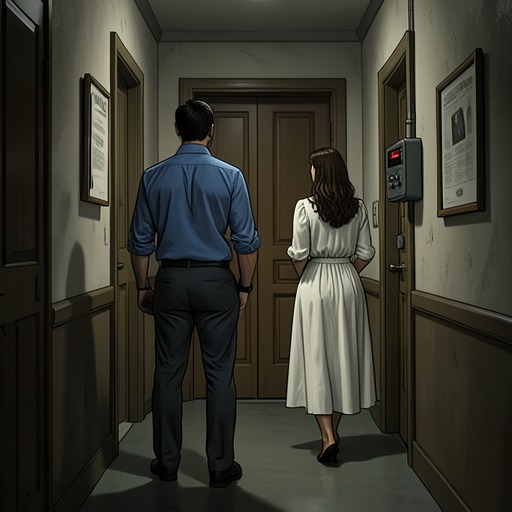
The tension remains visible later. After the nursing staff leave, Michiel takes off his shirt and heads toward the kitchen door, where Iefke stands in shorts. Her pale, scarred legs contrast with his long, tanned back. She explains that she is trying shorts because she has gym and wants to attempt wearing them here. Michiel looks icily at the stripes on her legs, then walks down the corridor without speaking. The scene does not explain his silence or present it as an explicit continuation of the Amelie dispute, but it places the two in a shared space where even a practical act of trying something new meets his wordless, difficult-to-read response. By the evening, they are ignoring each other, while the rest of the group moves around them carefully.
A relationship shaped by competing vulnerabilities
The conflict is not resolved by establishing a simple division between a guilty Michiel and a blameless Iefke. Iefke’s concern is anchored in the consequences she sees for Amelie and her child, but her decision to use Michiel’s adoption against him carries the argument beyond accountability into humiliation. Michiel’s insistence that Amelie chose to use does not erase the risk of a long drug conversation with someone whose recovery may be fragile; nor does the account show that he knew her two-year history or the stakes for her child. The disagreement is sustained by that gap between harm and intention, and by the difficulty of judging responsibility when the most serious consequences fall on someone outside the argument.
Their later silence also shows that the dispute affects more than the two people who speak most fiercely. Other patients and staff occupy the same environment, and the group’s careful movements around them make the fallout part of ward life. Michiel and Iefke’s relationship is therefore marked not by a settled judgment but by an unresolved collision: Iefke demands recognition that actions have consequences; Michiel resists being treated as the sole author of Amelie’s relapse; and the wound of his personal history remains exposed between them.