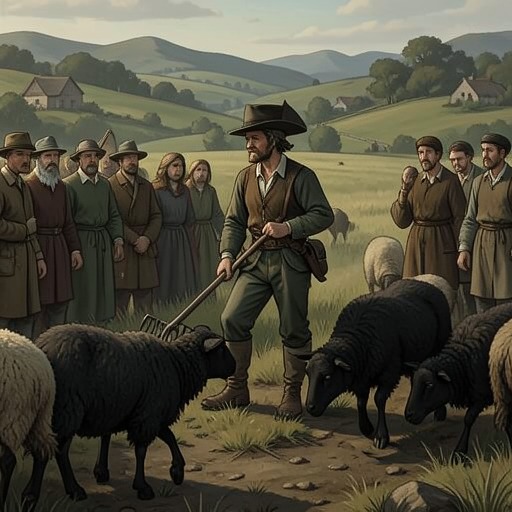
Rural depopulation and poverty caused by enclosure
UtopiaRural depopulation and poverty caused by enclosure form the central example in Raphael Hythloday’s argument that England produces theft through its economic arrangements and then punishes the people those arrangements have impoverished. As he explains at John Morton’s dinner, expanding pasture for valuable wool displaces farming households, removes the need for much agricultural labor, and makes basic goods dearer. In his account, theft is not an isolated failure of individual character: it is one possible consequence of a chain running from concentrated landholding to dispossession, unemployment, and hunger.
The argument against punishment alone
Raphael introduces enclosure as a cause of theft within a wider challenge to the English practice of executing people for stealing. The lawyer at dinner has praised severe penalties and wondered why theft persists despite repeated executions. Raphael answers that punishment cannot provide a livelihood to someone who has none. He likens a system that punishes without preventing deprivation to a teacher who chastises pupils instead of teaching them: the remedy, he argues, is to make it possible for people to live by work.
His diagnosis includes several groups pushed toward insecurity. Some people have lost the capacity to continue their trades through injuries sustained in wars. Noble households also retain many servants who have not learned a trade; when a lord dies, a servant falls ill, or an heir cannot maintain the same household, those dependents may be dismissed. Raphael describes these pressures before identifying pasture expansion as a cause especially associated with England. Enclosure, in his account, intensifies a general problem of poverty by removing both people and the work that once supported them from the countryside.
How pasture displaces rural households
The process begins, Raphael says, when landowners seek the higher returns offered by wool. Nobility, gentry, and religious landholders are dissatisfied with existing rents and turn cultivated or settled land into enclosed pasture. Houses and towns are pulled down, with churches sometimes left standing; land once occupied by communities is made into grazing ground. Forests and parks have already taken up land, Raphael observes, but enclosure extends the conversion into places that had been inhabited and worked.
The people affected are tenants as well as owners, and their removal may follow trickery, force, or prolonged mistreatment that leaves them feeling compelled to sell. Families of varied ages and circumstances must leave without knowing where they can go. Their household goods are sold for little, and the small sum they receive is quickly spent. Dispossession thus does not simply transfer land to a different use: it deprives households of homes, property, and the means by which their labor had been useful.
Enclosure also changes how much work the land requires. Many people are needed to plough and reap arable fields; a single shepherd can tend a flock across an area that would otherwise employ many hands. Once land is devoted to pasture, rural workers lose the agricultural tasks for which they were trained. Raphael emphasizes that the displaced are willing to work, but find no one to hire them when arable land has disappeared. Those who beg may be imprisoned as idle vagabonds, while those who steal face the death penalty. In his account, the same loss of work can therefore expose a person to either punishment for poverty or punishment for the means of escaping it.
Prices, production, and a widening crisis
The effects spread beyond the households directly expelled. As pasture expands and arable cultivation contracts, the price of corn rises. Wool becomes so costly that poor people who formerly made cloth can no longer afford the material, further narrowing the work available to them. Raphael also points to a disease that destroys large numbers of sheep. He treats this loss as a bitter reversal: the owners’ pursuit of profit has helped create the conditions for a wider vulnerability, although he observes that the damage falls on the animals rather than on the landowners whose conduct he condemns.
Even an increase in sheep, he argues, need not bring wool prices down. Flocks are held by a small number of wealthy owners, who are not pressed to sell and can wait until prices rise. The concentration of supply gives those owners a power over prices even when no single person holds a monopoly. Other livestock becomes expensive by a related but distinct route: the destruction of villages and neglect of rural labor reduce the number of people breeding animals. Wealthy landowners, Raphael says, tend instead to buy thin livestock cheaply, fatten it on their land, and sell it at a higher price.
He warns that consuming livestock faster than the regions supplying it can replenish their stocks would eventually produce scarcity. Rising grain prices also lead households to reduce their size, leaving dismissed workers with fewer prospects. Alongside these pressures, Raphael lists luxury in clothing and food across social ranks, as well as gambling and other costly pastimes. He presents these as additional drains that can deepen poverty and encourage people already without secure work to seek money through theft. The argument is cumulative: enclosure is a major cause, but it operates alongside changes in production, prices, household employment, and consumption.
Responsibility and proposed remedies
Raphael’s conclusion reverses the usual direction of blame. When people are poorly educated, their manners corrupted from childhood, and their means of living removed, he argues, it is unjust and ineffective to treat their later theft as though it arose independently of those conditions. England’s severity may look like justice, but it does not address how people came to be without work. The phrase that the country first makes thieves and then punishes them captures this causal indictment: punishment follows deprivation without repairing it.
His proposed remedies address the material mechanisms he has described. Those who have depopulated the land should rebuild the villages they have destroyed or lease their holdings to people willing to do so. The concentration of land and resources among the rich should be restrained; agriculture should be restored, and wool manufacture regulated so that displaced workers can find employment. More generally, he calls for fewer conditions that produce idleness, and for work to be created for people made poor by want rather than treating their poverty as evidence of criminal inclination.
A contrast with Utopian land use
Raphael’s account of Utopia offers a revealing contrast, though not a simple resolution of the problems raised by English enclosure. Utopian cities send people in rotation to farmhouses, where they learn agricultural work; families and populations are redistributed when necessary, and land is treated as something communities use rather than enlarge for private advantage. When the island’s population grows, the Utopians also establish colonies on neighboring land they consider insufficiently cultivated. They accept local inhabitants who agree to join their society, but use force against those who refuse to conform or resist their settlement.
This contrast makes land use central to both social designs, while also exposing a tension in the alternative Raphael describes. The Utopian system organizes labor and agricultural production to prevent scarcity at home, but its own claims to underused land can displace others. The account therefore sets English enclosure’s removal of rural people for private gain against a society that plans cultivation collectively, without presenting Utopian expansion as free of coercion. Together, the examples sharpen the underlying question: who controls land, who is allowed to work it, and whose needs count when a community decides how it should be used.