Society based on private property
UtopiaSociety based on private property is the social order Raphael Hythloday condemns in his debate with Thomas More and Peter Giles: as long as ownership persists and money measures the value of everything else, he argues, a community cannot distribute goods equitably or secure general happiness. His case turns on a contrast between property-based societies, where wealth accumulates among a few and law struggles to protect possession, and Utopia, where shared provision is meant to remove both want and the incentives that sustain greed. The dialogue tests this contrast rather than presenting it as an uncontested conclusion: More raises practical objections to common ownership, while Raphael answers from the institutions he says he observed among the Utopians.
Raphael’s Critique of Ownership
Raphael’s central claim is that private property makes just government impossible because the best things tend to fall to the worst people, while the many are left in misery. Even where a nation is materially plentiful, he reasons, individual efforts to acquire and retain as much as possible allow a small group to divide the wealth among themselves. Those who serve the public through steady industry may consequently fare worse than the idle, predatory people who prosper from the system. In Raphael’s account, inequality is therefore not an accidental flaw in an otherwise fair arrangement: it follows from the way property lets individuals claim resources for themselves.
He treats money as part of the same structure, not as a neutral instrument for obtaining necessities. When money becomes the measure of other things, it directs value toward private possession and magnifies the insecurity that property creates. Raphael argues that laws cannot reliably secure ownership even for those who have it: disputes over what belongs to whom produce continual lawsuits, while new laws fail to bring society into proper order. The legal system’s activity thus signals the instability of property rather than proving that it has been successfully protected.
Raphael allows that reforms could ease some of these pressures. Laws might restrict the amount of land or money an individual can accumulate, restrain the Prince, curb popular insolence, and prevent public offices from being bought or made so costly that officeholders seek to recover their expenses through corruption. But such measures, he maintains, would only mitigate the disease. A remedy applied to one social ill might provoke another, and the body politic could not be restored to health while property remained. His distinction is between limiting the damage caused by ownership and removing its underlying cause.
Utopia as a Structural Contrast
Raphael sets the Utopians’ arrangements against the failures he attributes to property. He describes fifty-four cities with the same customs and laws, each sending three senators once a year to Amaurot to consult on shared affairs. The settlement is not simply a collection of independent households: its political structure coordinates decisions and resources across the island. The people, Raphael says, regard themselves as tenants rather than landlords and do not seek to enlarge their territories.
Political safeguards are part of that alternative. The people name candidates for Prince, and two hundred Syphogrants choose from among them by secret vote; the Prince holds office for life unless suspected of seeking to enslave the people. Tranibors are chosen anew each year, and public questions must be debated over three separate days before a conclusion can be reached. Important proposals pass through the Syphogrants to the Senate and, on grave occasions, to the council of the whole island. These procedures are designed to prevent the Prince and Tranibors from secretly changing the government and to give representatives time to consult their constituencies rather than decide in the heat of initial debate.
The organization of households also serves collective provision. A city may contain no more than six thousand families, while each family is kept within set numerical limits; children can be transferred between households, and surplus population can be sent to colonies. These rules aim to prevent some cities from growing too large or becoming depopulated. Raphael’s account therefore presents common provision as supported by planning, public deliberation, and limits on local growth, rather than depending on goodwill alone.
Distribution, Reserves, and Money
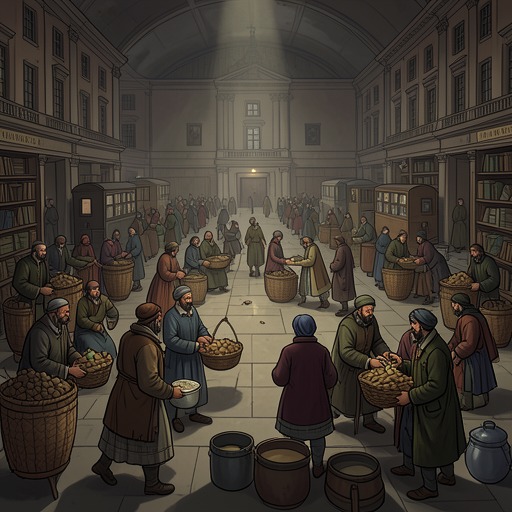
In the cities, goods brought from households are collected in designated storehouses. A father takes what his household needs without paying or leaving anything in exchange. Raphael attributes this open access to the assurance that supplies will remain available: people have little reason to demand more than they need when they do not fear being left without necessities. He also connects the system to the suppression of status competition. Where laws leave little room to display superiority through pomp and excess, the desire to outdo others cannot take the same material form.
Provision operates beyond individual households. At the annual council in Amaurot, representatives assess which towns have abundance and which face scarcity, then supply one another without exchange. The island holds stores sufficient for two years against a bad season before exporting its surplus. It gives a seventh of exported goods freely to the poor in the receiving countries and sells the rest at moderate prices. Public arrangements thus combine local access, transfers between towns, reserves against crop failure, and aid beyond the island.
External trade nevertheless brings Utopia a large stock of gold and silver. Raphael distinguishes this reserve from money used as the domestic measure of wealth: the metals are kept for exceptional contingencies, especially war, rather than treated as objects of everyday desire. The Utopians prefer iron for its practical necessity and, to prevent precious metals from acquiring prestige, use gold and silver for chamber pots and for the chains and fetters worn by enslaved people. They also give children pearls and jewels, who later abandon them as childish ornaments. These practices make the contrast tangible: a society’s values are not fixed by a metal’s scarcity but by the uses and meanings its institutions assign to it.
The Counterargument and the Limits of Reform
More challenges Raphael’s account by asking how people could live conveniently if everything were common. Without the prospect of gain, he fears, some might avoid work and rely on the industry of others; scarcity might lead to sedition and bloodshed, and equality might weaken the authority of magistrates. Peter Giles likewise resists the suggestion that societies known to them could be worse governed than a distant commonwealth. Raphael replies that the objection rests on an inadequate understanding of Utopia, where, he says, he lived for five years and saw its laws and rules at first hand. The exchange leaves the disagreement visible: Raphael offers an institutional example, while his interlocutors question its assumptions and practical stability.
His closing indictment returns to what money does to necessity. He calls other governments a conspiracy of the rich: those who have acquired wealth preserve it through arrangements presented as public authority, while the poor are made to toil for them. The severe laws of such societies, he argues, punish fraud, theft, and disorder without removing the conditions that produce them. In a year of famine, the grain hoarded in the rich men’s storehouses might be enough to prevent thousands of deaths if it were distributed; money, supposedly invented to procure necessities, can instead obstruct their provision. Raphael’s critique therefore links private property not only to inequality but to a political order in which abundance can coexist with preventable deprivation.
He identifies pride as a force that helps preserve this order. People may recognize that lacking necessities is worse than lacking superfluities, yet pride measures happiness against the misfortune of others and resists a condition in which no one remains poor to be looked down upon. Within the dialogue, Society based on private property is consequently both an economic arrangement and a hierarchy sustained by social comparison. Raphael’s alternative is sweeping, but the debate does not erase the questions More raises; it sets the moral force of shared provision against the fears of idleness, disorder, and weakened authority.