Utopian communal ownership and material equality
UtopiaUtopian communal ownership and material equality form the economic foundation of the society Raphael Hythloday describes: goods are held and distributed for common use, so people can obtain what they need without buying it or surrendering an equivalent. This arrangement is more than a method of supply. It is offered as an alternative to a social order in which property and money concentrate wealth, make access uncertain, and turn abundance into deprivation for many. Yet the system also depends on elaborate public coordination, trade with other nations, and rules that can compel outsiders to give way to Utopian settlement.
The Principle: Abundance Without Private Accumulation
Hythloday’s central claim is that a nation cannot be governed justly or happily while property exists and money sets the measure of other things. In his account, private ownership allows the best things to pass to the worst people, while a small number divide the wealth and leave the rest in misery. Even societies that continually make new laws cannot reliably protect property or settle who owns what; the recurring lawsuits are evidence that legal rules do not resolve the underlying conflict. For Hythloday, more regulation may ease the pressures created by private property, but it cannot cure them. A measure that limits one abuse may provoke another, leaving the body politic chronically ill. The contrast he draws is between societies where each person claims what they can acquire and the Utopians, among whom goods are distributed so that everyone lives in plenty. Equality here is material as well as formal: it is meant to prevent the insecurity and competition that follow when people must secure their own share against others. Hythloday links this practical security to a change in social values. Pride encourages people to seek distinction through pomp and excess, but a common system leaves little room to display wealth as personal superiority. Without fear of being denied necessities, he argues, there is correspondingly less reason to hoard or grasp.
How Goods Are Shared
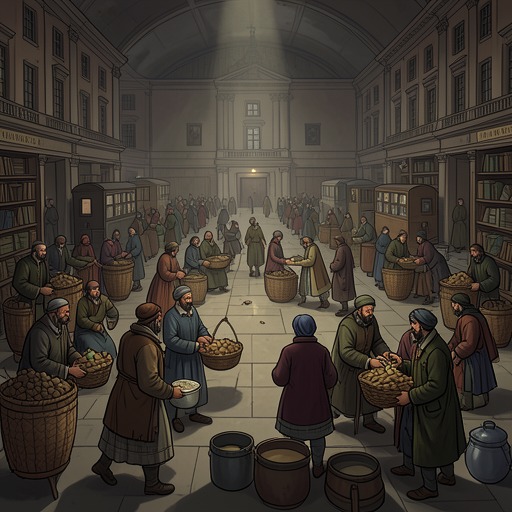
The arrangement is organized through families, neighbourhood markets, and public storehouses. Utopian families are structured by kinship and age: adult women marry out, while males remain in the household under the authority of its oldest member, unless age has weakened his judgment. Families are regulated in size, generally containing between ten and sixteen people, and children may be transferred between households to balance differences in numbers. No city is permitted to grow beyond six thousand families, with the surrounding countryside counted separately. These rules make population and household composition matters of public provision, not solely private choice. Each city is divided into four districts, with a market in the centre of each. Families bring what they produce or manufacture to designated storehouses, where goods of the same kind are kept together. A household head takes what the family needs without payment or exchange; the system does not rely on bargaining or a seller’s discretion to determine access. Its stated premise is that plentiful supplies remove both the motive to ask for more than is needed and the danger that a person will be refused. Nearby food markets provide produce, bread, fish, poultry, and livestock. The distribution of daily necessities thus rests on visible common stores and organized delivery, rather than private household wealth. The island’s production is coordinated across towns. Each of its fifty-four cities sends three senators to Amaurot once a year to discuss common affairs. The assembly compares places with surplus provisions to those facing scarcity, and supplies move between them without exchange; the island is treated, in Hythloday’s image, as one family. Public stores are maintained for two years against unfavourable seasons. Only after provision for the country and its reserves are secured does the council arrange to export the surplus. This system makes equality dependent not just on local sharing but on a shared account of need across the island.
Labour, Land, and Public Provision
The common stock depends on broadly organized work. Country households cultivate land, raise livestock, and transport materials to towns. Residents are sent out from the cities in rotation, with twenty returning each year after two years in the countryside and replacements learning agricultural work from those already experienced. Some ask permission to remain longer. This circulation is intended to keep the population familiar with farming and reduce the chance that ignorance or neglect will produce a shortage. The rural arrangement echoes the cities’ wider principle: land and labour are managed as necessities for the whole community, not simply as sources of private gain. That principle extends beyond the island. If population increases, Utopians send colonists to the neighbouring continent where they find more land than its inhabitants can cultivate. They welcome local people into their society if they accept its way of life and rules, arguing that careful cultivation can make the land sufficient for both populations. If the inhabitants refuse, the Utopians drive them from the territory they have marked out and use force if they resist. They regard obstruction of the use of idle land as a just cause of war, appealing to a natural right to the earth needed for subsistence. The policy exposes a sharp edge in the ideal of common provision: land is treated as a resource that should be productively shared, but Utopian judgment determines what counts as use and who must yield.
Money, Trade, and the Value of Gold
Utopia’s internal distribution does not mean the island has no dealings with money. After reserving supplies, it exports goods including grain, honey, wool, flax, wood, wax, tallow, leather, and cattle. A seventh of the exports is given freely to poor people in the receiving countries; the remainder is sold at moderate prices. These transactions bring back the few things the island needs, especially iron, as well as large amounts of gold and silver. Contracts are made in the name of a town rather than a private individual, and much of the treasure is held in bonds. The Utopians may leave funds with other towns or lend them to neighbours who need assistance, while keeping the resources available for emergencies. Hythloday distinguishes this external reserve from money as a domestic measure of worth. The Utopians keep precious metals for uncommon contingencies, not as necessities of ordinary life; iron is more valuable to them because it has an essential use. They consider gold and silver scarce but dispensable, while nature supplies water and earth abundantly. To keep accumulated treasure from inspiring public suspicion or becoming an object of attachment, they make chamber pots and restraints for enslaved people from the metals. Pearls and precious stones found by chance are given to children, who later set them aside when they outgrow them. These practices make the ranking of goods visible: material utility and common need, rather than rarity or prestige, are supposed to determine value.
Political Meaning and Tensions
Hythloday presents common ownership as a response to the consequences of money as well as property. If money ceased to be desired, he argues, the anxieties and harms associated with it—including fraud, theft, robbery, quarrels, and violence—would lose their force; poverty itself would diminish. He illustrates the claim with a failed harvest: even if thousands die, the hoarded grain in the rich people’s storehouses might have been enough to prevent the deaths if it had been distributed. In that contrast, scarcity is not simply a shortage of goods but a failure of access created by accumulation. His conclusion is polemical. Other governments, he says, allow wealthy people to pursue private interests under the appearance of public authority, using law to protect their acquisitions and extract labour from the poor. Against that system, Utopia’s arrangements connect household access, agricultural work, public stores, intercity transfers, and external trade into one account of social provision. But the account is not without friction: collective equality is administered through constraints on households and settlement, and the protection of one community’s access to land can become coercive toward another. The ideal therefore rests on a decisive proposition—that shared provision can make abundance serve everyone—while its institutions show how much coordination, and how much power over the use of resources, that proposition requires.